
Walls and Bridges
1/25/2024 | 26m 46sVideo has Closed Captions
North Carolinians discuss immigration and the Declaration of Independence.
Eight North Carolinians come together to discuss immigration, bringing refugees into the United States and what word in the Declaration of Independence means the most.
Problems playing video? | Closed Captioning Feedback
Problems playing video? | Closed Captioning Feedback
The NC Listening Project is a local public television program presented by PBS NC
Funding for The NC Listening Project is provided in part by High Point University, Sidney and Rachel Strauss, and Julia Courtney and Scott Oxford.
Walls and Bridges
1/25/2024 | 26m 46sVideo has Closed Captions
Eight North Carolinians come together to discuss immigration, bringing refugees into the United States and what word in the Declaration of Independence means the most.
Problems playing video? | Closed Captioning Feedback
How to Watch The NC Listening Project
The NC Listening Project is available to stream on pbs.org and the free PBS App, available on iPhone, Apple TV, Android TV, Android smartphones, Amazon Fire TV, Amazon Fire Tablet, Roku, Samsung Smart TV, and Vizio.
Providing Support for PBS.org
Learn Moreabout PBS online sponsorship[upbeat music] - At High Point University, we are focused on preparing students for the world as it is going to be.
- Hi, I'm Steve Wozniak, The Woz, and I'm proud to be High Point University's Innovator in Residence.
[bright music] - [Announcer] Quality Public television is made possible through the financial contributions of viewers like you who invite you to join them in supporting PBS NC.
- [Announcer] Funding provided by Sydney & Rachel Strauss, Julia Courtney, and Scott Oxford.
[dramatic music] - It's not a forum to try to change anyone's position on anything but to open up an avenue for conversation.
- And let's just go out on a limb and try something new and different.
- I have very strong opinions about things that I feel are ruining the dynamics of this country.
- I have opinions.
[laughs] - I mean, I've had this debate with my own family about we must welcome the immigrant.
I mean, it says it in the Bible, "Love the stranger, welcome the stranger."
- I'm not saying building a wall was the appropriate thing.
Maybe it is, maybe it's not.
I'm not that guy to make that decision.
- The people doing the seasonal farm work are brought in, because those are jobs Americans aren't gonna do in the first place.
- Eight North Carolinians talking about tough topics and sharing with each other in a way that maybe you haven't shared in the past.
Before you, you have a card, and it's the Pledge of Allegiance to the flag of this country.
I'm going to read this and then ask you a question.
I pledge allegiance to the flag of the United States of America and to the republic for which it stands, one nation under God, indivisible, with liberty and justice for all.
What one word means the most to you in this pledge, Jake?
- I'm gonna go with republic, because it's for everyone, and it's us, our power.
We elect the officials to stand for what we stand for.
I mean, there's lots of good words in here, like, obviously, God is really important, but the God I worship and the God he worships, they might be one and the same, we don't know.
But, I feel like that stands for the melting pot United States has become from when we started the official date to now.
We accept everybody.
- Actually, I'm gonna turn to you, because all of us came here after your ancestors were here.
So, what one word of this pledge means the most to you?
- I mean, obviously, to Jake's point, all the words are great.
For me, it's that last part around justice for all people, because I think that the way that the United States was, we'll say birthed, was through immigration, so through immigrants that came here fleeing their country and homelands because of religious reasons, because of taxes.
They keep coming here, obviously not good for the people who have been here, indigenous people, the land.
Now we're in 2023, obviously, indigenous people, I'll say lost that part, right?
But I think that our values of staying true and supporting the land have remained, and that's where we serve in the military, we serve to protect our own people.
And that means that we serve in the military, and we do respect our veterans that give that life to our today warriors.
But I think that that part of, "justice for all," means that truly does mean that, for all people.
It means that for the Ukrainian refugees that have come here from, the refugees, from Mexico, from Columbia, from all the different countries, that everyone is welcome in this country and can find safe haven here, should be able to find that.
And the people that are here should feel welcomed and to be a part of this country.
- There's some people who would say, "We don't have justice for all in this country."
Pilar?
- Yeah, that's the word I was thinking about it, and because we- - [David] Is justice the word?
- Yeah, justice for all, because unfortunately, I don't think this is happening right now in many regards.
And talking specifically for the Latino community, this is not applying for a lot of things.
And we know the immigration system is broken, as I hear all the time, "Why are these people "not getting a visa and coming with documents?"
Because it's not as easy as we think or as we say it.
But also, the immigration, not only for Latinos, before it was for other communities, has been managed and tweaked by the government of the United States.
And there is a book I recommend people to read, it's "The Brownish of America," and it tells all of this how at some point was like, oh Mexicans come because we need you to work here.
Yes, but then we don't want you here, and we know you are undocumented here, but we still keep you because we need you, so it's the double moral of it.
So I think yes, it's not justice for all.
It depends how we need it to be, so.
- Lee, what are your thoughts on what words jumps off that card?
Or when you recite the pledge, what word resonates more with you than the others?
- I'm gonna go with liberty.
Obviously, I am Black.
My people were brought here when the last census that we did for the United States when they started adding freeform, like where's your family from, what's your ancestry?
I don't know, I actually put, "Wherever I was stolen from."
I have no idea, because there's no way for me to track it back that far.
Other people can say I'm Irish from wherever.
Other people can say I'm French from wherever.
I just know I'm Black, that's it, not even what kind of Black person, just a Black American.
So, I don't think we have liberty for all, much like Pilar was saying about justice for all doesn't exist.
I don't honestly think liberty for all exists.
And my other word that I was bouncing back and forth between was allegiance, but without one, you can't have the other.
- Fiaz.
- Certainly, I think the words are awesome.
The pledge itself is fantastic, but where is the action?
Like everybody else was saying, there's some deficiencies.
And of course, for the immigrants that came legally, if that's the word, we applied for it, we had a particular process to go through.
There were many questions that you're not supposed to do this, you're supposed to do that.
And when we come here, the immigrants come here, they stand by that truth that we sign to be good and to avoid evil.
But sometimes when you come here, you find the other side already exists, the evil, for example, so many bad things happening, either it be drugs or getting into illegal activities, all of those were signed before we came here for the processing, but everything else exists here already.
So that's a little double standard again to see whether that's what, but other than that, yeah, liberty and justice for all, it's an amazing thing if it would happen to everybody.
- Nisha.
- My favorite word is united.
I feel like we have shown that here in this table.
We have so many different walks of life and so many different perspectives, but I believe strongly that if I were in trouble, and someone was putting a gun to my head, I think Katherine would try to save me.
And I strongly believe that that's how we support our military.
We go out, and we're united.
I don't care about your politics, but you're fighting for me, you're fighting for her, and united sums up our country, 'cause the bottom line is the bottom line, and at the end of the day, we're gonna stick together.
- Katherine, as she said that, I heard you utter, "Of course, I would."
- I'd try, I'd need Jake's help.
[laughs] [panel members laughing] - [David] So which word speaks more deeply to you - All, and it is a country founded on freedom for religious differences, for differences of opinion, for cultural differences, and this is a place where all should be welcome.
I mean, it's on the Statue of Liberty, so this should be a welcome place for all.
- Anna?
- I feel like one nation is probably the strongest that I feel, because we're not one nation, but we should be striving for that through the unity even though we do come from all walks of life, all different religions.
And if we can strive to be unified as one nation for a purpose, I feel like we would be even stronger than we are.
- We talk about immigration.
The words were, "The immigration system is broken."
I don't remember a time when it wasn't broken.
If you were in charge, how would you fix it?
- What I would do is first look at the people who have been here for such a long time, people who came to work here, have their families here and have been producing and integrating with the community and see how we can give them the path to citizenship, because they deserve it.
- Are you talking about Dreamers or others, Dreamers and?
- So, I have an addition to Dreamers, because when we talk to Dreamers, we are talking about youth, yes?
- Yes.
- People who came before they were 16 years old here to this country.
But when you see their parents or all the adults who came to work here, they were Dreamers too, so I struggle a little bit with that word, because I believe all of us, when we come here, we come because we have a dream that we want to make reality.
So, but I'm talking about everybody, because yes, the Dreamers are the future, of course, but also, we are talking people who came when they were young to work here, and now they are elders.
So, and with the Dreamers, of course, this is a country they know.
They came when they were little.
They grew up here.
They know the language, the system, and when people say, "Go back to your country," they are confused, "This is my country."
They haven't even been back to when they were born, so it's very confusing when people say that, so I would do that.
And also, I understand also that it needs to be controlled.
Yes, when people are coming in, and I give you another perspective.
I was thinking about this, because in Colombia, it's happening something similar with Venezuelans coming to Colombia.
And it was interesting for me visiting probably two years ago and listening to my family members, my friends, talking about those immigrants coming to take our jobs, and I was like, "Oh, that's what people say about us in the United States."
So, how we can really welcome people, but also talking about this liberty and justice for all, have a system to really support them coming here.
- I'm curious, when you see a governor, whether it's Governor DeSantis or Governor Abbott from Florida or Texas, place folks who have come across the border illegally onto buses, sending them to sanctuary cities to make a point, how does that fall on you?
- It's just weird, I lived in Texas before I moved back here again for like the 1800th time, 'cause I can't get away from North Carolina.
I keep trying to leave, but I keep coming back.
Last time I checked Texas history, it was the Mexicans' first, so how are you gonna send these people that you say are quote, unquote illegal, which like you said, no person is illegal, but I'm going to use the language that Greg Abbott would use in this case.
How are you gonna send these people who have more right to that land than anybody but the indigenous folks that were there before them.
How are you gonna tell 'em, "No, you don't belong here."
- But what about the point of sending 'em to Martha's Vineyards or to New York City, which is now under incredible financial strain because of this, just to make a point?
- I think it's just irresponsible and using people as a pawn- - [Pilar] Using anybody.
- And not valuing individuals.
- When these people are being sent there, it is the same country, it's just a different state.
Why do you want to punish another state within our country, within the larger spectrum of the state, just to put the responsibility on the other people?
Try to coordinate with them and find a solution.
I'm sure there are so many solutions possible.
- I will say the unpopular opinion about this.
I have no issue with refugees, immigrants, but you have one state sitting there.
You take all the, let's bring all the immigrants or illegals or undocumented, whatever word that whoever in life uses, and you bring them back to Texas, so now you have one state suffering with other states and other people that aren't seeing this or turning a blind eye to it.
And Texas is saying, "Hey look, "we have a major cartel problem, "a major child trafficking and sex trafficking problem."
And they're like, "No, we don't."
They're just sitting there with a blind eye.
They're not securing it, they're not making it safer.
I'm not saying building a wall was the appropriate thing, maybe it is, maybe it's not.
I'm not that guy to make that decision.
But when you're sitting there saying, "We need help," and you're getting a blind eyed turn to it, it's like, okay, well you know what, here, this is what we're dealing with.
- We should fairly allow them to come in.
I don't hear as much about the Ukrainian refugees or people from Canada or from other countries coming into United States as much as what I do hear about from Mexico and those coming through.
So, I think that immigration reform is important and needs to be done in a fair and equitable way.
- You bring up a very interesting point.
When the Ukrainian war began, and the focal point of the world was on that country, and we understood people being forced to leave to go to Poland or the United States or wherever.
Yet, when it comes to Honduran refugees being forced to leave their country because they're trying to save their lives, our lens shifts, why do you think that is, Anna?
- Well, once again, you've got your media who is pointing us towards the events of the world, and what are they focusing on?
And, how do you equate what's worthy to allow them to come in, war, killing, or a different type of, you know- - [David] Killing.
- Killing, that's not really war, but yet, if they don't, their lives are just as valued as anybody else's.
I do feel like the system's very broken.
There should be a set steps, one, two, three, four, whatever those are, whether it be background checks, whether it be sponsorships, whether it be helping them get into a job program and say, "Okay, you want to be a productive citizen, "show me how you're going to add to our society."
- We're talking about three different things, one, refugees, people that are in crises in their own countries that come here for refuge, that we're allowing them to be here for a period of time, not indefinitely.
Then there are illegal immigrants that are coming here without any permission, understanding they're fleeing terrible circumstances to be here, that's a totally different issue.
Then, we're talking about legal immigration, which is how most of us are here.
- When I think of the immigration issue, I have to think of my ancestors.
My great-grandfather, one came from Russia to avoid being drafted into the Czar's army and to avoid the pogroms, which were targeted attacks on Jewish villages.
My other great-grandfather came from Germany, also at a similar time, so late 1800s, to escape persecution.
I've had this debate with my own family about we must welcome the immigrant.
I mean, it says it in the Bible, "Love the stranger, welcome the stranger."
- I'm hearing what everybody's saying, and I see all the points that everyone's making, but the one thing that no one...
When you mentioned the xenophobia of the different groups that have come across and coming into America over the years, for one, every single one of those groups was pitted against Black people, every single one.
Because as long as those groups can make themselves look good compared to us, eventually they would be accepted, and we were not.
And number two, no one has talked about the concept of being exceptional.
- [David] Say more about that.
- When you say, "We don't want the criminals.
"We don't want the registered sex offenders.
"We don't want this, we don't want that."
You have to be exceptional to be wanted in the United States, no matter who you are.
If I go out and do something, maybe stupid, maybe not, and I end up in a police brutality situation, I shouldn't have to be exceptional for people to go, "Well that shouldn't have happened to you," which it goes back to you mentioning people are being described as criminals and stuff.
That shouldn't be why we don't want them, because that's setting an us versus them situation.
We only want the super good ones.
We only want the people who are productive in society.
Well, if you come here with nothing, how are you gonna start up with anything?
You can't, so it's kind of not fair for people to say, "Well, if they're gonna come here, they need to do it right, "and they need to be productive," when so many people, who are natural born American citizens aren't doing these things.
- Don't you think we should take care of our own problems then first and get our own people mobilized before we welcome in more people that can't be mobilized right away, 'cause they don't have the funding and don't have the...
I mean, you have to make educated decisions on what, like you're not gonna move into a house you can't afford.
- The people that we elect to office and all of the brain trusts that they work with, couldn't they figure out a way to marshal the energy of an influx of people who want to be here and help in some way connect that to helping to address some of the underlying issues.
If we could think more about how to make something happen as opposed to fighting against things, like we don't want these people to come, we don't want this person to have a voice.
If we could think more as a country and certainly, if our legislators could think more about how can we have a, can-do attitude, boy, maybe there's a way where we could put all our powers together for good.
- That's why we have a process in place.
Does it financially make sense for this person to be here right now, or do you wait?
One of the things that I've learned the hard way is never to push in.
When you push in, you perturb the people that you're around.
You do the opposite of what you wanna do, and you end up getting shunned.
And that's happened to me in a church environment before.
- [David] Isn't it clear that that process is just not working?
- No, it's not working, 'cause people are pushing in.
- No, and one example of that we can do it is the farm workers we bring every single year, and they've been coming here for decades and decades and they get this W2 visa.
They stay here because we need them, and we are able to do it.
They come, they come in buses in North Carolina through bus is the center, and they are distributed to the different farms, and they work and they go places to places the whole year.
I've talked to them, and some of them have been coming for 28 years.
- The people doing the seasonal farm work are brought in, because those are jobs Americans aren't gonna do in the first place.
Every time somebody goes, "They're coming here stealing our jobs."
Were you gonna clean toilets?
Were you gonna make beds?
Were you gonna pull tobacco?
None of you were gonna do these things for the money that they're going to pay you.
- I meet the people, and I hear their stories, and I realize, boy, this is a lot more complicated than the way I was thinking, that here's this person trying to just come here illegally and get a leg up or get something.
It's like, whoa, no, it is so much more complicated than that.
- But back to everything, people are always like, "Oh, they're not being productive members of society.
"They're not paying taxes, they're not doing this," they are, they're paying sales tax.
They are paying sales tax on everything that they bought.
- Some of the farmers from around the area where I'm from I've just been in passing conversations, and you ain't gonna get a bunch of high school boys now to go to work.
This new generation's not gonna go work in the fields.
- So do you think in your lifetime, you will see a solution to this problem?
- I think if both parties, as political when I say this, if they would stop trying to make each other look bad and start listening to each other, and all it is is trying to sham the other one, into looking like they're the big bad wolf.
It's like we were saying, Texas, moving people to different sanctuary cities.
Well one, they called themself sanctuary city, and they have open arms, but now that they're suffering like Texas is, they're not liking it.
But they never came to Texas to say, "Hey, how can we help?"
- If we all share the responsibility for the people in our country, the people trying to come into our country, what is it, a problem shared is a problem halved?
Not to refer to people as a problem, but that is the mindset that I feel like we need to get to.
If we all pitched in, we could actually make these problems more addressable.
- And that's one of the reasons why I chose one nation.
If we are taking these problems as the state's coming together, we could eventually solve it if we didn't have two separate parties butting heads to make one look better than the other.
The sad part is, is we're the ones that put them there.
They're the government that is supposed to be looking out for the betterment of us, as a society.
And when it does come time to vote, you need to be looking at those platforms that they say they want to work on reform.
- There's not a single person sitting here can say the politician they voted for fully represents them.
- [Panel Member] Exactly.
- You might have the bun to your sandwich, but you ain't got no filling in the center.
It's only representing a couple things that you- - [Panel Member] You had to choose the better- - Yeah, you had to choose the most important thing to you, and it's like, well here we are.
- We have a state of 11 million people, right?
If two members of the United States Senate, they represent everyone in the state, not just my wishes or your wishes or your wishes, [dramatic music] they have to strive there, at least we hope they do, to represent, to some degree, everyone.
- [David] Coming up on "The NC Listening Project."
- Most of my friends from here can tell you the exact first time a White person called him the N word, and it was usually they did something that they didn't like, and it's usually somebody that they respected until they said it.
- I feel like with slavery, people are just tired of talking about it.
They're tired of making everything about race, just like they're tired about talking about human sexuality.
- The best way to really understand the people, listen to their voices, indigenous voices, Hispanic voices, Ukrainian voices.
I think learning from the people is what we need to be doing.
- [Announcer] Funding provided by Sidney & Rachel Strauss, Julia Courtney, and Scott Oxford.
[bright music] - [Announcer] Quality Public Television is made possible through the financial contributions of viewers like you who invite you to join them in supporting PBS NC.
[upbeat music] - At High Point University, we are focused on preparing students for the world as it is going to be.
- Hi, I'm Steve Wozniak, The Woz, and I'm proud to be High Point University's Innovator in Residence.
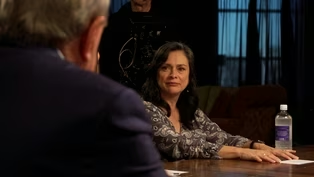
Video has Closed Captions
Preview: 1/25/2024 | 30s | North Carolinians discuss immigration and the Declaration of Independence. (30s)
Providing Support for PBS.org
Learn Moreabout PBS online sponsorship












Support for PBS provided by:
The NC Listening Project is a local public television program presented by PBS NC
Funding for The NC Listening Project is provided in part by High Point University, Sidney and Rachel Strauss, and Julia Courtney and Scott Oxford.