
Wanda Bahmet and Clay Fulton and the Lost 40
Season 17 Episode 12 | 28m 45sVideo has Closed Captions
Wanda Bahmet recounts surviving a Nazi work camp; Clay Fulton and the Lost 40 host a music festival.
Wanda Bahmet shares her story of surviving a WWII Nazi work camp, and her life in the United States after the war. In Rochester, roots rock band Clay Fulton and the Lost 40 host a music celebration at the Historic Chateau Theatre.
Problems playing video? | Closed Captioning Feedback
Problems playing video? | Closed Captioning Feedback
Postcards is a local public television program presented by Pioneer PBS
Production sponsorship is provided by contributions from the voters of Minnesota through a legislative appropriation from the Arts and Cultural Heritage Fund, Explore Alexandria Tourism, Shalom Hill Farm, West Central...
Support provided by:


Wanda Bahmet and Clay Fulton and the Lost 40
Season 17 Episode 12 | 28m 45sVideo has Closed Captions
Wanda Bahmet shares her story of surviving a WWII Nazi work camp, and her life in the United States after the war. In Rochester, roots rock band Clay Fulton and the Lost 40 host a music celebration at the Historic Chateau Theatre.
Problems playing video? | Closed Captioning Feedback
Where to Watch Postcards
Postcards is available to stream on pbs.org and the PBS app.
Providing Support for PBS.org
Learn Moreabout PBS online sponsorship(bright music) - [Narrator] On this episode of "Postcards."
(somber music) - We didn't know where our mother was.
We just had to follow what the orders were.
But orders were under a gun.
You cannot choose what you wanna do.
(gentle music) - I think Minnesota is a pretty spectacular creative community.
I feel more of that vibe of everyone being on the same team rather than being in competition.
And that's kind of the Minnesota music scene.
(bright music) - [Narrator] "Postcards" is made possible by the Minnesota Arts and Cultural Heritage Fund and the citizens of Minnesota.
Additional support provided by Margaret A. Cargill Philanthropies, Mark and Margaret Yakel-Julene on behalf of Shalom Hill Farms, a retreat and conference center in a prairie setting near Windom, Minnesota.
On the web at shalomhillfarm.org.
A better future starts now.
West Central Initiative empowers communities with resources, funding, and support for a thriving region.
More at wcif.org.
(gentle music) - Wanda's a special person, full stop.
She has a lot to teach us.
At her age, she has seen world history in a front row seat, and she has a survivor's tale of hardship, of near starvation, of forced labor, of relocation multiple times.
And we are blessed in Minnesota to have the years that we have with her.
(gentle music) - My name is Wanda Bahmet.
I was born on February 20th, 1934, in a very large city, very industrial city, Dnipropetrovsk.
Those were happy years in the beginning, and later on, they were not so happy.
(somber music) At that time, Ukraine was under Soviet rule, Soviet meaning Russia.
I lived in Ukraine till the time the Germans took us to Germany.
- Ukraine is a country rich in agriculture, it is rich in metals, in minerals, and it has ideal shipping ports to other parts of the Mediterranean and the world.
So it is a really fabulous piece of real estate that has been coveted and claimed by its neighbors.
(somber music) During the Russian occupation of Ukraine, things were very difficult.
The Russian Empire, which came to be the Union of Soviet Socialist Republics, occupied 11 time zones.
It was geographically enormous, and in that span of time zones were scores of cultures, each having, in many cases, their own language, their own traditions.
And it was a difficult task for anyone to try to keep that whole group moving in the same direction.
So they fell back to authoritarian regimes.
And Joseph Stalin was one of the early purveyors of terror, torture, disappearances, filling the gulags, killing millions of his own people in an effort to instill fear and terror in those who were living underneath his control.
- In my house, two rooms were separated for my grandmother, my father's mother, and then the rest of the rooms, well, we occupied my father, my mother, my sister, and I. That is during pre-war time.
During war time, there were also my aunt and her children were there for short time.
And during the war, Germans occupied my father's drafting room.
And it was a very uncertain time.
And then later on, my aunt was with us with her two children and she told us that grandma was killed by shrapnel.
(bomb exploding) - [Barry] The geopolitics of Ukraine were complicated during World War II.
Adolf Hitler, principally, starting in 1938, began his march across Europe.
And it seemed like the Nazi juggernaut was unstoppable.
(reporter speaking German) (bright music) - The German planes came over us and start shooting.
(Wanda imitating gun) (somber music) So we ran to the bomb shelter.
A bomb shelter was actually a hole in the ground covered by a board and then covered with a little bit of dirt on top.
I didn't make on time.
There was a bomb that exploded and I got deaf.
There were no food.
The stores were closed or pilfered or robbed.
There was nothing to eat.
There were other people that were hiding in our house besides my grandmother and my mother's aunt.
There were people laying on the road that were killed.
Actually during German occupation, if you had a radio, you would go to prison or you could get shot for that.
So you could not listen to what's happening in the war or news.
We were waiting for my mother to join us.
Well the German soldiers said, "There is a train.
Get into the train."
My father said, "Well I'm waiting."
No, all of us had to go and get into the train.
This was train not for people.
This is train that was carrying cattle.
We didn't know where our mother was.
We just had to follow what the orders were.
But orders were under a gun.
You cannot choose what you want to do.
The train would stop at the stops that there was very thinly populated.
And then a couple of days later, we found out that mother was couple... Couple wagons down.
She was actually in the same train.
- There were different types of camps.
We all know about the concentration camps, which were to be the death camps for 6 million Jews, gypsies, gays, political dissidents, and others.
There were displaced persons camps at the end of the war.
And there were also slave labor camps.
As the German war machine cranked up in World War II, young men were taken out of their factory jobs and sent into uniform and off to war by the tens of thousands.
Germany solved this staffing of the factory problem by taking people in lands they had conquered and saying, "You're gonna get on the train, you're gonna take with you what you have in your hands, and we will relocate you.
We're not telling you where, but get on the train."
They went to a camp called Ostarbeiters.
There were many of these, but “ostarbeiters” in German means literally “east workers” or “people from the east” who were conscripted to work in these factories to keep the factories going when the young men had gone off to war.
They worked for no wages, but they had a ration of bread, a place to sleep, and they were not free to come or go.
- Number 37, siebenunddreisig, that's all that I hear, siebenunddreisig, meaning 37.
So all these camps were built next to the factories.
When the factory is bombed, we had to do something in the camp.
Now our parents were working, so there were still some kids and a few elderly people that stayed in the camp.
We were allowed to go to a shelter.
Now we had the English would come and bomb, and then the Americans, there were two bombings a day.
So sometimes we just said, "Okay, what's the use running to the shelter?"
Now as time went on, you cannot really survive for long.
I got very thin and I had big boils that developed on my legs and on my arms.
All of a sudden, there was no bombing.
And what does that mean?
You know, no bombing, quiet.
The camp guards all disappeared.
When the war ended, most of the people did not want to return back to the Soviet Union.
My father would be either shot on the spot or sent to gulag camps.
My mother was very ill at that time.
And the kids, all the kids would go to some kind of reform school.
So there is no reason to return.
(somber music) We were taken to Bremerhaven.
We were put on a boat to come to the United States.
And in 10 days, we were already in New York.
We saw Statue of Liberty.
I decided that I would study chemistry.
I found another school that I wanted to go is this Illinois Institute of Technology.
That was a very excellent school.
After two years or so, I married the guy that I met at the University of Illinois.
After he got master's degree, he looked for a job.
By that time already, I was pregnant with a third child.
He got a job at Macalester College.
So we came to Twin Cities.
Life was sweet and good in the United States.
(gentle music) - There wasn't really anyone playing here in Minnesota, but Wanda, she connected us with people, and even like just getting the instrument itself.
They aren't really like made in America, they're made only in Ukraine.
And Wanda connected us with someone who had a Bandura.
And that's how we got our first Bandura.
Since 2022, we've been just playing a lot in Bandura and also performing.
- Wanda Bahmet was a tutor in Ukrainian language for Angelica and Justin.
And she encouraged them to look at the tradition of the Bandura.
We're too many thousands of miles separated from Ukraine and the human rights and cultural injustices that are being done today.
But it is possible from this distance to do something to keep the torch of Ukrainian culture, history, music, legends alive.
(gentle music continues) (soft music) (soft electronic music) - Check, check, one, two.
- Hello.
♪ One fine day ♪ I've gone wandering through (Clay singing indistinctly) That felt good.
(drums banging) So tonight is our first annual Heading Up North.
We're calling it a music celebration hosted by the Lost Forty.
And it's in the beautiful historic Chateau Theater.
We're gonna do a festival format today.
We're gonna have a lobby stage up front with solo performers from Rochester.
And then behind me will be the main stage.
This is our first time doing this, and we're hoping to make this an annual event.
But yeah, this is the the first big shabam.
When did you guys come to Rochester earlier this year?
- I was trying to remember.
- Was it back in spring time?
- It was a while ago.
- Okay.
♪ Amen ♪ Amen ♪ Amen - So we're in beautiful Carpet Booth Studios right now in Marion, Minnesota just south of Rochester.
It's the old Church of Marion that got renovated into a beautiful studio complex.
We are currently in the live room for the main studio spot.
So I'm in a band called Clay Fulton and the Lost Forty.
My name is Clay Fulton.
We formed in the spring of 2021.
I came into that project more with the mindset of a solo artist.
I had this batch of songs and it was during the recording process that I realized how much I missed being in a band.
And so a few of the people that record on the record became band members.
And then we kind of filled in the pieces from there.
We've done every show as this lineup.
We don't have any subs in our band.
- [Mike] I'm Mike.
I play lead guitar.
- [Clay] I'm Clay.
I play rhythm guitar and sing vocals.
- [Allan] My name's Allan, I play bass guitar, and I guess you could say I'm the keeper of the mixing rack as well.
- [Carly] I'm Carly and I do harmonies.
- [Peter] I'm Peter and I play keyboards and occasionally accordion.
- [Clay] Nick is our drummer and also sings harmonies in the band as well.
- I was playing a show at Little Thistle Brewing and Clay was at it.
He said, "Hey, I'm starting a band.
I want you to play drums in it."
And I was like, "Okay, cool.
Like send me the music, I'll listen to it, and we'll see if it makes sense."
And so then I listened to it and I was like, "This is a little country for what I normally do."
I normally live in like a rock and that kind of, but he was like, and so he's like, "It's gonna work, it's gonna be great."
- With that first rehearsal, it was definitely intimidating to be like, "All right, I don't know some of these people, I'm going to this person's basement.
We're gonna set up and we're just gonna see, we're gonna see what happens."
And like not only being blown away by like the talent of each and every member of being like, oh wow, I must have something if these people want me to be a part of this project.
It was so clear from the first day too that like everyone is so kind and so wonderful that it, I think after that first practice, I knew that this was gonna be like a long-term thing in my life.
- I think Minnesota is a pretty spectacular creative community.
I feel more that vibe of everyone being on the same team rather than being in competition.
And that's kind of the Minnesota music scene.
It's got a real good family vibe to it.
- It shouldn't go without saying that none of us would be here without Clay also.
And I feel like we like immediately, you know, as soon as we heard a lot of your original songs, wanted to jump on them.
- Easy decision.
- So it was very exciting.
(gentle guitar music) - I get the ideas for my songs mostly from personal experience.
It tends to be my therapy putting my problems or whatever it may be, emotions down on paper.
♪ I'll be driving down ♪ On Highway 61 ♪ Somewhere by me and yes go It's not that all my songs are sad songs, but a lot of those songs come from, you know, tougher times in your life.
And then I do on occasion write story songs about things that aren't about me.
But the majority of my work is definitely a personal relation.
(gentle guitar music) ♪ Baby love ♪ Baby love ♪ Just tell me I'm enough ♪ And call my bluff So I was born with a birth defect and so I wear a prosthetic.
When I was little, they were unsure of like my level of like physical activity would be when I was a little guy.
So my mom noticed that I was interested in music and listened, you know, intently.
When I was about five years old in kindergarten, signed me up for guitar lessons.
And so that's probably my earliest memory is playing classical guitar when I was five.
And I did that all the way through grade school.
So it was kind of the beginning of it all.
You know, everybody's situation's different, but I've had conversations that have made me feel so good giving someone some hope about, you know, their mobility or, you know, whatever they're struggling with with their own disability.
And I think that is really special, and I love when people feel good enough to talk to me about it.
Yeah, I'm not sure how time we have left.
Yeah, this is the Carpet Booth.
This is one of the vocal spaces or any isolation booth for amplifiers, whatever you might be doing.
But this is the room that the studio gets its namesake from, and it's covered with this beautiful carpet here.
So that's where you get the origins of Carpet Booth Studios.
- [Interviewer] They must have to vacuum the walls every once in a while.
- Yeah, I think the interns do a lot of cleaning around here.
(laughs) Yeah, buddy.
(gentle music) We've been fortunate enough now to work on three records here together as a group.
But the vibes out here are incredible.
Carpet Booth offers this really safe space.
And Zach Zurn, the owner and head engineer here, he's really good at getting the most outta you and having a fun time while you do it.
And then we've done a different process a couple times.
With this first record, I came in with every song written and fully formed.
The second record, which we called "Positive Numbers," was more creativity, even though I wrote the charts.
And now this last record, everybody will have split writing credits because everybody really did write parts of these songs.
So the name of our band, the Lost Forty, comes from a place up in Northern Minnesota.
I grew up going to that area in the Chippewa National Forest.
My grandpa lived up there in the '80s and '90s.
And I had heard this really cool story about the Lost Forty, which was this area that was supposed to be logged at the early turn of the century.
And due to some slip-up by surveyors, it didn't get logged.
And after they realized their mistake, they decided to protect this 40 acres of beautiful old growth forest.
And then also it's really difficult to come up with a cool band name.
And I'm like, this is a really neat part of me and a cool way I think to kind of incorporate into a band name.
♪ You old time thief ♪ Time thief ♪ You old time thief I couldn't remember if we had signed it, but I think 2023, we signed the door.
- I have never signed the door.
- [Interviewer] Now's your chance.
(singer vocalizing warmup) (Clay coughs) - Check, check, check.
Can you hear me out there, everybody?
How's everyone doing?
Well my name's Clay Fulton, and welcome to the first annual Heading Up North music celebration hosted by The Lost Forty.
(audience cheering) (dramatic music) - [Band Member] One, two, three, four.
- Yeah, we're just in a vibey like castle place.
(Molly singing indistinctly) One of my bandmates said it used to be a Barnes and Noble.
But I'm like, did Barnes and Noble have a castle thing going on?
(upbeat music) ♪ I know I can't keep you ♪ But I want to keep you in my good life ♪ ♪ I know I couldn't keep you ♪ But I want to keep you, and I know you love ♪ (people chattering) - [Interviewer] How is the festival going so far?
- I'd say so far, it feels like a big success.
Year one's rolling along nicely.
I'm overwhelmed by all the support from everyone in our community and really excited just for my turn to go play the gee-tar, you know?
(dramatic music) (dramatic music continues) ♪ Ooh ♪ Ooh - [Interviewer] You know the Lost Forty guys as well?
- They played my wedding.
There's no other humans like those guys.
They make things happen on the fly and always deliver a stellar and like, well yeah, like I said, they played my wedding.
Like they're the band that you're like, "Oh, we're gonna have a good time."
(upbeat music) ♪ Lately I've been ♪ Making many decisions ♪ That I can't take through (Clay singing indistinctly) - Yeah, this is... This is everything that we want people to know, like Rochester has a music scene, and Minnesota has a music scene.
♪ So I'm hitting that road (Clay singing indistinctly) (upbeat music continues) (Clay singing indistinctly) (music fades) (bright music) (gentle music) - [Narrator] "Postcards" is made possible by the Minnesota Arts and Cultural Heritage Fund and the citizens of Minnesota.
Additional support provided by Margaret A. Cargill Philanthropies, Mark and Margaret Yakel-Julene on behalf of Shalom Hill Farms, a retreat and conference center in a prairie setting near Windom, Minnesota.
On the web at shalomhillfarm.org.
A better future starts now.
West Central Initiative empowers communities with resources, funding, and support for a thriving region.
More at wcif.org.
(bright music)
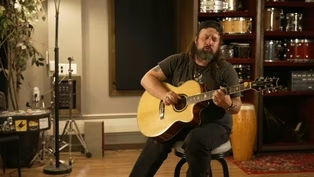
Video has Closed Captions
Clip: S17 Ep12 | 15m 36s | In Rochester, roots rock band Clay Fulton and the Lost 40 host a music celebration. (15m 36s)
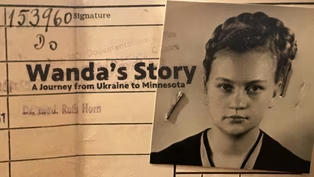
Video has Closed Captions
Clip: S17 Ep12 | 14m 22s | Wanda Bahmet shares her story of surviving a WWII Nazi work camp and post life in the United States. (14m 22s)
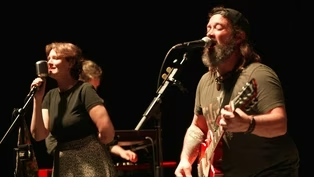
Wanda Bahmet and Clay Fulton and the Lost 40
Preview: S17 Ep12 | 40s | Wanda Bahmet recounts surviving a Nazi work camp; Clay Fulton and the Lost 40 host a music festival. (40s)
Providing Support for PBS.org
Learn Moreabout PBS online sponsorship New Episode
- Arts and Music

Innovative musicians from every genre perform live in the longest-running music series.










 New Episode

Support for PBS provided by:
Postcards is a local public television program presented by Pioneer PBS
Production sponsorship is provided by contributions from the voters of Minnesota through a legislative appropriation from the Arts and Cultural Heritage Fund, Explore Alexandria Tourism, Shalom Hill Farm, West Central...