
Iwo Jima: Eight Square Miles of Rock and Ash
Feb. 19, 1945: Marines storm Iwo Jima, where 21,000 Japanese defenders wait underground.
From
Iwo Jima: Eight Square Miles of Rock and Ash
Clip: Episode 6 | 11m 23sVideo has Closed Captions
Feb. 19, 1945: Marines storm Iwo Jima, where 21,000 Japanese defenders wait underground.
To protect B-29 bombers striking Japan, American commanders wanted Iwo Jima taken. On February 19, 1945, after 72 days of bombing, the Marines landed and met some 21,000 Japanese troops dug into tunnels and bunkers. The fight lasted nearly a month and cost 6,821 American lives. Of the 16 men in Sgt. Ray Pittman's squad, only three remained.
From
Problems playing video? | Closed Captioning Feedback
Problems playing video? | Closed Captioning Feedback
Corporate funding is provided by General Motors, Anheuser-Busch, and Bank of America. Major funding is provided by Lilly Endowment, Inc.;PBS; National Endowment for the Humanities; CPB; The Arthur Vining Davis...
Iwo Jima: Eight Square Miles of Rock and Ash
Clip: Episode 6 | 11m 23sVideo has Closed Captions
To protect B-29 bombers striking Japan, American commanders wanted Iwo Jima taken. On February 19, 1945, after 72 days of bombing, the Marines landed and met some 21,000 Japanese troops dug into tunnels and bunkers. The fight lasted nearly a month and cost 6,821 American lives. Of the 16 men in Sgt. Ray Pittman's squad, only three remained.
From
Problems playing video? | Closed Captioning Feedback
Where to Watch The War
The War is available to stream on pbs.org and the PBS app.
Buy Now
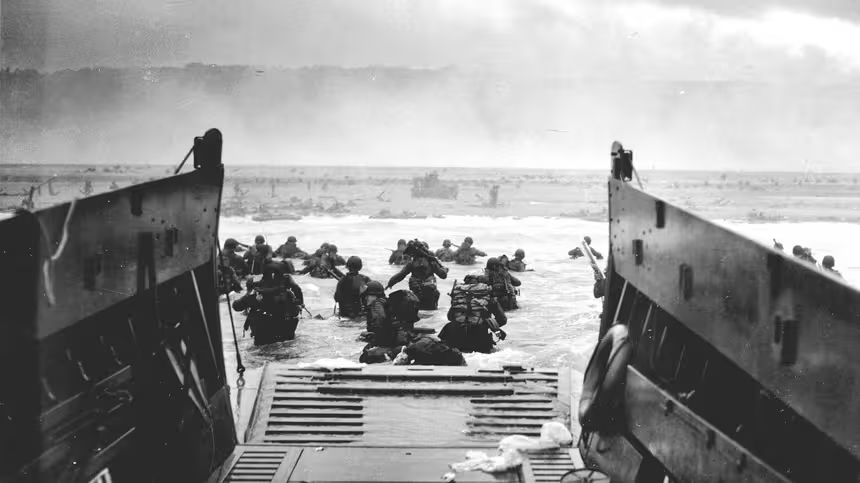
The War - A Timeline
Explore a multimedia timeline following events from World War II battles, diplomatic actions, and developments on America's homefront, from 1939 - 1945.Providing Support for PBS.org
Learn Moreabout PBS online sponsorship(energetic instrumental music) (plane whirring) - [Announcer] Airborne, the B-29's head for Tokyo.
Giant bombers equipped to range over 5,000 miles now swiftly cover the 1,500 miles from Saipan to their objective to open the full-fledged air war against Japan.
- [Narrator] Allied planners hoped the kind of bombing that had leveled German cities would destroy the Japanese will to resist and make unnecessary the bloody invasion that otherwise seemed inevitable.
American B-29's could now reach the enemy's homeland from Saipan and Tinian, but roughly halfway between them and Japan itself lay a tiny volcanic island, Iwo Jima.
It was an otherworldly place, barely eight square barren miles of rock and ash, reeking of sulfur, without safe drinking water.
But it had an airstrip from which Japanese fighters rose to harass American bombers as they flew to and from their mainland targets.
American commanders wanted the island taken.
Then, they could make it a haven for their crippled bombers.
(planes whirring) For 72 straight days, American bombers pounded Iwo Jima and its defenders with some 6,000 tons of high explosives.
(slow instrumental music) (explosions) Three more days followed of ceaseless shelling by the Navy.
In the early morning of February 19th, 1945, the Marines started toward the island.
Most were veterans of earlier landings, Saipan, Tinian, Palau.
(slow instrumental music) The first three waves met little resistance.
Some began to think this invasion would be difference, that for once the pre-invasion bombardment really had knocked out the island's defenses.
It had not.
Some 21,000 Japanese soldiers were waiting for the Americans inside a virtually impenetrable network of tunnels and bunkers.
As the fourth wave neared the beach, the enemy opened fire.
(explosions) (men shouting) Sergeant Ray Pittman of Mobile was there.
- Going into Iwo Jima, I was a squad leader by that time, and I always looked around and wondered, "Now, how many men am I gonna lose?"
'Cause we didn't know it was gonna be bad as it was.
(explosions) - [Narrator] Maurice Bell, also from Mobile, watched the fighting from the deck of the USS Indianapolis.
- I set up there with my binoculars and watching the Marines on the island, and I actually saw tanks going up, and they would come down to the beach, and a bunch of Marines would get behind the tanks, and they would escort 'em up.
They'd get up to certain points and jump down in the holes.
And the tank would turn and go back, escort more on up there.
(explosions) (men shouting) One day, I saw, I guess it was a Marine just a short distance up from the beach.
Had his flamethrower going, it was hot that day.
(fire crackles) And all of a sudden he stopped, he turned, he walked back to the water, he took the flamethrower off, and he undressed.
Put his clothes all down on top of the flamethrower, went swimming for about 30 or 40 minutes.
And he come back and he dressed, got his flamethrower, and he went back to fighting again.
I guess he thought he was gonna be killed anyway, so he might as well enjoy, cool off a little bit.
(energetic music) - [Announcer] The airfield is taken, and the advance grinds on.
Japanese are caught in the open.
(gunfire) Marines move ahead in a battle that outranks any ever fought in the Pacific.
Iwo Jima, in its first 15 days, has cost 2,050 American deaths, and the battle still rages.
(gunfire) (men shouting) - [Narrator] The fighting would go on for nearly a month before the Americans took the island.
(explosions) (slow instrumental music) The Japanese lost their entire garrison.
Once again, they had never intended to surrender.
Their mission was to kill as many Americans as possible before they were killed, themselves.
6,821 Americans died, five times the number killed on Guadalcanal or Saipan.
Among the dead were Private David Harris of Luverne, Corporal John Biswanche of Waterbury, Private Zarrer Richards of Sacramento, and Sergeant James Albert Chamblis of Mobile.
27 medals of honor were awarded to those fought on Iwo Jima.
13 of them had to be given posthumously.
So many of the men in one unit were lost that it came to be called the X-ray Company.
Of the 16 men in Ray Pittman's squad, only he and two others were left - What I went through after the war, the dreams and everything I had, it would be just like reality to me.
But it, it's really hard to explain just how you feel, because I came home and married and raised a family and lived a real happy life after the war, but so many of them left their blood on the sand on Iwo Jima and Saipan and Tinian that they didn't have that chance.
Ray Leopold's Front-Line Meal: Chocolate Roast Beef
Video has Closed Captions
Clip: Ep6 | 1m 50s | "We loved every single bite." Ray Leopold remembers his chocolate-covered roast beef. (1m 50s)
Video has Closed Captions
Clip: Ep6 | 51s | The German offensive strikes out of the Ardennes fog, and Mobile's Tom Galloway is in its path. (51s)
Video has Closed Captions
Clip: Ep6 | 5m 22s | Veterans of Carlson's Raiders, Marines Pete Arias and Bill Lansford face the horror of Iwo Jima. (5m 22s)
Providing Support for PBS.org
Learn Moreabout PBS online sponsorship












Support for PBS provided by:
Corporate funding is provided by General Motors, Anheuser-Busch, and Bank of America. Major funding is provided by Lilly Endowment, Inc.;PBS; National Endowment for the Humanities; CPB; The Arthur Vining Davis...