Washington Grown
Washington Apples
Season 11 Episode 1105 | 26m 46sVideo has Closed Captions
Shopping in Mexico City, Snowdrift Cider Co. in Spokane, making pupusas in Seattle.
We find Washington fruit in a grocery store in Mexico City, then back in Spokane tasting some apple ciders from Snowdrift Cider Co, and making pupusas with a Washington twist at the Salvadorean Bakery in Seattle.
Problems playing video? | Closed Captioning Feedback
Problems playing video? | Closed Captioning Feedback
Washington Grown is a local public television program presented by KSPS PBS
Washington Grown
Washington Apples
Season 11 Episode 1105 | 26m 46sVideo has Closed Captions
We find Washington fruit in a grocery store in Mexico City, then back in Spokane tasting some apple ciders from Snowdrift Cider Co, and making pupusas with a Washington twist at the Salvadorean Bakery in Seattle.
Problems playing video? | Closed Captioning Feedback
How to Watch Washington Grown
Washington Grown is available to stream on pbs.org and the free PBS App, available on iPhone, Apple TV, Android TV, Android smartphones, Amazon Fire TV, Amazon Fire Tablet, Roku, Samsung Smart TV, and Vizio.
Providing Support for PBS.org
Learn Moreabout PBS online sponsorship- Washington Grown is made possible by funding from the Washington State Department of Agriculture and the USDA Specialty Crop Block Grant Program.
And by The Potato Farmers of Washington.
Learn why Washington is home to the world's most productive potato fields and farmers by visiting potatoes.com.
[light music] - On this special season of "Washington Grown", we're following Washington produce around the world.
Here we go.
- I mean there is just stuff happening everywhere.
- Breakfast, lunch, or dinner.
- Breakfast, lunch, or dinner.
[Kristi laughs] I'm doing all the work over here.
- That's a Tomás deluxe.
All good things are better shared right?
- Cheers my friend.
- Cheers.
[Val laughs] - I can't even walk.
Hot diggety dog!
- We got a lot to explore and a lot to do.
So let's get to it.
- To Washington.
- To Washington.
- Washington.
- Hi everyone, I'm Kristi Gorenson and welcome to "Washington Grown".
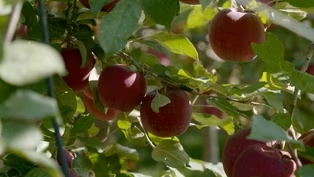
Washington's apples are the biggest, the juiciest, and the best around, and it's no secret.
Today we're exploring why Washington's fruits and veggies are so well loved around the world.
Tomás is testing apples to see if they're ready for harvest.
- Now how long?
Oh, actually, it's already starting to turn.
- And I'm making pupusas at the Salvadorean bakery in Seattle.
- Yeah, that easy, better than Ana.
Open it all away.
Yeah.
[laughter] - Then I'm checking out a grocery store in Mexico City.
- Chances are if you, if you go into a McDonald's restaurant in Japan, for example, the French fry you're eating is from Washington.
- Could be your potato.
- It could be my potato.
Yeah.
All this and more today on "Washington Grown".
- Looking for a completely authentic and unique cultural experience?
Then come on down to White Center in Seattle to the Salvadorean bakery.
Between the cakes, sweet treats, and incredible savory food, whatever the craving is, it can be found right here.
I'm here with Ana and Aminta at the Salvadorean Bakery in White Center, and the two of you sisters have owned this business for a long time, right?
- It's been a while.
27 years.
- Although their business is thriving in the community now, the story of the bakery didn't start with a happy beginning.
- First of all, I want to mention that we fled El Salvador because of the Civil War at that time.
- We couldn't even go to school because it was hard.
I mean, if I wanna tell you all the stories that I had and the challenges that I had to go through, you know, it'll take a long time.
- We used to have a bakery in El Salvador.
- We had different kind of jobs when we came here to survive.
You know, in the back of my mind was always the baking.
So we finally decided to open a business in 1996.
We were the first Salvadorean people who actually opened a a food business here in Seattle.
Here we are after 27 years, you know.
I feel proud what we have accomplished.
You know, bringing the culture of El Salvador here to Seattle through our food.
For some reason, we've been open for 27 years.
So, you know, give us a try.
- Because if you don't try it, you won't know it.
- Later in the show, Aminta is going to show me how to make a Salvadorean staple with a Washington twist.
Pupusas made with Washington zucchini.
- We are gonna cook this, and after that we're gonna taste them.
- Yeah, that's my favorite part.
[laughter] [happy music] - When you buy apples at the grocery store, how do you choose the best ones?
Is it the firmness, the color, the size?
There are entire teams of people dedicated just to ensure that apples in the market look and taste as perfect as possible.
And as it turns out, the best apple was grown in Washington state.
- We grow apples very well in Washington as an industry.
It's regarded as a premium product all over the world.
- Steve Smith is the director of marketing for Washington Fruit and Produce.
Whether his apples go to stores here in the states or to other countries, he wants to make sure that each one is perfect for the customer.
What does the color have to do with sales?
- The more red they have, the more revenue we receive.
At the end of the day, once shoppers have have bought apples off the shelf, what's left on the shelf generally is the lower colored apples, not the high colored apples.
Certain markets, certain countries, have certain size preferences.
Vietnam as an example, takes a smaller apple.
China takes a larger apple.
Markets like Mexico, they buy the whole tree.
High color, low color, large, small.
- Now, I know we're about a week away from growing these, but can you just show me the proper way to pick one of these Cosmic crisps, if that's okay?
- Sure, yeah.
If you set your finger right on the top of the stem there where it meets the tree, okay.
Press and turn it up.
That'll pop it right off.
There you go.
- Yeah, there it is.
Perfect.
So I didn't, I didn't ruin this.
- If you take the spur with it, that'll be next year's apple.
We'd be having a discussion about that.
[laughs] - Like all right, interview's over.
- Yeah.
[laughter] - Well, how do you know when this particular variety is ready to go?
I mean, I'm looking at this going, looks great.
- Yeah.
- But you saying it's got another week.
- The primary sign we're looking for though, is they're converting starches to sugar.
And we can measure the conversion from starch to sugar by variety at different stages in that conversion.
We'll know it's time to start harvest.
- Alright, so it looks like we've got a little something here in the back of the truck.
What are we doing here?
- We're gonna do starch tests on these apples.
And so there's a set of Cosmics and a few Fujis.
- Okay.
And why are we testing for starch?
- As apples mature, they convert from starch to sugar.
- Okay.
- We do an iodine test on them to get a look at how much conversion has happened.
- Okay.
- And so iodine turns starch black.
And so the flesh that is still starchy will be black.
The flesh that is converted to sugar will be white.
And so it gives us an indication of how far along the maturity they are.
Cosmics are a starchy apple, and we actually keep them in storage for up to a couple months after picking them to let those starches continue to convert to sugars.
- Okay.
What we'd expect to see in the Fujis is that there's already been quite a bit of conversion from starch to sugar.
Let 'er rip right on there.
- Just like that, huh?
- Just make sure it covers all the flesh.
- All the flesh.
Now how long with, oh, actually it's already starting to turn, so this doesn't take long.
So these are the Fujis.
Let's check out what our Cosmics are doing.
- Yeah, you can.
- Ooh, and you can smell it.
- This'll be the cleanest tailgate in the state.
[laughter] There's not much starch conversion yet in these Cosmics.
With the Fujis.
- A little bit less.
But yeah, so there's more sugar right now at this particular stage.
- More sugar right now in these Fujis yes, than there is Cosmics.
- Okay.
There you go.
Don't eat this one.
Wait till it gets to the store, okay.
- It's hard to beat a perfect Washington apple, but sometimes it's fun to enjoy fruit in a different way.
Today I am at the farmer's market in Coeur d'Alene Park near downtown Spokane, where I'm visiting with Snowdrift Cider.
And they love sharing the uniqueness of Washington's less popular cider apple varieties - We're smack dab in the heart of the apple capital of the galaxy [laughter] It's really easy to take some apples and make cider.
- Joseph Cox is passionate about the craft of cider making.
You see, to him the fun is in discovering new and different flavor combinations.
- I think what makes cider apples unique is that you wouldn't find yourself really eating those apples.
You pick an apple off the tree and it just torques your face out.
- Right?
- Those are the cider apples.
Those will make great cider.
Part of the fun's, like going out and finding these lost strains and like bringing them back.
Finding some apple tree alongside the road that some logger threw out a hundred years ago that just kind of made its own thing.
And so it's just fun.
- Okay.
I think it's time for me to take a taste.
- This is a classic bittersweet cider.
- Okay, all right.
Well lets give it a try.
- Yeah.
Cheers.
- Cheers, man.
Oh wow.
I was expecting sweet.
And it's just, it's dry, it's crisp, it's bright.
- Some caramel, some vanilla.
Yeah, - I was gonna say like oaky.
I almost get like this woodsy vibe behind it.
Alright, next up is their best seller, the Orchard Select.
- So Orchard Select is just our choice aromatic, bitter sharp apples from our orchard, blended with some Wickson crab apple.
- Okay.
- And so it's some of our best bitter sharp apples on display here.
- I'm excited.
Okay, let's try this one.
Mm.
Okay.
This definitely is a little bit more sweeter than the one I had before, but it's not too sweet.
It just kind of sits in the back of your palate a little bit.
It just brings a light smile to your face.
- Yeah, it's a classy cider.
- Yeah.
Yeah.
- It's a glass of wine.
It's apple wine.
- And this is one of your best sellers.
I understand why.
All right, time to take the Orchard Select around and see what everybody else thinks.
- This is a nice finish.
- I like that acid on the back end.
That's really good.
- Yeah.
Super good.
- Is this hard cider or regular?
- It is.
- Oh, that's probably what makes it really good.
- Where can you see yourself drinking a beverage like this?
- In the summer, at the dock, at the lake.
- It's a nice smooth finish.
It doesn't make you pucker.
- It's nice and crisp and not too sweet.
- Bright, I think that's the best.
- I think that's the best way to describe it.
'cause that's actually what it says on the bottle.
- Oh, is it?
- So you nailed it.
If they were giving out prizes, you'd win.
[laughter] - In this beautiful block of Cosmic crisp apples.
What is the purpose of this crab apple tree?
I'll give you the answer after the break.
- Coming up, I'm making zucchini pupusas at the Salvadorean bakery.
- Yeah, easy.
Better than Ana.
Open it all way.
[laughter] - And we're in The Kitchen at Second Harvest trying Chef Laurent's Apple Empanadas.
- The purpose of this crab apple tree is to cross pollinate these Cosmic crisp apples.
Apples in general have to have two different types of pollen to fertilize the the bud.
And that is the role of this crab apple.
[upbeat latin music] - We're back at the Salvadorean Bakery in Seattle.
Authenticity is the name of the game here and with so many incredible and tasty treats to try, there's no way you're going home empty handed.
- It's part of my culture.
I was born in El Salvador and this place makes it like over there.
- I from Honduras, I don't from Salvador, but I like the foods.
- Yeah.
It feels like home when you come over here.
Plus you see the flag, the hamaca over there too.
Like the everything.
- You know, you just open the door and you already feel like you're over there.
Ana and Aminta are the masterminds behind the bakery.
Aside from their amazing flavors and authentic Salvadorean recipes, their secret sauce is all in the ingredients.
- We like to work in within the neighborhood.
So there is a lady that has produce spot here and she brings all our vegetables, our zucchinis, our berries, everything fresh, very fresh.
- Washington grown.
- Washington grown, yes.
vegetables and fruit.
- Everything we need if we can get it within our neighborhood, we do it, we get it from them.
- Although everything here is delicious, One classic Salvadorean dish is a particular fan favorite.
- What I always get is the pupusas.
- When I come in here, I buy only pupusa.
[laughs] because I like it.
- Cheese and beans pupusas, those are my favorite.
- Pupusa is a tortilla made with, can be any vegetable, like zucchinis, carrots, jalapeños and garlic.
And, and you get 'em really hot from the grill.
Everybody likes pupusas.
- Today I am getting a special lesson from Aminta on how to make Washington grown zucchini pupusas.
- You be walking outta here, you wanna make pupusas yourself, by yourself at home.
- Okay, I can't wait.
- Pupusa is a very traditional food in El Salvador.
We call it street food because you can find pupusas anywhere in El Salvador.
- Yeah.
- There is a lot of things that you can make pupusas of like zucchini and there is also meat, chicken and all other kinds.
- All kinds of stuff.
- Yeah.
All kind of stuff.
But we're making zucchini here.
Zucchini pupusas.
- So let's get started on the salsa.
We start by rough chopping some carrots, onions, tomatoes, garlic, bell peppers and hot peppers, and adding it into a pot with two cups of water, then boiling them for 12 minutes.
After it's been cooked, we blend it up and add some seasoning salt and oregano.
Look at how smooth that is.
- Yeah.
Smooth.
- That's my kind of salsa.
Sticks to everything.
- Right.
- So step two, Aminta.
- Yes.
- What are we making now?
- We're making curtido.
- Okay.
So a slaw, right?
Like a coleslaw.
- Right, kind of.
Yeah.
- Once the cabbage is chopped, we add purple cabbage, carrots, onions, salt and vinegar.
- We use pineapple vinegar, but you can use like apple cider vinegar.
The curtido cannot be so acidy, so we add same amount of water.
We mix this and let it sit for, you know, a day or two is fine.
We just mix all the ingredients all together.
- You want it to cure a little bit.
- Exactly.
- I'll eat while you stir.
For the filling, we grate some Washington grown zucchini and chop up some onion, tomato and add some seasoning salt.
Then let it sit for 10 minutes.
- I pre-made this one.
So you see how much water, so you squeeze all.
- So you discard the water.
- Yeah.
Discard the water.
Then you come and add all the cheese and that's cotija cheese.
So you mix everything and this is what you get.
Now we need to make the masa, which is a corn flour.
[snap] [laughter] Make this kinda in your hand.
Then you grab your filling, squeeze it into the masa, and then you close it and then you flatten it.
So like a filled pancake kinda.
- Right, kind of.
Yeah.
We're gonna cook this and after that we're gonna taste them.
- Yeah, that's my favorite part.
[laughter] After the pupusas cook, it's time for the big reveal.
Show me how we eat these.
I'll do whatever you want me to do.
And we need some napkins.
My turn.
Okay, so we kind of open it up a little bit.
- Yeah, you did better than Ana.
Open it all way.
Yeah.
[laughter] - It's very light.
You can taste all the, the curtido and the vinegar.
- The masa is delicious.
I really like the zucchini and the cheese together.
- You can taste.
Yeah.
- And this can be eaten breakfast, lunch, and dinner.
- That's my kind of meal.
Thank you.
This was a lot of fun and delicious.
Thank you.
And I learned a lot.
Thank you so much.
To get the recipe for the Salvadorean Bakery's, Washington Zucchini Pupusas, visit us at wagrown.com.
Coming up, I'm exploring a grocery store in Mexico City.
I'm driving the cart.
I get to choose.
- Yeah, you get to choose.
[laughter] [upbeat music] - During our trip to Mexico City, we traveled with a large group of people.
That means a lot of mouths to feed.
So while our group explored the city, WSDA director, Derek Sandison and I went into a Mexican grocery store to see if we could find some Washington grown food to keep our group happy and well fed.
That's one of the things I love being in a foreign country, is going to a supermarket or grocery store so I can see kind of just the items that like everyday people are buying.
- Yep.
- And how it's different than what we see back at home and stuff.
As we looked at the produce, we ran into the Mexico representative for Washington apples and cherries, Juan Carlos Moreira.
He told us that when Washington cherries aren't in season, Mexico imports different varieties of cherries from other countries.
Still, customers get excited when Washington cherries finally hit the shelves.
- Washington cherries have a fantastic explosion of flavor.
- Yeah.
- They have a larger size and the color is so intense.
Since it's a very seasonal product, We take the circus approach where we say the circus is coming, circus is coming.
- Okay.
- So summer cherries are coming.
You will see them in your retail stores very soon.
- That's awesome.
So you're the hype man for the cherries.
Next we walked over to the apple section where many varieties of beautiful Washington apples were stacked high on the shelves.
And apple in Spanish is manzana.
Okay, well I'm gonna get some apples.
- Yep.
- Shall we?
I'm driving the cart.
I get to choose.
- Yeah, you get to choose.
- As we walked into the frozen food section, we ran into another friend from our group.
Potato grower Mark Hammer was admiring his product and how far it had come from his field back in Pasco.
We're a long way from Pasco, Washington, aren't we, Mark?
[laughter] - Yeah.
But feel a little bit at home.
- A little bit at home.
- Yes, I grow french fries for Lamb Weston and there's McCain and also Simplot.
And so as a grower, it's super rewarding to see our product down here in Mexico and see that the popularity of french fries is just blown up across the country.
- All around the world you'll see Washington french fries.
Chances are if you go into a McDonald's restaurant in Japan, for example, the French fry you're eating is from Washington.
- Yeah.
Could be your potatoes.
- It could be my potato.
Yeah.
So you're getting a little sun down here.
A little bit.
- Some cerveza?
- A little bit of cerveza.
[laughter] Speaking of cerveza, before we left, we had to pick up some famous Mexican beer.
Mexico, they love their beer.
- They do.
And they export a great amount of beer around the world.
They use a lot of Washington hops in the production of the craft brews down here.
About 70 to 80% of the hops grown in the United States are grown in Washington state.
Most of them in the Yakima Valley.
- Our hops make good beer.
- Our hops make good beer and, and the world knows it.
So.
- So we're gonna go check out.
- Alright.
- And eventually we're gonna have our beer, have our cerveza.
I love it.
- Sounds good.
- Yes, thanks for shopping with me.
- You bet, my pleasure.
Thank you.
- Thanks for letting me drive the cart.
- For those that live in Washington, getting a fresh apple can be as easy as going to the grocery store.
Or if you're really lucky, plucking it right off the tree.
But for other countries, getting that amazing Washington produce takes a little more work.
Ernesto Cardona is the CEO of Austral Trading in Mexico.
He and his company work day in and day out to bring produce from all over the world into the country for Mexican consumers.
- This is a family business.
I'm a four generation doing the same.
- Really?
- Yeah.
- Did you always know you were gonna be doing this?
- Yes.
[laughter] - There, was no question.
- This is my grandfather, no.
- Okay.
There was no question about it.
What types of produce come through this facility?
- Well, from Washington, maybe more than 45 different varieties in apples.
And in pears, 15 different varieties.
The fruit from Washington is the best food because of the flavor.
Because you can store it for a while, because the varieties, no, they're running a lot of varieties and new varieties.
Not only the pears but also with the apples.
The consumption, it's increasing a lot in Mexico because we're looking for the best for our workers, for our bodies, for our health.
- Once the trucks have been unloaded, the fruit is sent to markets like Central De Abasto.
From here, sellers can buy as many apples as they want to sell to their consumers.
- People come to these warehouses every single day.
- Yeah.
imagine that, to buy from a couple of boxes to a few pallets.
- Juan Carlos Murra represents the Washington Apple Commission and Northwest Cherry Fruit Growers here in Mexico.
He thinks the partnership between Mexico and Washington's farmers is a match made in heaven.
- You can have a truckload with apples here in less than a week.
- And that's an impressive journey 'cause we're a little over what, 2000, 3000 miles from Washington.
What are you hearing from the people of Mexico when they encounter our fruit?
What are they saying about it?
- Well, the first thing that they like is the uniformity, the color and the crunch.
Mexico is not self-Sufficient producer of apples.
So we do need to import apples and Washington apples are the best match.
- When I go to Washington, I feel good.
I feel better because I see how the growers and the packers are developing the infrastructure and all the things to increase the quality, the volumes.
They're having the fruit in their veins.
It's, it's amazing.
It's great.
- We're in The Kitchen at Second Harvest here in Spokane, Washington, and we are getting ready to taste some wonderful food.
And of course I have my co-tasters with me today.
I have Chef Laurent Zirotti.
Thank you for being here.
- Good to see you Kristi and Tomás.
- And my co-host Tomás Guzman.
- Here we are again.
- Yes, I know.
It's so fun.
And this time you have developed some of the recipes.
- Yes, we did.
- That we're tasting.
- That's exciting.
- Which is awesome.
- Yeah.
- We, we have such a hard job right, tasting food.
And enjoying each other - And our food this time, you know, all around the world, right?
- All around the world.
Getting the chance to visit Mexico City and Vietnam.
That was a true, true treat.
- And you could see I had a lot of fun grocery shopping with Derek.
- Yes.
- Even though you had a mishap in the grocery store.
- I had a mishap, yeah.
- You bet, my pleasure.
Thank you.
- Thanks for letting me drive the cart.
- Yeah.
[pop, shattering] - Whoa.
- Oh my gosh.
What happened?
- It must have rolled out here.
- What happened?
- That, get on camera?
- Just shattered.
All over.
[laughter] - And she hadn't even drinking that day.
- Had not been drinking.
Had not been drinking.
- Yeah.
It's neat to see the way different countries approach food and their processes.
- And being in a grocery store, that's like one of my favorite places to go.
- In general.
- In a foreign country.
- Yes.
- And you're just like, I don't know what this is, but I'm gonna try it.
I dunno what this is, but I'm gonna try it.
[laughter] Today, we're going to be making... - Empanadas.
- Empanadas.
- An unusual one.
We're gonna make it sweet.
- Okay.
- Because of the apple.
- And so empanadas.
I can see why you would make them sweet.
Because they are kind of like little mini pies, right.
- Little mini pies that you can snack on.
You make a lot and you snack all day with those.
- I that idea.
- That gets you in trouble.
- Alright, well, let's see what our wonders in the kitchen are doing.
We have WA Grown and Second Harvest folks in the kitchen making this for us.
Let's see how you do it.
Okay, here we go.
Apple filled empanadas.
I love empanadas.
You could put anything in them and I would love them.
- You'll see that a little trick.
Easy to do.
The circle, use a tortilla press instead of rolling them.
Just a tortilla press works great.
- This is a great base.
So you can add all sorts of stuff.
You could really just experiment, make it your own.
- Of course.
- What you do if you were going to make a savory empanada, what would be like one of your favorite things?
- Maybe some shredded chicken with some corn, some beans.
A little bit of cumin.
Make it a little more, you know, south American.
- If you don't want apple, you could do a berry or something like that.
- I'm sorry, I'm eating.
- Yeah, it's okay.
I'm gonna take another bite.
If you wanna find these recipes, go to wagrown.com because that's the only place you're gonna find them.
- That's right.
- That's the only place - I'm going there after the show.
- To get the recipe for Chef Laurent Zirotti's Apple Empanadas, visit us at wagrown.com.
Whether it's Washington's famous apples or fresh zucchini, our produce has a reputation for being fresh and delicious.
That's it for this episode of "Washington Grown".
We'll see you next time.
Video has Closed Captions
Preview: S11 Ep1105 | 30s | Washington fruit in a grocery store in Mexico City, apple ciders from Snowdrift Cider Co. (30s)
Providing Support for PBS.org
Learn Moreabout PBS online sponsorship
- Food
Christopher Kimball’s Milk Street Television
Transform home cooking with the editors of Christopher Kimball’s Milk Street Magazine.








Support for PBS provided by:
Washington Grown is a local public television program presented by KSPS PBS