
Washington Week full episode for December 25, 2020
12/23/2020 | 24m 21sVideo has Closed Captions
Washington Week full episode for December 25, 2020
Washington Week full episode for December 25, 2020
Problems playing video? | Closed Captioning Feedback
Problems playing video? | Closed Captioning Feedback
Major funding for “Washington Week with The Atlantic” is provided by Consumer Cellular, Otsuka, Kaiser Permanente, the Yuen Foundation, and the Corporation for Public Broadcasting.
Washington Week full episode for December 25, 2020
12/23/2020 | 24m 21sVideo has Closed Captions
Washington Week full episode for December 25, 2020
Problems playing video? | Closed Captioning Feedback
How to Watch Washington Week with The Atlantic
Washington Week with The Atlantic is available to stream on pbs.org and the free PBS App, available on iPhone, Apple TV, Android TV, Android smartphones, Amazon Fire TV, Amazon Fire Tablet, Roku, Samsung Smart TV, and Vizio.
Buy Now
10 big stories Washington Week covered
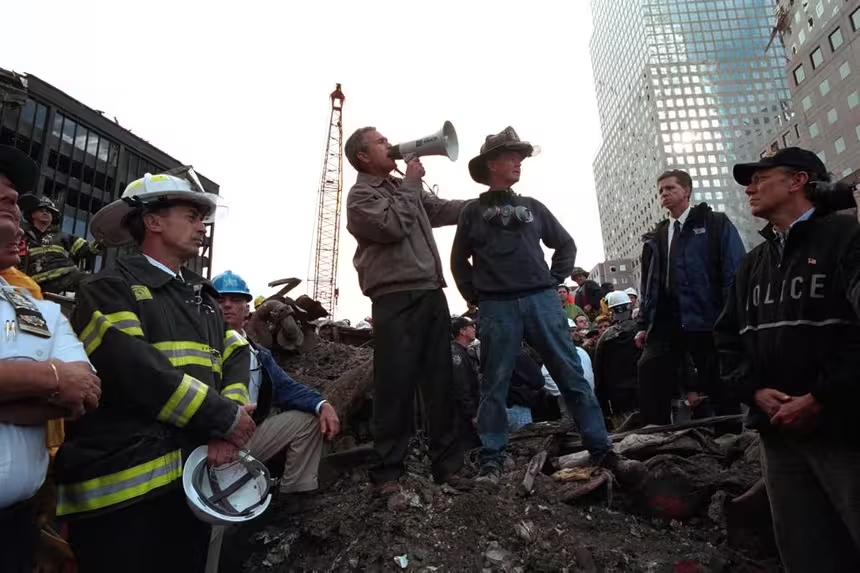
Washington Week came on the air February 23, 1967. In the 50 years that followed, we covered a lot of history-making events. Read up on 10 of the biggest stories Washington Week covered in its first 50 years.Providing Support for PBS.org
Learn Moreabout PBS online sponsorshipROBERT COSTA: Tonight, a Washington year in review.
A deadly pandemic.
ANTHONY FAUCI, M.D.
: (From video.)
If you look at how we've been hit, we've been hit badly.
COSTA: A racial reckoning.
TERRENCE FLOYD: (From video.)
Let's stop thinking that our voice don't matter and vote.
There's a lot of us.
There's a lot of us.
COSTA: And a turbulent election.
PRESIDENT DONALD TRUMP: (From video.)
They can try to steal the election from us.
PRESIDENT-ELECT JOSEPH BIDEN: (From video.)
The integrity of our elections remains intact.
COSTA: As the year that tested the American people, institutions, and democracy comes to a close, Washington Week looks back.
CHANTING: (From video.)
Black Lives Matter!
CHANTING: (From video.)
Stop the steal!
COSTA: Next.
ANNOUNCER: This is Washington Week.
Once again, from Washington, moderator Robert Costa.
COSTA: Good evening and happy holidays.
As we end this year in Washington, the past 12 months offer us a window into who we are and where this nation and its leaders might go in 2021.
The year began with a deadly pandemic that upended our health-care system and economy.
Then in May, the brutal killing of George Floyd in broad daylight sparked outrage and nationwide protests against racism and police brutality.
And in November the Biden-Harris ticket won the election, but President Trump keeps fighting and refuses to concede.
Joining us tonight to discuss the Washington year in review are three reporters who covered it all.
Weijia Jiang, White House correspondent for CBS News; Errin Haines, editor at large for The 19th; and Dan Balz, chief correspondent for The Washington Post.
Let's begin with the lessons from January and February, when health officials grew increasingly alarmed about the outbreak of a highly infectious novel coronavirus in China.
President Trump's response quickly became one of the biggest stories of the year.
JUDY WOODRUFF: (From video.)
China closed off Wuhan, a city of 11 million people, in an unprecedented effort to contain a deadly virus.
HARI SREENIVASAN: (From video.)
Health officials in Washington state reported the first death from the novel coronavirus in the United States today.
PRESIDENT DONALD TRUMP: (From video.)
Today I am officially declaring a national emergency.
Two very big words.
DEBORAH BIRX, M.D.
: (From video.)
We're appealing to all Americans to take these steps to protect each other and to ensure that the virus doesn't spread.
JOHN YANG: (From video.)
Yesterday New York saw the highest number of deaths yet in a single day.
PRESIDENT DONALD TRUMP: (From video.)
I see the disinfectant, where it knocks it out in a minute.
One minute.
And is there a way we can do something like that.
AMNA NAWAZ: (From video.)
A dozen states across the South and Southwest reported record increases this past week.
PRESIDENT DONALD TRUMP: (From video.)
If we didn't do testing, we'd have no cases.
ANTHONY FAUCI, M.D.
: (From video.)
We may see a surge upon a surge.
JUDY WOODRUFF: (From video.)
A grim reality, COVID kills more in the U.S. in a single day than ever before, as infections and hospitalizations continue to skyrocket.
PRESIDENT-ELECT JOSEPH BIDEN: (From video.)
And I know times are tough, but I want you to know that help is on the way.
COSTA: By late December more than 300,000 Americans have died.
Dan, when you look back on the pandemic and Washington's response, do you see a collision of politics and science?
DAN BALZ: Yes.
Remarkably so, Bob.
I mean, this should not have happened in the way that it did.
But tragically, this whole pandemic has become highly politicized.
And I think much of that lays at the doorstep of President Trump because of the way he did or did not handle it throughout the year.
He was often at odds, almost regularly at odds, with the scientists and the health officials in his own administration, and outside the administration.
He sent mixed signals.
He pushed against the advice of many of the experts.
And has created an environment in which people have taken sides over whether they should wear masks or social distance.
And unfortunately, more than 300,000 people have paid with their lives as a result of this.
And we're still deep in the middle of it, even though there is some hope on the horizon as the vaccine has begun to arrive and people are able to get it.
But this has been a terrible year.
And, as I say, much of it - much of it lays at the doorstep of the president.
COSTA: Weijia, you're on the White House beat.
Has President Trump's engagement with the pandemic changed in any way since the beginning of 2020?
WEIJIA JIANG: Bob, I think one thing that is remarkable is that it hasn't.
And in some ways, the beginning of the pandemic is ending in the same way under the Trump presidency, because his message has not matched the moment - in the beginning and even now.
As you rightfully pointed out, the president was always resistant to communicating the severity of this virus because he was leaning into his inclination to be a leader that offered hope, that remained positive.
But that did not match the science.
And even now I think he had a real missed opportunity to end his presidency on a high note with the rollout of a vaccine for the American public.
And even now he's not meeting the moment because he is not out here being the face of the vaccine and urging his supporters - who we know are hesitant to get it, to do so when it's available to them.
So, you know, we've seen this from President Trump from day one.
And he has been consistent in wanting to downplay how serious this virus is.
COSTA: Errin, how do you believe President-elect Biden and Vice President-elect Harris will handle the pandemic in their first 100 days?
ERRIN HAINES: Well, Bob, if the way that they campaigned and these early days during the transition are any indication, they plan to set the example and to lead from the top to show Americans where they stand on confronting this pandemic and how they hope that Americans will behave as we try to get to the other side of what has been a very, very grim period in our country's history.
Listen, during the campaign you saw them social distancing, wearing masks, holding campaign events, you know, in a socially distanced and responsible way - even as President Trump was holding, you know, rallies where his supporters, at least some number of them, were getting sick.
Holding events at the White House where people were getting sick, where dozens of people in the president's orbit have become sick, where the president himself became sick just before the election.
And then to see President-elect Biden taking the vaccine just this week, to see Dr. Fauci, who is going to be, you know, part of the Biden-Harris administration, taking the Moderna vaccine.
We know that Vice President-elect Harris, you know, a Black woman taking this vaccine, the optics of that could be very powerful in a community that is also skeptical - and rightfully so because of the history of race and medicine in this country - the message that that will send in ensuring, you know, confidence and trust in taking this vaccine, and encouraging Americans to really participate in what is going to hopefully be our new normal.
Listen, at the beginning of this spring the mantra was that we're all in this together.
That was an open question that I think didn't really bear out this year.
And I think that for the Biden-Harris administration that is a message that they will try to pick back up as they take office.
COSTA: As the initial surge of infections subsided in May, the police killing of George Floyd roiled the nation.
Within days, protests spread nationwide, but not just in his name.
YAMICHE ALCINDOR: (From video.)
Ahmaud Arbery.
He was a 25-year-old Black man chased and killed by at least two White men as he was jogging in a Georgia neighborhood.
CHANTING: (From video.)
Say her name!
Breonna Taylor!
AL SHARPTON: (From video.)
It's time for us to stand up in George's name and say: Get your knee off our necks!
(Cheers.)
JUDY WOODRUFF: (From video.)
As evening begins here in Washington police are firing tear gas, deploying flashbangs to disperse peaceful protests near the White House.
CHANTING: (From video.)
Feds go home!
Feds go home!
JUDY WOODRUFF: (From video.)
The investigation announced today over the use of federal force in Portland and elsewhere came as many cities pushed back on the president's actions and plans.
PRESIDENT DONALD TRUMP: (From video.)
Who would you like me to condemn?
CHRIS WALLACE: (From video.)
White supremacists and - PRESIDENT-ELECT JOSEPH BIDEN: (From video.)
The Proud Boys.
PRESIDENT DONALD TRUMP: (From video.)
Proud Boys, stand back and stand by.
PRESIDENT-ELECT JOSEPH BIDEN: (From video.)
The African American community stood up again for me.
(Cheers.)
You always had my back, and I'll have yours.
COSTA: Something erupted in 2020.
I wonder, Dan, was it akin to something we saw in the country in 1968, a country galvanized on issues of race, alarmed and horrified?
BALZ: I think this was somewhat different than 1968.
Certainly, there were tremendous protests in the wake of the assassination of Martin Luther King, Jr. in 1968, all over the country - many of them - many of them, frankly, quite violent.
Lots of looting and businesses destroyed.
I think this was different.
This was an awakening of a different type in 2020.
When everybody saw what had happened to George Floyd, when people watched him literally being killed in broad daylight, as you said, it sent a different message.
And it sent a message that something was deeply wrong in this country.
And what we saw in those protests - in those early days especially, but they kept on going - was the diversity of people who were in the streets.
Blacks and Whites, young and old, Latinos, Asians, all kinds of people.
And they were - they were calling for action.
They were calling for a recognition that there has been persistent racism in the country that has gone untreated or, at least, not resolved.
Look, this is a very difficult challenge for the country.
It has been for as long as we've been a nation.
But I think that what happened in the summer was a signal that there was a greater commitment, at least in the short term, to try to begin to do some things.
And whether it was in the private sector or politicians, they began to strike a different tone and make some different commitments.
But it is now in the - you know, in the hands of President Biden - President-elect Biden, and Vice President-elect Harris to try to take all of that and turn it into some kind of action that we have not seen in the past.
That's a big challenge.
COSTA: Errin, when you're reporting on the Biden-Harris team, are you seeing civil rights leaders pleased with the action they're taking in terms of the Cabinet picks and the agenda that's on the horizon?
HAINES: Well, what civil rights leaders, and activists, and others who are committed to racial equality - and really for the systemic change to racial inequality that existed long before the pandemic and that has been addressed only incrementally really in the history of our nation - what they are saying is that they are cautiously optimistic.
Joe Biden is somebody who became the primary nominee because of Black voters and, you know, his election, and Vice President-elect Harris' election, was largely because of the Black voters who, you know, came out and voted in record numbers, even in the midst of a pandemic, and who were protesting racial injustice and the unrelenting killing of Black Americans by law enforcement, even in the midst of a global public health and economic crisis.
So the stakes were high for these voters.
And they absolutely plan to hold this administration accountable.
President-elect Biden said in his acceptance speech that he understood that Black voters were the ones who got him to this point.
He has said that racial inequality is one of the four crises that he and Vice President-elect Harris expect to confront once they take office.
And so I think that you can expect those civil rights leaders, those activists, and others to be meeting not only with the president-elect and vice president-elect, but also with members of his administration, whom they expect to also use their Cabinet positions and their other positions in the administration to really and finally and fully address racial inequality in this country.
COSTA: Weijia, what was the pivot point, the linchpin moment for President Trump?
Was it Lafayette Square, when he walked across with General Milley and Attorney General Barr?
If that, why; if not that, why not?
JIANG: I think that's certainly one of them.
And it was really defining for the president to do that, because even to this point the president was unable to acknowledge why the protesters were in the streets, to acknowledge what it is that they were asking for.
Because President Trump, much like the way he handled the virus, was unable to acknowledge the problem of systemic racism and racial inequalities that have plagued this nation from its birth.
And that's one big difference between him and President-elect Biden, as Errin just pointed out.
And in taking the Bible to Lafayette Square, even faith leaders - and community activists have said the same thing - that he was using this as a prop to sort of, you know, illustrate what is America.
And that is having a country of law and order, which he was the president of.
And it was really showing his support for law enforcement rather than his understanding for why these people were risking their lives in the middle of a pandemic to make a statement.
And so I think in that moment, even without saying that, he was taking a side.
And he has said other things about police officers and law enforcement, making the case that there are just a few bad apples in the bunch.
Again, refusing to acknowledge that there are problems that go far beyond one or two officers.
COSTA: When you step back, Dan, and look at these first two topics - the pandemic and race - and it's a pandemic that has affected people of color in a troubling way, in a significant way - has anything changed at this year's end in terms of how the country operates and how it thinks about these issues and itself?
BALZ: Bob, I think we all hope that the country has changed somewhat.
And there's been some evidence that there's been a change.
I think there is broader support for some of the goals of the Black Lives Matter movement.
There's obviously controversy over that.
We saw that in the issue of the, quote/unquote, "defunding the police" matter.
But I think that - I think what has been set off from what happened over the course of this year - both in terms of the inequalities that have been revealed through the pandemic and the economic problems as well as the racial injustices that persist - I think that there is a greater willingness on the part of the country to address those.
But finding the right solutions is very, very difficult.
President-elect Biden has a huge challenge ahead.
And one the realities is that there are many younger African Americans who are - who are rather skeptical of him, rather skeptical of the entire political process.
They have lived through many, many years, in a sense, in a post-civil rights environment, in which the first African American was elected president of the United States.
And yet, the problem of police brutality and police violence in Black communities has not been erased or subsided in any significant way.
So that's the dilemma that the country faces at this moment.
COSTA: Let's dig into that a little bit, because the presidential campaign was always front and center.
President-elect Biden got a boost from Congressman Jim Clyburn, if you remember, in the South Carolina primary that powered him toward the Democratic nomination.
REPRESENTATIVE JAMES CLYBURN (D-SC): (From video.)
I want the public to know that I'm voting for Joe Biden.
JUDY WOODRUFF: (From video.)
A dramatic turn on the road to the Democratic presidential nomination.
What did not seem at all likely last week is now driving the narrative.
Joe Biden basked in the glow today of his stunning return to frontrunner status in the Democratic field.
ANNOUNCER: (From video.)
Please welcome Vice President Joe Biden and Senator Kamala Harris.
PRESIDENT-ELECT JOSEPH BIDEN: (From video.)
Kamala, as you all know is smart, she's tough, she's experienced.
She's ready to do this job on day one.
CHRIS WALLACE: (From video.)
I'm Chris Wallace of Fox News and I welcome you to the first of the 2020 presidential debates.
PRESIDENT-ELECT JOSEPH BIDEN: (From video.)
I'm not going to answer the question because - because the question is - PRESIDENT DONALD TRUMP: (From video.)
Why wouldn't you answer that question?
You want to put a lot of new Supreme Court justices - radical left - who is - listen - PRESIDENT-ELECT JOSEPH BIDEN: (From video.)
Will you shut up man?
VOICEOVER: (From video.)
Joe Biden is declared the 46th president of the United States.
PRESIDENT DONALD TRUMP: (From video.)
Well, I'm two-and-oh, and that's pretty good.
It was a rigged election PRESIDENT-ELECT JOSEPH BIDEN: (From video.)
The flame of democracy was lit in this nation a long time ago.
And we now know nothing - not even a pandemic or an abuse of power - can extinguish that flame.
COSTA: Errin, it was not just Congressman Clyburn, it was Black women in South Carolina that lifted Biden at that critical moment.
You've chronicled that part of the campaign for The 19th.
Why does that matter?
HAINES: Yeah, Bob, well, listen, I think the story of Black women as the backbone of our democracy has been something that started to come into focus in the wake of 2016 when we saw Black voters overwhelmingly voting for Hillary Clinton, and then in Alabama getting Doug Jones into the Senate, and then in Virginia in that crucial gubernatorial contest following that.
Black women as voters, as candidates, as organizers, as donors, you know, don't just vote on behalf of themselves or even their households.
They vote for their race.
They vote for their community.
They vote for this country, to make it freer and fairer.
And in this centennial year of suffrage, for which my newsroom is named, but in recognition of the omission of the Black women who were not guaranteed full access to the ballot and would not get that right for nearly another half a century, it is important to see them being valued not just for their output, but for their input.
And that was really kind of the story of 2020, especially for those voters.
And so, you know, I was somebody - you know, Joe Biden, when he got into this campaign last spring, said that he was in this as a battle for the soul of America.
Racism was on the ballot for Black voters, particularly Black women.
Headed into this year, even before the dual pandemics of coronavirus and systemic racism, which really plagued the Black community in 2020.
But, you know, seeing Black women respond to that and really wield their power in a way that they had not seen so forcefully in the spotlight before is definitely one of the storylines of this year and of this very consequential election.
COSTA: Weijia, another storyline is that while Biden and Harris won, President Trump's defeat remains a lingering story.
He refuses to concede.
What does the final month of his presidency look like, based on your reporting?
JIANG: Well, the president will continue to fight.
And, you know, this is his legacy which he is choosing, because he believes if he continues to really lean into this that he will have an impact and be able to convince the country that he is leaving office after a rigged election.
And in some ways he gave us a sneak preview of this even before November 3rd.
For months he had been talking about widespread fraud and how mail-in ballots were going to lead to that.
But the disclaimer was there was only if he lost, because he refused to answer what if he won, would that still mean that there was widespread fraud?
And then when the numbers revealed that he did in fact lose to President-elect Biden, he really went all in with this false narrative that he will continue to spin, I believe for the rest of his presidency, because the goal post for a concession continues to move.
And now it looks like he's not going to give one at all.
In the beginning, in the days after the election, his advisors - both on the campaign and in the White House, insisted that if the president exhausted all his legal options, and it was clear the outcome was not going to change, the president would acknowledge that he lost and would do the right thing.
But as time went on, it became more clear that that wasn't going to happen.
And, you know, if there's one thing we've learned about President Trump in the past four years it's that there's not much more he dislikes than a loser.
And so I do think this is his final attempt to save face and to try to control the story as best as he can, even though, of course, the facts and history tell a very different version.
COSTA: Dan, what's the cost to American democracy?
BALZ: Well, I think the cost is very serious, certainly.
The effort to question the integrity of an election, and to do so against all of the evidence, after all of the court cases that the Trump campaign and Trump allies threw up over the course of weeks and weeks, all of which were rejected - including two by the Supreme Court, which now has a six to three majority - conservative majority that President Trump helped to create.
I mean, the fact that he is continuing on this is damaging to democracy.
I mean, the overwhelming majority of people who voted for Trump say they think that Biden was elected illegitimately, according to some polls.
That's a very worrisome situation.
And there's no indication that he is likely to drop any of this once he leaves office.
COSTA: And Errin, do you think Biden and Harris can meet the moment, to meet the challenge?
HAINES: I think that that is definitely an open question, Bob.
Joe Biden certainly said that he was somebody who wanted to be a president not just for the people who voted for him.
And yet, we know that this election showed us that we have an electorate that's more deeply divided than ever.
And so, you know, bringing those folks back together, reaching out to those supporters - will they reach back out?
It really is an open question.
COSTA: That is the open question, and that's the question we'll leave it on tonight.
Many thanks for our reporters for being here: Weijia Jiang, Errin Haines, and Dan Balz.
And thank you for joining us.
We will keep taking you as close to the news as we can.
Our conversation will continue on our Extra.
You can find it on our social media and website.
And from all of us here at Washington Week, once again, happy holidays to you and yours.
I'm Robert Costa.
Good night from Washington.
Washington Week Extra for December 25, 2020
Video has Closed Captions
Clip: 12/23/2020 | 12m 14s | Washington Week Extra for December 25, 2020 (12m 14s)
Providing Support for PBS.org
Learn Moreabout PBS online sponsorship
- News and Public Affairs

Top journalists deliver compelling original analysis of the hour's headlines.

- News and Public Affairs

FRONTLINE is investigative journalism that questions, explains and changes our world.












Support for PBS provided by:
Major funding for “Washington Week with The Atlantic” is provided by Consumer Cellular, Otsuka, Kaiser Permanente, the Yuen Foundation, and the Corporation for Public Broadcasting.