
House Speaker Race Drags On and Obama Mum on 2016 Race
10/15/2015 | 9m 24sVideo has Closed Captions
Rep. Paul Ryan is skeptical about speakership.
Republicans are still searching for their next House Speaker, and the man who everyone wants, Rep. Paul Ryan, is said to still be reticent about assuming the leadership role which may cause potential no-name politicians to start throwing their hat into the ring according to NBC News’ Chuck Todd. President Obama withholds his opinion on the 2016 presidential race.
Problems playing video? | Closed Captioning Feedback
Problems playing video? | Closed Captioning Feedback
Major funding for “Washington Week with The Atlantic” is provided by Consumer Cellular, Otsuka, Kaiser Permanente, the Yuen Foundation, and the Corporation for Public Broadcasting.
House Speaker Race Drags On and Obama Mum on 2016 Race
10/15/2015 | 9m 24sVideo has Closed Captions
Republicans are still searching for their next House Speaker, and the man who everyone wants, Rep. Paul Ryan, is said to still be reticent about assuming the leadership role which may cause potential no-name politicians to start throwing their hat into the ring according to NBC News’ Chuck Todd. President Obama withholds his opinion on the 2016 presidential race.
Problems playing video? | Closed Captioning Feedback
How to Watch Washington Week with The Atlantic
Washington Week with The Atlantic is available to stream on pbs.org and the free PBS App, available on iPhone, Apple TV, Android TV, Android smartphones, Amazon Fire TV, Amazon Fire Tablet, Roku, Samsung Smart TV, and Vizio.
Buy Now
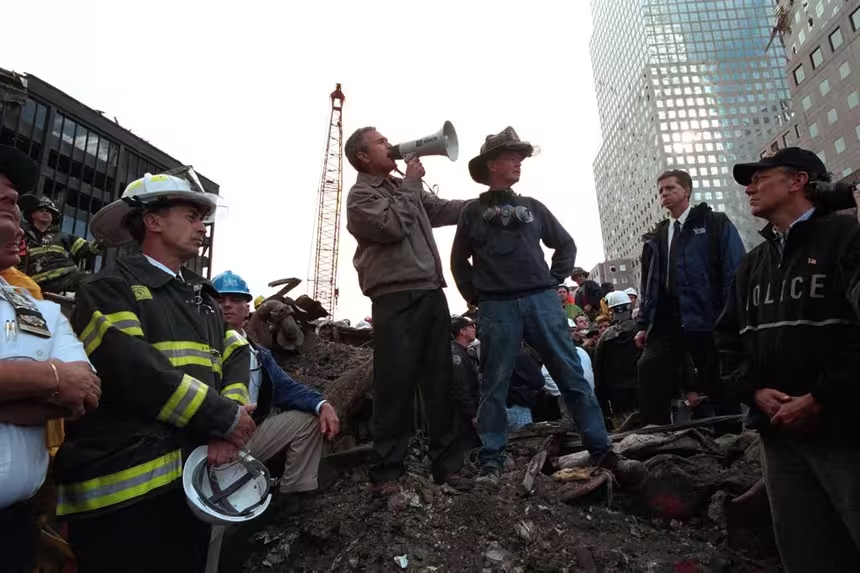
10 big stories Washington Week covered
Washington Week came on the air February 23, 1967. In the 50 years that followed, we covered a lot of history-making events. Read up on 10 of the biggest stories Washington Week covered in its first 50 years.Providing Support for PBS.org
Learn Moreabout PBS online sponsorshipANNOUNCER: This is the Washington Week Webcast Extra.
GWEN IFILL: Hello, I'm Gwen Ifill.
Welcome to the Washington Week Webcast Extra, where we try to get to everything we didn't get to in the main broadcast.
I'm joined in this valiant effort by Dan Balz of The Washington Post, Beth Reinhard of The Wall Street Journal, Alexis Simendinger of RealClearPolitics, and Chuck Todd of NBC News, the newbie.
(Laughter.)
Somewhat overlooked in a week - (laughs) - in a week chock full of news is the fate of the speaker of the House, which not for nothing is indeed second in line in presidential succession.
Catching you up, John Boehner said he's quitting by the end of the month.
His number two, Kevin McCarthy, jumped in then out of the race to succeed him.
And Ways and Means Committee Chairman Paul Ryan, the Tea Party's vice - the party's vice presidential nomination - the Tea Party's, too - in 2012 - nominee in 2012, he's pulling a Biden; he just can't decide.
So what's the state of this drama, Chuck?
CHUCK TODD: (Laughs.)
Well, it is still just waiting for Ryan.
But what's been interesting this week is that a bunch of other candidates have now said, well, if he doesn't run I'll get in.
There's a California (sic; Kansas) congressman named Mike Pompeo who's on the Benghazi Committee, so people might get to know him during the Benghazi testimony.
I believe Mike McCaul, who's the Homeland Security guy - he's a familiar face, does a lot of TV - a Texas congressman, he's saying if Ryan doesn't run I'll throw my hat in the ring.
If Ryan doesn't do this, there's going to be like six or seven people most people have never heard of who are going to try this thing.
My favorite, though, anecdote this week is apparently there is a secret line of succession for the speaker of the House.
Apparently, after 9/11 they came up with in a case of emergency list.
No one knows what the list is, but whoever speaker is has to submit it to the clerk.
So the clerk of the House - DAN BALZ: Committee chairs or something?
CHUCK TODD: Well, nobody knows what order.
It's up to Boehner what order he created.
But there is an emergency - GWEN IFILL: But we don't know what it is.
CHUCK TODD: No.
I asked Boehner's people about it.
I said, will Boehner just say - drop the mic and say, fine, use my succession list?
(Laughter.)
DAN BALZ: It may come to that.
CHUCK TODD: Right.
He said, no, no, no, he's going to stay until they pick a new one.
GWEN IFILL: Oh, that would be great.
OK, let's talk a little bit about 2016 and the degree to which the president of the United States is - at least they've tried to lure him into this discussion.
He was asked at a press conference today about whether - what he thought about Hillary Clinton and the 2016 field and her move on trade authority, and this is what he said.
PRESIDENT BARACK OBAMA: (From video.)
During the course of what will be a long campaign, I probably won't be commenting on every single utterance or decision that the various candidates make.
It is natural and proper for candidates to run on their own vision and their own platform.
GWEN IFILL: So Alexis, you were there.
Is this a brand-new approach for the president - (chuckles) - to decide he's not going to talk about 2016 when he has been?
ALEXIS SIMENDINGER: In a week of U-turns, this was a U-turn in the sense that the president has not been shy about commenting, and often with generous tones, about Hillary Clinton's pronouncements from the campaign trail.
And the one he just recently got into trouble with was the interview he did with 60 Minutes, in which he volunteered in response to a question that she had made a mistake with her emails, but hey, there was no national security breach here, nothing dangerous here.
And he used this interesting term, "we" - "our impression" - and then he went on to describe basically giving her a pass.
And he got enormous blowback, not just from Republicans but from inside the FBI because they're conducting an independent, you know, investigation, and it was like he just put his hand on the scale.
GWEN IFILL: So today - so today was lesson learned.
ALEXIS SIMENDINGER: It was a little bit of lesson learned.
And you know, the president has - one of the things our colleagues at the White House, we were all talking about, is the president was not shy in reprimanding Senator Warren for her position on the Trans-Pacific Partnership and her resistance to trade, and yet he's giving Hillary Clinton a nice big, fat pass.
BETH REINHARD: I also wonder if he will be as demure when it comes to not weighing in on the Republican field, because he's also done that quite a bit and I have a feeling might continue to enjoy that.
ALEXIS SIMENDINGER: That's where the word "probably" came in.
DAN BALZ: Yeah, I suspect the line he's drawing - I'm going to avoid getting into a conversation about what this Democrat or that Democrat said - GWEN IFILL: How does this compare to what other sitting presidents have done while watching an election which they're clearly passionately interested in unfold right outside their door?
DAN BALZ: Well, you know, in some cases a president is endorsing his vice president to be his successor.
And so - GWEN IFILL: That's true.
This is particularly awkward.
(Laughter.)
CHUCK TODD: Well, by the way, I think that's what today was about.
I think this is the Biden thing going on, where it's - GWEN IFILL: You do?
DAN BALZ: I agree with that.
CHUCK TODD: I think if Biden - if he doesn't run and he's out of the picture, then I think you'll see him be more - DAN BALZ: But I think he's going to be tentative about pushing back at Secretary Clinton when she differs with him on a policy.
CHUCK TODD: That a lot, but especially with Biden sort of hanging over, because then people might - we might sit here and say, ah, ah, ah, look what he's doing, he's putting his finger on the scale.
GWEN IFILL: Except that that 60 Minutes interview was only a week ago and Biden was still out there then, so I don't know, things change, what can I say.
DAN BALZ: That was a - that was just a mistake on his part.
CHUCK TODD: He did it with Petraeus, too.
GWEN IFILL: That's right.
CHUCK TODD: And by the way, it turned out they wanted to bring a felony charge.
ALEXIS SIMENDINGER: And he also - the president was not shy about discussing Secretary Clinton's endorsement of a no-fly zone in Syria, which he does - GWEN IFILL: It's only when she disagrees with him that he hesitates, doesn't have anything to say.
ALEXIS SIMENDINGER: Well, you know, it's long been described that he has already chosen her as the nominee.
But as you say, you know, he's feeling like he got reprimanded and he needs to be fair.
GWEN IFILL: I have a couple of extra money questions for you, Beth.
One is Jeb Bush says he's going to release a list of his bundlers, but he has a different definition of what that is.
Tell us, first of all, what it is, and what he means.
BETH REINHARD: It was a little bit disappointing.
So in the past, when presidential candidates have released bundlers, we're talking big money.
For example, Hillary Clinton is calling them Hillblazers.
They have all raised at least $100,000.
When Jeb Bush's brother, George W., who's largely credited with, you know, really succeeding in this area of, you know, having supporters bundle as many individual contributions as they can, he had a $100,000 tier and a $200,000 tier.
Jeb Bush is taking it down, down, down to $17,600, which to most people sounds like a pretty random amount.
It happens to be the amount that, if lobbyists collect that much on behalf of a candidate, they have to file a form with the FEC.
It's a rule most people are not familiar with, but that the Bush campaign has decided to rely on.
Now, what does that allow him to do?
It allows him to release a very large list of names.
We have no idea whether they raised $17,600 or $200,000.
GWEN IFILL: It makes your job harder.
Face it, it just makes money reporter - campaign finance reporters' jobs harder.
BETH REINHARD: It does, it does.
GWEN IFILL: I have one more question to ask you about this, and anybody else feel free to jump in.
After looking at these numbers, who had a secret strength and who had a secret weakness?
BETH REINHARD: I think the strength was in the small-donor donations that we saw, like we talked about earlier, for Ben Carson.
I mean, that was really striking.
And almost predictably, all the outsider candidates - Carly Fiorina, Ben Carson and Donald Trump - are all doing very well in that arena, and the more legacy type candidates like Jeb Bush not as well.
GWEN IFILL: What about Ted Cruz?
CHUCK TODD: I was just going to say I thought his - so if you look at it, some people did well with fundraising and some people did well, were smart with spending, and some people did pretty well with - he's basically steady Eddie.
In the - just in the top tier of raising money.
He's running a smart race, so he's got a low burn rate.
And oh, by the way, he's also spending it pretty smartly and seems to have staff in all the right places.
He is - the out - DAN BALZ: And he's got a super PAC or some - BETH REINHARD: I was just going to say he's also got $40 million on the side.
CHUCK TODD: Of some force too, which hasn't had to spend any money.
He's the outsider candidate who is running a traditional campaign.
So he's trying to run a campaign like Jeb Bush, but he's got that outside - look, I think he's undervalued.
If he were a stock, he would be - it would be, you know, a buy, buy, buy at this point with him.
GWEN IFILL: Yeah.
I think it also leaves a lot of questions about people like Chris Christie.
Is there room in all of this for him?
It doesn't seem like there is.
CHUCK TODD: Lindsey Graham has more money than Christie, right?
BETH REINHARD: Yeah.
GWEN IFILL: Is that true?
CHUCK TODD: Yes.
He had more money.
I mean, what has happened?
BETH REINHARD: Christie and Rand Paul have less than $2 million each.
GWEN IFILL: Wow.
BETH REINHARD: Kasich doesn't have much more than that, by the way, and you know, he's still talked about as a contender.
CHUCK TODD: Well, he's got a super PAC that does have some money.
BETH REINHARD: He does, but you know, I think - GWEN IFILL: This is the Washington Week Webcast Extra.
(Laughter.)
We go into the weeds so you don't have to.
Thanks, everybody, for joining us.
While you're online, stick around for a few and take part in our election-year feature, 16 for 2016, where you can find 16 of our panelists' best tweets about the Democratic debate this week.
And add your voice to the discussion, #16for2016 - that's 16 for 2016.
And we'll see you next time on the Washington Week Webcast Extra.

- News and Public Affairs

Top journalists deliver compelling original analysis of the hour's headlines.

- News and Public Affairs

FRONTLINE is investigative journalism that questions, explains and changes our world.











Support for PBS provided by:
Major funding for “Washington Week with The Atlantic” is provided by Consumer Cellular, Otsuka, Kaiser Permanente, the Yuen Foundation, and the Corporation for Public Broadcasting.