
Wayne County
Clip: Season 48 Episode 23 | 9m 34sVideo has Closed Captions
Stephen interviews Warren Evans on COVID-19 impacting the US Census count.
Long before the COVID-19 pandemic took over the headlines, the US Census count was expected to be one of the biggest stories of 2020. Now, the coronavirus is disrupting the constitutionally mandated count. In Michigan, Wayne County Executive Warren Evans held a virtual town hall to talk about the importance of the census. Stephen spoke with him about what’s at stake and how the pandemic is impact.
Problems playing video? | Closed Captioning Feedback
Problems playing video? | Closed Captioning Feedback
American Black Journal is a local public television program presented by Detroit PBS
Wayne County
Clip: Season 48 Episode 23 | 9m 34sVideo has Closed Captions
Long before the COVID-19 pandemic took over the headlines, the US Census count was expected to be one of the biggest stories of 2020. Now, the coronavirus is disrupting the constitutionally mandated count. In Michigan, Wayne County Executive Warren Evans held a virtual town hall to talk about the importance of the census. Stephen spoke with him about what’s at stake and how the pandemic is impact.
Problems playing video? | Closed Captioning Feedback
Where to Watch American Black Journal
American Black Journal is available to stream on pbs.org and the PBS app.
Providing Support for PBS.org
Learn Moreabout PBS online sponsorshipand how the pandemic is impacting the count.
It's great to see you, even under the circumstances.
But let's talk about what those circumstances look like in Wayne County, the largest county here in the state of Michigan.
And the home of Detroit, the largest city, that has had a disproportionate effect and consequence as a result of COVID.
Yeah, it's been devastating to the county.
As I think most people know, the city has its own health department.
So, we provide the health services for the other 42 communities in Wayne County.
And the numbers have been staggering, as everyone knows and the death count has been significant.
And even in a number of our county communities, many of them loaded with nursing homes.
And that has been one of the hot spot areas.
But by and large I'm happy with people's response when we started to get our arms around this.
In terms of working very hard at testing and working very, very hard at getting people to appreciate social distancing and those sorts of things.
And at least until Memorial Day, we were doing a pretty good job.
I'm not so sure what it's going to be in 10 days from now, but certainly the numbers in Wayne County have been trending down.
And it was so bad, that I'd catch myself sometimes saying "These numbers look great."
But the numbers had three, or four, or five deaths.
Not one death is great.
So you see the world differently.
But we're plugging away at it.
Yeah.
This is still a census year and... I am always nervous in a census year, about getting folks to fill it out, so that we can count everybody and get the money that we deserve because of that.
This of course makes that more complicated, I think.
Just because... For no other reason than people are distracted.
But the county is still working with other governments, to try to really push to get those numbers up.
I saw something recently that we're at 43% or 48% in the City of Detroit.
That's not good.
We've got to get that number higher.
Better in some suburban areas.
But yeah, the number is extremely low.
And I think you're absolutely right, people are distracted.
We've been working on the census for almost a year, so you couldn't anticipate this happening.
But the bright side of this is, people are home and confined.
And if they would focus for 10 minutes, you could fill out the form online.
A number of ways.
People need to really understand, that the revenue that these communities will get over the next 10 years, is in large part dictated by being counted in the census.
And so, besides the fears that I think some people have about how the information would be used.
Hopefully that's been dispelled, that that is not really an issue.
The issue is, think about what services you'd like to see enhanced.
And what are the shortfalls in services that you've seen through this pandemic?
That ought to help everybody think about.
We need every penny we can get, during this next 10 year period.
And the under count is quite often young people, I mean, it's everybody.
As you said, 45% or so in the City of Detroit's atrocious and it's not much better in some other places.
And we're working hard at that, but it's young people, one to five, are quite often missed in the count.
And I don't think... What's a one year old or five year old?
Think about it, this is for 10 years, that kid will be 15 at the end.
And school lunch programs and a number of other things will be affected, all of the time that that young person is growing up.
So people need to really focus on being counted.
It's our tax dollars that come back.
This is not pie in the sky, or money from heaven.
This is our tax dollars, that we need to be more than a donor state.
We need to get our fair share of revenue back.
Yeah.
Let's also talk about the budget impact of all of this.
The city is in very bad shape and worried that casino revenue, for instance, won't return.
Which is a huge part of keeping the city's budget balanced.
The state has a projected deficit, the number is just staggering.
Counties have to be in the same kind of I would imagine.
Yeah, big revenue losses.
Obviously, property tax collection, when people are unemployed and those sorts of things are an issue.
I made the decision based on Wayne County's past history, when I took office.
In that employees had given significantly and in anticipation of a budget shortfall, I was not about to lay people off.
At the time, that might have been fiscally prudent, but it absolutely wasn't people prudent.
With respect to having the pandemic and then having employment related issues.
So, we ran up a pretty good, significant deficit in that area.
And then losing revenue from parking in the airport and a number of other places.
Ridership at the airport, been down over 90% for the last month.
And so, tremendous revenue loss.
But on the bright side, thank God, we're sitting there with a rainy day fund of $140 million.
And the county's running in a way that it was not six years ago, or five years ago.
So we'll get through it.
But it is tough, but it also makes the point that being fiscally prudent is important.
You can't anticipate when these things are going to happen, but you have to be ready to deal with them reasonably.
And I commend our staff for... And the other county electeds, for working through it as well.
Yeah, I also wonder what you make of, when we eventually get to a space where we're on the other side of all of this.
Some of the things that we might need to do differently going forward, particularly in government.
As you said, Wayne County is better prepared for the revenue shortfalls than it was before.
And probably better prepared than a lot of other governments.
But I also imagine that there's going to be some things that we just are not going to be able to do, and maybe some things that we don't want to do.
And one of them I always come back to, is the tax foreclosure process here in the City of Detroit.
Which of course has led to a lot of blighted homes and bad neighborhoods and people displaced.
It's on hiatus right now and so is the auction.
Is that something we ought to I think about?
"Well, if we can do without it in an emergency, can we do without it permanently?"
I think it's something that we do have to think about.
You have some fundamental issues that'll be exacerbated now with unemployment.
People losing their houses, especially moderate and poor income people.
That's the largest investment they have in this world.
And it's the last investment that people need to lose.
Many similarities to the issue of water.
You have the argument, "Well, nothing in life is free."
And on the other hand, human beings need water.
And so it helps to show all of the inequities that we have in the system, that really need to be worked on when this is over.
And I don't mean worked on with a blue ribbon committee, who comes up with a bunch of recommendations that you stick under the couch.
I mean, people who sit there and say, "This can't happen again."
The disparities in health care that we see all of the time.
And if you think back about it, I can think back about it.
Just healthcare issues, where there are predispositions in the healthcare community.
But I think some healthcare professionals don't even realize are racist.
Black women have a higher tolerance for pain.
So, they don't need the same level of pain... That's an example of myths that are accepted.
People of color will complain more in the hospital.
So you don't have to worry about those complaints.
Like someone can tell what complaint is legitimate and what one isn't.
And people don't complain generally.
So they're just so many things, that we look at the healthcare disparities and understand.
And if you don't fix those inequities, then every time something like this occurs, there will be a disproportionate number of deaths of people of color.
And that's not something that we can afford to tolerate.
And I just hope that when this dies down, the fire will burn in people to say, "Let's make sure this doesn't happen again."
Video has Closed Captions
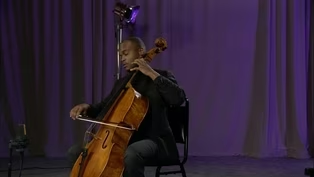
Clip: S48 Ep23 | 2m 5s | An encore performance by cellist Kamyron Williams from the Sphinx Organization. (2m 5s)
Video has Closed Captions
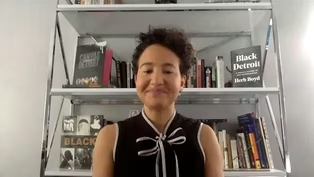
Clip: S48 Ep23 | 9m 20s | University of Michigan Assistant Professor Riana Anderson about stress & trauma right now. (9m 20s)
Providing Support for PBS.org
Learn Moreabout PBS online sponsorship New Episode
- News and Public Affairs

Top journalists deliver compelling original analysis of the hour's headlines.
 New Episode
- News and Public Affairs

FRONTLINE is investigative journalism that questions, explains and changes our world.
 New Episode
 New Episode
 New Episode
 New Episode
 New Episode
 New Episode


 New Episode
 New Episode
Support for PBS provided by:
American Black Journal is a local public television program presented by Detroit PBS