
Wayne State receives $6 million grant for Black studies
Clip: Season 51 Episode 3 | 8m 39sVideo has Closed Captions
Wayne State University receives a $6 million Mellon Foundation grant for Black studies.
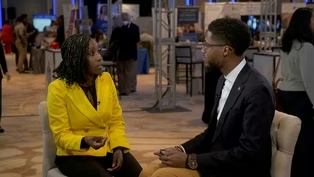
Wayne State University President Dr. M. Roy Wilson discusses an unprecedented $6 million grant from the Mellon Foundation for the creation of the Detroit Center for Black Studies and to the hiring of 30 new faculty members with interest in the Black experience. He talks about the importance of expanding Black studies in Detroit and the impact it will have on promoting diversity and inclusion.
Problems playing video? | Closed Captioning Feedback
Problems playing video? | Closed Captioning Feedback
American Black Journal is a local public television program presented by Detroit PBS
Wayne State receives $6 million grant for Black studies
Clip: Season 51 Episode 3 | 8m 39sVideo has Closed Captions
Wayne State University President Dr. M. Roy Wilson discusses an unprecedented $6 million grant from the Mellon Foundation for the creation of the Detroit Center for Black Studies and to the hiring of 30 new faculty members with interest in the Black experience. He talks about the importance of expanding Black studies in Detroit and the impact it will have on promoting diversity and inclusion.
Problems playing video? | Closed Captioning Feedback
Where to Watch American Black Journal
American Black Journal is available to stream on pbs.org and the PBS app.
Providing Support for PBS.org
Learn Moreabout PBS online sponsorshipDr.
Wilson, welcome back to American Black Journal.
- Oh, good to be here.
- So this is a really exciting development at Wayne State University, and one of the things I think is really exciting about it is that it seems to recognize the importance of Detroit, and Detroit's black history in an economic context or in an academic context, I should say.
Tell me about this grant from Mellon, and how it will change Wayne State.
- Yeah, so there's two parts to the grant.
The first part and by the way, in terms of background it's a 6 million grant from the Mellon Foundation, one of the largest grants that they've given.
So there's two parts to the grant.
The first part is recruitment of 30 scholars, faculty members, full-time faculty members who are interested in studying black culture, African-American history, anything related to the African diaspora.
So that's one part of it.
And on that part it'll be 30 faculty, and different stages of development.
There'll be 10 who are tenured faculty who we'll recruit from other institutions.
They're already have proven themselves.
They're typically four professors, and they're seasoned investigators.
Another 10 will be tenured track.
So they're on their way to becoming tenured, but they're a little less seasoned in their career.
And then a third are those who had just finished their postdoc, their doctoral training in either in postdocs or early stages of their career.
And we want to nurture them so they become good faculty members.
So 30.
Then the second part of the grant is something that I think is really, really exciting.
And that's the Detroit Center for Black Studies, I think is the name of it.
Yeah, Detroit Center for Black Studies.
And this will be not just Wayne State, it'll be centered here at Wayne State, centered in Detroit, but it'll be a research institute basically to bring people, scholars from throughout Michigan universities to be able to do research on the African diaspora, as I mentioned, to do community outreach activities, do other activities that connect with the black experience.
- And I know that this is, the timing of this is somewhat about the funding, and the availability of the funding.
But it comes at an important time at the university, and it will have an effect across a broad spectrum of the university.
I think one of the things that sometimes is presumed about things like this is that it's just in an African studies department, this is something that affects all of Wayne State.
- We're going to be recruiting faculty throughout the humanities at Wayne State.
So in all departments basically throughout the humanities departments anyway.
So they'll come from different perspectives.
Some of them will be in the African American Studies Department, many of them will not.
But the thing that they will all have in common is that their aerial scholarship will be in that area which brings up another point.
They don't necessarily have to be African American.
There are scholars who are not African American who are still interested in that scholarship.
And so these will all be people who are interested in that scholarship, which I think is really important that it's centered here in Detroit because Detroit does have a population of African Americans about 80% which I think is larger than any other city in the country.
And we're centered here in Detroit.
We've been here for 153 years.
We have a history of promoting diversity, and history of bringing in immigrants from all over the region who have been disenfranchised.
And so we kind of have that social justice bent anyway.
And so to marry that with the funding that allows for us to really scale this in a way that we just would not have been able to do without the funding.
I mean, most universities, most of the time, we're recruiting, two or three faculty for specific areas.
It's unprecedented to recruit 30 for a specific area.
- Talk a little about how the Detroit Center for Black Studies will also connect with the community here in Detroit, as you say, will connect with other universities, but it's also important that that's here in our city.
- Yeah, I think so.
I mean, as I mentioned, Detroit is 80% African American.
So I'm happy that that will be here.
Scholars Fund throughout Michigan, particularly University of Michigan, Michigan State, and the three campuses of the University of Michigan, Michigan State, Oakland University, various community colleges will all be able to participate.
And it'll be a central place for that type of scholarship to be able to be supported, and nurtured.
Along with the scholarship, as I mentioned, there will be certain activities, whether it's community events, activities related to training, activities related to educating the wider Detroit community about issues of African-American culture.
That would be a centerpiece for that.
- What's the timetable for all of this?
How soon will people be able to notice this difference at Wayne?
- Well, we're going to start the recruitment process right away, but this is a project that we think would take four to five years before we have all the recruitment and before everything is set up the way we want it to be set up.
- And the other significant thing about the timing of course is that this is your last year as president at the university.
You're going to go off and have a sabbatical, and then there'd be some other things.
But talk about this as part of the legacy of your leadership at Wayne State.
- Well, as I mentioned, when I wrote a few words about my not renewing my contract, I mentioned that Wayne State gave me my voice.
And what I meant by that is that I care deeply about issues about diversity and inclusion.
And Wayne State is unapologetic about that.
And one of the last things that we did over the last couple years is really look at social justice in a systemic sense, and throughout the university to see what we could do better in terms of social justice, in terms of increasing diversity, in terms of really being more inclusive society.
And I think this would be this ability to scale this African-American, in African diaspora studies as an output of that effort.
That social justice effort that we put in is kind of like a capstone I think too.
That's something that we care deeply about as an institution, and that I care deeply about as an individual.
But to be able to actually do something, and hopefully have it be a transformative initiative for the institution and for Detroit.
Closing the wealth gap for Black-owned businesses in Detroit
Video has Closed Captions
Clip: S51 Ep3 | 7m 26s | Metro-Detroit Black Business Alliance CEO Charity Dean discusses the racial wealth gap. (7m 26s)

Lt. Gov. Garlin Gilchrist II on downtown Detroit’s future
Video has Closed Captions
Clip: S51 Ep3 | 6m 56s | Michigan Lt. Gov. Garlin Gilchrist on the administration’s investment in downtown Detroit. (6m 56s)
Providing Support for PBS.org
Learn Moreabout PBS online sponsorship New Episode
- News and Public Affairs

Top journalists deliver compelling original analysis of the hour's headlines.

- News and Public Affairs

Today's top journalists discuss Washington's current political events and public affairs.




 New Episode


 New Episode
 New Episode
 New Episode
Support for PBS provided by:
American Black Journal is a local public television program presented by Detroit PBS