
Wayne State University hosts Black men’s health symposium
Clip: Season 52 Episode 14 | 13m 13sVideo has Closed Captions
Wayne State University hosts the “Brother, Let’s Talk” Black men’s health symposium.
The Wayne State University School of Medicine, the Wayne Mobile Health Unit and community stakeholders host a symposium on Black men’s health. Host Stephen Henderson talks with three men involved with the forum about the disparities and societal pressures that impact the health of Black men, the importance of changing behavior and eating habits, and the correlation between mental and physical heal
Problems playing video? | Closed Captioning Feedback
Problems playing video? | Closed Captioning Feedback
American Black Journal is a local public television program presented by Detroit PBS
Wayne State University hosts Black men’s health symposium
Clip: Season 52 Episode 14 | 13m 13sVideo has Closed Captions
The Wayne State University School of Medicine, the Wayne Mobile Health Unit and community stakeholders host a symposium on Black men’s health. Host Stephen Henderson talks with three men involved with the forum about the disparities and societal pressures that impact the health of Black men, the importance of changing behavior and eating habits, and the correlation between mental and physical heal
Problems playing video? | Closed Captioning Feedback
How to Watch American Black Journal
American Black Journal is available to stream on pbs.org and the free PBS App, available on iPhone, Apple TV, Android TV, Android smartphones, Amazon Fire TV, Amazon Fire Tablet, Roku, Samsung Smart TV, and Vizio.
Providing Support for PBS.org
Learn Moreabout PBS online sponsorshipStudies have shown that African American men have a lower average life expectancy and higher rates of chronic diseases than white men do.
Multiple factors are of course to blame, including socioeconomic status, access to healthcare and genetics.
The Wayne State University School of Medicine is partnering with local community leaders to hold a symposium that will address these health disparities on April 13th at Hartford Memorial Baptist Church.
The event is called Brother, Let's Talk: A Conversation On Black Men's Health.
I spoke with three people who are involved with the forum, entrepreneur and philanthropist Collin Mays, Dr. Harold Neighbors, who's professor emeritus at the University of Michigan School of Public Health and Dr. Phillip Levy, who's a professor of emergency medicine at Wayne State.
So Collin, I'm gonna start with you, this idea that we need to talk, I love the title right?
And we absolutely need to talk.
This is something that we don't talk enough about.
This is something that a lot of us don't know, I think enough about, and there are some real psychological barriers, I think, to getting a lot of us in a different mindset about focusing on health.
Tell me about pulling this symposium together.
- Absolutely, Stephen.
Again, thank you so for the opportunity to come on "American Black Journal" again, such a pleasure to be here with you.
Brother, let's talk, let's talk about health.
It's gonna take place on Saturday, April the 13th at the historic Hartford Memorial Baptist Church in the city of Detroit.
This conversation is, as you've mentioned something that is well needed in the black community.
Black men are at greater risk of hypertension, premature death, and even just emotional stress that we're carrying.
And Dr.
Neighbors will be able to touch upon that as well.
But the importance of this symposium is it's a safe space.
Of course, the church has always been a safe space in the black community, and it's gonna be a safe space for us to not only have dialogue around some of the challenges that we might be facing from employment to family, to relationships, et cetera, but also to really talk about some of the physical challenges that we have when it comes to making sure that we're going out and exercising, making sure that we're eating that apple or that that other piece of fruit daily, and that we're just being as healthy as we possibly can be for longer lives.
- Yeah and Collin, this is a very personal issue for you as well.
Talk about your health journey.
- Yes, so I've lost 200 pounds over the course of three and a half years and actually have a book coming out in April to discuss that as well.
But, you know, my role in life, my life mission is to encourage other black men to really reclaim our health and make sure that we're living the best lives that we possibly can.
They always say health is wealth, and I certainly believe that to to be the case.
So my journey was really just more so understanding that, hey, I have to be around long enough to raise kids, to be part of my family and really just give back to my community.
So for me, losing 200 pounds was certainly nothing that could happen overnight, but really was a catalyst for me wanting to promote this and heart disease runs in my family, unfortunately.
So this is very near and dear to my heart.
- Yeah so I mean, I want to pause there 'cause you said that like you were just noting what the weather is outside, but you lost 200 pounds.
That's an incredible number.
And I think for a lot of people, they hear something like that and they think, well, I could never do that, right?
That has to have been some sort of heroic effort on his part.
But there are a lot of folks who need to drop a few pounds.
I have at various times in my life, been a little heavier than I am now and had to do it.
So talk about what you did to get to that incredible goal.
- Sure and I know that Dr. Levy and Dr.
Neighbors will also discuss this a bit but a lot of it was the behavior component, making sure that I'm changing kind of my behavior around food.
You know, I used to wake up and just think about where am I gonna go eat to eat.
Like that was the first thing I was thinking about.
But then I altered my behavior to encompass more.
So what can I do holistically to nourish my body?
What can I do holistically to ensure that I'm putting in the right amount of food and the proper food and water, water, water.
I can't stress that enough.
Yeah, we have got to drink more water.
I drink probably a gallon and a half a day of water but it's important.
And eliminating some of the things that we can easily get rid of, like a pop soda.
You know, I've never been a drinker, but even limiting alcohol will certainly be a great impact.
And fasting, fasting was huge for me.
Making sure that I'm going 14 to 15 hours of resetting my body.
- Yeah so, Dr.
Neighbors, Dr. Levy, you have two different kind of approaches to this subject, and I want to get to both of 'em.
I think there are both kind of critically important to understanding how this affects folks in our community, in the African American community.
So I'm gonna start with you Dr.
Neighbors, in talking about the sign of the kind of cultural and societal pressures that define this problem and lead to it and in many ways stop us from dealing with it.
- Yeah.
Thank you.
There are lots of pressures on us as black men.
I think I'm going to leave a lot of the big tickets, societal pressures to Dr. Levy because I know he's been studying that very intensely in the Detroit area.
I've done that kind of work myself as well and support him a hundred percent in what he's doing.
I think the way I want to talk to you today is, first of all, I have the most gray hair of anybody up here so that makes me the senior citizen of the group.
And I will tell you that I was born in 1953 and that makes me 71 years old.
And like Collin, I want to talk about this from my own personal journey.
I've got three chronic diseases chasing me, trying to take me out, hypertension, type two diabetes and chronic kidney disease.
And I won't go into all the details about those, but what I want to let every everyone know is that in addition to making the kind of decisions that Collin made to lose weight, and by the way, I think I've probably lost 200 pounds over the course of my lifetime, but I may have gained 198 of them back.
So, you know, one of the lessons to take from Collin's journey is the persistence of it.
You know, we can all lose weight, but we've gotta stay with that healthy lifestyle that Collin pointed out in order to keep the weight off and stay healthy.
So I'm a big fan of behavior as well.
I will say that I'm a doctor, but I didn't go to med school, let's put it like that.
So I have a PhD, I do research and I've done research on black men in depression, black men in diabetes, and now I'm looking at life expectancy.
And so I just find it unacceptable and unnecessary that black men live sicker and die younger.
So the reason we all have to come together and talk is because this is a crisis.
This is an emergency.
We have to change and we have to change immediately.
So, you know, as we go through this conversation, my emphasis is on, you know, fun, food and fellowship.
We can have fun by working out.
And all I mean by that is going for a walk.
We've gotta eat real food, what I call real food.
And that means staying away from some of the food that tastes good, but it's not really good for us.
And again, that's what Collin did.
And then of course, fellowship.
My research shows that one of the worst things can happen to men period, but especially black men, is to feel like we are alone and socially isolated.
So that's why it's always about brother, let's talk.
The not so good news is that we don't like to talk about this subject.
We as men, we just don't talk enough about it.
- That's a great segue to Dr. Levy and talking about, you know, the role that not just that medicine plays in this issue, but the way in which the relationship between African American men and the medical community affects this thing.
I mean, this whole thing about not wanting to go to the doctor, not wanting to do the things that the doctor says, "Hey, I gotta have you do this so that you'll be healthier."
I mean, that is a huge part of what is off here.
- Yeah, I couldn't agree more, Stephen.
and thanks to Dr.
Neighbors and to Collin for sharing their stories.
I think the one thing you'll pick out from both of their stories is that it starts with the person themselves, right?
Change behavior, you have to be motivated to do something different than you were doing, you know, the day before or the week before.
And just to put some things in context.
So when you look at heart disease, which is my focus and actually should be all of our focus areas because it's the number one cause of death in this country.
And by far the number one cause of death in the city of Detroit.
So Detroiters compared to the rest of the country, are almost twice as likely to die of heart disease.
And when you look at that heart disease death, where it's occurring in, it's not 85-year-old people, it's 55-year-old folks, right?
It's younger individuals.
So my career has been as an emergency physician working at Detroit receiving hospital for more than 20 years.
When the pandemic hit and we started to see brown and black communities suffering disproportionately, we stepped back and said, why is that?
It's not because COVID had a predilection for the color of someone's skin.
It's because it revealed all of what we're talking about, the failure of individuals to take control of things like hypertension, diabetes, cholesterol.
And basically what we saw is that people were dying from COVID because their bodies had changed over time from these conditions.
And the body just couldn't handle the additional stress, the physiologic stress that COVID, you know, bore onto the human being, right?
And so I think you know about this, hopefully your, you know, the viewers on here do.
We created a mobile health outreach to make it as easy as possible to bring care into communities to make things place-based, barrier free, access enhanced to facilitate when people are ready to make that decision, just come on out to a neighborhood resource.
It doesn't have to be a day off of work.
It doesn't have to be a monumental task to go get your blood pressure checked, to get your lab work done, to make sure if we identify abnormalities through that process, that people are doing what they need to do to take control of their own destiny.
And we know from working with the payers in the area, about 40 to 50% of people who have insurance don't utilize prevention services that are readily available.
This isn't a problem of uninsured, right?
This is a problem of people just maybe having some distrust with the medical system because let's be honest, you know, again, I've been working in Detroit receiving for a long time, the system doesn't always rise up when it needs to and, you know, make black men and women feel valued and take care of 'em the way they should.
But when you look at who's disproportionately impacted, it's black men, right?
And so that's why this conversation is so important and what we're bringing together here.
You know, Collin, with his story, Dr.
Neighbors, with all the research and information that he brings to bear and what I bring, we're bringing resources on site to this event that people can get free tested.
Come out, get your blood pressure checked for free, get your lab work done for free.
And we have models of care now that we're developing that don't require you necessarily to go to the doctor.
Not that doctors aren't involved, but you can get a lot of this done right in your neighborhood.
Get yourself measured.
Community health workers are available to help with the social needs that are available.
Pharmacists are there to help get you the prescriptions that you need.
It doesn't have to be hard, we just gotta take the first step.
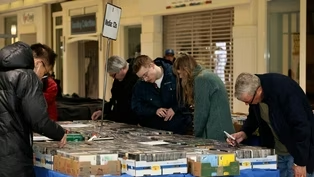
Bookstock returns for 20th year to support Detroit literacy
Video has Closed Captions
Clip: S52 Ep14 | 11m 1s | Michigan’s largest used book and media sale, Bookstock, returns for its 20th year. (11m 1s)
Providing Support for PBS.org
Learn Moreabout PBS online sponsorship
- News and Public Affairs

Top journalists deliver compelling original analysis of the hour's headlines.

- News and Public Affairs

FRONTLINE is investigative journalism that questions, explains and changes our world.












Support for PBS provided by:
American Black Journal is a local public television program presented by Detroit PBS