
WCAZ Radio 100th Anniversary
4/21/2022 | 25m 22sVideo has Closed Captions
WCAZ Radio 100th Anniversary.
The small town of Carthage has one of the oldest radio stations in the state, signing on in 1922. We look back through its history with some of the folks who have worked there through the years.
Problems playing video? | Closed Captioning Feedback
Problems playing video? | Closed Captioning Feedback
Illinois Stories is a local public television program presented by WSIU
Illinois Stories is sponsored by CPB, Illinois Arts Council Agency, and Viewers like You. Illinois Stories is a production of WSIU Public Broadcasting.
Support provided by:


WCAZ Radio 100th Anniversary
4/21/2022 | 25m 22sVideo has Closed Captions
The small town of Carthage has one of the oldest radio stations in the state, signing on in 1922. We look back through its history with some of the folks who have worked there through the years.
Problems playing video? | Closed Captioning Feedback
How to Watch Illinois Stories
Illinois Stories is available to stream on pbs.org and the free PBS App, available on iPhone, Apple TV, Android TV, Android smartphones, Amazon Fire TV, Amazon Fire Tablet, Roku, Samsung Smart TV, LG TV, and Vizio.
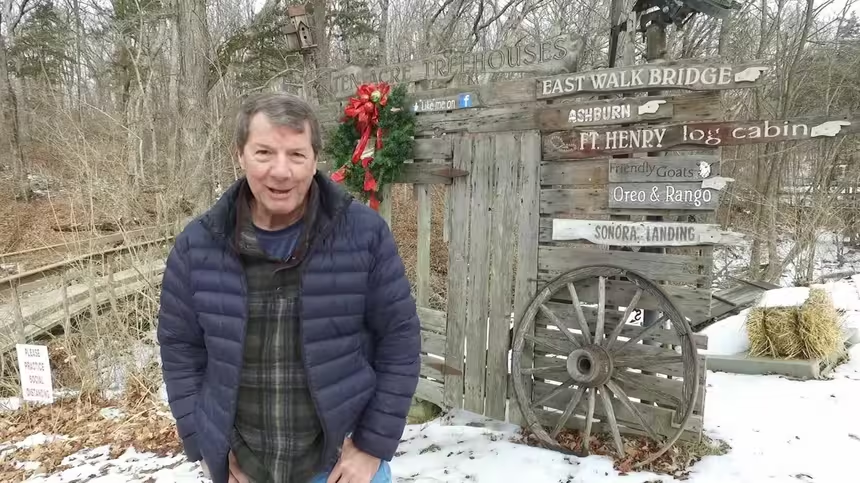
Illinois Stories
Join Mark McDonald as he explores the people, places, and events in Central Illinois. From the Decatur Celebration; from Lincoln’s footsteps in Springfield and New Salem to the historic barns of the Macomb area; from the river heritage of Quincy & Hannibal to the bounty of the richest farmland on earth.Providing Support for PBS.org
Learn Moreabout PBS online sponsorship(upbeat music) - [Announcer] Illinois Stories is brought to you by The Corporation for Public Broadcasting, Illinois Arts Council Agency, and by the support of viewers like you.
(upbeat music) Thank you.
(upbeat music) - Hello.
Welcome to Illinois Stories.
I'm Mark McDonald in Carthage at WCAZ Radio, celebrating its 100th anniversary on the air this year.
Imagine, back in 1922, a radio station in Carthage, Illinois, going on the air.
It claims to be the second downstate radio station in existence in Illinois.
And they're celebrating this year.
And, Mike Seaver, it's quite an achievement, and we're gonna hear why, because not only did this little town radio station survive all those years, but it actually had some real scrapes with getting back on the air, but it's a big deal, isn't it?
A hundred years.
- It really is, there are very few radio stations, particularly, excuse me, with the same call letters that have been on the air a hundred years.
A lot of the AM radio station, they're approaching their hundredth anniversary, but very few of them have the original call letters the WCAZ has.
They were issued to Bob Compton of Carthage native in 1922, and they've remained in this county ever since.
- We're gonna learn more about the history.
And we're also gonna learn about, I talked about this scrape that you had with the SCC, with the FCC that caused the closing of this radio station for a while, and we'll learn a little bit about how you could got back on the air.
But for the folks here, we're on main street on the Square here.
- We are.
- But it wasn't always here, was it?
It was in a number of locations around.
- Five or six different locations in town, yes.
- One at Carthage College was one.
- Yes, it was.
- And I guess all the other five locations were within about a block of the Square.
- They were all on the Square.
- Yeah, and we're gonna also talked to some folks who have worked here through the years.
It's probably, I know you called yourself a radio gypsy, a lot of radio people are like that, where they hop around, they move around and it's kind of interesting, if you get a person that sticks around for any period of time, isn't it?
- It is.
It's very rare.
- And you came back to radio.
- I did, I did, after for about a 20 year absence.
- Did you ever think you were crazy for doing so?
- Sure.
- Listen, while I've got you here, you're one of the investors, you're one of the owners.
- Yes.
- And back in 2018, in the scrape I'm talking about with the FCC, you got back involved, helped get the station back on the air and then you've been an investor ever since.
- I have been.
- Why did you reinvest in radio?
- Well, two reasons.
Number one, I'm a Carthage native.
This is my hometown.
And I started in radio in 1959 here in Carthage.
- At this station?
- At this station.
- Oh, okay.
- Yes, and my family has been invested in Carthage most of their life.
My dad worked here before he passed away and I just wanted to see the call letters, WCAZ, remain active.
- Okay.
Well, listen.
I would like you to take us in and right now you got a young man that's on the air working the controls in there.
- Sure.
- I kinda like to see for myself how a small station operates, can we go in?
- Well, let's go take a look.
- Okay.
Thanks.
- Well, Brad Still is the on-air personality.
We're here in the afternoon.
You come in early though, don't you?
- I come in pretty early, 6:00, 6:30 or so.
- So your day's just about up by the now, isn't it?
- It is, it's a little passed over.
- Yeah, somebody come in to relieve you?
- No, I'm the only on air person.
We do have someone that does sports games and those things.
- I see, so whoever comes in later, everything will be programmed already.
- That's it, programmed and ready to go.
- You and Dixie have taken care of that for the day, right?
- Dixie does that work, I won't take... Dixie keeps the place rolling.
- Yeah, a lot of us probably still think of, okay, here's what a radio guy does, there's vinyl records to spin and there's music to announce, and there's news to read, but a lot of that stuff's taken care of for you digitally, isn't it.
- Everything I do is digital, I've never spun a disc.
I've never even played a CD.
- Is that right?
- It's pure digital.
- But you do announce some music, right?
- Yeah, we do announce music, but all of the music I do is we do digitally and it comes in through this system, which is called Arrakis.
So like, this is the hour set up that we're in right now.
And then over here, we'll go by time, but if you go up, so here's the song log.
And then we'll, I mean... - And that's already been programmed in, those are song log.
- They're either here before, or I've put them in.
- And we're country here, right?
- This is real country.
- Okay, and so this knows when to play each tune.
- Yes.
- And then there are also like when on your shift, there are breaks for obituaries and for announcements and community calendar and things like that.
- Absolutely, or just in a general fun stuff we would've put on.
- So when you're not reading, what you're in here is to make sure that nothing goes awry?
- That is correct.
- Everything is going out over the air, there is no issue.
- Which does happen.
- And this is how you know the level of the music, because what we're in there is the levels, right?
- Yeah, this is the end studio, so I know we have it off right now, of course, but that's how we know we're broadcasting.
And then up here we have the radio line and then the online, separate podcast line.
- Ah, okay.
And that tells you that everything's going out the way it should.
- That's correct.
- Okay, and what is the computer screen over here for?
- So this is the production computer.
So in here, when I record commercials and that as well.
So this is actually Don Thurman news out there now, has just recorded a happy birthday.
So this is where we mix it down, do the editing, tighten it up and then we'll transfer it from this computer to this computer, it's doing something now.
- How long have you been, I mean, I ask you this for a reason, how long have you been in radio?
- I have been in radio for like one year.
- Like one year, so radio has always been like this to you.
- I've never known it either way.
- Digital, is it?
- Yeah, digital is all I've ever, yeah.
When I do the (indistinct), I send them right to a device, I don't even use papers.
- Did you look at any of that stuff from a hundred years ago?
Did you look at any of those pictures, or those video?
- I'm familiar with the process.
I mean, I grew up watching (indistinct), Cincinnati, of course as many people.
- [Mark] Before digital.
- And they were moving the tracks in and out and all that stuff, and I'm just like, it's not that easy, but it's much easier than they had for sure.
And I've had opportunity to talk to some of the past DJs through interviews and whatnot and we really got a good idea of the big difference that I have it easy compared to them, for sure, for sure.
- Well, thanks for showing us around.
This is terrific.
- Absolutely.
Thanks for coming out here.
Like big fan, big fan.
- Don Thurman we were just talking to Brad, he's been in this business for all of one year, and he probably can't imagine you were in for 47 years, you started in 1970.
He probably can't imagine what your life was like when you went into that studio.
- I was actually still in high school when I started, Jerry Nut owned the radio station and we used his equipment to do the ball games, football games at the high school.
And as my senior year of high school, I got to do up in the crow's nest.
I was a band announcer for the band.
And one of my memories from back then was the band would form like an umbrella, and I would just say, to the fans there, watch the band now as they perform, "Raindrops Keep Fallin' on My Head".
And that was how I got my bearing with Jerry, and guys there at the school were saying, you're friends with Jerry, see about getting a job.
And so after school one day, I stopped by and talked with Jerry about getting a job there.
And he said, "I can find something for you to do."
And so I had erase tapes and file records and stuff like that, that's how I got started.
I was part-time back then in '69, and when I graduated in '70, went full time.
- Yeah, and then you were on the air, right?
- Yeah.
- And we were talking how much an on air person had to do, because you started out with either vinyl or with tapes.
- Yeah.
- And you were so busy because you had to time everything out and you had to hit all the brakes, you pretty much had to do everything by yourself.
- Yeah, plus also what they call back timing back then, you had to make sure all the records ended and so on by the certain time of the hour.
And that was, so you kind of got onto.
- Yeah, and then you you probably were ripping wire part of the time to deliver some of the news, right?
- We had a UPI, United Press International machine, and one of my first on air jobs was to rip and read the headlines, we didn't have the network audio feeds back then.
And so I take the latest headlines off of the UPI machine and read those at the top of the hour, I said Jerry Nut was the owner at that time.
And my first, I was just so nervous and so scared being on the radio, 'cause I've ever been used to before.
And I would have enough news there for fill five minutes and I'd have it done in about two and a half minutes.
- [Mark] Yeah, he was reading so fast.
- Yeah, you have to get it done over with and remember Jerry saying, where's the fire, slow down.
I can't even understand what you saying.
And eventually I learned how you read things a little bit lower.
And our listeners, a lot of our listeners were senior citizens and they appreciated that slower pace of delivering the news and stuff.
- Don, thank you.
- Sure, (indistinct) nice to meet you.
- Greg Phelps, we've had an opportunity to talk to some of the former employees of WCAZ.
And the reason I wanted to come talk to you, you are a farmer employee.
- Right.
- But you also had the foresight when they closed in 2018, you were still with the station, you had the foresight to save some of the historical stuff because a lot of it just got lost, didn't it?
- Yeah exactly, the equipment's gone, I think there were some plaques too, but history is a big part and WCAZ had a huge part of area history and it would be a shame, all these old pictures to get lost to time and that.
So I said to Rob Dunham, would you please let me take them over to the archives department at WIU.
These guys do a fantastic job of preservation and they'd be available for the ages, and be available not just for Hancock County, but from McDonough, for Missouri, Iowa, whoever would wanna see them.
There were a lot of people that went through the station through the years.
- You were there from 1994 to 2018.
In fact, we can look at some pictures here we have from you and your time.
This is the old studio, it's not the one they're in now, but it's very similar.
- Right, this was on the west side of the Carthage Square.
And this was taken, I believe about mid-December, late December.
We all came over to kind of, I guess kind of say your goodbye to kind of the listeners and that we talked about a lot of the history, a lot of the things we'd all experienced.
Most of us at that at time had been there for about 20 years or so.
So that was the old studio right there.
Actually would've been, Madison would've been the address of it.
And of course, Don Thurman, Sandy Shaman, Rob Dunham, Keith X and myself, were just having a, just a conversation, sat down for about an hour, an hour and a half.
- There were many generations that passed through theirs employees and owners.
We've got a picture here of Jerry Nut, who was one of the owners at the time, you knew him, I guess, didn't you?
- Yeah, I met him when I first started over there.
In fact, we used to laughingly say, he and his wife would be walking around the Square.
So there's a couple nuts loose on the Square.
Jerry was one of those, he was very hugely community involved.
He loved to get out in the community.
He loved to do a lot of things, was a great guy.
Great personality, a lot of fun to talk to.
- And this was, you had DJ day back in the day and here's a look at some of the principles.
And we were talking about Jerry Nut.
He's back in here with the soup to nut shirt on and a bunch of the folks that worked at the station there.
And here's another one, you did a lot of live stuff.
Here's a choir that shows up into the studio to do some numbers, to be put on the air, I guess, right?
- Well, WCAZ was very much a generational radio station.
We had grandparents that had come into the studio.
In fact, at that time, or for a while, the studio was where the Carthage Public Library is now.
And they had come and done live performances.
I don't know how many people I had talked to over the years that said, "Oh yeah, when I was young, I went over there and sang."
or we'd done some church stuff, church group had gone in there and saying, they were huge on live music through the forties, fifties.
- And not only live music, 'cause you get a big mention here in the Peoria Journal Star.
This is the sports page, but if you look to here, "You have got to have leather lungs", is the headline from this short.
And it talks about the number of games, all kinds of games that your station broadcast.
- We did, that was one of the things in the Rob Dunham era that we really expanded on Keith X, myself and Rob, we did a lot of, in fact that year we did 163 sports broadcast throughout that whole year from junior high, high school, pretty much everything.
- That's almost every other day.
- It was.
- Yeah, wow.
So were you doing play by play too?
- Yes, Keith and I did the play by play, a lot of it Rob banned the studio back in the day.
I think I did over a hundred games in the single season.
- You were using a phone line, I'll bet, weren't you?
To get back to the station.
- Early days of cell phone, we were also using phone line a lot and a thing we called the Marti, which was a remote transmitter.
- Another thing the station did.
And so talk about community involvement and you happened to be a recipient of one of these, but this was the Honor Team, what was that all about?
- The Honor Team was something that WCAZ had done for a lot of years, and we were still doing up until when I started as an employee, where we would give Hancock County area coaches the opportunity to bring athletes and we would give them a free dinner, give them a certificate, kind of a way to say thank you for a great sports year.
Used to be in the Riverfront Restaurant up in Dallas City, of course until it burned.
But we did that banquet a lot, and it's funny that, and I can remember WCAZ broadcasting my high school ball games.
They were always noted for that, Jerry Logan did them at that time, but you would get this certificate.
You came and got a free meal, and for a high school kid, I mean, hey, that was great.
- WCAZ also brought a lot of entertainment to town, and there were big names that you wouldn't see otherwise, unless there was a station to bring them into town, and we have an examples here of some of these publicity photos that were actually signed over to you all through the years.
Now these are before your time, but maybe not before Thurman's time, no, no, before Thurman's time too.
But this was in the old days and these groups and these individual entertainers all came through, didn't they?
- And of course, one of the most famous ones we've got in here is this smiling fella Gene Autry, came in the Cowboy (indistinct).
Came through and stopped at the radio station, I know Dennis Weaver stopped at one time, was a big star in the seventies.
We used to have a lot of pop artists come through and they would give their memorabilia, they would sign over things, local acts, because we were so famous for live music and they would have a big studio, the microphone, they would bring them up and let them play on like a Saturday night.
- Yeah, what a treat.
And that's before most people, didn't have TV, they weren't able to see these people any other way, this was it.
- Yeah, this was it.
And we had a lot of live performances, our Sunday morning we used to have a program called "The Sunshine Hour", which were put on by a couple over in Burlington.
I think it reached something like 12,000 broadcasts, used to be on every day, then was on every Sunday.
And we did a lot of live things, we did a lot of music.
Music used to be such a great part, and it's nice to see them now carrying on that legacy.
- This is precious too, because this would've been, not only did you do music, but you also had during your melody hour, you would poetry or someone, whoever was in the air would read poetry.
And they would read out of this book which was called gems.
And they're all kind of short and I'm sure they're all kind of sentimental, but this was a big part of it too, introducing people to all kinds of art.
- Well, "Melody Hour" was one of those big programs that did the live music and all kinds of things.
I had a grandmother that listened to them every day, even back in the days before I started.
And I mentioned that we're we were a generational station.
You had great grandparents that had had their games on our airwaves or had been on our airwaves all the way through to the grandkids and that was kind of the neat thing.
It just made the area, a big family.
- You saved an old poster, show it to us.
- Yeah.
This was one of the last banners we had.
We were pretty proud of them.
We used to put these out wherever we'd go to ball games and things like that.
And I think this had the old style microphone, this kind of said us, 'cause we were a hometown family radio station.
And that was one of the things we'd hang out at every ball game when we were live, when we were out doing things like that, this is one of the things we'd hang up and it is been preserved pretty well, pretty big piece of my life.
- It's a pretty good thing you saved that because they're all gone, I assume that this is it.
- Yeah, pretty much everything.
All the memorabilia like that is pretty much gone now.
And it was a station that had a huge legacy, I mean, they said the call numbers are going a hundred years, and actually legend has it, one of the first stations to do live sports.
It was one of the first stations, I mean, it was who you thought of for the community calendar, the church calendar, little things like that.
We were a mom and pop station.
And as I say, people liked us because it was just like a bunch of old friends.
When you turned on the radio conversationally coming to you and just letting you know what was going on in the area.
'Cause at the time I started, I know I was just a little bit outta college, eager to set the world on fire, I said, they read the calendar and church calendar every single day, I was like, what is going on?
But you found out that that was a part of our legacy, was being the information place and just being a bunch of old friends, you could tune in any time and listen to.
- You got your jacket still.
- Yep.
This was one of the things... - That's pretty sweet.
- Nice set jacket, this is what they used to wear.
That was the old symbol when we did country music, the little cowboy was kind of infamous on all our apparel and I had a nice set and jacket, I guess, kind of the eighties style team high school type jacket.
- Three state country.
So you went into Iowa, Missouri and Illinois, huh?
- Yeah.
And we used to do a lot of live events.
We didn't do much sports in Iowa and Missouri, but we did a lot of live events.
We did used to have Mr. Mike Shay used to do some of our Iowa stuff, longtime broadcaster in the area.
But we went down, we did live events, we did kids games.
We came out and did an hour's worth of kids games at a lot of different fairs and festivals just to get out in among the community.
- Thanks for getting this stuff out for us.
It's been a pleasure seeing it and thanks for the time.
- Oh, you're very welcome Mark.
- Amy Graham, during part of this program, we talked about this hiatus when the CAZ was off the air and the fact that it was pretty a lot of jeopardy during that time, whether the little radio station would get back on the air.
What happened was ownership got into a row with the FCC.
And what happened was, as Mike was explaining to me, FCC redlined the station, which mean forced it off the air for some violations.
So you and the mayor and the community got involved because the people who were listeners, they made a lot of phone calls, didn't they?
They didn't want their station off the air.
And somehow in what?
Six months?
You got it back right again, tell us how it happened.
- Well, with the hard work of a lot of people that are in this community proud of WCAZ and working together, it was blood, sweat, and tears, and let's move this forward and find some resources that we can pull and use and search for a station that we could possibly buy, or could we get 990 back?
There were all sorts of options.
And so we needed to bring in as many people as we could that could help us get this off the ground because basically we had to start from scratch.
- What was the rub?
What got the FCC to the point where they said, "Nope, you're off the air."
- Well, I can't respond to that.
I wasn't involved at that particular time.
All I know is that WCAZ has been a lifeline to this community for many, many years.
And when it went off the air, it was like losing a family member.
We didn't have our local news, we didn't have our regular obituaries, we didn't have the farm reports, and so for many residents, they were just at a loss and that's why they called the mayor and expressed their concerns.
- Well, and people had to step up because we talked to Mike Seaver, he became one of the 11 investors that put up some money to get it back on the air.
But without local investors, that wouldn't happened either.
- Well, that was one of the options.
There were a few other options that we were considering, but really to keep WCAZ within local control, that was the best option.
To get local investors and then get our radio station back on the air, it was insurmountable, we thought, but it did happen within six months.
- That's a pretty good time.
When you talk about the bureaucracy of trying to deal with a federal agency.
- That's exactly right.
So we're very proud of our commitment and the folks that helped us do this.
- Thank you.
- You're welcomed.
- Well Trisha, it's a big year.
- It's a huge year for WCAZ.
- It is, and we just learned this year almost didn't happen because in 2018, it was looking pretty iffy.
But here we are 2022 and it's a hundred years.
- And we were going to celebrate.
- Okay, how?
- We are, so with WCAZ's, turning the call letters, turning a hundred years old, we decided to bring country music back to Hancock County.
- What does that mean?
- We are gonna have a music concert on May 14th.
So we are going to have Sequoia Drive, Liz Bentley, which is a local from Quincy, Illinois, and now living in Nashville.
And then we're gonna have Keith Anderson.
- Okay.
- And we're gonna have it at the Augusta Fairgrounds.
So anyone in Hancock County or any county can come.
- And when is that?
- May 14th.
- So you're hoping that there isn't a thunderstorm that day, 'cause that's an outdoor venue, isn't it?
- That's a little hateful, wasn't it?
- Well, no, May's pretty iffy.
- No it's gonna be beautiful.
- Oh it will be beautiful.
- It's going to be beautiful.
- Pioneers often had a bumpy ride headed west, for WCAZ that bumpy ride ended up in 100 years of operation.
With another Illinois story in Carthage, I'm Mark McDonald.
Thanks for watching.
(upbeat music) - [Announcer] Illinois Stories is brought to you by The Corporation for Public Broadcasting, Illinois Arts Council Agency.
And by the supportive viewers like you.
(upbeat music) Thank you.
(upbeat music)


- Arts and Music
The Best of the Joy of Painting with Bob Ross
A pop icon, Bob Ross offers soothing words of wisdom as he paints captivating landscapes.





 New Episode



Support for PBS provided by:
Illinois Stories is a local public television program presented by WSIU
Illinois Stories is sponsored by CPB, Illinois Arts Council Agency, and Viewers like You. Illinois Stories is a production of WSIU Public Broadcasting.