
Weaver and Radio Orchestra
Season 15 Episode 10 | 28m 45sVideo has Closed Captions
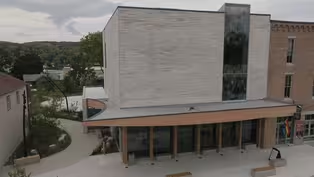
Weaver Christine Novotny, violist Nora Taksdal and the Versterheim museum space.
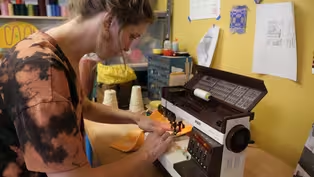
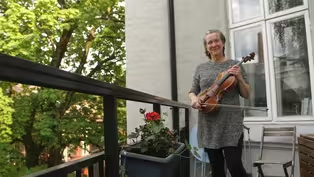
Christine Novotny is a weaver from Grand Marais who is inspired by nature; Nora Taksdal shares her thoughts on being principal violist in Norway’s radio orchestra; and the the Versterheim is a distinctive museum space that is open to the public.
Problems playing video? | Closed Captioning Feedback
Problems playing video? | Closed Captioning Feedback
Postcards is a local public television program presented by Pioneer PBS
Production sponsorship is provided by contributions from the voters of Minnesota through a legislative appropriation from the Arts and Cultural Heritage Fund, Explore Alexandria Tourism, Shalom Hill Farm, West Central...
Support provided by:


Weaver and Radio Orchestra
Season 15 Episode 10 | 28m 45sVideo has Closed Captions
Christine Novotny is a weaver from Grand Marais who is inspired by nature; Nora Taksdal shares her thoughts on being principal violist in Norway’s radio orchestra; and the the Versterheim is a distinctive museum space that is open to the public.
Problems playing video? | Closed Captioning Feedback
How to Watch Postcards
Postcards is available to stream on pbs.org and the free PBS App, available on iPhone, Apple TV, Android TV, Android smartphones, Amazon Fire TV, Amazon Fire Tablet, Roku, Samsung Smart TV, and Vizio.
Providing Support for PBS.org
Learn Moreabout PBS online sponsorship(light music) - [Announcer] On this episode of "Postcards."
- I think it's really powerful to create something with our hands.
It's total alchemy on the loom.
When people do that for the first time, like a switch flips in their brain.
- In joy and in sorrow, you can always reach to the essential human core through music.
- Vesterheim Commons was designed with the idea of creating a new front door for Vesterheim.
(light upbeat music) - [Announcer] "Postcards" is made possible by the Minnesota Arts and Cultural Heritage Fund and the Citizens of Minnesota.
Additional support provided by: Margaret A. Cargill Philanthropies, Mark and Margaret Yackel-Juleen on behalf of Shalom Hill Farms, a retreat and conference center in a prairie setting near Wyndham, Minnesota, on the web at shalomhillfarm.org.
Alexandria, Minnesota, a year-round destination with hundreds of lakes, trails, and attractions for memorable vacations and events.
More information at explorealex.com.
The Lake Region Arts Council's Arts Calendar, an arts and cultural heritage-funded digital calendar, showcasing upcoming art events and opportunities for artists in West Central Minnesota.
On the web at lrac4calendar.org.
Playing today's new music plus your favorite hits, 96.7 KRAM, online at 967kram.com.
(mellow music) - When I tell people that I'm a weaver, they're like, "Oh cool, what is that?"
You know, they have no, they often have no reference for it at all.
This is fun.
I feel like I'm in a reality TV show.
You know, like those moments where they're just talking in the car.
So this is North House Folk School, I don't know if you've been there.
- [Speaker] Do you teach here often?
- Yeah, I teach like, I don't know, five or six times a year.
Yeah, I moved here in 2020 to do a program with North House, a two-year residency program.
And so really they just give housing and a studio and a stipend and opportunity to work with mentors and to teach at the school.
And they like let you fly, and yeah.
And then after the program ended, we just decided to stay.
- So this is it, huh?
- Yeah.
Go.
- [Speaker] Oh, this is magical.
- It is.
- Yeah.
Yeah, so this trail, it kind of like switched backs down closer to the lake.
And then there's this like amazing rocky shore that no one is ever at, even though this is all state park.
I was working out in the mountains in California doing some outdoor education and I'd gotten a degree in painting.
I was very focused on painting.
Eventually I moved into Minneapolis and was like, "Wow, this is a pretty cool place."
And then a few years later I took a weaving class and then I've just been chasing that in some form ever since.
Like in painting you can just, whenever you want, in oil or acrylic, you can just paint over it.
You can smear the last thing you did.
Like there's almost too much freedom and creativity is bolstered by some parameters, you know, some limitations.
And on the loom, when you set up a warp, you have to make what you've put on there work.
And that's always a fun challenge.
So this is the first weaving that I ever did.
And the weave structure is overshot.
So overshot consists of you weave with two shuttles.
There's so much terminology in weaving.
And a shuttle is what holds your weft yarn.
One of them is your tabby shuttle, which is plain weave.
And that weave is the background like all of this turquoise areas.
And then the other one weaves the pattern.
And that's the gold that you can see in like all of these circles and rings.
And a really unique thing with overshot is the way that the weave structure is set up.
You can get really interesting curves and circles, like something that we don't think of as being accomplishable on a grid system, like weaving is, everything is at right angles, but you can get these incredible more organic forms.
There's a really strong history and tradition in Swedish and Scandinavian hand weaving.
I'm not Scandinavian, I'm not Swedish.
And because I learned to weave here among so many descendants, it was just, it was like the culture of weaving that I practiced the most.
(soft music) So I went to Sweden over the summer working with this 83-year-old rug weaver named Ulla Parkdal.
I met her when I was traveling in Scandinavia the year before, just briefly.
I went out to her studio, and I immediately was like, I want to come back and study with this person.
Her designs are amazing.
And it was a technique that I hadn't practiced before, but also the opportunity to work on this loom, which I'd never seen anything like it.
You press a button on top and it's attached to an air compressor and the beater comes and just slams into the cloth.
And so the quality of rugs that you can get, because there's so much power being packed into that rug, like it's really, really dense.
When they're rolled up, they stand up straight.
This is the rug that I wove in Sweden with Ulla Parkdal.
It's 10 pounds, it's very heavy.
It's been rolled up for a while.
She'd always point to these little guys and she'd go, "Oh, the little dots, the little dots are so nice."
It makes the whole carpet a lot more dynamic, just having those little flecks of color.
And it's the same with all of the different diamonds.
They're all a slightly different combination of blues and greens.
So it just keeps our eye moving around the piece the whole time instead of getting stuck in just a first read.
And you know, changing out like the weft bundles to get this variation of color.
I mean, that's something that has to be done by a human.
I want to have a point of view in weaving.
And I think that all of the teachers that I have looked toward, I look toward because they have a point of view.
This is gonna be one of the pieces in the American Swedish Institute exhibit, so.
In Minnesota we have a lot of people who are preserving cultural traditions, a lot of organizations.
One of them is North House Folk School.
Also in Minneapolis, there's the American Swedish Institute.
And I've worked with them on some upcoming shows.
I was saying before, like if you look really closely, this is the same technique that I was using on the rug, but the scale of it is just really different.
I bet it took me two or three hours to dress the loom to get it all ready to wind the warp and dress the loom.
And then this small section that I've done is probably three hours.
So the first time that my dad saw me doing this, he was like, "Wow."
Something that I love about teaching is being able to share what I've learned from mentors, things that I've figured out in my studio.
I remember making mistakes when I was learning to weave and like calling my instructor freaking out 'cause I thought I had just completely ruined it.
I love it when people make a mistake in my class 'cause it's like the best opportunity to teach and for the whole class to learn.
I definitely take inspiration from the world around me.
I'm really lucky to live in Grand Marais that has so much wild space around it and a lake, a massive lake that changes every single day.
(light music) - [Speaker] Does somebody in the area make brooms?
- Yes, Marybeth Garmoe.
I want to make things by hand because, this seems like a good one, it connects me to all of the people that came before me that made things by hand and not just made them by hand, but like chose to go that extra step and make them beautiful.
This is actually a technique that Ulla taught me, doing like all these butterflies in a row.
In these rug weaving factories, there used to be like four or five people that just did this all day.
Like their only job was to wind the right colors together in butterflies and deliver them to the weavers.
Like every day that I'm in my studio and I'm sitting there meticulously weaving by hand, like it is kind of ridiculous.
(laughs) You know, I don't think that like craft is gonna save the world and I don't think that we can go back to the way that it was before where we're all like weaving our own cloth and I don't really think that we need to, but we can think more seriously about like the way that industry produces things.
Another reason that I think weaving and making anything by hand is really important is because it just helps you appreciate everything around you.
You know, when I look at a hand-knitted sweater now, I'm like, "Wow, I can tell it's hand-knitted.
I can see all of the hours and all of the love that went into it."
I have a sweater from my mom that she hand-knitted when my parents first got married and she's passed now and I put that on and like I can feel her in that.
Sorry.
Yeah, it's like, what a gift.
(soft music) I think it's really powerful to create something with our hands.
It's total alchemy on the loom.
I mean, it's incredible.
And I think when people do that for the first time, something really like, a switch flips in their brain.
That's what happened with me when I first learned to weave.
I was just like, by the end, I was like, I have no idea what I just did.
I couldn't reproduce it, but like I want to try it again and I want to get better at this and I want to kind of figure it out 'cause it's a little magic, but it's a lot, it's a lot.
(laughs) Oh, thanks for coming on the journey with me, guys.
(laughs) (delicate orchestral music) - So I am Nora Taksdal and I am the principal viola player in the Norwegian Radio Orchestra.
The special thing with the Norwegian Radio Orchestra, I think is that is an orchestra that is going to serve the Norwegian public because we are funded by tax money from the population, we play in the radio.
So every concert is being transmitted on radio and several concerts also on TV.
So we mainly work in Oslo in our studio, but we also travel around the country.
Everyone has a relationship to this orchestra.
Actually they call us the Sound of Norway.
The space where we play now, it's called the Store Studio, which means the big studio.
It's not like a big concert hall, but it was built around the second World War and it's quite iconic in its style and it's very famous in Norway because there have been so many different TV and radio productions from there.
We are 54 musicians and many Norwegians, but also people coming from Italy, Sweden, Germany, various countries.
Well, I started 16 years ago and after that I think 38 or something of the musicians are new.
So now I'm among the oldest and I really enjoy having all these youngsters coming up and inspire me.
You know, very, very skillful young musicians and still I have some older colleagues that can keep the histories and keep the tradition.
I was not the kind of kid who only wanted to make music.
I had lots of interests, but I grew up in a home where both parents played piano and then I played violin and I was not kind of extremely gifted, I think.
I was an ordinary string player.
But then gradually I got into an environment in Oslo with the young people playing.
(light viola music) And from the age of 15, 16, I started practicing quite a lot and with some friends I founded a string quartet, the Vertavo quartet, and we would switch between first violin, second violin, and the viola.
But I started really loving the viola more and more.
What I really love about the viola is the depth and the width and also the fact that it's being tuned deeper than a violin.
And it's bigger.
So if you hear a violin, the violin can go down to this note, a G, but we have one more string, which is deeper.
So I can go all the way down to- (light viola music) So I'm very fond of this range.
So it's pretty much like the difference between a saxophone and an alto saxophone, for instance.
I like the role of the viola in music making because we are kind of a middle part.
Sometimes we play with the basses, sometimes we play with the upper voices and we can have our own solos.
Lots of people think the viola is a bit melancholic.
I really love it.
I think it's so human somehow.
So many people say they haven't known what a viola is, but when they hear it's like wow, it's so much nicer than a violin.
(laughs) So I like that.
I have always been more fond of the sound, you can make all kind of noises.
I mean you can- (scratchy viola music) Actually no.
Doesn't always need to be beautiful, you can play- (twangy viola music) Some contemporary pieces.
We even do like this.
(wood tapping) So this actually the only one that exists.
This is really my little, not little, my big passion.
I had the (indistinct), the brilliant Hardanger fiddle builder and player make a Hardanger viola for me, which is maybe there are some viewers or somebody who has heard about the Hardanger viola, but we have not found any Hardanger viola in the world like this.
So it's made with five resonant strings under here.
These that I don't play on.
(soft music) So they just resonate and I play on the upper strings.
(delicate viola music) I am really happy this has materialized because it used to be just a dream, but I really wanted to hear what the Hardanger viola would sound like, even if I'm not a folk musician.
So it's my hope and ambition to learn some Norwegian folk music to play on this.
And that's part of our mission to keep the Norwegian music life and tradition, of course alive, but also of course to play the music from all over the world.
We used to say that the versatility is our trademark.
So we do jazz, we do pop music, we do folk music, rock and roll.
We have even been doing the typical Norwegian stronger of dead metal.
So we do all kinds of things, but the classical music is the core of our work.
Yeah, I have had a rather long way before I came to the Radio Orchestra, but what happened was I got the job as the principal viola player in the Bergen Philharmonic in a very beautiful city on the west coast.
And then I got the job in the Oslo Philharmonic.
Then I came to the Radio Orchestra because I was a substitute for friends.
I really enjoyed the fact that it was a radio orchestra and broadcast company orchestra because we could reach so many people who were not used to hearing classical music.
Yes, I was born 1968 and when I was a kid, all we had was the NRK, the Norwegian Broadcast Company, radio and TV, and even only black and white TV in the beginning and only one channel in the radio and one channel on TV.
We were amazed to hear about America with lots of channels because we didn't have that.
It was a state company and the advantage was that everyone knew what was going on because everyone would hear classical symphonic music even if they didn't like it.
And now when we have separate channels, you kind of need to find it yourself to switch on the classical music.
It's difficult to keep the heritage, as I said, that this should be an offer for everyone because it seems to be more of the kind of cultural upper class who keep this going, which is extremely sad.
Yeah, I think it's an amazing question what classical music has meant to me, because of course, making music with others and realizing that this is a language, a common language that is so dear, in joy and in sorrow you can always reach to the essential human core through music.
I think it's amazing and that's why it's so important that we keep this alive because I'm mean, I am, and my colleagues, very few of us will be a new Mozart, but if we keep this alive, maybe our great grandchildren's neighbor could be the next genius, you know?
So I really feel the calling to bring it to the next generation.
(uplifting music) (light music) - Vesterheim Commons was designed with the idea of creating a new front door for Vesterheim, a distinctive space that really said to visitors as they came to our campus saying, here's where you start your visit.
Let me tell you a little bit about how this building was designed.
We entered into a relationship with a company called Snohetta, and Snohetta is a company who has its roots in Norway.
It's a space that also meets a number of needs for us.
It creates a public space where we can hold a number of different events, large and small.
It has a exhibition gallery like the one we're seated in here today.
And also it has a digital production space that allows us to reach out to an audience that's really a global audience now for us.
We are poised for a lot of new and exciting programs here.
We have a very vibrant folk art school where you can connect with us either in person taking classes or if distance is a problem.
You can also connect with us online.
- I learned this skill here at Vesterheim at the Folk Art School.
I learned from both an American carver and a Norwegian carver.
There's something for everyone.
Baking, weaving, Norwegian language, woodworking, rosemaling, jewelry making, just everything.
- Being at Vesterheim has helped me learn about my ancestors and when I do this weaving, I feel closer and connected to them that I think is very important.
I know where it came from.
(soft music) - We have a very dynamic tours to Norway program where we take folks over to Norway on trips that are very specific to some of the folk arts and some of the heritage of Norway.
- I was a Lutheran pastor for over 35 years and retired and started volunteering.
And then when I heard that they were looking to hire a tourist to Norway coordinator, I put my application in 'cause I've led four tours to Norway before.
So the fact that I have connections now all over Norway and those are deepening and it's kind of given me a second life.
(bright folk music) - We also have a wide range of dynamic exhibits that happen here at the museum that cover a lot of different topics and they change quite frequently.
So if it's been a number of years since you've been to Vesterheim, I think it's worth making another visit here because it's a lot different than you may have remembered from several years ago.
Vesterheim has a very special relationship with Norway's government.
I think a highlight of this relationship with the government of Norway that's coming up with our dedication is Norway's foreign minister, as well as Norway's ambassador coming here to Vesterheim and to Decorah to help to open Vesterheim Commons.
(bright folk music continues) I think another part of the immigrant story that's important to remember is, although we focus on the Norwegian immigrant story here, there are threads in our storyline here at Vesterheim that apply to many different immigrant groups.
The challenges of assimilating to a new culture, determining what parts of your culture remain and what begins to fall away with each passing generation.
Those are universal stories, whether you come from Norway, whether you come from Zimbabwe, whether you come from Ireland, whether you come from Mexico, those all are storylines that apply to all of us.
(light music) (light upbeat music) - [Announcer] "Postcards" is made possible by the Minnesota Arts and Cultural Heritage Fund and the Citizens of Minnesota.
Additional support provided by: Margaret A. Cargill Philanthropies, Mark and Margaret Yackel-Juleen on behalf of Shalom Hill Farms, a retreat and conference center in a prairie setting near Wyndham, Minnesota, on the web at shalomhillfarm.org.
Alexandria, Minnesota, a year-round destination with hundreds of lakes, trails, and attractions for memorable vacations and events.
More information at explorealex.com.
The Lake Region Arts Council's Arts Calendar, an arts and cultural heritage-funded digital calendar, showcasing upcoming art events and opportunities for artists in West Central Minnesota.
On the web at lrac4calendar.org.
Playing today's new music plus your favorite hits, 96.7 KRAM, online at 967kram.com.
(light upbeat music)
Preview: S15 Ep10 | 40s | Weaver Christine Novotny, violist Nora Taksdal and the Versterheim museum space. (40s)
Video has Closed Captions
Clip: S15 Ep10 | 12m 43s | Christine Novotny is a weaver who draws inspiration from the nature. (12m 43s)
Nora Taksdal - A Norwegian Viola Player
Video has Closed Captions
Clip: S15 Ep10 | 11m 39s | Nora Taksdal plays the viola and is the principal violist of the Norwegian Radio Orchestra (11m 39s)
Video has Closed Captions
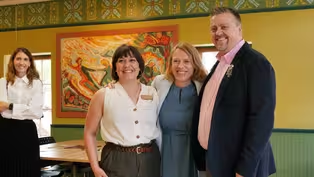
Clip: S15 Ep10 | 5m 23s | The Versterheim is a distinctive museum space that is open to the public. (5m 23s)
Providing Support for PBS.org
Learn Moreabout PBS online sponsorship

- Arts and Music
The Best of the Joy of Painting with Bob Ross
A pop icon, Bob Ross offers soothing words of wisdom as he paints captivating landscapes.










Support for PBS provided by:
Postcards is a local public television program presented by Pioneer PBS
Production sponsorship is provided by contributions from the voters of Minnesota through a legislative appropriation from the Arts and Cultural Heritage Fund, Explore Alexandria Tourism, Shalom Hill Farm, West Central...