
W.E.B. Du Bois' childhood, family and education
Clip: 5/19/2026 | 3m 43sVideo has Closed Captions
Born in 1868, W.E.B. Du Bois rose from hardship to academic excellence.
Born in 1868 in Massachusetts, the same year the 14th Amendment guaranteed citizenship and equal protection, W.E.B. Du Bois grew up in a predominantly white community where he experienced freedoms denied to most Black Americans of his time. Raised by his mother after his father abandoned the family, Du Bois was supported by a close-knit community that nurtured his intellectual gifts.
Problems playing video? | Closed Captioning Feedback
Problems playing video? | Closed Captioning Feedback
Support for American Masters is provided by AARP, The Rosalind P. Walter Foundation, Thea Petschek Iervolino Foundation, Burton P. and Judith B. Resnick Foundation, The Philip and Janice Levin Foundation,...
Support provided by:

W.E.B. Du Bois' childhood, family and education
Clip: 5/19/2026 | 3m 43sVideo has Closed Captions
Born in 1868 in Massachusetts, the same year the 14th Amendment guaranteed citizenship and equal protection, W.E.B. Du Bois grew up in a predominantly white community where he experienced freedoms denied to most Black Americans of his time. Raised by his mother after his father abandoned the family, Du Bois was supported by a close-knit community that nurtured his intellectual gifts.
Problems playing video? | Closed Captioning Feedback
Where to Watch American Masters
American Masters is available to stream on pbs.org and the PBS app.
Buy Now
A front row seat to the creative process
How do today’s masters create their art? Each episode an artist reveals how they brought their creative work to life. Hear from artists across disciplines, like comedian Chris Fleming, actor Greg Kinnear, sports journalist Taylor Rooks, and more on our video podcast "American Masters: Creative Spark."Providing Support for PBS.org
Learn Moreabout PBS online sponsorship- [Narrator] William Edward Burghardt Du Bois was born in the rolling hills of Western Massachusetts in 1868, the year the newly ratified 14th Amendment guaranteed full citizenship and equal protection of the law to all Americans, black men and black women included.
(upbeat music) - Du Bois is born in a small town in a very white state, in a area that has a very small black population.
He's able to enjoy freedoms that the vast majority of black Americans can never have.
- [Narrator] William's mother's family had been free for generations and planted deep roots in Great Barrington.
(singer singing in foreign language) They also held tight to the thread that tied the family to its distant past across the Atlantic.
A song was passed down from an ancestor who was kidnapped from West Africa and sold into slavery.
- It was Wolof, a language that seemed to say, "Let me out, let me out."
"Do bana coba, do bana coba, gene me, gene me."
Dubois always used that memory and that ancestor to peg himself by African roots.
- [Narrator] William's father, a mixed race native of Haiti and Civil War veteran, feuded with his in-laws and abandoned the family when William was a toddler.
He would never see his father again.
The Burghardt family in the town rallied around his mother, Mary Silvina, so that young William could concentrate on his education.
- Mary Silvina, she has a precocious kid, a brilliant child, who is devouring everything that comes into his view.
He's gonna be introduced to Latin, he's gonna be introduced to Greek, he's gonna be introduced to religious doctrine, so Du Bois is kind of baptized in this understanding of the West.
He was able to distinguish himself as a student, becoming the valedictorian of his high school class.
- His mother had a stroke right around the time that Du Bois was getting out of high school.
She died shortly after Du Bois graduated from high school.
- "There followed the half-guilty feeling, that now I could begin my life without forsaking my mother.
Now I was free and unencumbered, and at the same time, more alone than I had ever dreamed of being.
This very grief was a challenge.
Now, especially, I must succeed, as my mother so desperately wanted me to."
A brief history of Reconstruction
Video has Closed Captions
Reconstruction saw Black progress, then backlash erased gains after brief equality. (2m 32s)
Du Bois used visualized data to confront racism at the 1900 Paris Exposition
Video has Closed Captions
At the 1900 Paris Expo, Du Bois used data to present a visually captivating case against racism. (2m 25s)
The formation of the NAACP and Du Bois’ magazine, “The Crisis”
Video has Closed Captions
How Du Bois used "The Crisis" and NAACP efforts to expose racism and celebrate Black achievement. (3m 10s)
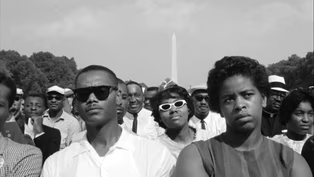
W.E.B. Du Bois passed away on the eve of the 1963 March on Washington
Video has Closed Captions
Du Bois’ death at the 1963 March on Washington marked a passing of the torch in civil rights. (1m 48s)
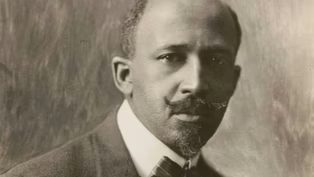
W.E.B. Du Bois: Rebel With a Cause
Video has Closed Captions
Explore the life and legacy of notable Black scholar and civil rights pioneer W.E.B. Du Bois. (2m 29s)
Providing Support for PBS.org
Learn Moreabout PBS online sponsorship












Support for PBS provided by:
Support for American Masters is provided by AARP, The Rosalind P. Walter Foundation, Thea Petschek Iervolino Foundation, Burton P. and Judith B. Resnick Foundation, The Philip and Janice Levin Foundation,...