
Wet Plate Photography, Quilter, Community Space
Season 15 Episode 7 | 28m 45sVideo has Closed Captions
Carla Rodriguez's wet plate photos; Anna Johannsen's 3D quilts; the Madison Mercantile
Carla Rodriguez is an artist from St. Paul who specializes in wet plate photography; Windom’s Anna Johannsen shows her skills as a 3D quilter and cowboy sharp shooter; Military veteran Kristine Shelstad started the Madison Mercantile - a small town art and community gathering space.
Problems playing video? | Closed Captioning Feedback
Problems playing video? | Closed Captioning Feedback
Postcards is a local public television program presented by Pioneer PBS
Production sponsorship is provided by contributions from the voters of Minnesota through a legislative appropriation from the Arts and Cultural Heritage Fund, Explore Alexandria Tourism, Shalom Hill Farm, West Central...
Support provided by:


Wet Plate Photography, Quilter, Community Space
Season 15 Episode 7 | 28m 45sVideo has Closed Captions
Carla Rodriguez is an artist from St. Paul who specializes in wet plate photography; Windom’s Anna Johannsen shows her skills as a 3D quilter and cowboy sharp shooter; Military veteran Kristine Shelstad started the Madison Mercantile - a small town art and community gathering space.
Problems playing video? | Closed Captioning Feedback
How to Watch Postcards
Postcards is available to stream on pbs.org and the free PBS App, available on iPhone, Apple TV, Android TV, Android smartphones, Amazon Fire TV, Amazon Fire Tablet, Roku, Samsung Smart TV, and Vizio.
Providing Support for PBS.org
Learn Moreabout PBS online sponsorship(bright music) - [Announcer] On this episode of "Postcards."
(gentle music) - Photography speaks to a lot because it is like capturing these specific moments in someone's life that you can look back on.
- I would say my style is a little bit different because I just don't like doing ordinary things.
- Having lived in bigger cities like Austin, Washington DC and things like that, I knew what was possible and I knew that we deserved it.
(bright music) - [Announcer] "Postcards" is made possible by the Minnesota Arts and Cultural Heritage Fund and the Citizens of Minnesota.
Additional support provided by Margaret A. Cargill Philanthropies, Mark and Margaret Yackel-Juleen on behalf of Shalom Hill Farms, a retreat and conference center in a prairie setting near Wyndham, Minnesota.
On the web at shalomhillfarm.org.
Alexandria Minnesota, a year-round destination with hundreds of lakes, trails and attractions for memorable vacations and events.
More information at explorealex.com.
The Lake Region Arts Council's Arts Calendar, an arts and cultural heritage funded digital calendar, showcasing upcoming art events and opportunities for artists in West Central Minnesota.
On the web at lrac4calendar.org.
Playing today's new music plus your favorite hits, 96.7 Kram online at 967Kram.com.
(gentle music) - There's a moment where the plate goes into the fix and it turns from a negative to a positive.
And I remember seeing the image kind of come through this fog and just being like, "Oh, this is what I'm doing now.
This is what I'd like to do."
(bright music) And I remember my teacher, expressing that to my teacher and her being like, "Good luck.
It's really expensive and the learning curve is steep."
And I was just like, "Challenge accepted, thanks."
(bright music) This stuff that I'm doing right now, like the silver nitrate, it's not like breathe bad, but it's like if getting my eyeball bad, so I should be wearing goggles.
Be safe kids.
Do as I say, not as I do.
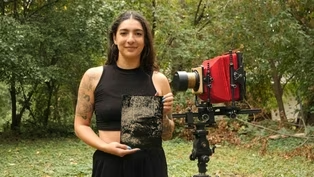
Essentially, wet plate refers to the overarching process and then there's derivatives basically on what you're making it on.
So I'd make mostly tintypes, which means it's done on metal.
So in this case, for me, it would be aluminum.
You kind of create this skin on the plate, do like a little finesse with your hands and then put that while it's still wet into a silver nitrate bath, which is part of what makes it light sensitive.
So at this point, all these steps you can do kind of in the light, but once it goes into the silver nitrate bath is when it needs to be red light or darker.
Could your face a little bit more this way?
- Yeah.
- Ready, one, two.
Good job.
I shoot the image either with a tremendous amount of light or sunlight, which might be a longer exposure.
Take the plate back into the dark room, process it immediately.
A lot of people think it's development, but it's actually just the fix pulling out the unexposed silver from the plate so you can see the black ground and see the image essentially.
(chill music) Something that I think is really interesting now with digital photography or with our phones where a lot of those images that we make that are like documenting our lives, documenting the people around us are only living on our phones and we don't make things anymore and we don't print things.
And so, I wonder a lot about what that's gonna look like if those things get lost or when the apocalypse happens and all that's left, it's gonna be tintypes, let me tell you.
(chill music) There's this deep history of postmortem photography with wet plate.
A lot of times that's the only time people got photographed.
Yeah, so these are some of the postmortem images, so the children are dead in these images.
Yeah, they tried to pose them sometimes as if they were alive.
This is like a kind of like a hidden mother thing where there's somebody with a sheet over them holding the child up.
We have a totally different relationship with death now than we did then.
I think people were a lot more comfortable with it.
So it was okay for them to have the only picture of their loved one be of them after they're no longer in their body.
The desire to have documentation of your visage or like your family, that kind of thing, our memories are so unreliable, especially when somebody's gone.
I'm gonna get emotional, sorry.
It's like a lot of those pieces go away really fast, the sound of their voice, the way they smell, even sometimes the way that they looked.
And so, I think photography plays this really beautiful role where it's like we at least get to hang on to the shape of their face or the way their eyes looked and especially specifically in that moment.
I'm not a super history nerd or buff.
I'm actually kind of surprised I got so drawn into this process.
I think for me, it was more like the tactile nature of it and the chemical process of it.
But the history is super interesting and something also that I tried to... Not tried to, I have to speak to in my work, we don't see a lot of tintypes or wet plate images of Black and Brown folks.
Part of that is access, right?
And class.
People paid to have these images made and when youre a slave or oppressed, you don't really have a lot of access to those things.
There are some images of Black folk, but they're really rare.
It's like when you find a tintype like that, they can be really expensive because of the rarity.
I feel like it's part of my job and my responsibility as an artist working with this process to think about that, address that and try to like add to a new history that we're doing now with this process.
(bright music) So I grew up in Houston, Texas.
I'm a first generation American to Venezuelan immigrants.
My mother came from Maracaibo and then my father from Caracas.
And they both immigrated here, gosh, probably in the eighties, nineties.
(upbeat music) My mom was a beautician, but she was really creative.
She was really good at like floral arrangements and obviously like hair can be really creative and stuff too.
And then my dad was a personal trainer, but he was like an aspiring actor as well.
So they were both like really creative.
They're both like amazing dancers.
My dad loved to sing.
They're all like mixed up.
They're just like random pictures.
These are like some of my mom's clients.
I don't know, she really was like, "Oh, let me take pictures."
Look at this, this is so funny.
This is her coat and I don't know who these women are, but my mom took these pictures of these women in her coat, in her house for some reason being like, "Yeah, model this for me," or whatever.
(gentle music) So my mother was diagnosed with colon cancer kind of late stage and struggled with that really heavily for a year and then passed away in 2012.
And then, my father has always struggled with mental illness.
It was kind of acute for about a decade and then in 2016 he ended up taking his own life.
So I've unfortunately experienced a lot of loss early on.
I had really deep connections with both my parents, so it was really tough.
(gentle music) I think a lot about them when I make pictures.
So especially for families and I think a lot about being able to give somebody something like this that they can hang on to for a long time.
And if it's kind of bittersweet where I'm glad that I can do this for somebody else 'cause I didn't get to do it for myself.
(gentle music) I treasure the fact that my mother was this much of a documentarian or that she cared this much about images.
And it's like, knowing...
I don't know, it's kind of like...
Sorry.
Knowing that I was loved by them is really nice.
That's how I feel when I look at them.
I was like, "Oh, wow, she loved me so much."
She was just like...
There's just like so much evidence of that in every picture that I look at.
And so, it's really great.
♪ All my life ♪ I've prayed for you ♪ When I'm tired ♪ You follow through ♪ I can breathe ♪ Breathe I feel like my life, I've experienced a lot of instability and with wet plate, there's a lot of unpredictable chemical anomalies or that kind of thing that can happen due to like temperature or the way I've handled something or how old the chemistry is.
But being able to control something wild like that has helped me feel more stable in my life.
The human experience is having something and losing something.
At some point in our lives, whatever that looks like, we're gonna experience loss.
Photography speaks to a lot because it is capturing these specific moments in someone's life that you can look back on.
I know it's a testament to how time trudges on and things change and I think that's painful and beautiful at the same time.
♪ I'm not sure ♪ I can maintain ♪ Control ♪ Every little piece of you ♪ Hurts now twofold ♪ I'm supposed to ♪ Not want to at all ♪ But I do (sewing machine revving) - I started quilting probably 17 years ago and I think I probably started out as kind of just a... No, I did not, I was gonna say a normal quilter, but no, I didn't.
I started out kind of with optical illusions.
(bright quirky music) I am Anna Johanssen.
I enjoy doing various types of art.
I would say my style is a little bit different because I just don't like doing ordinary things.
That gets boring, I like a challenge.
Building successes, I mean, that's kind of my whole mantra because I've been a teacher for over 40 years and the best part was hearing the kids say in art classes, "I didn't know I could do that."
And they got success and they try things that are more difficult.
This one is Procion dye and this is what I was showing here with doing the stitching, put on the jewels.
This is a nebula.
I gotta get my eyes.
(sewing machine revving) Quilts are so underrated.
It seems like sometimes people think, well, I already have one I don't need anymore, but there's lots of hours that go into it, lots of love sometimes.
And this one is using scraps where I sew it to used fabric sheets.
It's bits and pieces of lots of stuff, this is my daughter's dress.
(bright music) One of the best homemade starches that I've ever made or used is one third cup of vodka and I add two thirds cup of water.
Give it a stir and then with a dry iron, take out your orneriest wrinkles.
Or I could do this (laughs).
- My ribbons are from county fair, state fair, for some paintings that I had done, making sunshine pickles and another one for sauerkraut.
So I kind of dabbled into that too.
I do cowboy action shooting.
So I've got some ribbons for getting first and second place.
That was like- - Wait, what?
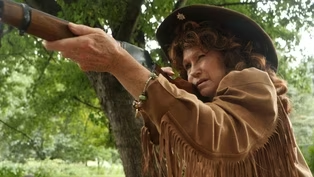
(cowboy music) - I do cowboy action shooting.
We dress in the era of the late 1800s to 1900, and you have to shoot each weapon in exactly the order they say as fast as you can.
(gun fires) My sister and I do it.
We used to do it more when her husband was alive.
We have aliases, I'm Mule Town Molly, I'm the Grande Dame, Grande Dame however you want to say it.
(cowboy music) The original definition of Salmagundi is anchovies, meat, vegetables, all arranged on a plate and covered with a dressing.
In other words, it's a salad.
They're all different, but they come together as one.
I've always loved that word anyway, it's kind of poetic.
And so, I thought that's what my gallery exhibit is going to be.
It's Salmagundi.
So there's 65 pieces, pencil drawings, oil painting, acrylics, fiber art and the biggest, most beautiful dog you'll ever see in your life.
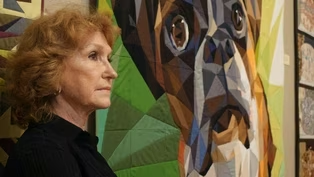
I think it's 55 by 65 paper pieced with over 1,000 pieces of a boxer that looked just like my dog.
One of the most fun parts of the gallery I have been told by the comments in the sign-in book is the 3D quilts.
You need the glasses to look through to see the effect.
And then, there's an interactive one where you can play around using the 3D glasses, see what works and what doesn't.
You have to use pure colors and then have a little bit of black surrounding it and that will separate it.
So the red is gonna come right out at you, the blue and the violet are gonna be way behind that you could almost grab it.
I got the idea from the fact that I was teaching a unit in art on it.
So then I got to thinking, now why couldn't I do this with fabric?
And this was just playing around to see how many animals you can find in it.
There's birds, deer, and this one really pops.
(gentle uplifting music) I think I like this the best of the fiber, but I love my cat and squirrel and of course, Francisco.
I just like things that aren't so ordinary and boring.
(bright music) The cowboy action shooting really shocks people when they hear that.
In fact, usually they say, "You?"
Because it's a little old lady shoots guns, real guns.
So I think it's the shock value.
Maybe I like that, maybe I like the shock value.
(bright orchestral music) It's just been a whole different way of life than going to school every day and teaching school.
And I'm looking forward to seeing what else I can learn how to do, figure out how to do.
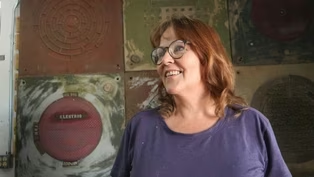
(bright orchestral music) (lively music) - The Madison Mercantile is a coffee house within a larger art and innovation center.
So the Madison Mercantile kind of was born of a desire to have a space for the community to gather.
And when I moved here, I missed good coffee and I missed community and art.
So it was pretty much a selfish endeavor to build what I thought I wanted and it turned out the community needed it to.
(lively music) I graduated from Madison High School and left, joined the military, was gone for about 40 years and had settled outside of Austin, Texas.
And my husband passed away unexpectedly about five years ago and I decided I just needed to be back with my tribe.
So I moved back up here where my sister and brother and nieces and nephews and friends were and it was really a great decision.
I'm glad I'm back.
(uplifting music) I enjoyed my time in the military.
I got to live all over the United States, a couple of deployments, spent a lot of time in Germany, but I'm happy that I'm able to bring what I learned through the military to bear as we build this art and innovation center.
(gentle bright music) When I first moved back to Madison, I told my family I was just gonna buy a big old house and be that crazy old lady in Madison and just relax and not volunteer for things and just kind of live my life.
But my life of service in the military and the need to be involved and to see a problem and fix it, I think that's what really drove me to start this.
I knew that I wanted coffee and art and culture and music, and I felt like people in small towns deserve that as well.
(gentle uplifting music) So if I was missing that kind of thing in my life, I was sure that there was others in town that were as well.
So I think moving back here, having lived in bigger cities like Austin, Washington DC and things like that, I knew what was possible and I knew that we deserved it.
(gentle uplifting music) The other thing was, it was during the pandemic, and at that time, people were proving that they could move to a small town, bring their job with them and be successful.
So I think that one of the key drivers was seeing that a town such as ours could be a magnet for people who wanted to change their lives, move out of the big city, bring their jobs with them, live at maybe a little bit slower pace, but that doesn't mean your life has to be boring.
We can have culture, there's so much talent out here.
We just needed a place to showcase it.
♪ I carry mine everywhere I go ♪ Knowing where the wind The building that we eventually bought for the mercantile is 15,000 square feet, a lot bigger than we had anticipated.
So instead of just a coffee house with a art gallery, we ended up with a lot more square footage that we could fill with things that people wanted.
So, for about a year, we just said yes to everything.
Someone would come in and say, "You should have a stage."
Well, we built a stage.
"You should have a gift shop," we did that too.
(gentle uplifting music) We had a foundry in town that cast sewer covers like this and other metal items.
So these are the casting plates that the foundry used to use.
They're wooden and then they would be pressed into a mixture of sand and some other substrate, and then the metal would be cast into them.
But they're just beautiful and they were just rotting away in the building as it was falling apart.
And the owner of the building let us go in there and save as many as we could.
We got about 100 of them.
and we're gonna be using these to decorate in the coworking space, which is why we're calling that the Foundry Lounge.
The foundry closed in 2009, but prior to that, it provided sewer covers and things like this for about half of the United States.
They're just beautiful in their own right.
I think they're pieces of art themselves.
(gentle bright music) So we finally kind of came up with different lines of effort that we have, arts and culture, senior services because we are an older community predominantly, food and wellness, youth services, something we're gonna be developing.
(gentle uplifting music) Donated, everything's pretty much donated.
Blue Cross Blue Shield was closing a gym in Minneapolis and we got all of their weights and things.
It's about 80% in here, hopefully we'll get her done and be able to have some yoga.
(gentle uplifting music) Madison has been extremely supportive.
Everything from the mayor, the city manager, the city council on down to local community members.
Nothing but support.
I recently had a surprise party thrown for me, and I was so excited to see people from 94 down to three years of age from all walks of life in town, people from the Bible study group, the quilt group, other organizations that meet here that I just wouldn't have known had it not been for this experience.
Just made some really good friends.
There are people in town I believe that are here because they made friends here at the Merc and they feel like they belong to the community now.
(bright music) My favorite part of the mercantile is looking out at the crowd and seeing people sitting, talking, who wouldn't normally be together.
(bright music) I think every little town, every small town deserves a place for culture and community to grow.
And if anybody out there is thinking about doing something like this, I would just say go for it.
There are resources out there.
There's grant funding, there's support.
Your community probably needs it and will want it and will support it.
So don't hesitate.
Just find yourself a cool old building and get started.
(bright music) (bright music) - [Announcer] "Postcards" is made possible by the Minnesota Arts and Cultural Heritage Fund and the Citizens of Minnesota.
Additional support provided by Margaret A. Cargill Philanthropies, Mark and Margaret Yackel-Juleen on behalf of Shalom Hill Farms, a retreat and conference center in a prairie setting near Wyndham, Minnesota.
On the web at shalomhillfarm.org.
Alexandria Minnesota, a year-round destination with hundreds of lakes, trails and attractions for memorable vacations and events.
More information at explorealex.com.
The Lake Region Arts Council's Arts Calendar, an arts and cultural heritage funded digital calendar, showcasing upcoming art events and opportunities for artists in West Central Minnesota.
On the web at lrac4calendar.org.
Playing today's new music plus your favorite hits, 96.7 Kram, online at 967Kram.com.
(bright music)
Video has Closed Captions
Clip: S15 Ep7 | 9m 12s | Fabric Artist and Quilter Anna Johannsen likes seeing life from unusual perspectives. (9m 12s)
Video has Closed Captions
Clip: S15 Ep7 | 11m 32s | Wet plate photographer Carla Rodriguez uses the nearly two century old tintype process. (11m 32s)
Wet Plate Photography, Quilter, Community Space
Preview: S15 Ep7 | 40s | Carla Rodriguez's wet plate photos; Anna Johannsen's 3D quilts; the Madison Mercantile. (40s)
Video has Closed Captions
Clip: S15 Ep7 | 9m 2s | Kris Shelstad, a US Military veteran, recognized a need in her community and create it. (9m 2s)
Providing Support for PBS.org
Learn Moreabout PBS online sponsorship

- Arts and Music
The Best of the Joy of Painting with Bob Ross
A pop icon, Bob Ross offers soothing words of wisdom as he paints captivating landscapes.











Support for PBS provided by:
Postcards is a local public television program presented by Pioneer PBS
Production sponsorship is provided by contributions from the voters of Minnesota through a legislative appropriation from the Arts and Cultural Heritage Fund, Explore Alexandria Tourism, Shalom Hill Farm, West Central...