
WETA Arts: April 2021
Season 8 Episode 2 | 28m 33sVideo has Closed Captions
Filmmaker Jay Schlossberg, Smithsonian Craft Show and more.
Filmmaker Jay Schlossberg; Sylvia Soumah, Coyaba Dance Theater; Smithsonian Craft Show; Maggie Boland, Signature Theatre.
Problems playing video? | Closed Captioning Feedback
Problems playing video? | Closed Captioning Feedback
WETA Arts is a local public television program presented by WETA
WETA Arts: April 2021
Season 8 Episode 2 | 28m 33sVideo has Closed Captions
Filmmaker Jay Schlossberg; Sylvia Soumah, Coyaba Dance Theater; Smithsonian Craft Show; Maggie Boland, Signature Theatre.
Problems playing video? | Closed Captioning Feedback
How to Watch WETA Arts
WETA Arts is available to stream on pbs.org and the free PBS App, available on iPhone, Apple TV, Android TV, Android smartphones, Amazon Fire TV, Amazon Fire Tablet, Roku, Samsung Smart TV, and Vizio.
Providing Support for PBS.org
Learn Moreabout PBS online sponsorshipHello.
I'm Felicia Curry, and welcome to this edition of "WETA Arts," the place to discover what's going on in the creative and performing arts in and around DC.
A local filmmaker tells the inside story of DC's legendary alternative radio station WHFS 102.3.
Man: This was live radio, real people programming music to change your view, make you learn something.
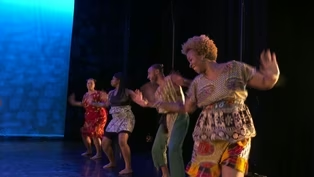
Curry: A local choreographer's company celebrates West African dance.
Woman: I bring in the community to fill up the stage because we all matter, and so that's what my company is about.
Curry: A group of local women have created a fundraising machine through the nation's most prestigious art fair-- the Smithsonian Craft Show... Man: It's harder to get into that craft fair than it is to Harvard.
Curry: and I speak with Signature Theatre's Maggie Boland about the future of theater after the pandemic.
It's all ahead on "WETA Arts."
WHFS in Bethesda, Washington's first stereo FM station, went off the air in 2005, but its heyday was in the Seventies, when it introduced a generation of Washingtonians to major talents before they became famous, among them Bruce Springsteen, Frank Zappa, and Emmylou Harris.
Longtime WHFS fan Jay Schlossberg decided the tale of this beloved progressive rock station needed telling.
Man: [Humming bassline] Different man: All right.
Come on.
♪ I remember... ♪ Persuasions: ♪ WHFS ♪ My name is Jay Schlossberg.
I'm director and executive producer for a documentary feature film called "Feast Your Ears: The Story of WHFS 102.3 FM."
Persuasions: ♪ WHFS ♪ Schlossberg: The movie is about one of the most beloved, legendary FM stations ever to grace the airwaves.
Announcer: WHFS in Bethesda, Maryland, coming to you from high atop the Triangle Towers.
Different announcer: Welcome to the future.
I started a Facebook page for the film and figured that, you know, 3, 4, 5 years down the line, when the movie's about ready, I'll have, you know, 3,000 or 4,000 followers, and we have over 30,000.
I think what they did was fascinating because they were really flying by the seat of their pants.
In this clip, we're gonna get a little background from the two founders of WHFS.
Well, this is where it all began back in 1961.
Bill Tynan and Bob Carpenter conceived the idea of a brand-new, Class A FM radio station, one that would broadcast in stereo.
Man: WHFS' first location was at 8218 Wisconsin Avenue in Bethesda, the Bethesda Medical Building.
We were in the basement.
[Static] Announcer: This is a test transmission from radio station WHFS, Bethesda, Maryland, operating on 102.3 megacycles.
Man: Two really incredible engineers, Bob Carpenter and Bill Tynan, were with Johns Hopkins.
They got the money together and actually built 'HFS from the ground up.
They obtained the license.
They invented, if you will, the equipment.
Well, I met Bob Carpenter on the air on amateur radio.
We were both amateur radio operators-- hams, as they call us-- and we found out we were both interested in FM broadcasting as well as amateur radio, and we decided, "Why don't we build a station of our own?"
Didn't have a lot of money.
There was no stereo equipment available.
Bob built the console.
He was concerned about building a power supply for it that was quiet enough, a low enough hum, so we used a car storage battery to run the console.
We used to time off the air to charge the battery.
What made it beloved was when they finally got into the freeform progressive music.
Freeform progressive is basically the deejays playing whatever they want whenever they wanted.
There was no corporate overlords saying, "You must play these same 150 songs."
The idea behind it is to introduce new music.
Schlossberg: Jake Einstein was a huge force behind the changes that started to happen at 'HFS starting in '68, when the first freeform shows began to pop up.
Because they weren't making any money, anyway, they would actually sell the airtime to these deejays, and then the deejays would have to go do their own advertising, do the spot themselves and earn their money that way.
"Spiritus Cheese" was Josh Brooks, Mark Gorbulew, and Sarah Vass.
They changed everything because they really found a way to find their audience.
Damian: For WHFS, the music of the Sixties really began with a few individuals that brought us kind of an enlightened type of radio, and if not for them, we wouldn't be here tonight telling you about the Sixties.
Weasel wouldn't be here with his insanity and Cerphe with his and so on and so forth, started with people like Frank Richards and "Electric Brew," but no one could possibly deny the impact that "Spiritus Cheese" had on the Washington area, so tonight we pay tribute to "Spiritus Cheese," and we have a little bit of one of their shows for you right now.
Gorbulew: I met Josh Brooks when he was known as Henry Stanford Brooks, and we were college mates at Bard College in Upstate New York, and we were also college mates with Walter Becker and Donald Fagen of Steely Dan.
Chevy Chase was another college mate of ours.
Brooks: And when we got out of Bard, we decided we wanted to start a radio show, and the idea was hatched at another friend's apartment in New York, his loft in New York that was above the Spiritus Cheese Company, and we came up with the idea of naming the show "Spiritus Cheese."
We went around, looked around at various cities.
Boston already had something.
New York had something.
Philadelphia already had something along the lines of what we wanted to do.
Gorbulew: We decided to go down the Washington, DC, because we were selling Owsley acid and we had friends down there, including John Hall, who we knew from Bard College.
Schlossberg: 3 weeks after "Spiritus Cheese" went on the air-- which was July 27, 1969-- there was a concert you might have heard about called Woodstock.
Grace Slick: ♪ When the truth is found to be lies... ♪ Schlossberg: The 3 of them got backstage and had a reel-to-reel tape deck and interviewed Jerry Garcia and Neil Young and a number of other musicians who were back there, and so when they came back to Washington, listenership went from maybe 800 to 30,000, and it changed the fortune of the station and the whole trajectory of where they were going.
Jefferson Airplane: ♪ You are the crown of creation ♪ Schlossberg: The local stereo stores and record stores and the surf shop and the waterbed store, there was a place for all these maybe not main line type of retail businesses to find a place to advertise.
Ian Anderson: ♪ Sitting on a park bench ♪ Schlossberg: Then you add in the burgeoning nightclub community, clubs that came out-- Desperado's and the Wax Museum, eventually the 9:30 Club-- they all had a place to advertise to the exact right audience.
That freeform thing was pretty much over by 1969 or 1970, but 'HFS somehow was able to maintain that all the way through July 1983.
"It changed my life."
You'll hear that over and over and over on the social media page for the film or on Twitter.
It's really lifted my heart, in a way.
I really didn't expect that.
It changed my life because it made me aware of some of the things I maybe wasn't aware of through the lyrics of the musicians of the era.
This was in-the-moment, live radio, real people programming music to make you happy, make you sad, change your view, make you learn something.
You have the social impact.
You had economic impact.
You had cultural impact, and it's resonating to today.
That's why we're telling this story.
Curry: To get updates on the film's release date, follow it on Facebook or sign up for the newsletter at FeastYourEarsTheFilm.com.
Dance Place in Northwest DC is the home of Coyaba Dance Theater.
Founded in 1997 by Sylvia Soumah, Coyaba presents the dance traditions of the diverse ethnic groups in West African culture.
While the company has performed around the world, Soumah's focus is on giving back to her local community while preserving the legacy of West African dance in DC.
[Drums playing] Soumah: I'm Sylvia Soumah, head of the African Dance Program here at Dance Place.
My company is a contemporary company.
It's Coyaba Dance Theater.
Ah!
Yah!
Soumah, voice-over: I started the company because I just wanted to be a head of a dance company that's doing work that's partly from Africa but also about the African American experience.
Keeping that energy going.
Soumah, voice-over: I do Coyaba not for the money, not for the labels, not for the prestige, not for the award.
It was always about the work, and it was always about community, and it was always about love.
♪ Birthday girls, do you dance ♪ ♪ Go, Maggie, oh, girl ♪ ♪ 4, 5, 6 ♪ Soumah, voice-over: I started doing African dance classes in 1993, and we have live drummers during the class.
It's all races, all ages, all ethnic groups.
For me, it doesn't matter, you know.
It's, if you want to do it, if you want to learn and you want to be respectful and you want to learn our culture, what better way?
It is through dance and music.
We add 'em up.
♪ 2, 3, 4, 5 ♪ ♪ And 1, 2, 3, 4, 5 ♪ Soumah, voice-over: Nobody wants to sit and read a book about history.
You want to dance.
You want to move.
When you can really experience it and dance it...
I think it's the best way to downplay stereotypes because then all that goes out the window.
I grew up in Cincinnati, Ohio.
Carla Perlo was a student at the University of Cincinnati, Ohio, and the director of Dance Place, and she started an inner city dance program in Cincinnati, so I met her when I was 10 years old.
That was my first introduction to modern dance or dance with some structure.
I had learning disabilities, so, you know, so dance was that outlet.
I was something that I can really shine in that I didn't have to work so, so hard for, but, you know, in academics, I kind of struggled.
[Cheering and applause] What I loved about modern dance is, you can tell your own story, as opposed to ballet, and you can be barefoot, and you can wear whatever you wanted.
In my 20s, I moved here to Dance Place to pursue modern dance.
I got into traditional West African dance after the birth of my son because I had brought my son.
He was two years old, and I brought him to a modern dance class, and I was trying to get him to sit down, you know, stay in his umbrella stroller.
That wasn't happening, and he wanted to get up and move, and I was like, "Oh, God, I'm doing plies.
Can you sit down?"
The person who was doing the class, he was like, "Bring your son to a African dance class."
I was like, "He can make all the noise he wants because there's a million kids there," and I was like, "OK. Well, Yeah.
I'm gonna bring him," and so that's how I got hooked.
[Drums playing] I've seen people come in, you know, finish dancing, and they are sitting down there crying.
They got through this whole emotional thing that draw and bring out whatever, what's going on in their life or at the moment what happened, and then to be a African dance teacher, you're a therapist.
I keep my company very small... Go.
Do your thing.
Yeah.
Soumah, voice-over: but I bring in the community to fill up the stage because that's important because it's not about the professionals.
It's about a feeling.
It's about conveying a message that community matters.
People matters, and it's doesn't matter what economic base you come from.
We all matter, and so that's what my company is about.
It is also important for me to make sure that the people who work with me have opportunities to be directors, choreographers, teachers.
It's not just about me.
I want them to be able to do everything that I could do and to push, you know, this art form forward.
It's important for me to pass it on because if I try to keep everything, then it's gonna get lost.
I was one of those skinny, little girls who got picked on.
I got bullied.
You know, I got bullied about my skin color, you know, about my hair, so, like, for me, I'm always pulling for the underdog.
I got a good eye for spotting, like, "This kid needs a little bit of something, some inspiration.
"This kid, I'm gonna make this kid shine so everybody can see how special this kid is," or, "I'm gonna make this woman shine because I want everybody to know how special she is."
There's something about those drums and, you know, rhythm, your heartbeat, right?
You know, when you hear your baby cry when it's born, that's a great sound, right?
To me, sound is love.
You can find African dance classes taught by Coyaba members, including Sylvia Soumah, at the Dance Place website.
The all-volunteer Smithsonian Women's Committee has raised millions of dollars for initiatives ranging from studying elephant genetics to an exhibit about the 1960 sit-ins.
They did it by creating the most prestigious art fair in the nation.
Cissel Gott Collins is among the women documenting the history of the organization.
Gott Collins: The women's committee started at a White House dinner in 1965, where someone suggested to Dillon Ripley, who was the secretary of the Smithsonian, that it might be nice if we had a ladies auxiliary to do the sort of thing that ladies do, to escort people around and to be promoters of the Smithsonian to the Washington community at large.
And that's how it kind of started, except these women were not about to just be ladies auxiliary sorts.
Mary Livingston Ripley, the wife of the secretary, called everybody she knew in October of '66, and by 1967, we were giving out grants.
We gave our first one to the Anacostia Museum for books and for a little library and for a sewing machine.
The reason that we do the grants is that the Smithsonian is huge.
They can't do everything.
An example, the Mpala Wildlife Research Center in Kenya.
We gave them a grant to build residences.
In Myanmar, they wanted to put trackers on bats to trace diseases.
We gave them a--I believe it was $27,000 grant for the collars.
It's these small things.
It's a wonderful idea, but if they couldn't get the funding for it from another source, it just wasn't going to happen.
One of the things we used to do to raise funds was to have dances.
We just had a wonderful time getting it all organized, making sure there were enough people there to make some money on this project.
I guess it was in '81 that we started looking around for ways of raising more money.
And Lloyd Herman at the Renwick suggested a craft show.
The first year of the craft show was 1983.
And the funds raised went from being able to give grants in the 70,000 area to a hundred and some thousand.
So it was significant, and it's gone up from there, which is very nice.
My history with the Smithsonian show goes back to the eighties.
I got in and thought, "Oh, this is fine."
The next year, I did not get into the fair.
Gott Collins: The exhibitors for the Smithsonian Craft Show are juried.
Bean: I was a juror for the fair, and the quality of the work is really amazing.
It is some of the most sophisticated work done in the field.
How we make our money is with our Smithsonian Craft Show.
We have a show called Craft2Wear that is all jewelry and wearables.
Gott Collins: We had to cancel our April show in 2020, and couldn't have the Craft2Wear in October as we usually do.
Murray: I kind of volunteered to lead an effort for an online event.
Since about 2015, we've had a sustainability award at the Smithsonian Craft Show, and that is presented by an organization called Honoring the Future, and we are collaborating with them on Smithsonian Craftoptimism.
When the jurors jury, they don't have the price points.
So we could have someone like Keith Lewis who does earrings, and they're lovely, and they're about $75 each.
There are ceramic artists.
Their pieces sell for 75, $80,000.
It's not easy to sell online unless you're selling to people that already know your stuff.
We found that things that are priced between 50 and $500 have a much higher chance to sell.
The Smithsonian Craft Show is a live in person event, so most of the artists who exhibit are from the Eastern Seaboard, because if you are a glass or ceramic artist, it's very expensive and dangerous to transport your stuff across the country.
But for a virtual show, it doesn't matter where you are because the artist will ship directly to the purchaser.
I do love the art part of the Smithsonian Women's Committee.
I have John Iversen earrings.
He's from New York.
Starr Heigenbring's scarf.
She's from New Orleans.
And Holly Anne Mitchell bracelet from Indianapolis.
It is all tiny, rolled up newspaper with little crystals and things around it.
So it looks fancy, but it's just little newspaper rolled up.
And that is her thing.
We've got some pretty unusual jewelry coming into this show.
We've got some that people are like, "Is that--is that a Barbie doll head in that broach?"
And the answer is yes, it is.
[Laughs] And, "That bracelet that looks like black fringe, is that made out of inner tubes?"
And the answer is, yes, it is.
We have some really interesting artists from the D.C. metro area.
We have Jessica Beels, who has this whimsical series of birds.
She can make a bird out of a page, out of an atlas, or a Chinese menu.
And there's just something about these birds that is--you just want them.
Kim Shalk is a clothing designer who makes very sustainable clothes.
And while it's very wearable and simple, it is also decidedly sort of couture.
What attracts me to the Smithsonian Women's Committee is not the crafts.
It is the opportunity to work on the grants that we award the Smithsonian.
I fell in love with the Smithsonian going to the Museum of Natural History and just feeling like it was just the coolest place in the world with that mastodon in the front hall and the Hope diamond.
All that stuff has always really grabbed me.
The most fun thing about being a member of the Smithsonian Women's Committee is when you go meet with the person who has applied for the grant, which is just so fun always.
You walk in thinking, "what do I care about golden tree frogs or native orchids?"
And after you talk to somebody who's passionate about it, you work on a presentation, and then the whole Smithsonian Women's Committee gets together, and then we vote on what's gonna get funded.
Putting Craftoptimism together has been done at a breakneck pace.
As one of our key committee members has said right from the start, "It's been hair on fire."
It's an incredibly talented team.
It's really rewarding to work with these women.
It's the working with each other that is so wonderful.
They are interested, excited, energetic, willing, creative, fascinating people.
And it's just--that is probably what's kept me involved more than anything else is the women.
They're just fabulous.
Curry: To check out the art at Craftoptimism, go to smithsoniancraftshow.org.
The show runs from April 24th through May 1st.
Signature Theatre in Shirlington, Virginia has been entertaining audiences since 1989 with Broadway classics and new commissions.
I'm here with Maggie Boland, the managing director of Signature Theatre in Shirlington, Virginia.
I know that Signature, along with many other organizations, have now turned to digital programming.
♪ Let the sunshine ♪ But Signature's doing something really different and really special with that programming.
Can you tell me a little bit about that?
We made the decision pretty early, actually last April or May, to not chase after reopening in person, 'cause it felt so uncertain to us.
Once we made that decision, it was actually very freeing to be able to imagine a full season of fully produced filmed productions.
We wanted it to feel as much as a Signature season as possible, and so we knew we couldn't start small.
Our first project was Signature Vinyl, which was a pretty large-scale production filmed outdoors before we were sure we could be inside safely with everyone.
♪ You better look at what you've got ♪ Boland: And then Simply Sondheim, a review of the great Stephen Sondheim's work, with a cast of 12 and 16 musicians.
♪ Now you know ♪ I'm sure people are thinking, how did you possibly get that many people in the room?
Boland: We were able to put together a very robust safety plan in partnership with our unions.
We were able to rehearse in person because of the testing protocols that requires a significant amount of testing.
Everyone involved in the production has been tested many, many, many times.
They would tell you feels like thousands of times.
The theater was divided into different zones so that the performers could take off the masks and be filmed without masks.
Knock wood, everyone's been extremely safe, stayed healthy.
♪ Somebody put me up short ♪ ♪ And put me through hell ♪ ♪ And give me support ♪ ♪ For being alive ♪ ♪ Make me alive ♪ Curry: So tell me what we can look forward to.
I mean, you are doing something really special.
Most places aren't producing musicals.
Boland: We actually have the remainder of our digital season.
"Midnight at the Never Get."
It's a brand-new musical that takes us into a sixties speakeasy vibe.
"After Midnight," which is a beautiful revue of Langston Hughes poetry set to the music of Duke Ellington and many others Man: Yeah!
♪ Read my story ♪ ♪ It's how I spread my wealth ♪ Boland: We have "Daniel J. Watts' The Jam," which is a really exciting solo performance piece, although there is a deejay also in the show.
♪ Jam, yeah!
♪ Boland: And then finally, "Detroit '67," Dominique Morisseau, which again is play, but is filled with Motown music.
♪ Maybe you want to give me kisses sweet ♪ Boland: Even those projects that are technically non-musical have an awful lot of music in them.
Can you tell me very briefly about some of the things you've been doing during the pandemic for your community specifically and for your students?
Signature's had more demand for our education programming during the pandemic than ever before.
We've had a series of really successful master classes for learners of all ages.
We've continued several of our training programs for teenagers.
Students all filmed themselves at home for this year's Signature in the Schools play.
I think we've been able to use this program to work with a larger group of students who really need ways to connect with one another at this time.
♪ It's a play on words, something I cooked up ♪ ♪ Spoken word preserves ♪ Curry: Is filming theater the future of theater?
It doesn't quite feel like theater and it doesn't quite feel like a film.
We've had viewers in 47 states and multiple countries around the world.
But I think we need the audience.
That's--that's the missing piece.
Curry: When do we get back to live in person?
Boland: Unlike this year when we made the decision that we're not gonna attempt the reopening, we're gonna do the opposite this time.
And if it turns out we're wrong, we will adapt to whatever comes our way and hopefully just continue to keep artists employed, keep our staff intact, and keep making great art in whatever form we can so that we can stay connected to the community.
Staying connected to your community.
Shirlington is so lucky to have you.
Keep creating beautiful art.
We're so grateful for it.
Maggie, thank you so much for your time.
We appreciate it.
Oh, it's so great to see you.
Thank you so much for having me.
Here's a thought to leave you with from human rights activist Archbishop Desmond Tutu.
"Do your little bit of good where you are.
"It's those little bits of good put together that overwhelm the world."
I'm thrilled to be with you and to be sharing with you stories about the resilient art scene here in the D.C. area, and I look forward to seeing you again.
Be well, be creative, and be open to the art in everyday life.
For "WETA Arts," I'm Felicia Curry.
Announcer: For more about the artists and institutions featured in this episode, go to weta.org/arts.
Preview: WETA Arts: April 2021
Preview: S8 Ep2 | 30s | Filmmaker Jay Schlossberg, Smithsonian Craft Show and more. (30s)
Providing Support for PBS.org
Learn Moreabout PBS online sponsorship
- Arts and Music
The Best of the Joy of Painting with Bob Ross
A pop icon, Bob Ross offers soothing words of wisdom as he paints captivating landscapes.













Support for PBS provided by:
WETA Arts is a local public television program presented by WETA