
WETA Arts April 2026
Season 13 Episode 7 | 28m 36sVideo has Closed Captions
U.S. Air Force Drill Team, Omnium Circus & Yemen’s Repatriated Antiquities
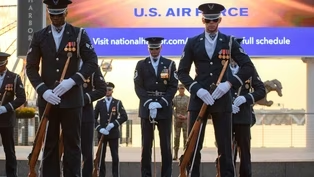
This April, WETA Arts presents three Regional Emmy Award-winning segments from our last season. The U.S. Air Force Honor Guard Drill Team synchronize bayonetted rifles, Omnium Circus reimagines a circus for those with disabilities, and the Smithsonian’s National Museum of Asian Arts partners with the Republic of Yemen to repatriate trafficked antiquities.
Problems playing video? | Closed Captioning Feedback
Problems playing video? | Closed Captioning Feedback
WETA Arts is a local public television program presented by WETA
WETA Arts April 2026
Season 13 Episode 7 | 28m 36sVideo has Closed Captions
This April, WETA Arts presents three Regional Emmy Award-winning segments from our last season. The U.S. Air Force Honor Guard Drill Team synchronize bayonetted rifles, Omnium Circus reimagines a circus for those with disabilities, and the Smithsonian’s National Museum of Asian Arts partners with the Republic of Yemen to repatriate trafficked antiquities.
Problems playing video? | Closed Captioning Feedback
How to Watch WETA Arts
WETA Arts is available to stream on pbs.org and the free PBS App, available on iPhone, Apple TV, Android TV, Android smartphones, Amazon Fire TV, Amazon Fire Tablet, Roku, Samsung Smart TV, and Vizio.
Providing Support for PBS.org
Learn Moreabout PBS online sponsorship♪ Hey, everybody.
I'm Felicia Curry, and welcome to a very special edition of "WETA Arts."
Over the past few years, our show has been honored with multiple Emmy nominations and awards in a variety of categories.
Today's program showcases Emmy-recognized stories of the past year.
In this episode... the Air Force perfects performing.
Woman: I just thought, "That's the coolest thing I've ever seen."
Curry: Omnium Circus accommodates all audiences.
Omnium is expanding people's minds by showing them what people with disabilities can do.
Curry: And in a period of unrest in their homeland, Yemeni antiquities find refuge.
If you don't have history, I don't think you would have a future.
It's all ahead on "WETA Arts."
♪ [Drums beating] Off Interstate 295 in southwest DC at Joint Base Anacostia-Bolling, members of the United States Air Force Honor Guard aim for perfect synchronicity.
Man: All the service branches have honor guards or ceremonial units, and our primary mission is to provide funeral honors for military members in Arlington National Cemetery.
So, if you think about the people that carry the caskets, that's the pallbearer team.
The 21-gun salute everyone knows about.
And the color teams that march, those are the different elements of a funeral.
Man: Team, atten-hut!
Curry: But within the honor guard, there is an elite unit that takes performance to another level.
It's called the Drill Team, and its leader is Master Sergeant Ken Barrows.
Barrows: So, the whole Honor Guard's mission is "To honor with dignity."
We go out and do funerals and ceremonies.
But the Drill Team's mission specifically is to recruit, retain, inspire.
So, we will do high-visibility missions with Air Force leadership and even United States leadership like the President, Secretary of Defense.
We go out to international military band performances.
We go out to air shows to see if we can give back to the community as well as see if we can bring in any potential recruits.
[Applause] The original purpose of drilling is to win the battle.
Curry: Military drilling in the United States dates back to the Revolutionary War.
McKinley: The most disciplined force, the best-organized... the one that can respond to commands quickly, they're usually gonna be able to win.
Anytime you get a group of airmen together... ♪ and you have a narrow focus on precision drill, naturally these members are going to want to elevate their skills and go beyond just the basic weapons' tactical purpose and are designed a little more to entertain or to challenge the member.
It's not easy to do what they do, that 11-pound weapon.
It's not easy to choreograph something like that.
We're one of the only services where the weapon leaves their hands constantly and one of the only services where we redo our routine every year.
Man: Stand easy.
You know what they say-- Amateurs practice till they get it right.
Professionals practice till they can't get it wrong.
So, we're gonna do another one.
Ready?
Move.
[Drums beating] Mask: Perfection is our goal, but excellence is always our standard.
Man: Click.
Curry: Once you're in the Honor Guard, you can apply to be on the Drill Team.
Barrows: I'm looking for a good airman first.
A good airman follows our core values-- integrity first, service before self, and excellence in all we do.
Good airmen will come in here, they'll put the work in, and they're gonna be excellent.
♪ Curry: The Drill Team finds recruits in many ways.
There is a sergeant-- his name is Sergeant Day-- and he was posting about the Drill Team on TikTok, and I just thought, "That is the coolest thing I've ever seen."
It looked so fun.
So, I wanted to be a part of that.
Curry: While women have been in the Air Force since it was created in 1948, they only became eligible to join the Honor Guard in 1971.
McKinley: In 1976, women started performing as pallbearers, as color guard, as firing party.
And then, by the early eighties, Senior Airman Lori Meyers, she became the first female on the Air Force Honor Guard Drill Team.
And she paved the way for a number of women to serve on the Drill Team.
♪ Norwood: Being the ninth female on the Drill Team since 1948 has truly been an honor.
When I first applied for the Honor Guard Drill Team, I didn't make it because I just was not strong enough.
Unfortunately, we're not as strong as the men, genetically speaking.
So, it's very difficult, but it's all mental.
♪ I would come in early to work to try to train with one of the trainers, stay after work, did everything that I could, and then, the second time around, thankfully I made it.
We did change the requirements to be more inclusive.
So, the height requirement we used to have was 5'10", got changed to 5'6".
And it doesn't matter what gender.
And when they do the routine, the maneuvers aren't modified because of gender.
They just have to learn how to manipulate the weapon.
♪ Curry: Those admitted to the team must first perfect the drills.
They will spend another four to six months typically learning how to actually be performance-ready.
Airman Buford's been on Drill Team for about... three months now.
She's not quite performance-ready yet.
Buford: I started off strong, then I got injured.
And it was kind of a struggle after that, but I definitely kept trying my hardest.
I did not want to give up, because I really wanted to join.
Norwood: She's amazing, a very good driller, has the right mindset.
She's smaller than me.
So, you can imagine how that goes.
I don't have a very big wingspan.
So, it's definitely a process of making sure that you're still doing things properly but also not looking crazy.
[Laughs] Curry: And timing is paramount if you're going to create a gauntlet of spinning bayoneted rifles.
Barrows: The first time I ever tried it, I got hit.
It's learning the right steps and the right cadence.
I put a lot of trust in my trainers to tell me, "Hey, this guy's ready to go."
When they tell me that, it's like, "Okay, I know I can walk through there and not get hit."
Curry: Today's performance is at National Harbor.
Barrows: The event is called the Drill at Dusk.
This one's considered a halftime drill.
It's about seven minutes long.
Atten-hut!
Announcer: And now, leading the charge, Master Sergeant Kenneth Barrows of your United States Air Force Honor Guard Drill Team!
[Cheering and applause] ♪ As in every Air Force mission, the Drill Team executes each movement with flawless timing and exacting precision.
♪ McKinley: The philosophies that we follow haven't changed from 1948.
There's still a desire to take everything a step further, excellence in all we do, to serve others, to honor with dignity.
All those things remain the same.
♪ Announcer: Although our routine is frequently revised and improved upon, one tradition remains the same-- the use of the line formation.
Watch the domino effect created by the quick reflexes of each team member, then make some noise and show some love.
The louder you cheer, the harder they will perform.
[Cheering and applause] ♪ I know you can be louder than that.
Give it up for your Drill Team!
[Louder cheering and applause] I would say it's art.
♪ That precision, that discipline, it really does reach people.
♪ Announcer: Representing every member past and present of the United States Air Force, your United States Air Force Honor Guard Drill Team!
[Cheering and applause] Man: That's pretty impressive.
I'm not gonna lie.
I liked the performance, just the way that they maneuvered those weapons.
I was like, what the...?
I've never seen that in my life.
Announcer: Fall out.
Buford: Watching these inspires me to work harder and be better so that I can be out here doing it with them.
Barrows: I thought it was a really good performance.
I'm really proud of them.
There was a couple nerve-wracking parts in there for myself, but it worked out really well.
Norwood: I wanted to be able to show that you can do this whether you're a man, whether you're a woman, whether you're short, whether you're tall.
I wanted to be able to show all the little girls out there, or even the boys out there, that anybody can do it.
Anyone can be a part of that change.
You just have to have the right mindset.
Curry: The Drill Team performs up to 150 times a year around the world.
Follow them on Instagram @usafdrillteam.
There have been clowns and acrobats for thousands of years, but the circus, with its collection of breathtaking acts, only dates to the mid-1800s.
[Circus music] From horse-riding tricks to sound and light show extravaganzas, circuses continue to seek new ways to delight their audiences.
♪ 1, 2, 3, 4, 5, 6, 7, and go.
Curry: In Northern Viriginia, the circus has come to town, but it's not like any circus you've seen before.
Woman: Company, I just wanted to say thank you.
The show is fabulous.
Ready?
Curry: Founder Lisa Lewis has created a circus revolutionary in its inclusivity.
It's called Omnium, which means "of all."
Lewis: 90% of us will face disability at some point in our lives if we live long enough.
[Cheering and applause] What prevents someone from being able to fully participate in a performing-arts experience?
We believe in embracing inclusion.
Lewis: If you're deaf, we use sign language.
Announcer: The clown is doing time steps and tap-dancing.
He's still in a tutu... Lewis: If you're blind, everything is described simultaneously through a set of headsets which you pick up at the coat check.
We have a touch tour.
So, those who are tactilely-oriented can feel little miniature props.
There are people for whom noise is very triggering.
So, we make sure that the decibel level never gets too high.
We leave the house lights on.
If someone gets deregulated and they need to leave to go to the calming center, they need to do so safely.
We create as much access as we possibly can to make sure that everybody is able to enjoy the production.
♪ And anything that anybody else needs, if you write me in advance and if we can do it, we will.
Man: So, Dick is onstage juggling.
Malik does his dance.
So, anything you might need from production is gonna be right next to the green rooms.
Woman: Do you need some help with them?
Lewis: Oh, and I need to unpack that one sometime.
Man: Check, 1, 2.
Lewis: Eric's here!
It's good to see you!
Okay.
Curry: Eric Latcheran of Chantilly, Virginia, works with Lewis promoting Omnium.
He and his mother, Gina Latcheran, were among the first to discover Omnium when it was founded in 2021.
I love the circus, but he was scared to death.
The noise, the smells, everything that came along with the circus.
♪ Curry: Omnium's approach makes it possible for Eric, who has Down syndrome, and his mom to enjoy the circus together.
Gina: The lights were on.
There were no loud noises, just fun.
The performers came and introduced themselves.
Clowns without makeup... Gina: Or without something that might have been scary.
What color is this?
Yeah.
Gina: I think the favorite part is that he's made friends.
Gina: It's improving his speech.
It's improving his energy level, and that's wonderful.
Come on.
We got to go help your mom.
Eric: OK.
Curry: Not only did Lewis expand the potential audience, she took it one step further.
Lewis: I looked in the ring, and I thought, "The people in the ring "don't represent the people in the audience.
Why can't that be more connected?"
♪ Curry: Including staff and performers, 40% of the people in Omnium have a disability.
I am an actor, director, dancer, artistic director... and producer.
I have osteogenesis imperfecta.
We go... Yes, so, when you're sending me off, do I need to-- What happens... If you've met other people with OI, we are the biggest hams in the entire world.
And then I jump out of the chair.
Man: Right.
And then it's just for a little bit.
Really, until Omnium, I was very uncomfortable around circus because of the "freak" idea and all of that stuff.
Lisa really takes Omnium and turns that on its head.
Thank you, Suzy.
Lisa convinced me in her authenticity.
I believed in what she was doing.
Man: 5, 6, 7, and boom!
And to get to do circus stuff?
Come on.
How fun is that?
Ooh, it's gonna be so fun.
It is going to be a fabulous collection of some of the best circus acts in the entire world.
One of our dancers is a seven-time NCAA gymnastics champion, and he does a tap-dance number.
Our aerialist is a beautiful aerialist.
Legs are irrelevant.
I get comments all the time-- "Are you a sideshow?
Are you a freak show?"
No, obviously not.
But go back in history.
People with disabilities were not given any opportunities.
But the circus itself was a big proponent of people with disabilities.
It's really truly special to work together and create and really see the gifts and the talents in each person.
You guys are all such special, special people.
We've got this.
Man: Whoo!
And what are we gonna do?
All: Change the [bleep] world!
[Cheering] Go get them, everybody!
Curry: It's showtime.
♪ Welcome to Omnium, a bold new circus.
♪ [Applause] ♪ [Applause] ♪ I don't know how to describe it.
Like, it was so, like, perfect.
The jump rope, that was really amazing.
[Laughs] ♪ Gina: I see so many friends who are coming back year after year.
Omnium is expanding people's minds by showing them what people with disabilities can do.
It's not reliant upon verbal skills.
It's not reliant upon intellectual skills.
And that's such a beautiful, unifying force for people.
For a brief moment in time, we can all connect with our hearts.
[Cheering] Man: Whoo!
Curry: For more information about where Omnium Circus is performing next, go to omniumcircus.org.
For many people, ancient artifacts provide a deep connection to the past.
But governments have to work hard to protect their country's heritage from wanton destruction and looting, especially in areas of the world struggling with civil unrest.
One such government, the Republic of Yemen, is taking an active role in preserving its priceless antiquities right here in Washington DC.
Now to a major legal case involving the alleged smuggling of ancient religious artifacts.
We cannot accept that terrorists steal cultural goods.
Individuals are trying to sell objects which appear to have been illegally looted and trafficked.
Curry: An epidemic of crime is plaguing the world of ancient art.
Man: Iran lost more than 15,000 artifacts.
Many of them are extremely important.
Curry: Around the world, looters are plundering objects from cultural heritage sites.
Man: It's easy to dig in some desert and just take these priceless artifacts to sell them if you have markets.
Man: The United States has a strong law-enforcement obligation and interest to bring these objects out of the market.
Man: We work around the clock to pursue those individuals that are behind the looting and theft of these artifacts and trafficking them.
Curry: Special agent Robert Mancene works for Homeland Security Investigations, or HSI, in the Cultural Property, Art, and Antiquities unit.
On my phone, I probably have about 15,000 pictures of artifacts that I'm happy to have been able to return.
There are Greek pieces.
There are Italian pieces.
There are Turkish pieces.
Curry: While investigating a transnational trafficking network, Mancene's team found a New York-based gallery owner who was dealing in stolen goods.
Mancene: Over a thousand objects of many different origins were seized.
Among those, 64 were from the country of Yemen, those stone-carved heads.
♪ These steles really tell the rough journey of these objects.
The nose is broken.
Tape was attached to them.
They have blue pigment.
It's modern blue pigment.
They tell very much the story of how... careless were the smugglers.
Where is the respect of funerary objects?
♪ It's a region that has hundreds of archaeological sites.
How do you protect them?
We also need to consider why all these objects are getting out.
Lenderking: Buyers can be part of cultural trafficking networks, and that's a particular concern for the United States government.
Money that's falling into either criminal syndicates or used for the purposes of carrying out acts of terrorism, these are things that we have to be on the lookout for.
Curry: Returning an artifact to its country of origin is called repatriation.
Al-Hadhrami: We were approached by the U.S.
that, "We have these artifacts we wanted to repatriate to Yemen."
For me, it was a happy news, but then I looked at the situation in Yemen.
Curry: Yemen has been in a state of civil war since 2014.
Al-Hadhrami: Unfortunately, all you hear about Yemen is war, conflict, Iranian-backed militia that are just firing at the Red Sea.
Lenderking: The contemporary significance of Yemen is that it's a strategically located country at the bottom of the Arabian Peninsula.
These are areas through which, say, 15%, 17% of world commerce actually pass.
And that's one reason why people have fought over Yemen, I think, for hundreds of years.
Curry: The same geography that intensifies conflict now created untold wealth in antiquity.
From antiquity's perspective, all trade has to go through Yemen, and that made powerful kingdoms and civilizations within Yemen.
Catanzariti: The kingdoms interacted with a lot of cultures from the East and the West.
Yemen becomes a crossroad of culture, artistic traditions, economic exchange, you name it.
Curry: The Smithsonian's National Museum of Asian Art's permanent collection contains Yemeni artifacts unearthed by archaeologists, whose records, as much as the objects themselves, help scholars piece together what life was like centuries ago.
Catanzariti: It allows us to go to the excavation reports and understand these objects.
We know that the lions come from a residence of a trader.
That allows us to better understand how residences were decorated.
The permanent collection that we have has an archaeological context.
The repatriated objects do not have an archaeological context, and we're losing that kind of information when it's looted.
Mancene: They're a piece of history.
People feel they need to have them.
So, maybe it's that.
Maybe it's because they're so beautiful.
Many of the objects that you will see in museums were purchased or donated a long time ago, before law enforcement really began to crack down on the art market.
Curry: And the United States has been cracking down, not just on smugglers but on collectors.
Mancene: Working with the Antiquities Trafficking Unit, we were able to execute some warrants at a home of a private citizen, and we were able to seize dozens of artifacts from many, many different countries, and amongst those were these three Yemeni artifacts-- an alabaster ram, an alabaster female figure, and a silver vessel.
Catanzariti: The silver vessel, we have no idea where it comes from.
It was probably-- our assumption again-- owned by elite people, but we don't know that.
Mancene: When you deprive a country of their cultural property, you're hurting countless individuals.
Al-Hadhrami: Although we have other priorities now, at the same time, we cannot ignore that our history has been stolen, and if you don't have history, I don't think you would have a future.
Curry: The solution Ambassador Al-Hadhrami proposed was an historic partnership.
Al-Hadhrami: I looked at the situation in Yemen and talked to my government and to the U.S.
and said, "You know, I think it would be better at this stage for these priceless artifacts to just find good institutions that would house them for safekeeping in the U.S.
So, the ambassador comes to us and says, "Can you help us look after these pieces?"
And we say, "Yes."
It's allowed us to explore in a new way how we can be the very best partners in their ongoing efforts to preserve their cultural heritage.
Curry: The Smithsonian's National Museum of Asian Art's specialists are collaborating with Yemen's scholars to try to recover the secrets these objects could reveal about what life was like centuries ago.
Robinson: The position our museum is taking is that we're going to document those stories.
Less and less will we be presenting objects as if they'd fallen out of the sky.
We're not just putting these items here just for safekeeping anymore.
We're really starting a partnership with the Smithsonian that would preserve Yemeni heritage, preserve these cultures, and put them into context.
Curry: On February 21, 2023, the Embassy of the Republic of Yemen hosted a repatriation ceremony.
Mancene: It was a very joyous occasion.
People were very moved to have their objects back.
Al-Hadhrami: I felt relief that now we could claim that we brought them back home, even though they're staying here in the U.S.
for the moment.
But they will be displayed as a temporary loan from the Republic of Yemen.
That actually gives back these pieces the respect they deserve.
Lenderking: This is really a very important way of the United States helping to connect with these countries culturally.
And in the case of Yemen, these artifacts are cultural unifiers in a country that has been enmeshed in civil war for the last eight years.
I think the broader lesson that I hope we're having some success in transmitting is that habits of collecting need to change.
♪ To see Yemen's repatriated artifacts for yourself, visit the National Museum of Asian Art at 1050 Independence Avenue Southwest.
For more information, go to their website at asia.si.edu.
Here's a thought from President John F. Kennedy-- "Art establishes the basic human truth "which must serve as the touchstone of our judgement."
Thank you for watching "WETA Arts."
Be well, be creative, and enjoy the art all around you.
I'm Felicia Curry.
Mask: It is crazy how much laundry and upkeep we have to do.
When people see those uniforms, I don't think they know how much it takes.
We're federal criminal investigators, but, yeah, we have the moniker of "special agent," so... I mean, my mommy thinks I'm special, so...ha ha ha.
[Indistinct chatter] ♪ Narrator: For more about the artists and institutions featured in this episode, go to weta.org/arts.
Preview: S13 Ep7 | 30s | U.S. Air Force Drill Team, Omnium Circus & Yemen’s Repatriated Antiquities (30s)
Providing Support for PBS.org
Learn Moreabout PBS online sponsorship

- Arts and Music
The Best of the Joy of Painting with Bob Ross
A pop icon, Bob Ross offers soothing words of wisdom as he paints captivating landscapes.












Support for PBS provided by:
WETA Arts is a local public television program presented by WETA