
WETA Arts: February 2021
Season 8 Episode 1 | 25m 45sVideo has Closed Captions
WETA Arts celebrates Black History Month with stories from around DC.
WETA Arts celebrates Black History Month, featuring an award-winning fiction film about neighborhood change in DC, a documentary about the history of segregation in Alexandria, a first-generation Ethiopian American musician who fuses the music of his heritage with that of the African diaspora, and a Black actor who is on the front lines of representation, equity, inclusion in DC’s theatre scene.
Problems playing video? | Closed Captioning Feedback
Problems playing video? | Closed Captioning Feedback
WETA Arts is a local public television program presented by WETA
WETA Arts: February 2021
Season 8 Episode 1 | 25m 45sVideo has Closed Captions
WETA Arts celebrates Black History Month, featuring an award-winning fiction film about neighborhood change in DC, a documentary about the history of segregation in Alexandria, a first-generation Ethiopian American musician who fuses the music of his heritage with that of the African diaspora, and a Black actor who is on the front lines of representation, equity, inclusion in DC’s theatre scene.
Problems playing video? | Closed Captioning Feedback
How to Watch WETA Arts
WETA Arts is available to stream on pbs.org and the free PBS App, available on iPhone, Apple TV, Android TV, Android smartphones, Amazon Fire TV, Amazon Fire Tablet, Roku, Samsung Smart TV, and Vizio.
Providing Support for PBS.org
Learn Moreabout PBS online sponsorshipHello.
I'm Robert Aubry Davis, and welcome to "WETA Arts," the place to discover what's going on in the creative and performing arts in the DC area.
A local filmmaker's first feature, "Residue," cuts close to home.
Merawi Gerima: It's as realistic as I could've made it to illustrate how it feels being Black in DC and watching the city pulled right from under you.
A musician discovers Colombian music with African roots.
Kumera Zakarias: What I've done as a musician with Kino Musica is taking my own heritage as a starting place for making connections.
Davis: Two local artists reveal Alexandria history through dollhouses... Robin Hamilton: You have this very beautiful, idyllic town, and yet there's the backdrop of the evils of segregation.
Davis: and we meet award-winning, DC-based actor Felicia Curry, who gives us a glimpse into today's theater scene.
It's all ahead on "WETA Arts."
Davis: The film "Residue" has earned international acclaim for a story about a man who finds his old neighborhood unrecognizable.
"Residue" filmmaker Merawi Gerima talks with WETA film critic Travis Hobson about the film's depiction of racism and neighborhood change here in Washington.
Thanks for joining me, man.
Thank you for having me, Travis.
Talk to me a little bit about "Residue" and the story and how you came up with it.
"Residue" is a film about a young man who's returning to his neighborhood after many years away to make a film about his childhood and his neighborhood, but when he gets back to his neighborhood, he's not really able to recognize, you know, this place where he grew up... Y'all remember me?
Jay from across the street.
Gerima: and so it's about him and what happened to the neighborhood and how to fit in at this new city which is not really designed for him.
Are there any particular scenes in the film that you would say directly correlate to your own experiences, to your own life?
There's a scene in the film where Jay is coming out of his house with his mother, and they find, you know, this white couple letting their dog poop on his mother's lawn.
You know what happened to them?
I think they moved.
I know the grandfather passed not too long ago.
And then she tried to lie about it, and I was just like, "Why would you lie to me?"
That just really doesn't make any sense.
Oh, hell no.
Uh-uh.
Get off my lawn.
Shoo!
Shoo.
I was going to clean it up.
It's not a big deal.
Clean it up?
No.
It-- When you clean that poop up, it still leaves a residue.
Uh-uh.
I'm sorry.
Not on my lawn.
Man: Listen.
You don't have to be a jerk.
Come on, Rachel.
Let's get out of here.
Man: Ha ha!
She's crazy.
Wait, wait, wait.
Jay, we got bigger fish to fry.
Come on.
I got to get to the office.
[Indistinct] Man: Have a nice [beep] day.
Rachel: [Beep]damn.
Jay-- Jay, no, no, no.
Jay, stop.
Stop.
Rachel: Come on, Jim.
Jay, come here.
Come on.
Don't listen to him.
Jay, come on.
I got to get to the office.
Jay, stop.
Come on.
Look.
You can't fall for that [beep].
He's a decoy, Jay.
Those are the decoys.
How many people do we know, lives wasted on some [beep] like that?
The reason it was important to put that in the film was because, you know, Jay's mother is somebody who, you know, he's taking cues from, you know, in terms of, like, what's going on in the city.
When I first got back to DC, I was so caught up in just kind of the really angry, entitled, white folks telling you what to do and how to act in your own city.
My mother was trying to keep me focused on, "If you really care, you can't get lost in these, you know, small skirmishes."
It's probably in that moment that really the drive to make "Residue" was really born, and that's kind of my way of listening to her.
Hopson: Yeah.
That anger really comes through.
It's kind of simmering within him from the very beginning.
I think about that scene really early on where a guy's telling him to turn his music down and he doesn't really know quite how to react to it.
Man: Hey, is this your truck?
Yeah.
Turn the music down.
The music's too loud.
Who are you?
I'm Jake.
I live up the street.
Turn the music down.
You're also double-parked.
Don't make me have to call the cops.
The film encompasses a wide variety of themes.
Obviously, gentrification is one, police violence, identity, but the narrative, it's almost surreal, I think, in its presentation.
I really love that.
People do call the film surreal, you know.
I mean, it's realistic as I could've made it to illustrate how it feels being Black in DC and just kind of watching your city being, you know, kind of pulled right from under you, and--you're right-- it's a mixture of confusion and anger because you could never imagine in a million years somebody talking to you like that, telling him to turn his music down.
Are you interested in telling any other stories from the area for your next project, or what's in line for you?
Everything I think of kind of comes out of the DC area and DC culture.
Part of the task is, of course, pursuing my own projects, but also, like, finding ways to, like, nurture and curate a broader film culture in the city.
There are quarter of a million hypercreative Black folks in DC who are raring and ready to go, so many stories that I wouldn't even have a handle on.
Well, I'm looking forward to seeing what you do next and seeing you grow as a filmmaker, man.
Appreciate it.
Merawi Gerima, thanks for joining us to talk about "Residue."
I really appreciate it.
Travis, thank you so much, man.
It's been a pleasure.
Davis: You can see "Residue" on Netflix and you can request a screening for your group through the distributor Array.
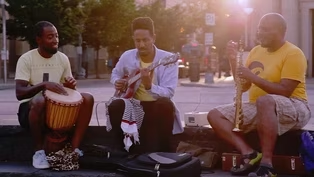
DC has a thriving Ethiopian music scene with many cover bands playing hits from home.
The band Kino Musica, however, is breaking new ground with a musical fusion based on sounds from all over the African diaspora.
Zakarias: I'm Kumera Zakarias, and I'm a musician and educator.
I am the founder of Kino Musica.
I've been the bandleader for about 5 years.
[Singing in Amharic] We have covered music from Cape Verde, from Nigeria, from the Horn of Africa.
In the Pacific Coast of Colombia during the time of enslavement in the colonial period, the terrain allowed enslaved Africans to escape.
These descendants of Africans live in relative isolation from other communities, and so because of that, you see a lot of musical instruments, particularly the marimba, that have direct predecessors in Africa.
You can kind of line up some elements of musica del Pacifico and play a song from Mali, and it sounds--has that same kind of bluesy delivery style.
I found wonderful musicians to record with in Bogota, Colombia.
There is some instruction that I did in terms of how to play Ethiopian music, but it was something that was really intuitive for them because the rhythms were so similar.
I grew up in Austin, Texas.
It was mostly a Mexican immigrant neighborhood, and so that was a lot of my early musical influences, was from those traditions.
My parents are from two different ethnicities in Ethiopia.
My mom is Amhara, and my father is Oromo.
Ethiopia has about 80 ethnicities.
There's no real one Oromo music, but there are a lot of different styles that are tied to different regions.
I've really, really delved into the musical styles that come from the Horn of Africa, not just Ethiopia, but the collective region.
It is in some ways using music as a way for me to connect with my own ancestry and a way to connect and learn about my culture outside of the family dynamic.
I found it to be really rewarding to be able to independently kind of learn about my music and still honoring where I came from.
My experiences working in DC in Northwest DC around Columbia Heights and Petworth were part of the initial inspiration that I had for starting Kino Musica.
I learned so much about Salvadoran cumbia, and I listened so much to Los Hermanos Flores and groups like that, and so I started just putting all these influences together, and we started the group.
We wanted to make original music that was inspired by classic Ethiopian music and music from other genres.
It's very difficult for musicians to record or create new, original compositions in this style in part because a lot of the audience want to hear the classics.
They want to hear covers.
For me, as an Ethiopian American, as a second-generation American, to put my music within other contexts where there is African American or Latin American, that's showing a more realistic and human side to who we are and what our presence is in the DC area.
DC is a city with a very diverse Black community, and this is something that we're very conscious about in our group, that we're putting Ethiopian music in other musics, making a connection to African American traditions.
It's also important that we're inclusive about what is African music.
Davis: Here's Kino Musica covering "Arke Yehuma," a timeless Ethiopian love song.
["Arke Yehuma" playing] Zakarias: ♪ Your love came to me ♪ ♪ Your love came to me ♪ ♪ Your love came to me ♪ ♪ Your love came to me ♪ ♪ And I want your love ♪ ♪ And I want your love ♪ ♪ Your love came to me ♪ ♪ Your love came to me ♪ ♪ Your love came to me ♪ ♪ Your love... ♪ ♪ And I want your love ♪ ♪ And I want your love ♪ ♪ And I want your love ♪ ♪ And I want your love ♪ ♪ And I want your love ♪ ♪ And I want your love ♪ [Music ends] Davis: Local filmmaker Robin Hamilton set out to make a film about two Alexandria artists who create miniatures and ended up exploring an overlooked part of Alexandria's history.
I'm Robin Hamilton, and I am a filmmaker, and I directed and produced "Our Alexandria."
"Our Alexandria" is a film, a documentary film, about two artists-- Linwood and Sharon.
They recreated their stories, their childhood, their memories, through dollhouses.
You often think of dollhouses as play and fun, but there was a level of history.
There was something deeper in those houses.
The clip you're about to see is one of my favorite clips because it showcases what community is all about.
Sharon: This lady made fried chicken and chitlin', which a lot of people don't know--Black people do-- chitlin' dinners and cakes and pies, and she sold them to make money.
My friend Leonard would go there and buy these dinners for his mom, maybe on Friday or Saturday, and this helped this lady.
This helped her income.
This gave her a means to help pay for her home or just to live.
Lot of clubs and churches still do this selling of the dinners, so that's a combination story of Thanksgiving and selling dinners.
It wasn't just a source of filling your stomach, so to speak.
It was also a source of filling each other up emotionally.
People felt safe.
They remembered her.
They felt nurtured, and when I look at that clip, when I look at that dollhouse, that's what I feel.
Even the hues of the house are these warm, orange, yellowish.
It's a glow, and it represents warmth, and I think that says family.
That says community, and that's why I think that particular house is so special.
This next clip we're gonna watch is about the work that Sharon did.
She was a public health nurse, and she was able to represent that in this particular dollhouse.
Sharon: I was a public health nurse there for 33 years, and I did home visits and also worked in the clinic, in various clinics.
Will they be tuberculosis, sexually transmitted diseases?
Yeah.
This is real, HIV, all of that, a maternal job.
You know, we would go out and visit, so from birth to chronic diseases.
High blood pressure, you know, that's a big thing in the African American community, so patients with everything, but back in the day, public health was real important in the community.
To go out, to reach out, we did home visits and encouraged them to come in for health care, not just to wait until they were so sick, they would be going to the emergency room.
You tried to encourage them to come in and do preventative care to take care of yourself.
Hamilton: One of the reasons why she wanted to be a public health nurse was because she did not see her people in her community being taken care of, and she really wanted to let her community know that this may not be accessible to you in other parts of Alexandria, but we can help you take preventative care.
You have this very beautiful, idyllic town told through childlike eyes, and yet there's this backdrop of Jim Crow.
There's this backdrop of the evils of segregation.
There were very reluctant initially to let me do a film on them, and I found it so interesting because they said, "We're not doing anything special."
I just feel like you never know who has an incredible story to tell, and all of us have talents and gifts, and those gifts matter.
They matter, and they make a real contribution to the community, and this film is proof.
Their work is proof that everyone's voice matters and everyone's voice contributes to society in some way, and we need to value that and respect that.
Davis: You can get a copy of "Our Alexandria" or arrange for a screening for your group via the filmmaker's website.
♪ There may be a twist or turn ♪ ♪ But be strong, and you will learn... ♪ Davis: My guest has played practically every theater in DC, from Factory 449 to the Kennedy Center.
She's been nominated for 9 Helen Hayes Awards which recognize excellence in theater in Washington, DC.
Capitol Steps: ♪ 76 unknowns... ♪ Davis: She's even performed with the political satire group the Capitol Steps, and we're pleased to welcome Felicia Curry to "WETA Arts."
Felicia, well, "A," welcome, and, "B," of course, I've seen everything you've ever done.
Hi, Robert.
Thank you.
March of 2020 came, and, of course, I was seeing theater every single day the way I do, and then all of a sudden, it was a cliff.
Tell me what jumping off that cliff was like for you.
You say, "March of 2020," and everything floods back.
I was doing my first one-woman show at Everyman Theatre up in Baltimore, and it was a world-premiere commission by Caleen Sinette Jennings, a local DC playwright.
We were in our first full week of the run...
I want to be an actress.
Read every play you can get your hands on.
Prepare yourself to play Hansberry, Shakespeare and everything in between.
Curry: and I remember distinctly, on that Saturday afternoon, a couple of patrons came in with hoods on and masks on, and I knew something was happening.
♪ Gonna walk around Harlem in my brand-new shoes ♪ ♪ Gonna walk around Harlem ♪ ♪ Bye-bye, Green Mountain blues ♪ Curry: After that evening, we closed the show.
I was sent home and told that we would be back in a month.
Everyman was actually one of the first theaters to work through an Actors' Equity contract to record "Queens Girl: Black in the Green Mountains" so that the masses, the world, can see Caleen's story.
Tell me what you were doing right to that moment and how you dealt with it.
Before all of this happened, I had just finished a show at the Kennedy Center by Mo Willems and Deborah Wicks La Puma called "Don't Let the Pigeon Drive the Bus"... ♪ As a bus-driving bus driver ♪ Curry: and I mention Mo because he did something really wonderful through the Kennedy Center.
I'm gonna do a Lunch Doodles with you.
Curry: He would sit down with the young people live on Zoom and create with them.
Mo was showing us that creating art was a way to shift... You are a very good friend.
Curry: and as we got further into it, people stated realizing, beyond just doing readings, we could actually produce theater.
I know that Arena Stage did a one-woman production outside.
I know that Signature Theatre, Olney Theatre... Woman: ♪ How do you solve a problem like Maria?
♪ Curry: have been producing events with theater artists where you can see us work, give a little piece of ourselves so that the art is still being created.
And we have to, you know, concern ourselves not just with the theater performers.
Keeping these theaters together is a massively complicated project, trying to keep people with a paycheck.
You've been working with some organizations that have been doing that, as well, right?
Absolutely.
I mean, you say that, and I immediately think of theatreWashington, who has really taken care of the DC arts community.
They have a program called Taking Care of Our Own and was used to help theater artists that were struggling, and these theaters, when I'm talking about creating this online content, this is the way the theaters are taking care of their theater artists.
Everybody had to pivot.
What was the pivot like for you?
What did you do in life?
I've been lucky to be able to work on a lot of online projects with theaters all over DC.
I did "Will on the Hill" with Shakespeare Theatre, which is usually an in-person event.
I've done a couple of readings for Theater J and for Signature Theater.
I worked with an organization called the Black Artist Coalition to put together a piece called "I Am... A Celebration of Black Artistry," which came immediately after the George Floyd event.
♪ Just you and me ♪ ♪ Just be the change... ♪ Curry: When I realized that theater wasn't going to come back for a little while, I've been teaching fitness at a place called Rock the Reformer.
Well, Felicia, I know about another role you'll be picking up, and it's time to tell our viewers.
I'm stepping down as your host for "WETA Arts" after 7 years, and Felicia will be taking the helm as your new host of "WETA Arts."
It's been such an honor to bring you the latest on our arts scene here in the DMV, and I could not be more pleased that Felicia will succeed me in fulfilling the mission of this important show.
I personally am excited to see the show grow under Felicia's stewardship.
If you still want to catch me, I'll be continuing to provide my take on local events on WETA's "Around Town."
I've truly enjoyed our time together, and with that, thank you for watching this edition of "WETA Arts."
I'm Robert Aubry Davis... And until next time, I'm Felicia Curry.
Announcer: For more about the artists and institutions featured in this episode, go to weta.org/arts.
Preview: WETA Arts: February 2021
Preview: S8 Ep1 | 30s | WETA Arts celebrates Black History Month with stories from around DC. (30s)
Providing Support for PBS.org
Learn Moreabout PBS online sponsorship
- Arts and Music
The Best of the Joy of Painting with Bob Ross
A pop icon, Bob Ross offers soothing words of wisdom as he paints captivating landscapes.













Support for PBS provided by:
WETA Arts is a local public television program presented by WETA