
WETA Arts February 2022
Season 9 Episode 5 | 28m 44sVideo has Closed Captions
Hip hop artist Warren “WAWA” Snipe; fashion designer Nikki Hendricks; Jubilee Voices.
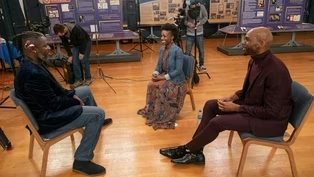
Felicia Curry interviews deaf hip hop artist Warren “WAWA” Snipe, an actor & activist who went viral for his American Sign Language interpretation of the “The Star-Spangled Banner” at last year’s Super Bowl. Fashion designer Nikki Hendricks’ collections respond to current events & history, and the Washington Revels Jubilee Voices ensemble works to preserve African American history through music.
Problems playing video? | Closed Captioning Feedback
Problems playing video? | Closed Captioning Feedback
WETA Arts is a local public television program presented by WETA
WETA Arts February 2022
Season 9 Episode 5 | 28m 44sVideo has Closed Captions
Felicia Curry interviews deaf hip hop artist Warren “WAWA” Snipe, an actor & activist who went viral for his American Sign Language interpretation of the “The Star-Spangled Banner” at last year’s Super Bowl. Fashion designer Nikki Hendricks’ collections respond to current events & history, and the Washington Revels Jubilee Voices ensemble works to preserve African American history through music.
Problems playing video? | Closed Captioning Feedback
How to Watch WETA Arts
WETA Arts is available to stream on pbs.org and the free PBS App, available on iPhone, Apple TV, Android TV, Android smartphones, Amazon Fire TV, Amazon Fire Tablet, Roku, Samsung Smart TV, and Vizio.
Providing Support for PBS.org
Learn Moreabout PBS online sponsorshipHey, everybody.
I'm Felicia Curry, and welcome to "WETA Arts," the place to discover what's going on in the creative and performing arts in and around D.C. Curry, voice-over: First, I speak with Warren "WAWA" Snipe, creator of dip hop, also known as deaf hip-hop, about his journey from Gallaudet University to the Super Bowl to Hollywood.
Interpreter: Music.
Music does not discriminate.
And for me, I would like to bring you into the Deaf community.
Curry, voice-over: A local fashion designer goes green.
Woman: I didn't have any plastic in that collection.
Not at all.
I mean... not--not any zippers, no polyester.
Nothing.
All: ♪ And before... ♪ Curry, voice-over: We revisit a story about a singing ensemble that powerfully combines historical reenactment and traditional music.
Woman: Some of us are dressed as enslaved people.
It helps to make the music real.
All these stories coming up on "WETA Arts."
♪ [Hip hop music playing] Curry, voice-over: Acclaimed D.C.-based hip-hop artist WAWA, also known as Warren Snipe, picked up a mic in 1990 and hasn't stopped rapping since.
I interviewed him at his alma mater, Gallaudet University, where with the assistance of an American Sign Language interpreter, we talked about what it's like in what he calls WAWA's World.
WAWA, welcome to "WETA Arts."
I also want to welcome Juran.
We are so excited to have you here.
So I'm gonna start by asking you the question I think everyone is wondering about.
"WAWA."
where did it come from?
Juran, interpreting: Growing up in Philadelphia, Pennsylvania, some couldn't pronounce "Warren" because of that "R." You know the accent there in Philly.
Um...so...
I roll my "R"s, almost like how the Spanish language rolls their "R"s. But it wasn't completely clear pronunciation.
So instead, we used WAWA.
Curry, voice-over: WAWA's high school English teacher encouraged him to apply to Gallaudet University in Northeast D.C., the nation's oldest school for the deaf.
Gallaudet was his first encounter with sign language.
Juran, interpreting: I can understand you.
You can understand me.
I don't have to say "Huh?"
or "What?"
or ask again.
It was the best thing that ever happened to me, because I felt included.
I felt as though I belonged.
I didn't feel as though I was the only one.
I wasn't the last person to know or find out about something.
One of your videos, "Only ASL One"-- Can you tell me a little bit about that video and what kind of influence Gallaudet had on that?
Juran, interpreting: You know, sometimes people take that first ASL class and they see a deaf person and they find out that they're deaf and they know that they're learning ASL, and they finally meet that person, they want to talk to that person.
So this really talks about that first interaction.
[Hip hop music playing] Your inspiration and your passion for really educating folks about the Deaf community and in particular about Black Deaf history, where does that show up in your music?
Does it show up in your music?
Juran, interpreting: So I wrote a song called "Black Deaf in America."
It's like a Who's Who in the Black Deaf community.
I mean, you hearing people are supposed to know them.
So I'm giving that introduction from them to you, you to them.
Curry, voice-over: The song became the basis of Black History Month class projects, like this video made by students at the Ohio School for the Deaf.
WAWA: ♪ Andrew Foster, man with the plan ♪ ♪ Built 32 schools in Africa motherland ♪ ♪ Claudia Gordon, lawyer from my tribe ♪ ♪ Breakin’ down barriers and she rise ♪ ♪ CJ Jones, the freakin’ living legend ♪ ♪ "Baby Driver," "Avatar," man, where you been?
♪ ♪ Ernest Hairston and Linwood Smith ♪ ♪ Black Deaf in America, the book, yo get it, get it ♪ ♪ Whoo!
Oh, my gosh, I'm just getting started ♪ Curry, voice-over: As a kid, WAWA liked old-school rappers like LL Cool J, Run DMC, Queen Latifah, but he couldn't understand what they were saying.
[Hip hop music playing] Juran, interpreting: Now, my sister, bless her heart.
She always would write down the lyrics for me for songs.
And then she would mouth them with the speaker's next to her.
And I'll watch the speaker and I'll watch her... her lips and then the music.
So I was able to follow.
That helped me tremendously.
I said, "Oh, man, I want to do that.
"I don't have to sing.
I can rap, you know, almost like talking."
[Hip hop music playing] Curry: How do you hear the music?
How are you able to communicate with the collaborators in the room to make everything happen?
Juran, interpreting: Now, on stage, of course, you practice, but I need to have additional monitors placed on the stage so I'm able to feel the vibration.
♪ What that mean to me?
Lemme see... ♪ ♪ (Nothing, nothing) ♪ ♪ Cawfee, cream, please, then I keep on truckin’ ♪ ♪ Judgin’ by the cover, ya can’t read blank noggin’ ♪ ♪ I B ME (aayyee) yeah, I’m buggin’ ♪ ♪ Old skool, daddy, I see you kinda lovin’ (it) ♪ ♪ Got my CI and my hands do the talkin’ ♪ ♪ I’m a late bloomer, but you got your head bobbin' ♪ Your song "Loud"... Tell me about how that came about.
Juran, interpreting: The pandemic was quite stressful, but we can still move forward and enjoy ourselves.
So I wrote based on that.
["Loud" playing] The Deaf community and the hearing community, I was ready to release it to them, but I was not expecting it to go viral.
So the whole world was jumping on this, and it was a "Wow" moment for me.
Curry, voice-over: WAWA fell in love with acting at Gallaudet and found roles in theaters around D.C. and along the east coast.
Then he was hired to interpret the National Anthem at Super Bowl LV.
Juran, interpreting: So, I realized that the world will be watching this.
So, how will I, as a signer, sign it in a way that everyone can understand?
Now, American Sign Language, it's one, but there are other languages that share sign language, and we call that Universal Sign Language.
So that is a set language.
So I decided to include Universal Sign in my performance so everyone, not just deaf people, but hearing people, too, understand what was being done.
So, I practiced and I practiced every day in my bathroom.
I know I looked like an idiot, but I did not care.
["National Anthem" playing] Man: ♪ O say can you see ♪ ♪ By the dawn's early light ♪ ♪ What so proudly we hailed ♪ ♪ At the twilight's last gleaming ♪ Juran, interpreting: Next thing I know, I have so many text messages from people that I don't even know.
They were reporters, reporters.
I'm like, "How in the world did reporters get my number?"
So I'm trying to respond to them.
They're asking so many different questions.
I must have answered questions until about 2:00 or 3:00 that morning.
Curry, voice-over: The press also reported on his recurring role as Terry in the DC Comics-based television series "Black Lightning."
Juran, interpreting: You know, I grew up reading the comic book of that character, and I remember watching the very first season of that.
I watched it religiously.
Oh, man, I loved that show.
French spelling or an Arabic name... which means lovable.
What do you want with our daughter, Anissa?
Juwan, interpreting: I've done two seasons with them so far, and it's been so great, and other opportunities are just coming in since then.
It's been great.
So what do you say to the folks who may say that rap and hip-hop is really a young person's game?
Juwan, interpreting: So you mean I'm too old to rap now?
Please!
But really, rap is for everyone.
Rap is for everyone.
Music--music does not discriminate.
And for me, I would like to bring you into the Deaf community, and this is through my eyes, my lens.
Many people in the Deaf community have different perspectives, but this is WAWA's world.
This is what it means for me.
I'm not asking you to like it, but I'm asking you to respect it.
Well, thank you so much for inviting us into WAWA's world.
We really appreciate having you on "WETA Arts."
Juwan, interpreting: Thank you.
Thank you.
I really appreciate being here.
It was great.
[Hip hop music playing] WAWA's 2021 album "Wamilton," as well as many of his other releases are available now on all major music streaming platforms.
[Music playing] Curry, voice-over: D.C. has a growing high-fashion scene, and Nikki Hendricks is giving it fire.
She teamed up with the people behind the Capital Fringe Festival to give her designs a global consciousness.
My name is Nikki Hendricks.
I'm a creative that loves fashion.
Hendricks Designs is usually colorful.
It's for confident people who are not afraid to live life differently.
Curry, voice-over: Her latest collection is inspired by her collaboration with DC Arts promoter Capital Fringe.
Woman: Capital Fringe is a non-profit arts organization here in the District of Columbia.
And our main mission is to give artists a launching pad to further their careers.
In 2020, we created the residency Down to Earth to provide earning opportunities to local artists.
We received about 150 applications, and they really were primarily from visual artists.
Nikki was the only fashion artist that applied to the program.
It was a residency that had my name all over it.
The themes were perfect.
It was spot on with my brand.
Immediately, I started planning, putting things together, taking trips to the Aquatic Gardens, learning about the environment, learning about the people that used to live in the park, the indigenous people... learning about the plant life, the vegetation, and how I could incorporate that into the patterns.
Brienza: Nikki's proposal allowed the program to tell the story of fast fashion and how most of us are walking around with plastic on our bodies and not thinking about where they go and we throw them into the landfill.
♪ Having a fashion artist create a whole collection based off of the plant and wildlife, using nothing of plastic was something that could help tell the story of the area.
Curry, voice-over: Nikki studied fashion at MICA, Maryland Institute College of Art in Baltimore.
Hendricks: My first design that I created, I screen-printed on the fabric.
The imagery is supposed to represent like a greedy, but beautiful monarch.
It was the beginning of my process in realizing that I'm a conceptual designer.
My first collection, it was an ode to the goddess Ocean from Yoruba religion.
She's a goddess of love and happiness and joy.
♪ Once I did that collection, it was kind of like, "OK, "this is your calling.
You're good at this.
People are really responding to this work."
♪ [Cheering and applause] This is my pattern table.
This is where all the magic happens.
My grandmother was an art teacher, so she was a very instrumental part of how I got involved in design.
My mother has always been so supportive of that.
On my dad's side, there's Blackfoot and Cherokee Indian, and my mother's side is a very heavy Cherokee presence as well.
To learn about these other parts of my background, you know, it was just very powerful for me and even more grounding, you know.
I'm American-American-- ha ha--I guess!
♪ My second collection, the Blends, I interviewed 20 models of different backgrounds, descents, diasporas, and I asked them, "What does it mean to be American?
Like, what does it mean to exist here in this country?"
I also asked them what symbols best represented their identity.
Some people said the feminist symbol, a diamond, the Greek evil eye.
So I took all of those symbols and I put it into a fabric.
That's why I called it the Blends.
It was a blend of a lot of feelings and ideas, but it all came together into one cohesive collection.
♪ [Camera shutters clicking] So, the Blends is actually the collection that catapulted me internationally.
I got this e-mail saying, "Oh, hi, Nikki.
"We really love your collection.
"And we would love to have you featured in New York and Paris Fashion Week."
And when I tell you I was running up and down the halls, like I was going crazy!
Like, I couldn't believe it.
From that exposure, I got into "Vogue," British "Vogue," "GQ," "Vanity Fair," "Baltimore Style" magazine.
♪ Being featured in "Vogue," "Vanity Fair," "GQ" let me know that she was serious and that she was gonna bring the level of commitment that the issues needed.
She started going to the Gardens and developing the different patterns that she made for the clothing.
The water lotuses that are at the Aquatic Gardens, they are taken from a foreign land and then forced to thrive in another place, so I thought that really reflected kind of the journey of African-Americans coming from a foreign place and having to adapt and thrive.
This is my African-American heritage skirt.
♪ So it features the names of people killed, the police brutality, and also the lotus flowers.
This outfit features the turtle pattern that I use to represent my indigenous American heritage.
I layered and layered it and layered it to show the depth of the story of indigenous American people.
This was the climate change pattern.
This was supposed to replicate frog skin.
The colors are like pollution.
You know, yellow kind of makes me think of biohazard a little bit.
♪ A fabric printer use organic cotton.
Using organic materials is going with the eco-friendly way.
Once I got my fabric, it was just making it!
[Sewing machine humming] I didn't have any plastic in that collection, not at all.
I mean, not any zippers, no polyester, nothing.
So it was--it was great.
Nikki's residency period was definitely a success story, not just for the clothes that she created and the stories that she told, but she has carried what is it to be a sustainable fashion artist with her.
♪ Hendricks, voice-over: The goal with my clothing is to eventually become fully sustainable, eco-friendly fabrics, recycled fabrics from the creation to the user wearing it and the user giving it back and recycling it.
So that's the goal with my brand.
Well, my hope for the D.C. fashion scene is more support for designers and small brands, a place where designers can have things manufactured in D.C. "Made in D.C." would be nice to put on your clothes one day.
Curry, voice-over: To learn more about Nikki Hendricks' work, check out her website.
♪ The performances in the next story are from 2019, but their message is timeless.
Many D.C.-area Civil War reenactment groups focus on re-creating battles.
Meet a group dedicated to recovering lost music and making it relevant today.
Man: ♪ ...away, steal away home ♪ Man and woman: ♪ I ain't got long ♪ ♪ To stay here ♪ Curry, voice-over: Fort Stevens Park in Northwest, D.C. is the site of the only Civil War battle to take place in the District.
["Battle Hymn of the Republic" playing] The U.S. Park Service is hosting a commemoration.
Woman: I'd like to welcome each and every one of you... Woman: We'll be singing songs from the Civil War era, including a really haunting, beautiful song, "Lord, How Come Me Here?"
which explains the plight of African-Americans when they came to the shores.
♪ Lord, how come me here?
♪ Curry, voice-over: This is no ordinary performance.
The Jubilee Voices have dedicated themselves to celebrating and preserving African-American cultural traditions throughout the ages.
They are giving voices to those history forgot.
All: ♪ ...get on board ♪ Man: I'm 88 years old.
It's actually been part of my lifelong hope that something like this would occur, because most Americans are not grounded in the most basic music of African-Americans.
All of that music--gospel, jazz, blues--came from these songs, and it's very important that we preserve them.
All: ♪ Get on board, get on board ♪ B̃lackford, voice-over: The character I portray is Harriet Ann Howard, and she is the wife of Enoch George Howard.
Enoch George Howard was an enslaved person who lived in what is now Sandy Spring, Maryland.
And Harriet Ann Howard, he purchased her freedom and he purchased the freedom of his family.
Some of us are dressed as free people.
Some of us are dressed as enslaved people.
It helps to make the music real and make the context real.
It's for the audience as well as for us.
Curry, voice-over: The Jubilee Voices are part of the Washington Revels, a chorus of over 100 singers who are dedicated to celebrating cultural traditions.
All: ♪ Vive la compagnie ♪ Man: Sing!
Curry, voice-over: Blackford found out about the Washington Revels in 1992 through an audition notice in the "Washington Post."
All: ♪ Vive la compagnie ♪ I signed up, figuring, "Oh, it'll be medieval and we'll stand and sing somewhere."
And it wasn't like that at all.
I came and I auditioned, and I got in and met this wonderful community of people.
[Singing] Curry, voice-over: Her first Christmas Revels concert was Celtic themed.
Other performances were set in England, Wales, Spain-- anywhere there might be a time and place with a folk culture to re-enact.
One was set in the alley communities of a large urban center.
And I think that's where the germ of an idea of having an African-American something came from.
♪ Oh, come on, day!
♪ Curry, voice-over: Blackford directed a scene that featured a ritual called Jonkonoo.
All: ♪ Hey, oh, in my soul ♪ Man: ♪ Oh, day ♪ [Indistinct response] Man: ♪ Oh, day ♪ Curry, voice-over: Jonkonoo was practiced in North Carolina during the week between Christmas and New Year's when enslaved people were permitted to travel from plantation to plantation.
Blackford: Folks would beat out rhythmic songs and sing, while others would move in a circle, in a counterclockwise circle as an expression of praise.
And there are some groups that still portray this and practice this ring shouting, but there are very few.
And it's a reason why we want to help preserve this tradition and tell people about it.
Because so many people don't understand that when you're shouting and getting happy in church, that is a vestige, an echo of that tradition.
I love the idea of Revels having ensembles that are specific to a certain time period in certain groups.
Ash: We sing a variety of music in the sense that some is from Africa that we brought here.
So this is mission one for me.
All: ♪ ...get on board, get on board ♪ Curry, voice-over: Blackford researches authentic music to perform with the support of resources like the Library of Congress' American Folklife Center.
The most exciting piece we're working on is "Kumbaya."
Now, when I was a little girl, "Kumbaya" was something you sang at camp, and to me it was kind of boring.
Woman singing on recording: ♪ ...Lord, Kumbaya ♪ ♪ And [indistinct] Lord, Kumbaya ♪ Blackford, voice-over: And then it became sort of an object of derision later on.
I had no idea what rich history was behind this song.
Woman, singing: ♪ O Lord, Kumbaya ♪ Blackford, voice-over: We have a member of a Gullah community.
And when she heard this recording of "Kumbaya" done in Gullah in the 1920s, she said it took her back.
Her grandmother sang it this way, her people sang it this way.
Woman, singing: ♪ ...Kumbaya ♪ Curry, voice-over: Blackford is moved by a song performed by Electronica artist Moby called Trouble So Hard."
Moby: ♪ Ooh, Lordy, trouble so hard ♪ Curry, voice-over: She finds 4 early recordings dating back to 1937.
Woman: ♪ ...looked on the bed ♪ Blackford: Vera Hall, the woman who sang the original recording, her voice evokes so much pain and so much struggle, yet so much strength.
Hall: ♪ Ooh, Lordy, trouble so hard ♪ ♪ Ooh, Lordy, now, trouble so hard ♪ Ooh, Lordy... ♪ Blackford, voice-over: We're going to go through these different versions and figure out how we want to interpret this music so it retains its strength and retains the evocative nature of her voice and the story she's trying to tell.
Man: ♪ Oh, Lordy... ♪ Curry, voice-over: The Folklife Center's Archive Challenge program created a performance opportunity for Jubilee Voices to present the results of their research.
Man: ♪ Don't nobody know my trouble with God ♪ ♪ Don't nobody know my trouble with God ♪ Blackford: It's life changing.
And we see this when we sing to communities, where there are multiple generations.
Woman: ♪ Somebody cryin', Lord, come by here ♪ ♪ Somebody crying, Lordy, come by here ♪ Blackford: The elders are tapping their feet and smiling 'cause we're getting it right.
The young ones are learning the songs, and even the bored teenagers kind of take notice and see how this music moves them.
Woman: ♪ Come by here, well, in the mornin'... ♪ It fulfills our mission of preserving this music and handing it down in the oral tradition to other people, so it can live, so it doesn't become a museum piece, but a part of living, breathing, continuing history that keeps the contributions and the music of our ancestors alive.
Woman: ♪ Whoa, Lord ♪ ♪ Come by here ♪ In 2021, Washington Revels made its triumphant return to the stage with the Christmas Revels at historic Glen Echo Park in Maryland.
Check out their website for upcoming shows and check out a special Juneteenth performance with the Jubilee Voices in partnership with the office of Historic Alexandria.
Here's a thought to consider from artist Kehinde Wiley.
"If art can be at the service of anything, it's about letting us "see a state of grace for those people who rarely get to be able to be seen that way."
Thank you for watching this episode of "WETA Arts."
Be well, be creative, and enjoy the art all around you.
I'm Felicia Curry.
Announcer: For more about the artists and institutions featured in this episode, go to WETA.org/arts.
♪
Preview: WETA Arts February 2022
Video has Closed Captions
Preview: S9 Ep5 | 30s | Hip hop artist Warren “WAWA” Snipe; fashion designer Nikki Hendricks; Jubilee Voices. (30s)
Providing Support for PBS.org
Learn Moreabout PBS online sponsorship
- Arts and Music
The Best of the Joy of Painting with Bob Ross
A pop icon, Bob Ross offers soothing words of wisdom as he paints captivating landscapes.













Support for PBS provided by:
WETA Arts is a local public television program presented by WETA