
WETA Arts February 2026
Season 13 Episode 5 | 28m 10sVideo has Closed Captions
Stanley J. Thurston’s Heritage Signature Chorale; DC Improv at President Lincoln’s Cottage
WETA Arts returns in February with a spotlight on Stanley J. Thurston, founder of the Heritage Signature Chorale, a choir showcasing African American choral traditions. Viewers also learn about an unexpected partnership between President Lincoln’s Cottage and the DC Improv Comedy Club, featuring stand-up performances by comedians who are also lawyers.
Problems playing video? | Closed Captioning Feedback
Problems playing video? | Closed Captioning Feedback
WETA Arts is a local public television program presented by WETA
WETA Arts February 2026
Season 13 Episode 5 | 28m 10sVideo has Closed Captions
WETA Arts returns in February with a spotlight on Stanley J. Thurston, founder of the Heritage Signature Chorale, a choir showcasing African American choral traditions. Viewers also learn about an unexpected partnership between President Lincoln’s Cottage and the DC Improv Comedy Club, featuring stand-up performances by comedians who are also lawyers.
Problems playing video? | Closed Captioning Feedback
How to Watch WETA Arts
WETA Arts is available to stream on pbs.org and the free PBS App, available on iPhone, Apple TV, Android TV, Android smartphones, Amazon Fire TV, Amazon Fire Tablet, Roku, Samsung Smart TV, and Vizio.
Providing Support for PBS.org
Learn Moreabout PBS online sponsorship♪ Hey, everybody, I'm Felicia Curry, and welcome to "WETA Arts," the place to discover what's going on in the creative and performing arts in and around D.C.
In this episode... a choir gives voice to less heard music.
The goal was really for this to become something that more groups would adopt.
That was a bizarre answer.
[Audience laughing] Curry: Laughter peals at Lincoln's house.
Woman: Lincoln loved a bawdy joke.
He loved a dad joke.
It's all ahead on "WETA Arts."
♪ The Washington, D.C.
area is home to hundreds of choirs, reflecting a wide variety of ensemble sizes, profiles, and performance offerings.
Among these is the 60-plus member Heritage Signature Chorale, HSC for short.
HSC was founded in 2000 by conductor Stanley Thurston, and today their new smaller ensemble, the HSC Chamber Singers, is about to debut.
[Choir singing] Define the tempo that I'm establishing.
2, 3, 4.
♪ Curry: It's an hour before the audience arrives, and conductor Stanley Thurston is still drilling sections of a composition by Virginia composer Adolphus Hailstork called "Seven Songs of the Rubaiyat."
[Choir singing] Thurston: You're still holding the tied eighth note when I said don't hold them.
It's time to perform, you all.
We need all the things.
[Choir singing] Thurston, voice-over: "The Seven Songs of the Rubaiyat" is a set of songs, all a cappella, and they have to be intertwined without re-pitching from the piano.
♪ Come fill the cup... ♪ Thurston: That's a level of musicianship that takes a little bit more kind of experience.
♪ If I did not have those ten years of vocal trainings, I wouldn't be able to do it at all.
♪ And the bird is on the wing... ♪ Ronald Johnson: I need to hear these intervals and where we are going to these key changes.
I said, you've got to really, really focus a little differently right now.
Curry: Thurston reached out to Heritage Signature Chorale Singers he thought could handle adding additional concerts to the regular season schedule.
Thurston: With all of the issues that were happening with funding and being cut back, we said, well, we need to be able to present more performances more often in a shorter window of time.
If you're in the chamber group, the idea is that you learn all the music on your own, come to a few rehearsals, and then you put the show up.
So this is our first year of trying it.
We'll see how it goes.
[Choir vocalizing] Yeah, right.
OK.
I think that's all we need to do.
Curry: Some members of the HSC Chamber Singers predate the big choir's founding in 2000.
It started with the CACS, which is the Church Association for Community Services, which started at First Baptist through my pastor emeritus, Reverend Frank Tucker.
He asked Stanley Thurston, who was the Minister of Music, to form a choir.
After CACS sort of started fading out, we decided we wanted to keep the choir together.
♪ Harris: There was plenty of gospel choirs in DC, but there was no choir of African American descent performing classical pieces.
Thurston: The mission of the Heritage Signature Chorale is to promote the African American choral technique.
It has a little darker kind of a timbre, and it's more expressive than the baroque type of singing.
♪ We did symphonic pieces, as well as Negro spirituals and music written by African American composers that are classical pieces.
♪ Curry: Negro spirituals is the term Harris and Thurston prefer for music sometimes called African American spirituals or just spirituals.
♪ Thurston: It's not gospel music.
It is not necessarily church music.
♪ It's the spiritual from the spirituality of the folk at that time and the story that's being told.
There were some that were just more work songs, just something to kind of keep the day going and not get too humdrum about the work that was being put on folks to do.
Singers: ♪ Wade in the water... ♪ Thurston: Some became what we're calling coded messages, like it's time to escape or whatever or "Meet down at the river."
Singers: ♪ Roll, Jordan, roll... ♪ Thurston: Or something that's just more upbeat, with the whole idea is just to make you feel better.
Singer: ♪ To hear Jordan roll ♪ ♪ Harris: When I'm singing something like Verdi's "Requiem," which we've done before, there's a very different sort of energy than when I'm singing Moses Hogan: "I Can Tell the World" or something like that... ♪ Harris: just for the sheer fact that there's a different connection for most singers, African American singers in particular.
♪ Thurston: I became aware of these songs as a child.
They were being sung in the church when I grew up.
Choir: ♪ Ride on, King Jesus... ♪ Thurston: So I heard them.
I didn't quite put a title on them, but I had heard the tunes.
It was later when I was, like, in college, I'm hearing where composers that have gone to study composition now have started writing them in.
Curry: Thurston grew up in Chicago, where his music training focused on traditional European classical repertoire.
Thurston: I was the fifth child.
Everyone took piano lessons.
Of course, piano was classical.
I was studying Clementi and, you know, Czerny and all those exercises, and Bach and Mozart.
I got into All-City High School Chorus, so I got a lot of exposure to choral music, and I had already been playing since I was 6 or 7.
Curry: For college, Thurston headed to Morgan State University, an historically Black university in Baltimore, intending to major in economics.
Thurston: Well, I said, well, you like to sing, so why don't you just go on over to the choir just for the fun, to have something fun to do.
♪ Sing Hallelujah ♪ ♪ Hallelujah... ♪ Thurston: And, of course, I walked into the choir not knowing the whole history of Morgan State University Choir, and I couldn't believe what I was hearing.
Ha le lu yah, page 46.
Curry: Under the baton of renowned choral conductor Dr.
Nathan Carter, Morgan State University's choir had become one of the most prestigious choruses in the nation and toured worldwide.
Thurston: I didn't tell the director I played piano or anything.
I just said, "Well, I just want to sing."
So I went back in the back and sang, and then the next week in rehearsal, he asked me to come to the piano.
From then on, I was assistant director of the choir.
And then I was in and I said, "Well, if I'm gonna do all this, I might as well get a degree in music."
Curry: His experience at Morgan State was a revelation.
Thurston: I wasn't aware of all these Black composers that had written classical music when I grew up in Chicago.
♪ And I loved the style of singing that came out of Morgan State, which was a little bit more of a robust sound.
♪ Thurston: When I graduated college, I said, "Well, we have to have an adult choir that does this."
So we started Heritage Signature Chorale for that reason.
Curry: After college, Thurston became the music director of many ensembles, performing all kinds of music, from opera to jazz, but the Heritage Signature Chorale has always stayed in his focus.
Johnson: Stanley brings his keyboard skills, his personality, his mastery for detail.
He's been able to attract some of the best singers because his whole heart has just been right in it.
3 and 1.
[Choir singing] He's a force to be reckoned with.
♪ Thurston: OK, folks, it's showtime.
Be very proud of the work that you put in, particularly like the "Songs of the Rubaiyat."
That was kind of the whole point of starting Heritage-- to bring those pieces to life.
And they're coming to life today, right?
Ha ha!
You're dealing with basic church choir members from all across the city, you know.
Thurston: Remember to smile when you go in.
Harris: So now you're asking them to do things that was completely out of their realm.
Here we go.
Harris: But we do it year after year and successfully to the high expectations that Stanley requires us to perform.
[Applause] Curry: Heritage Signature Chorale has performed with the National Symphony Orchestra, at Carnegie Hall, and in Paris, Vienna, and Rome.
[Cheering] [Piano music] Choir: ♪ Come!
Come!
♪ ♪ Come fill the cup ♪ ♪ Come fill the cup ♪ ♪ And in the fire of spring ♪ ♪ Your winter garment of repentance fling... ♪ Man: What's incredible about Stanley's work, what's incredible about the Heritage Signature Chorale is that they've done it under such adverse circumstances.
They have not had the access to the kind of funding that a lot of other choirs in Washington, D.C.
have had.
And yet they still make it go because they believe so passionately in the mission of it that they will never let it falter, and they will make sure that they're able to take advantage of every opportunity they can, and they need to be honored for that.
Everybody should be doing these works.
♪ Eanes: The elevation of music by African Americans into its rightful place in the choral canon has happened because there have been real champions of the art form, and Stanley is one of those people.
He has an encyclopedic knowledge of repertoire.
That makes him rise to the level of national treasure.
Thurston: The goal was really for this to become something that more groups would adopt.
I think for a long time, white choirs didn't think they should be singing it or they thought they might be shunned, you know, if they sang it.
♪ Thurston: So I think that door has swung a little bit where it's more acceptable to do this variety of music, even if it's not that authentic story of the people that are standing onstage.
♪ Thurston: And my thought is, it's actually not going to be a challenge.
I think it's going to expand just from the people that I've come across.
People are curious about it.
People want to learn something different.
And now it's so much to pick from.
Choir: ♪ I've been 'buked ♪ ♪ And I've been scorned... ♪ Lai, voice-over: I would never think that I would sing with a African American group, but I find out, Oh, this is something I should experience.
♪ Lai, voice-over: This is something I start to feel I have a sense of belonging because I love the music, and it is bringing my musicality to the next level.
♪ Lord, if I got my ticket ♪ ♪ Can I ride?
♪ ♪ Ride away... ♪ Johnson, voice-over: What I'm thinking is that Stanley sees something in me that he wants me to be at this level with him right now.
♪ Ride away to the heaven that morning ♪ [Applause] Johnson, voice-over: I am honored to be with him at this juncture of his life and on this journey.
McCoy: It was so wonderful to hear such a plethora of musical genres all in one concert and one evening.
So I'm on cloud nine.
♪ Lai, voice-over: I feel the conductor with me.
I could almost feel his heartbeat.
And that was amazing.
♪ Woman: The "Seven Songs from the Rubaiyat."
I never heard that before.
Every time I come, though, I learn something.
Choir: ♪ He's got the whole world in His hands ♪ Harris: "He's Got the Whole World in His Hands."
I've been singing it all my life as a child, so it's just something that's very personal.
♪ He's got the whole world in His ♪ ♪ Hands ♪ I feel excited.
It was great!
Oh, my gosh.
[Cheering] This was a high mark, particularly the Hailstork, "Seven Songs."
That's a huge accomplishment.
These composers have such a knack for creating these beautiful sounds on paper, but then it has to come to life.
It's just a piece of paper, right, unless you have people that are going to really take the art to make it beautiful.
To see everyone take charge of making the art come alive and to see them particularly grow from where we first started, that's magic.
Curry: You can hear more of the concert on our radio station, WETA Classical at 90.9 FM.
Go to weta.org/arts for details and... catch the Heritage Signature Chorale in concert on Saturday, February 21st, and Saturday, May 16th, both at 6 p.m.
For details and tickets, go to heritagesignaturechorale.org.
Any parents in here?
Anybody got kids?
[Audience members cheer] On a hill in the Petworth neighborhood of Washington, D.C., performers and audiences pay homage to one of our best presidents, who was actually a really funny guy-- Abraham Lincoln.
How old is yours?
Mine?
Yeah.
Still 19.
[Laughter] "Still 19"?
Woman: Still 19.
Comedian: That is a disturbing, weird way of putting it.
"Still 19"!
It's like he got held back from being 20.
Curry: This may look like an ordinary night of stand-up comedy.
That was a bizarre answer.
[Laughter] Curry: But what makes it different is the venue.
I'm going to keep talking to you... Curry: The venue is the parlor of a 34-room house that Lincoln and his family lived in for a quarter of his presidency.
Hawkins: My name is Callie Hawkins, and I'm the CEO and executive director here at President Lincoln's Cottage.
We've been doing this since 2016 at a really divisive moment in our nation's history.
And when we look back on how far we've come, we're so proud... ah, uh, uh... of this program.
[Laughter] Hawkins, voice-over: We all grow up learning so much about the mythological Lincoln.
Lincoln loved a bawdy joke.
He loved a dad joke.
He loved everything in between.
And it really helps us understand him better when we understand that part of him.
Curry: Lincoln was so well known for his humor that printers published Lincoln joke books during his presidency.
Hawkins: It was very mission relevant for us to explore something that talked about Lincoln's humor, but we didn't think that a program on historical humor would be funny at all.
[Curry laughs] ♪ At President Lincoln's Cottage, we do not censor artists, so we make no promises about what you're going to hear tonight.
[Laughter] This program would not be what it is without the partnership of the DC Improv, specifically Chris White.
So, Chris, please come on up.
Thank you very much, Callie.
In fact, let's give it up for Callie.
Come on!
[Cheering] Lincoln used this place for a lot of different things, but one of them was to relax.
And I am a history dork for lack of a better term.
And I love the fact that we get to basically use this space the way Abraham Lincoln did, which is my way of saying you have to laugh.
[Laughter] How did this relationship between DC Improv and the Lincoln Cottage begin?
They called me up and said, "We have a great idea.
"Why don't we come and do a comedy show here at Lincoln's Cottage?"
We had the connections to make this happen.
I myself have a huge interest in presidential history, and so it was a great thrill for me personally.
I feel like they were doing me a favor that I could come up here and be a part of this experience.
Hawkins: The Lincoln-Douglas debates is where we got the title for our comedy series, which is "Two Faces Comedy."
Famously, Lincoln's political opponent, Stephen Douglas, called him two-faced.
Lincoln said, "I leave it to you, audience members.
If I had two faces, do you think I'd be wearing this one?"
[Laughing] White: Each show has a theme that in some way ties to either Lincoln himself or the Lincoln family or the way that the cottage was used.
Themes have explored everything from grief to immigration, veterans' affairs.
Sometimes they're just really silly, like the one comedy night where the only thing that brought people together was all the comics had beards.
Tonight's theme is lawyers, and you guys might ask yourself, "What does that mean?"
Well, because the theme is lawyers, we theoretically should do a show that's about an hour, but again, because the theme is lawyers, we're going to do five and bill you for the entire hour.
[Laughter] That said, you guys ready to get some lawyers up here and have a good time?
Let's get some applause going as we bring our first performer to the stage.
[Cheering] Hi.
Wow.
It's so exciting to be here in Lincoln's Cottage.
And it is true.
Lincoln was very, very funny.
I did some research, and as it turns out, he told a lot of fart jokes... [Laughter] which is really-- Yeah, it's totally surprising.
I really would have thought he'd be more of a [bleep] joke kind of a guy... but no, no.
[Laughter] Arluk: What drew me to do comedy?
I had a milestone birthday, and I wanted to do something different-- something that kind of pushed boundaries that, you know, made me a little uncomfortable.
Hey, everyone.
How you doing?
Arluk, voice-over: So I thought, well, I'll take this stand-up comedy class.
Having a 13-year-old son is really awesome if you hate having sex with your spouse.
[Laughter] And I had so much fun.
[Laughs] And my teacher said, "This doesn't have to be the only time you do it."
Hi, everyone.
Thank you so much.
Arluk, voice-over: There are open mics all over the DC area, and you can keep doing it if you want to keep doing it.
[Laughter] I just don't get it.
For me, it's just fun.
How do you decide on which comics get the privilege of doing a show here in the parlor?
There's tremendous diversity in the DC comedy scene, just like there is in the Washington, DC arts community.
So when we're trying to figure out who to bring in for these shows, it really is that attempt to sort of give this opportunity to a lot of different people and let the audiences here enjoy the wide variety of talent that we have here in DC.
Has anybody here ever had a retail job where, like-- You have?
Where'd you work?
Nordstrom.
Nordstrom.
Damn.
Sorry.
[Laughter] Anybody else have a retail job?
Are we all bougie?
Are we all privileged?
Oh, my God!
[Laughter] Comedy sounded so cool, but one--I'm a woman, and two--I'm a Black woman.
And so when I'm watching stand-up growing up, there's, like, a handful of people that I had to look up to.
So it was always something I dreamed of doing one day.
And then the pandemic occurred.
That's the number of cases.
That's the number of positive tests.
It just so happens I was trained at the CDC's Public Health Law program.
Since the history of John Snow, public health professionals didn't think how to address this kind of discrepancy?
The audacity.
I had information.
so I made videos and I put it out there, and I tried to be funny and entertaining.
This new "Call Me By Your Name" song by Lil Nas X, unacceptable.
And then everything really took off when I did a satire video about Lil Nas X's new music video.
As a mother, I need to speak out against this because children are impressionable.
My son is going to watch this and want thigh-high boots, and I don't even know where you find thigh-high boots for a toddler.
Stand-up is such a good vehicle for getting people to listen and care about something.
You know, I got into stand-up comedy because I watched stand-up comedians when I was younger be able to do this.
And one of the jokes that sticks out to me that really just, like, really, really got in my brain when I was little, was Chris Rock telling a joke about bullet control.
You don't need no gun control.
You know what you need?
We need some bullet control.
We need to make-- we need to control the bullets.
That's right.
I think all bullets should cost $5,000.
[Laughter] $5,000 for a bullet.
You know why?
Because if a bullet costs $5,000, there'll be no more innocent bystanders.
[Laughter and applause] Houston: The audience is laughing, but I'm also like, "Oh, that's a great way to get gun control discussion, you know, out to the public, and, you know, in a place where it's normally not, like not just in the halls of Congress or with people who are experts in that field.
Anybody got younger kids?
How many you got?
Man: 7, 10.
Oh, I thought you said you had seven kids.
I was like, "You need a hobby.
[Bleep]."
All right.
Seven and ten.
Just the two kids.
OK.
Do y'all do Elf on the Shelf?
Yeah.
OK.
Um, w-why do you do that?
[Laughter] I definitely want to bring a lot of my political comedy to the stage.
I think doing it at Lincoln's Cottage is the perfect setting for that.
And, uh, you know, shout out to Abe Lincoln.
Shout out to Abe Lincoln helping to free my people.
Me, as a lawyer, there's two things I don't allow in my house, and that's feds and ops, and that elf is both.
[Laughter] Why are you allowing a stranger to come in your home and make a list of your child's alleged crimes and take it to a white man up north?
What the [bleep] is wrong with you?
[Laughter] When you put it that way.
Houston: Yeah.
[Laughter continues] Houston, voice-over: I feel like these kind of shows really attract an audience that crave really smart comedy.
They crave comedy that has layers, and political comedy is the perfect, perfect kind of comedy for that kind of audience.
Why do you think Lincoln came out here to think instead of being in the atmosphere of the White House?
The Civil War had completely transformed Washington.
It went from being a sleepy Southern town to the center of the Union war effort almost overnight.
And by the summer of 1862, the Lincoln family was desperate with grief over the death of their little boy Willie.
The move out here reflects Lincoln's balancing his role as husband and father and as commander in chief.
I think he knew that his family needed some quiet, and these grounds, which were rural back then, really provided respite.
The DC Improv has been super creative and allowed us to cut through a lot of really challenging topics, which is exactly how Lincoln used humor.
I got some weird questions as part of my job recruitment.
I got questions about my love life.
Like, they said, "Are you currently divorced?"
That's a really specific pointed question, right?
And I said, "Well, yes, but I'm married to my second wife, and she loves it when I call her that."
[Laughter] And here's my favorite question.
They said, "Are you currently engaged in any terrorist activities?"
And I'm like, "Currently?"
[Laughter] "Sir, if you're engaged in terrorism, now's a good time to tell us."
Is it, though?
[Laughter] I grew up in a small town in North Dakota in the only Pakistani Muslim family.
So a lot of bizarre, strange things there that I use for my humor.
But I don't think it always has to come from pain.
I think it has to come from this deep-down, innate urge to want to entertain and make people laugh.
My son said, "Daddy, I want to be just like you."
Audience: Aw.
And he wanted to play a game.
He goes, "I'm gonna be Daddy and you're gonna be me."
I go, "OK."
So he goes, "I'm Daddy.
I'm going to comedy show."
[Laughter] Then he points to me and says, "Now cry!"
[Laughter] Tareen, voice-over: I've performed in London, Paris and East coast, West coast, all over the place, and I love that.
And then he goes, "Now I'm Daddy at comedy show.
No one's laughing."
[Laughter] Tareen, voice-over: When I get different kinds of crowds, I can lean in on certain things without having to give context, and that makes it so much more fun.
Got me thinking, like, civil rights attorney terrorist.
Like, that's a really specific niche, you know.
What would a civil rights attorney terrorist even do?
It'd be like, "Hi, Mr.
bin Laden, sir.
"I'm your civil rights attorney terrorist.
"I noticed your Death to America video is not closed captioned for the deaf or hard of hearing."
[Laughter and applause] "I see you're not paying your female terrorists as much as the male ones."
[Laughter] Tareen, voice-over: I don't know if there's anything inherently funny about the law itself, but I do think that stand-up comedians and lawyers have a lot of parallels in what we do because as lawyers, it's our job to distill something very complicated into something that's palatable and interesting and, hopefully, entertaining in some way, whether it's persuasive or whatever.
And same thing with being a comedian.
Thank you, guys, so much for coming out and being part of this tonight.
Good night!
Thank you.
[Cheering] How are you feeling?
Anytime you can get together in a room full of people and just laugh about something that on its face isn't necessarily funny-- lawyers, you know, not necessarily funny-- but get together and laugh, and it just, it's contagious.
Yeah.
It really is.
Yeah.
White: I feel like the whole point of the show is, you know, there's so much great talent in this city and in the comedy world in general, and it's really great to see that variety, to see the mix of people... Curry: Yeah.
and the ways people can make you laugh.
It was a great show.
The "Two Faces Comedy Series" is back this fall.
Information about tickets and tours is at lincolncottage.org, with more stand-up and comedy classes at dcimprov.com.
And... don't forget to follow our comics: Elizabeth Booker Houston, Badar Tareen, and Pam Arluk.
Thank you for watching "WETA Arts."
Be well, be creative, and enjoy the art all around you.
I'm Felicia Curry.
We don't really talk about challenges.
We say...failure is not an option at Heritage, so... nobody wants to hear about it.
Just let's just get it done.
This particular moment of ours is calling on us to show up with empathy, and whether that's in a deep, serious political conversation or over a laugh, they're both important.
Announcer: For more about the artists and institutions featured in this episode, go to weta.org/arts.
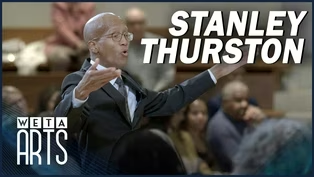
How Stanley Thurston and His Choir Elevate Black Choral Music in DC
Video has Closed Captions
Clip: S13 Ep5 | 13m 29s | Go behind the scenes with Stanley Thurston and the new Heritage Signature Chorale Chamber Singers. (13m 29s)

Inside DC Improv’s Two Faces Comedy Series at Lincoln’s Cottage
Video has Closed Captions
Clip: S13 Ep5 | 13m 1s | Stand up comedians perform at inside President Lincoln’s Cottage in Washington, D.C. (13m 1s)
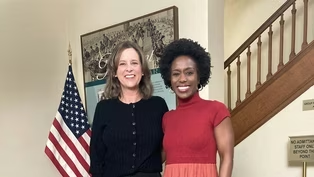
Preview: WETA Arts February 2026
Preview: S13 Ep5 | 30s | Stanley J. Thurston’s Heritage Signature Chorale; DC Improv at President Lincoln’s Cottage (30s)
Providing Support for PBS.org
Learn Moreabout PBS online sponsorship

- Arts and Music
The Best of the Joy of Painting with Bob Ross
A pop icon, Bob Ross offers soothing words of wisdom as he paints captivating landscapes.












Support for PBS provided by:
WETA Arts is a local public television program presented by WETA