
WETA Arts March 2024
Season 11 Episode 6 | 27m 30sVideo has Closed Captions
Nat’l Museum of Women in the Arts; fiddler Seán Heely; Jazz community leader Amy Bormet.
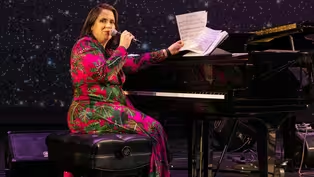
The National Museum of Women in the Arts, the first museum in the world solely dedicated to championing woman artists, has reopened its doors to the public after two years of renovations. Viewers also meet Seán Heely, a Virginia-based fiddle player who keeps the tradition of Scottish Celtic music alive. Plus, learn about Washington Women in Jazz with founder Amy Bormet.
Problems playing video? | Closed Captioning Feedback
Problems playing video? | Closed Captioning Feedback
WETA Arts is a local public television program presented by WETA
WETA Arts March 2024
Season 11 Episode 6 | 27m 30sVideo has Closed Captions
The National Museum of Women in the Arts, the first museum in the world solely dedicated to championing woman artists, has reopened its doors to the public after two years of renovations. Viewers also meet Seán Heely, a Virginia-based fiddle player who keeps the tradition of Scottish Celtic music alive. Plus, learn about Washington Women in Jazz with founder Amy Bormet.
Problems playing video? | Closed Captioning Feedback
How to Watch WETA Arts
WETA Arts is available to stream on pbs.org and the free PBS App, available on iPhone, Apple TV, Android TV, Android smartphones, Amazon Fire TV, Amazon Fire Tablet, Roku, Samsung Smart TV, and Vizio.
Providing Support for PBS.org
Learn Moreabout PBS online sponsorship♪ Hey, everybody, I'm Felicia Curry, and welcome to "WETA Arts," the place to discover what's going on in the creative and performing arts in and around D.C.
In this episode, the National Museum of Women in the Arts transforms... Woman: What we do now is both art and advocacy.
Curry: a Celtic musician holds court... Man: It's all about sharing and community.
Curry: and women play jazz.
I have people coming back and performing with me at Blues Alley that were on my showcase 10 years ago.
Curry: All these stories coming up on "WETA Arts."
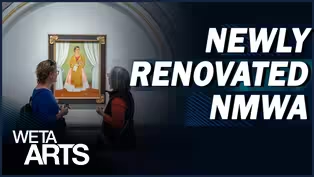
♪ At the intersection of 13th Street, H Street, and New York Avenue, you can find the National Museum of Women in the Arts, or NMWA for short.
It's the first major museum exclusively dedicated to women artists.
It closed in 2021 to undergo a major transformation.
Good afternoon, everyone.
Thank you so much for being with us.
We started thinking about a renovation project several years ago with a few things in mind.
Curry, voice-over: The renovation wasn't just about moving walls, but expanding the museum's goals.
Whenever you clear out a space, whenever you have blank walls and empty floors and you look back at your collection, it lets you see it anew because every possibility is open.
One of the things that I know as a curator, particularly one who's interested in contemporary sculpture, is that artists need elbow room.
They work at large scale, and we need a more open floor plan.
One of the biggest challenges that this building presented was the complex geometry.
♪ In a renovation of an historic structure that's listed on the Historic Register, there are some limitations in terms of what you can do to the exterior... ♪ but we looked really hard at how to reorganize the floors.
♪ We have a series of walls and alcoves so that when you walk into the galleries, you get a really expansive view all the way down through the space.
That opening up of the spaces and the vistas also started to give them some very significantly larger wall spaces, and that leads to the flexibility that they were looking for.
♪ Curry, voice-over: On October 21st, 2023, the museum is finally ready for the public.
Good morning, ladies and gentlemen, distinguished guests, friends, and welcome to this historic occasion marking the grand reopening of the National Museum of Women in the Arts.
[Applause] Woman: NMWA's founders Wilhelmina and Wallace Holladay would be immensely proud to see what we are celebrating today, and it chokes me up every time.
Goldberg: So without further ado, I'm inviting today's speakers to join me in the ceremonial cutting of the ribbon.
3, 2, 1.
[Cheering and applause] Here we are in front of the painting that started it all-- "Still Life of A Fish & A Cat" from 1620 by Clara Peeters, and that is how Mrs. Holladay's collection started and really started her interest in creating this museum.
Curry, voice-over: Philanthropist Wilhelmina Cole Holladay and her husband Wallace began collecting woman-made art in the 1970s.
Their collection formed the core of the National Museum of Women in the Arts.
When our founder Wilhelmina Cole Holladay began the museum, she really wanted to reinsert women into the history of art.
♪ What we do now is move beyond what is the traditional canon into both art and advocacy.
♪ It was a lot of heart and soul to figure out how we could grow our collection space in a museum that was created in 1987 as a very sort of small place, so the collection has gone from 500 pieces of art in 1987 to more than 6,000 now, and we think that this new building just displays everything to its best advantage.
♪ Curry, voice-over: The openness of the space accommodates new ways of presenting works.
Wat: It's not just looking at something.
It's experiencing with your body, and to do that, you really need to be able to sort of get all the way around it and look at it from every side, converse with the folks that you're with.
That's really what we want, is that powerful engagement moment with the works of art.
You can see the individuals in each of the alcoves kind of engaging with the art on a more intimate level and investigating the artist and establishing that relationship which we all think is really important for the art and the artist and the viewer.
Sterling: It's about how the art works together to create narratives, stories that are meaningful to people, so I like the juxtaposition, for example, of the Alison Saar "Scorch Song" with the Lavinia Fontana "Portrait of a Noblewoman."
The experiences are extremely different, and yet they talk to each other in a way that you wouldn't see in a gallery if you went chronologically through the march of history.
We'll just spin around really quickly.
I wanted to just sort of tell you about the surprise on this piece.
Curry, voice-over: Another way the renovation expands on the mission is by making the museum capable of displaying previously undisplayable works of art.
Wat: She said, "Every time I install it, it's a different work of art."
One of the things we wanted to do is really show works that are a little tricky to install.
I'm thinking about our Niki de Saint Phalle sculpture, a marble sculpture that's over 5 feet tall.
It weighs more than 2,000 pounds.
It's over a ton.
Previously, we would have been a little nervous about where to sort of safely set her down, but with the changes that Sandra Vicchio and her team, our architect, have created for us, we can place any artwork anywhere in this building, and that has been incredibly liberating for us as we plan exhibitions for the future especially.
Sterling: Part of the value of the renovation, if you will, we're able to introduce ourselves all over again.
I think over 40% of the works you'll see on the walls are things you've never seen before.
That's pretty impressive to me.
Curry, voice-over: The public seems to agree.
Woman: I was excited to come back to see what they were gonna put on display and if anything was new.
A lot of these artists probably haven't even been out for a decade, maybe even longer, but it's interesting to see, like, with Sonya Clark and her "Curls" with the combs and then, like, across the hall, it's, like, a felt pipe.
You see the contrast of different types of materials being used.
You never think of women using these type of materials.
Woman: What do you do with your silver?
One artist has hung it from the ceiling, and I think that's really interesting because we put away things that are really important to us in cupboards, and I love how things are kind of out there that we would celebrate and appreciate.
When I studied art history more than 40 years ago, we studied almost exclusively men.
Women have always painted and always done art, and we should celebrate their interpretation of the world around us.
Sterling: When I see people walking through the galleries for the very first time, I really hope they're experiencing a sense of wonderment at the works on the walls, and then I hope everybody sees themselves in the works that they see in the galleries.
♪ Curry, voice-over: Though regular hours at the National Museum of Women in the Arts are 10 A.M. to 5 P.M. Tuesday through Sunday, they've launched an after-hours experience called NMWA Nights on the third Wednesday of the month.
A new exhibit called "Women to Watch" opens in April.
Check out nmwa.org for details.
Saint Patrick's Day celebrates the arrival of Christianity to Ireland.
The Irish are one of a number of peoples known as Celts who each have their own history, language, and music.
[Fiddle plays] Man: Welcome, everyone, to the MacMillan Whisky Room for the D.C. Scottish Session.
Curry, voice-over: Seán Heely is dedicated to preserving the Scottish Celtic tradition.
♪ We met him at a music gathering known as a session.
♪ Heely: My name is Seán Heely, and I am a professional Celtic musician-- Celtic fiddler, harpist, Gaelic singer.
♪ Celtic music draws me in because it's just a brilliant type of music while also drawing from a deep well of tradition.
Curry, voice-over: While Celtic culture shares similar roots, there are some key differences.
[People whooping] Heely: It's very much language- and location-based.
It's not just Ireland and Scotland.
We have Wales, Brittany in France, Galicia in Spain, Asturias, and many others.
If you just look simply at the comparison of Irish and Scottish music... ♪ with Irish, it's a bit more flowing and maybe more connected, and then when I'm playing Scottish fiddle music, there's a lot more lift off of the string.
♪ There's a bit more space, and there's a bit more directness, and then there's strathspeys.
♪ It's a type of dance tune, and everything about them is what you would think Scottish music is.
It's got this kind of direct nature to it.
♪ Da-dum day da-da-day da ♪ ♪ Dum ba-day da-da da da-da da-da dum ♪ It's got the Scotch snap, we call it.
Curry, voice-over: Heely got into music by way of his family.
He began his musical journey at 10 years old.
Heely: My elder sister actually had played the violin, and I started plucking on it and thought it was pretty cool.
I played Irish fiddle as well as classical.
I loved all the great pieces by Beethoven, Mozart, and Vivaldi.
I did a lot of time just obsessively practicing this harder-level music that I really had no business doing, but somehow I did it.
Ha ha!
I took it as far as senior year of college, and I was paying the bills by playing in symphonies.
I could have easily gone into that symphony route, but it just became sort of, like, my passion to go really deep into Scottish music and culture.
♪ One of the things that I noticed successful people in the field doing is competitions.
There was one here in the Warrenton, Virginia, area.
Then I said, "Well, I got to prepare some music for this competition and see what I can do."
♪ I was playing more of the music that I liked, and it wasn't necessarily what they were looking for.
They were looking for more of that East Coast Scottish music, so that more classical side, and I was like, "Well, I could do that"... ♪ so I prepared a whole different set and went back the next year and won.
♪ It's good street cred, but it's more about what you do after that really counts.
[Applause] Curry, voice-over: Since becoming a Scottish fiddle champion, Heely has toured nationally and internationally as a solo artist and in Celtic bands.
He's recorded albums, performs an annual Christmas show of Scottish and Irish music, and he was even an artist- in-residence at Strathmore, a premier music mentorship program.
Heely also teaches the next generation of Celtic musicians.
Heely: I have a private studio, and right now, I teach mostly adults, but I do teach kids, as well, and the first thing that I usually spend at least a year or more teaching is just how to bow different tunes-- bow a jig, bow a reel... ♪ and then ornaments with the left hand or the right hand, that's a whole language in itself... ♪ and then sometimes when I'm playing, you'll hear a little bit of double-stopping, we call it, so droning.
♪ Curry, voice-over: To better understand the music, Seán Heely also learned Gaelic, which allows him to study some Celtic music in its original language.
Heely: I consider myself a tradition bearer, and also I'm adding to the tradition with my own compositions.
I became that way after learning about the culture and learning what was fading, so, like, when I go to Scotland sometimes these days, like in Glasgow, I don't hear any of the old music, and it kind of bothers me, really.
For me, like, the real heart of the music is that original stuff that was happening, and I knew that in order to be able to build on that, I needed to know the foundations of what was written before.
[Click] [Woman singing in Gaelic] Heely: One time, I went to the Library of Congress and listened to some old recordings, and it was fascinating, like, to hear some of the Gaelic songs.
Woman: ♪ Gu'n tugadh crodh Chailein... ♪ Heely: There was a recording I like to mention.
I heard this kind of, like, "squeesh" and then this sound of liquid hitting something, and I looked up the notes, which are all in Gaelic, and was able to deduce that it was a milking song for a cow.
[Splash splash] Chorus: ♪ Ill o bha bo... ♪ Heely: There were songs for everything, and that was so fascinating to learn, and I was able to actually perform one of those songs from the archives.
♪ O theid is gun teid ♪ ♪ O theid mi thairis ♪ ♪ Gu innis nam bo ♪ ♪ Far an ceolmhor ainnir ♪ ♪ Ill o bha ho... ♪ Curry, voice-over: Heely channels his research and experience into the Scottish sessions he leads in hopes of keeping the traditions alive.
♪ Heely: The most brilliant thing about sessions is, it includes everyone.
Anybody could come and give a song.
Anybody can bring their instrument and play along to the music.
♪ Woman: In general, we probably have 10 or 15 people actually playing in the session, and then at least another 10 or 15 who have come specifically to watch us play.
♪ Woman: This music just feels like it's in my soul, and when it just all comes together, it's just when I feel most alive.
♪ Heely: I love being able to do so many different things with it.
I'm able to perform in almost any location with this music.
Whether a giant concert hall or a very intimate space like a pub, it just feels the same.
There's no ego about it.
Woman: Scottish sessions are always friendly.
Everybody is welcome.
You don't have to play music.
You just have to come.
♪ Man: The music played at the session is pure.
There's no amplification, no sound effects.
It just goes right from the musicians directly to your ears.
Once you're hooked, you're hooked.
Woman: This is something that I wish we had more of.
When I've traveled to Scotland, I experienced this at sessions there, and I just wish this was a weekly thing.
Fox: I think that's something about Celtic music in general, is, it's not just about the notes that you're playing.
It's about everything that surrounds it.
♪ Heely: It's all about sharing and community.
♪ Curry, voice-over: Drop in on Seán Heely at a D.C. Scottish session at the MacMillan Spirit House in Alexandria, Virginia.
For more performances, check out seanheely.com, and there's more Scottish music to enjoy at Tartan Day Tattoo D.C. on April 2nd at Northern Virginia Community College in Alexandria.
Go to thewashingtontattoo.com for tickets.
♪ Whoo!
Whoo!
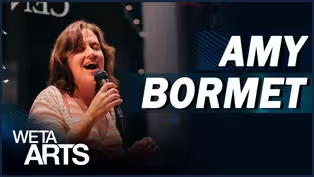
[Whooping and applause] Jazz is a profound part of the history of Washington, D.C., with clubs that welcomed the greats and named its premier arts public school, the Duke Ellington School of the Arts, after one of its own native sons.
♪ Let's make a change... ♪ Curry, voice-over: When pianist Amy Bormet began at Ellington, she didn't imagine she would become not only a musician, but also an advocate for women.
♪ Oh ♪ Man: Amy, how you feeling?
Good?
Good.
The vocals sound really trebly up here.
♪ Curry, voice-over: It's the first and only rehearsal before the first performance of a new big band called the Celestial Spang-A-Lang.
Spang-a-Lang is a beat pattern for jazz drums, and "celestial" refers to the all-star performers at tonight's gig.
♪ Bormet: This is gonna be solid, and everyone coming in are, like, very phenomenal improvisors and also really great session readers.
♪ We pick people who function well under pressure.
♪ Curry, voice-over: Celestial Spang-A-Lang's performance is part of the month-long Washington Women in Jazz Festival, founded by Bormet.
Bormet: I started Washington Women in Jazz in 2011, and I had just done a residency at the Kennedy Center... ♪ Rising heat ♪ ♪ Bormet: and I wanted to be on bigger jazz festivals.
I started looking at them... ♪ and there'd be no women instrumentalists anywhere on the schedule, even within the bands.
♪ I knew all of these women who were performers here, and I said, "Well, what if I create something "that we can collaborate on to gain an audience for women musicians?"
This is my big hit, had it played on the radio.
♪ Let's make a change ♪ ♪ For the better ♪ ♪ No more excuses ♪ ♪ And no more lies ♪ ♪ Let's make a change... ♪ Curry, voice-over: As a child in Oregon, Bormet learned to play on her grandmother's piano.
Jazz and I have had a beautiful, beautiful relationship.
I grew up listening to Duke Ellington, Count Basie, Ella Fitzgerald, Sarah Vaughan, and what I really wanted when I first started playing was a connection.
I played a lot of classical music, and jazz was really a space that I could be myself 100% and create with people in a way that it was different every time it happened.
My father moved here, and I was living in Oregon.
He said, "Oh, I scheduled something for you, "this audition.
There's a school here called Duke Ellington," and I was already a huge Duke Ellington fan, and I was like, "Wait.
What?"
so I went to the school the Friday before Labor Day and auditioned and got in, and I remember calling my mom being like, "Mom, I'm not coming home.
I'm gonna start school on Tuesday."
It was definitely a male-dominated space, so that's not really something that bothered me because I was already, you know, a White person in a mostly Black space, so I was already othered.
♪ What really was important to me is that I had the chance to meet other professional women jazz musicians-- Shirley Horn and Geri Allen and Abbey Lincoln and, like, all of these people who I went to see perform and then got to meet.
The opportunities that had been given to me, a lot of them have come through the women that knew how intensely dedicated and passionate I was about this music.
So it's snare.
It's the same thing happens on the bridge.
♪ Curry, voice-over: Bormet met drummer Angel Bethea while teaching at Duke Ellington's Summer Jazz Arts Institute.
I first met Amy, so 13, 14 years old.
She was telling us drummers how important it is to know every part of the music, not just the rhythm, not just playing drums, so she had us scatting, which was-- You know, I can't sing, so I was like, "Amy, what's going on here?"
but that was really important to my development and being able to connect with the other musicians on stage.
When I saw her play, I was like, "Oh, that's interesting.
OK. OK.
I see what you're doing there."
Bethea: I started playing a lot more gigs through Women in Jazz.
Bormet: She came and performed at the Emerging Artists Showcase, where I can have college and high-school women and nonbinary jazz musicians come and perform and meet each other and network.
Bethea: She made sure to connect me with other people who looked like me to make sure that I saw that it was possible to become a musician and do this for a living.
[Singing indistinctly] ♪ ♪ No good-byes ♪ ♪ Woman, voice-over: I chose the saxophone in fourth grade.
I watched "The Princess and the Frog," and it's set in New Orleans, so there's a jazz band.
♪ I just really liked the way that it sounded, and, luckily, like, no one else wanted to play it, so there were enough school instruments for me to borrow one.
There weren't that many other girls playing saxophone.
Woman, voice-over: All my teachers were men and specifically White men, actually.
When I got to school, my saxophone teacher, Ms. Alme, she's a woman, and that, like, changed my whole perspective, just feels good to have somebody to look up to that's more like me.
♪ Bah, voice-over: A showcase like this, it allows us female-identifying jazz musicians to support each other through our playing.
Oh.
It was dope.
We got to play together for real.
Like, we actually have to play together, for sure.
Now that I've, like, been here and I, like, have, like, the Mr. Henry's vibe, I might make an appearance at the jam sessions on Wednesdays since I, like, know about them now, so maybe.
For sure.
Bormet: The Emerging Artists Showcase is my favorite thing on the whole festival.
I continue to do it, even though it's crazy amount of work, because it's so exciting and energizing to be in the room with these people and to also see the way that they develop their careers after this.
[Cheering and applause] I have people performing with me at Blues Alley that were on my showcase 10 years ago.
Curry, voice-over: Blues Alley is one of Washington's premier jazz venues and another stop on the Washington Women in Jazz Tour.
Bormet: Blues Alley is a super exciting place to highlight all of the amazing women that I play with, and it's a wonderful spot to perform because you can hear each other so well, but it's also a legacy place.
I would go down there after school and hang out for the sound check and hear, like, McCoy Tyner and Ahmad Jamal and, like, Mose Allison.
To have Washington Women in Jazz there, it's an achievement for the festival.
[Cheering and applause] Thank you, thank you.
I've lived different places and traveled all over, and I keep coming back to D.C. because of the sense of community and also the sense of political power through the arts.
I want to inspire people because this is a festival that's very much DIY.
It's very low-budget.
I want people to feel like if you rely on your community, if you rely on these collaborations, if you ask people for help, you can make something bigger than just yourself and to think about what changes they want to see within not only their workplace and their career, but also the wider community of D.C. [Applause] Curry, voice-over: The Washington Women in Jazz Festival runs throughout the month of March, with performances across the DMV culminating in a whole weekend of performances and workshops on March 30th and 31st at the Penn Arts Building at N and 17th Streets NW.
Get details and tickets at washingtonwomeninjazz.com.
♪ Here's a thought from Golden Globe-winning television writer and producer Shonda Rhimes.
"Dreams do not come true just because you dream them.
"It's hard work that makes things happen.
It's hard work that creates change."
Thank you for watching this episode of "WETA Arts."
Be well, be creative, and enjoy the art all around you.
I'm Felicia Curry.
I have a saying.
I say, "Without the arts, "we're kind of just a black-and-white world, but with the arts, we're full of color," so thank you so much.
[Applause] ♪ [Saxophone whimpers] ♪ [Laughter] Ha!
♪ [Whooping and applause] Yoo!
Announcer: For more about the artists and institutions featured in this episode, go to weta.org/arts.

Explore Celtic Music with Musician Seán Heely
Video has Closed Captions
Clip: S11 Ep6 | 8m 59s | WETA Arts delves into the celebration of Celtic culture with Seán Heely. (8m 59s)
Meet DC Jazz Musician Amy Bormet
Video has Closed Captions
Clip: S11 Ep6 | 8m 42s | WETA Arts profiles D.C. pianist Amy Bormet. (8m 42s)
The Newly-Renovated National Museum of Women in the Arts
Video has Closed Captions
Clip: S11 Ep6 | 7m 47s | Felicia Curry explores the renovation and grand reopening of the National Museum of Women (7m 47s)
Preview: S11 Ep6 | 30s | Nat’l Museum of Women in the Arts; fiddler Seán Heely; Jazz community leader Amy Bormet. (30s)
Providing Support for PBS.org
Learn Moreabout PBS online sponsorship

- Arts and Music
The Best of the Joy of Painting with Bob Ross
A pop icon, Bob Ross offers soothing words of wisdom as he paints captivating landscapes.












Support for PBS provided by:
WETA Arts is a local public television program presented by WETA