
WETA Arts March 2026
Season 13 Episode 6 | 28m 42sVideo has Closed Captions
Renovation at George Washington’s Mount Vernon.
In March, WETA Arts puts a spotlight on the recent large-scale restoration work done at George Washington’s Mount Vernon. Washington’s sprawling estate is a persevering symbol of our first president’s life story, and this renovation has revealed new insights about the private person behind the public figure.
Problems playing video? | Closed Captioning Feedback
Problems playing video? | Closed Captioning Feedback
WETA Arts is a local public television program presented by WETA
WETA Arts March 2026
Season 13 Episode 6 | 28m 42sVideo has Closed Captions
In March, WETA Arts puts a spotlight on the recent large-scale restoration work done at George Washington’s Mount Vernon. Washington’s sprawling estate is a persevering symbol of our first president’s life story, and this renovation has revealed new insights about the private person behind the public figure.
Problems playing video? | Closed Captioning Feedback
How to Watch WETA Arts
WETA Arts is available to stream on pbs.org and the free PBS App, available on iPhone, Apple TV, Android TV, Android smartphones, Amazon Fire TV, Amazon Fire Tablet, Roku, Samsung Smart TV, and Vizio.
Providing Support for PBS.org
Learn Moreabout PBS online sponsorship♪ Hey, everybody, I'm Felicia Curry, and welcome to "WETA Arts," the place to discover what's going on in the creative and performing arts in and around D.C.
As our nation marks the 250th anniversary of the American Revolution, our attention turns to the Founding Fathers and the world they inhabited.
Here in Washington D.C., we are within driving distance of many sites that evoke the era, few more iconic than George Washington's Mount Vernon.
Preserving this landmark is a year-round endeavor, but in 2016, the preservation team recognized the need for unprecedented measures to secure the house's long-term stability.
[Birds chirping] ♪ George Washington's Mount Vernon in Virginia sprawls across 500 acres of forest, gardens, and outbuildings, crowned by a mansion that has been a tourist destination for literally hundreds of years.
There's something special to know that you're walking where George Washington walked, or you're seeing the vista that he saw.
Because of his commitment and perseverance, we have a country of liberty and a country based on law.
And so I think all of us here are dedicated to protecting that legacy for future generations.
Curry: Protecting that legacy means constant maintenance and attention.
And in 2016, the staff discovered a big problem.
There was a little bit of asbestos in the house that had been put in around a furnace that had been in place in the early 20th century, and we were abating that asbestos.
And in doing so, we had to pull up some floorboards.
I got a phone call saying, "Tom, you got to get up here right now."
And when I got to the house, a carpenter was standing on a ladder holding one of the floor joists over his head because it wasn't attached at either end.
Curry: The walls were not connected to the floors.
Reinhart: They had wrapped the top of the foundations in copper so the termites couldn't get into the frame.
We thought it all connected, that there was wood in there.
When we pulled the copper back the wall sat on brick, the floor came almost to the brick, and the connection just didn't exist.
Curry: The floors were only being held up by pillars in the cellar.
In an event where extreme lateral force was put upon the house-- like a hurricane, an earthquake, a tornado-- the house's frame could actually give.
Curry: Also, in other areas of the house, brick was failing where a hard cement had been used for repairs on the original brickwork.
One reason you try to use the lime mortar with historic brick is your water can come back out and evaporate through the lime.
With hard cement, these brick would tend to load up with moisture, and then when freezing weather came, it would start blowing apart, just like this.
It starts spalling.
If you put modern mortar in a historic brickwork, eventually it's going to fail.
Reinhart: The work that was done in the late 19th century and in the 1930s surely saved this house.
Curry: It was time to save the house again, very carefully.
This place, as we often say here, is George Washington's autobiography.
He didn't write about himself.
And one of the things that becomes very clear to me in my 12 years here is that Washington utilized the architecture of Mount Vernon to express himself.
He made design decisions, and he tells us who he is through how his architecture impressed or the stories that his architecture told.
Curry: The renovation is giving staff a rare firsthand glimpse into the way the real George Washington thought and lived.
♪ This is the really exciting thing.
This dark soil is actually topsoil that's been buried, so... So the old mansion lawn.
This was the ground surface... Yeah.
pre mid-1770.
So we have all these little hidden time capsules.
We can't really do anything around the mansion until we're guaranteed to not destroy something permanently.
And so archeology is very involved in this project from the beginning, making sure that everything around the mansion is understood.
These layers to my left here, we read them like pages of a book the way a historian might read documents left behind.
But, of course, not everybody left documents behind.
♪ Welcome to the archeology lab.
This is where all of the objects that we take out of our excavations come to.
We clean them, we process them, we identify them, and we spend a long time analyzing them.
We've got traces of Native American presence here that go back around 10,000 years.
We tend to find a lot of spear points.
This is a pretty interesting artifact that we found.
We're actually looking at Mount Vernon as a site of production of all of these tools.
And that really just gives you an idea of how intensive the Native presence was thousands of years ago here.
Bradburn: The legal process by which the English would take control of the Native land, essentially conquering the land, would be the king had claimed ownership of this land, and he would give a grant of land.
Then you'd have to survey the land, and that survey would then be turned into a legal document, known as a patent.
And the patent would be the legal title to own the land.
Curry: The Washingtons' ties to Mount Vernon start with George Washington's great-grandfather, John Washington, who arrived in Northern Virginia about 50 years after the English first arrived at Jamestown in 1606.
The key story in the transition of the Washingtons from England to America is the English Civil War, where their family had been on the Royalist side, on the losing side.
So John Washington, who's the immigrant, becomes the first mate on a trading vessel, trying to really, you know, make a little money in the tobacco trade.
The tobacco trade was in that period a chance where somebody from a modest background in England could make something of themselves, could make a lot of money.
If they're lucky.
Tobacco requires lots of labor because each individual plant is grubbed and planted.
The key in Virginia for wealth creation is really not necessarily the acquisition of land, although that's critical.
The land is worthless without labor.
The people with the most command of labor are the ones who develop the fortunes.
Slavery becomes critical to wealth creation by the 1680s in Virginia.
So two generations before George Washington is born, that is sort of the way to wealth in this growing colony.
Curry: Evidence is everywhere on the property, including the very earth into which the house is set.
We can actually kind of go through time here.
You can see this layer with the nice over-fired brick in it.
The enslaved folks are the primary producers of bricks.
60,000 to 70,000 bricks were made at Mount Vernon.
The ones that didn't quite cut muster were tossed out, and that's why they ended up in here.
[Indistinct conversations] I always kind of wondered when they were producing 60,000-plus bricks a year how they kept track.
What you're looking at are impressions made from someone's finger.
In this instance, we have a nine, zero, and another part of a zero.
And I'm guessing we probably had a third zero.
This is brick-- either 900 or 9,000.
♪ [Tools tapping and buzzing] The enslaved community made a lot of brick here.
As you see, they left something that's a very lasting edifice.
Curry: The land the edifice is on came into the Washingtons' possession back in John Washington's time.
Bradburn: The Crown Colony of Virginia created a system called the headright system.
That was a way to incentivize people to import labor.
You would pay for the transportation of a certain number of people from England to come as indentured servants to work in Virginia for a certain amount of years.
For you paying for that importation of labor, you received a headright of 50 acres per head.
Washington marries Anne Pope, and they get 700 acres of land as a wedding gift.
And that's the beginning of the Washington fortunes.
John Washington was both lucky and good at selling tobacco both in London and also on the Continent.
And with that money, he can import indentured servants and also eventually import some enslaved Africans.
Then he starts to amass land in Virginia.
He goes on to build some great estates, most significantly 5,000 acres known as Little Hunting Creek on the Potomac River, which would ultimately become known as Mount Vernon.
It's really going to be the generation after John Washington the immigrant, where enslaved labor is going to replace indentured servitude in the tobacco trade in Virginia.
John Washington's son Lawrence is going to inherit some of that labor, land, and marries Mildred Warner, who's extremely wealthy.
The Warner fortune includes land and labor.
Their son, Augustine Washington, will inherit some of that.
And then Augustine also marries women who bring more land that help him establish his own success.
His first wife was Jane Butler, and his second wife, Mary Ball, also brought more land into the relationship and more children as well.
Curry: Augustine and Mary Ball's son George was born in Popes Creek, Virginia in 1732.
In 1734, Augustine started building a house at Little Hunting Creek Plantation, the house that would become the center of the mansion.
The family moved to Little Hunting Creek a year later.
The house, at 10 rooms and 1 1/2 floors, was considered grand in its day.
George's childhood affluence proved short-lived.
Bradburn: George Washington's father dies when George Washington is only 11 years old.
Augustine's estate is divided up amongst George Washington's half brothers as well as himself, and what's left for George and Mary Ball is really not enough to be productive.
It's a small estate, and you clearly can see this is a gentry-level family that's really clinging to that status as George Washington's growing up.
They have enslaved people, but this doesn't mean that they are wealthy.
He's not allowed to go to England to get a proper gentleman's education-- learn a little Latin, maybe a little Greek, learn the classics, become a polished gentleman, which provides status.
George Washington never gets that.
His brothers do.
So he's around people that have that polish, who are moving in the world that he wants to move into.
And he always keeps that, a little bit of insecurity around that lack of a formal education.
Curry: George Washington's older half brother Lawrence inherited Little Hunting Creek Plantation and renamed it in honor of Admiral Edward Vernon, with whom he had served in the British navy.
Lawrence marries into the Fairfax family, which is a critical step.
Once again, Washingtons marrying well to advance their social status, their ability to command labor, wealth, land, and opportunity.
The Fairfaxes are highly connected in the political leadership of the whole colony.
George Washington is going to try to make the most of this.
One of the things the Fairfaxes and Lawrence Washington encourage George Washington to do is to become a surveyor, which is taking undocumented land and turning it into a legal document that describes that land that can then be bought and sold.
Being a surveyor, you could still be a gentleman, and it also gives you opportunity to make money and really have a hand in the growth of the colony.
And George Washington becomes the official surveyor of Culpeper County at age 17.
Curry: In the meantime, Lawrence Washington and his family lived in the 1734-built house.
It's really cool to be working on the original framing and one of the oldest portions of the house, so, you know, almost 300-year old framing that's still, you know, very intact, very structurally sound, so that's pretty cool.
♪ These beams overhead are the original 18th-century beams that Washington put in, but clearly, these are not.
That's something that we had to put in for structural reasons.
♪ We're using old-growth oak and pine of a type that is very rare in America now.
And some of that was cut on our property because some parts of Mount Vernon have never been completely logged out.
And so we're dealing with trees that are hundreds of years old and are the descendant trees of the trees that the house was built out of in the 18th century.
This is one of, in this vicinity, a few original members.
So all of these joists we've replaced during revitalization.
And we put them through the process that they would have done in Washington's time, too, so you can see the tool marks.
They were hand-hewn with broadaxes, and then they were pit-sawn with a two-person up-and-down saw to get the same saw marks that would have been here originally.
We can see kind of, you know, the craftsmen that built the early house is different from the craftsmen who built this south end or the north end.
There's a lot more complexity to the ornamentation and the moldings that George used in his additions.
Things like augers were changing.
We can see the auger marks that they used and tell, "Oh, they used spiral bit augers."
So I don't know.
We can nerd out over that stuff.
Curry: The restoration is revealing new information about the early renovations to the house.
For the longest time, we didn't know what Lawrence ever did with the house.
By closely looking at the timbers as we were doing our structural work, it appears he's working on the interior of the house.
We think he changes it from kind of an odd vernacular plan to a very formal Georgian plan, with a central passage running through from one side of the house to the other, which is really the fashionable plan in England at the time.
Poor Lawrence Washington dies young.
The estate at Mount Vernon is inherited by Lawrence Washington's daughter Sarah.
Sarah, sadly, who's a child, dies within two years, and when she dies, the estate goes to her mother Anne, and George Washington begins renting Mount Vernon from Anne in about 1754.
This is also at the same time of the French and Indian War.
So George Washington is using Mount Vernon as his base, but most of the time, he's out away from Mount Vernon.
Curry: The French and Indian War, a conflict in North America between Great Britain and France, gave the 21-year-old Washington an opportunity for distinction through active military service, a recognized path to status, honor, and advancement.
The first thing he does when he rents the house from Lawrence's widow is he expands it and raises the roof to make it a big two-story house.
Because he's a young guy in his 20s, he wants to show that he's rich, that he's serious, and that he knows what good taste is because he's looking for a wife.
And he ends up finding Martha Custis, who was the richest widow in Virginia, and he marries her and brings her here to Mount Vernon.
Bradburn: Anne dies in 1761, and George Washington inherits the estate.
That marriage is a massive transformation of George Washington's abilities to achieve his ambitions to be one of the great men of Virginia.
She's going to bring a lot of wealth and enslaved people to Mount Vernon from the southern part of Virginia.
This bowl may have been manufactured on site.
This could have been also produced in Tidewater, Virginia in the Williamsburg area, with a lot of the enslaved folks that Martha Washington transported to Mount Vernon when she moved in after their marriage in the late 1750s.
This is a pottery tradition that was transplanted from West and Central Africa to this region, along with the people that had the skills to produce it.
We also have evidence-- this is lead shot, the type that would be in a shotgun shell-- enslaved folks were hunting waterfowl for themselves, but they were also selling this waterfowl to the Washingtons' dinner table.
This is all 18th-century window glass.
We recovered this collection of glass from a layer in the piazza.
That's exciting for us because the mansion was expanded from 1775-76.
Bradburn: By the early 1770s, George Washington is really looking to expand his mansion house.
There's practical reasons, but there's also, like, "I got to keep up with the Joneses" kind of reasons that Washington's expanding at that time in the 1770s.
His sister, Betty Lewis, is married to Fielding Lewis.
They are building a brand-new house in 1773.
His brothers have built big houses.
The 1770s is a time when the status symbol of the home really needs to expand.
Curry: And to be fashionable, expansion meant Georgian architecture, named after the successive reigns of King George I through George IV.
Boroughs: Georgian architecture is highly symmetrical, classically-influenced architecture.
It becomes sort of a dominant look and style of British architecture.
Washington is a rule-of-thumb architect.
He's trying to get it right as best he can.
He doesn't have enough money to tear the place down and start from scratch.
And so he's building on these earlier changes but trying to make it as aesthetically pleasing and also correct and proper based on the ideas of the day.
How do you expand a Georgian house and keep it symmetrical?
If you're going to add onto the sides to it, you're going to make it look low and long, and so you're going to have to go up as well when you expand.
But then I think the brilliant move he makes in the architecture is he's going to change the kitchen and the servants' house on the side, and they're going to be perpendicular to the home block, and all of a sudden, you've got a beautiful five-square, aesthetically-pleasing expansion.
You're also going to add the cupola.
The cupola is going to be critical 'cause it extends the verticality of the house, so you can have that proportionality.
Draws the eye up, makes the house look more magnificent from afar.
And the cupola is a really ambitious addition.
The cupolas in the 18th century in Virginia, they're on courthouses, they're on the College of William and Mary.
They're on public houses of great stature.
They're not typically on homes, certainly not in the Chesapeake.
It's an addition that really shows that Washington has some uniqueness in his eye to his architectural ambition.
And it's fantastic.
And then the piazza, the mystery of the piazza.
When did he get the idea for it?
It's just an obvious thing in a way, but it's not.
It's not common, certainly in Georgian architecture, to have this full-length, full-height colonnade on the back of your house.
It really functions as a grand gallery.
It has, of course, the commanding view.
It really is a combination of practical and visionary approach.
It's quite remarkable.
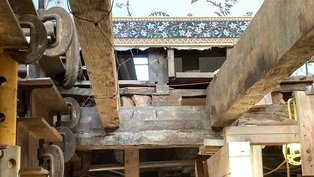
In essence, we have four different house frames within this one house.
So you have the 1734 part, you have the 1758 part on top of it, and then you have 1774 to the south and 1776 to the north.
There had been a history of pulling out rotten timbers, which basically severed a wooden part of the house from the foundation.
We bolted a big steel channel to the lowest part of the wall.
And then, all of this forest of steel going back, these big, long beams that run out toward the river, and on the other side of the house, they're levers.
And we're sitting at the fulcrum point, and that big yellow beam out there is equaling the weight of the house.
So we didn't jack the house up.
We just balanced it out so that the weight on the foundation could be relieved and then we stuck in the new beams.
Curry: On May 4, 1775, Washington left Mount Vernon for Philadelphia, where the Second Continental Congress would appoint him Commander in Chief of the Continental Army.
When George Washington goes to war in the American Revolution, he's constantly worried about Mount Vernon.
He's thinking about it all the time.
We know this because the correspondence exists.
He's writing to Lund Washington.
Lund is a cousin who has taken on the management of Mount Vernon throughout the war.
He's got 1/2 of the building framed out.
He's trying to decide what to frame out.
George Washington is writing instructions to Lund not only about that but what trees to plant and what lanes to build, what vistas to carve out of the trees.
Curry: The British surrendered at Yorktown on October 19, 1781.
Washington remained Commander in Chief of the Continental Army until a peace treaty with the British was signed.
On December 23, 1783, George Washington resigned as Commander in Chief in Annapolis, Maryland.
The notion that after he successfully won the Revolution that he would then turn back the military commission and come back to Mount Vernon, we take that for granted today, but that was just utterly remarkable.
Curry: Doing so affirmed civilian control of the military and prevented fears of dictatorship or monarchy.
The day after he resigned his commission, he was back at Mount Vernon.
The Mount Vernon you see today was designed in the 1780s.
The mansion would have been done, the cupola put on, and then the front of it, the gardens, the serpentine walks, and the plantings, that was all laid out in the 1780s by George Washington and then put in the ground by enslaved people.
That was an incredible period for him of rethinking this place.
And then he gets pulled back into the political sphere with the movement to create a new constitution and then becomes President.
Curry: Washington served as President of the United States from 1789 to 1797.
His decision to leave office set a lasting precedent of peaceful transfer of power, foundational to American democracy.
The day after he left office, he headed home to Mount Vernon.
Bradburn: Washington, before the American Revolution, he's acquiring enslaved people, he's expanding his operations, using slave labor, as any other Virginia planter, really can't distinguish his attitude.
We don't see any particular concern about any of that until during the American Revolution, it's clear George Washington is serving with African Americans in the Army.
The army that he commands at Yorktown is 1/5th Black.
The valor shown by African Americans at different aspects of his service is critical.
And so you see him expressing the idea that slavery needs to be ended not only at Mount Vernon but really more generally.
In the 1790s, you see him beginning to try to figure out how to transition the enslaved people at Mount Vernon to free labor.
More than half of the enslaved people who are here are actually owned by the Custis estate, so Martha has this right to their labor until she passes away, at which point those people will, by law, go to the family of her relationship with Daniel Park Custis.
So George Washington's working with their agents to try to acquire these people, and that doesn't work.
And so by the time he dies, he hasn't really finished whatever efforts he was trying to do in his lifetime, and it's left to his will, where he frees the people that he owned here at Mount Vernon.
And the people who were owned by the Custis estate go to the Custis descendants.
Curry: Washington kept working on improving the estate until just weeks before his death.
Mount Vernon immediately becomes one of the most famous places in the United States.
This is before we have a capital.
It's before we have monumental architecture anywhere.
Even during George Washington's lifetime, Mount Vernon was visited by people who wanted to understand this place and this country.
They kept coming after he died, and now we welcome a million visitors a year at Mount Vernon.
George Washington's Mount Vernon welcomes visitors year-round.
In addition to the historic mansion and grounds, explore the museum and education center or enjoy films, lectures, performances, and seasonal festivals.
Visit mountvernon.org for details.
Thank you for watching "WETA Arts."
Be well, be creative, and enjoy the art all around you.
I'm Felicia Curry.
We're standing on the foundations that were built by people before us, in this case literally.
For those early craftsmen to do what they did with the tools they had available then, it makes you appreciate an electric grinder from time to time.
[Laughs] I think all departments feel the weight of the responsibility of this place, and we take it very seriously, and nothing happens without me knowing.
[Laughs] Become architectural historians, kids.
It's very important.
[Bird chirping] Announcer: For more about the artists and institutions featured in this episode, go to weta.org/arts.
Providing Support for PBS.org
Learn Moreabout PBS online sponsorship

- Arts and Music
The Best of the Joy of Painting with Bob Ross
A pop icon, Bob Ross offers soothing words of wisdom as he paints captivating landscapes.












Support for PBS provided by:
WETA Arts is a local public television program presented by WETA