
WETA Arts: May 2021
Season 8 Episode 3 | 26m 53sVideo has Closed Captions
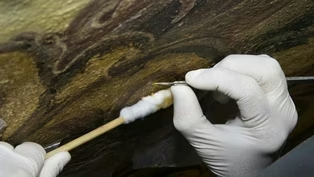
Repairing the Capitol's artwork; film "The Freewheelin' Insurgents" and more.
In May: Architect of the Capitol Curator Dr. Michele Cohen describes art repair post Jan 6; Psalmayene 24’s film The Freewheelin’ Insurgents melds Black Lives Matter activism and local theater; a wonk-by-day/drag queen-by-night competes to lead an LGBTQ+ group in Josh Davidsburg’s film Queen of the Capital; host Felicia Curry interviews Julie Kent, artistic director of The Washington Ballet.
Problems playing video? | Closed Captioning Feedback
Problems playing video? | Closed Captioning Feedback
WETA Arts is a local public television program presented by WETA
WETA Arts: May 2021
Season 8 Episode 3 | 26m 53sVideo has Closed Captions
In May: Architect of the Capitol Curator Dr. Michele Cohen describes art repair post Jan 6; Psalmayene 24’s film The Freewheelin’ Insurgents melds Black Lives Matter activism and local theater; a wonk-by-day/drag queen-by-night competes to lead an LGBTQ+ group in Josh Davidsburg’s film Queen of the Capital; host Felicia Curry interviews Julie Kent, artistic director of The Washington Ballet.
Problems playing video? | Closed Captioning Feedback
How to Watch WETA Arts
WETA Arts is available to stream on pbs.org and the free PBS App, available on iPhone, Apple TV, Android TV, Android smartphones, Amazon Fire TV, Amazon Fire Tablet, Roku, Samsung Smart TV, and Vizio.
Providing Support for PBS.org
Learn Moreabout PBS online sponsorshipHi, I'm Felicia Curry, and welcome to this edition of "WETA Arts," the place to discover what's going on in the creative and performing arts in and around D.C.
The Capitol's art collection gets a makeover.
Woman: As a result of January 6, we're focused on surface-cleaning the objects.
Curry: Local Black actors benched by the pandemic find a new outlet to express their grief and anger over social injustice.
Man: This film was really a love letter to the Black Lives Matter movement.
Curry: Philanthropy goes GLAAD with a drag organization called the Imperial Court.
Man: You don't necessarily think Washington, D.C. and drag, although maybe we should.
Curry: And I talk with Julie Kent, the artistic director of the Washington Ballet, about dance in the time of corona.
It's all ahead on "WETA Arts."
On January 6, 2021, while the nation watched unprecedented scenes of turmoil, Dr. Michele Cohen also saw the danger posed to the Capitol's abundant art.
Dr. Cohen takes us inside the building to the historic works she safeguards as the curator of the People's House.
Cohen: I'm Michele Cohen.
I'm the curator for the Architect of the Capitol.
The Architect of the Capitol is responsible for the preservation and maintenance not just of the Capitol building itself, but also of the entire Capitol campus.
Unlike a museum curator, I'm not researching and installing exhibitions on a regular basis.
I am the steward of the art that is under the aegis of the Congress.
So our focus is on preservation of murals, architectural sculpture, and also providing information to the public about the art and the architecture.
As a result of everything that happened on January 6, we are faced with a fairly ambitious task, which is to clean any art on view in the Rotunda, certainly treat the East front doors, to remove any accretions that settled, and also to surface-clean the walls, the murals on the Senate side of the building.
A lot of things were dispersed in the air-- pepper spray, bear spray, fire retardants, and these chemicals can just sit on the surface, and it forms a film.
There are many different types of conservators or art preservation specialists.
Part of our effort now is to very carefully use a HEPA vacuum to remove dust and grime.
If something is still adhering and mechanical method is not successful, then the conservator is tasked with coming up with a solvent that will safely remove this contaminant.
With the Martin Luther King bust, the patina is still intact, but it needs to be carefully dusted and cleaned.
We have someone who is a specialist in treating historic furniture.
For example, the Rotunda benches are historic artifacts that are an important part of our collection.
The Rotunda is a place that you have to experience.
It's really about the awesomeness of space and of distance.
You enter that room, and your eyes are drawn up to the top of the dome, to the "Apotheosis," the mural by Constantino Brumidi that was painted during the Civil War that shows George Washington in a god-like way.
And he's surrounded by figures representing the original 13 states.
And then further along the perimeter are groups of figures that represent America's achievements in different areas.
There's one called Marine, which shows the figure of Neptune holding his trident, and then there's a female figure laying the Atlanta cable.
So what Brumidi did in this mural and in other murals throughout the building is he synthesized American current events with a tradition of mural painting that dates back to the Renaissance, and then, of course, to even the Roman murals.
The Brumidi Corridors combine a lot of decorative panels that highlight very sensibly rendered flora and fauna that link them to the American landscape.
There are thematic panels where Brumidi created fresco lunettes that mark the entrances to various rooms.
There's a mural that depicts Benjamin Franklin, and he's actually associated with the space that had formally been a post office.
And another one that refers to military affairs.
So as artists often are charged with doing today when they do public art, the idea is to create something symbolic, something that's gonna represent that place and the purpose it serves.
Most of the art in the Capitol is permanent, although things have moved around.
An interesting example of that is the portrait monument that honors Elizabeth Cady Stanton, Susan B. Anthony, and Lucretia Mott.
When it was first gifted in 1920, it was only briefly in the Rotunda, virtually for one day.
And then it was removed to a space referred to as the crypt, which sits directly below the Rotunda.
The 75th anniversary of the passage of the Suffrage Amendment triggered an interest in bringing it back to the Rotunda.
My favorite piece is the "Car of History."
It's a functional sculpture.
It incorporates a neo-classical figure in a Roman chariot.
And the wheel of this Roman chariot is a clock.
It's positioned in what's now Statuary Hall, but had previously been the old hall of the House of Representatives.
And it is positioned over the doorway directly facing the Speaker of the House.
So it's as if to say be mindful of what you do and say here, you are making history.
And I, Clio, the muse, I'm--I have my ear.
I'm listening, and I am making a record of it.
Statuary Hall wasn't conceived to be a space for exhibiting art.
It really leant itself to sculpture, not to paintings because of the circular nature of the space and the strong presence of the columns.
In Statuary Hall, you see a range of sculptures in marble and in bronze.
This sculpture of Chief Standing Bear by Benjamin Victor was unveiled in 2019.
He was the first Native American to establish in a court of law that Native Americans should be viewed as persons under the law.
One of the things I think that really makes this such an outstanding piece is his use of patination.
By sort of rubbing away the patina, he's bringing out subtleties, like the bear claw necklace that hangs around his neck, the moccasins, his authentic pattern.
Right now we are dealing with an event that affected a lot of different parts of the building, but we know as in the past that we are able to address these problems and continue to preserve this great building and the Capitol campus to, you know, serve the American people and inspire all who come here.
For me being a curator, the Architect of the Capitol, is a great opportunity and a great responsibility.
I have always been really committed or interested in the idea of public art, and I'm really honored to help preserve the art that is so integral to the public spaces of this building.
To learn more about the art in the Capitol, visit the Architect of the Capitol's website at aoc.gov.
Since March 2020, Arena Stage has been finding innovative ways to engage audiences through film.
For their Arena Rifts series, they reached out to local talent to produce movie musicals.
Among these works is a hip-hop film called "The Freewheelin' Insurgents."
Man: I'm Psalmayene 24, an I am the producer, director, and writer of "The Freewheelin' Insurgents."
The casting director and line producer over at Arena Stage told me about the Arena Riffs initiative in which Arena commissions 3 separate lyricist and composer teams to create 20- to 30-minute short musical pieces that could be streamed.
That was pretty much all I was told about the creative constraints of the piece.
And I was in after that.
"The Freewheelin' Insurgents" is a film about a cadre of hip-hop theater artists who have gotten together to rehearse in Rock Creek Park.
Hip-hop is a culture that primarily consists of the elements of rapping, DJing, graffiti, and then b-boying or b-girling, which is popularly known as breakdancing.
Man: ♪ From aristocrats to average Joes ♪ ♪ Everybody's gonna know you don't need human beings ♪ ♪ Treated like animals ♪ Psalmayene 24: Hip-hop's roots as a genre puts socio political content sort of at the forefront.
♪ They killed Martin ♪ Woman: 1968.
♪ They killed Malcolm ♪ 1965.
♪ They killed Medgar ♪ 1963.
♪ They killed them all ♪ ♪ They killed Fred Hampton ♪ 1969.
♪ They killed Steve Biko ♪ 1977.
♪ They killed Patrice Lumumba ♪ 1971.
♪ They killed them all ♪ One of my favorite raps in the film begins like this-- ♪ It's like we're living in the Dark Ages ♪ ♪ We got theaters with dark stages ♪ ♪ Immigrant babies in cages, folks unemployed with no wages ♪ ♪ If your skin is black it's still a fact ♪ ♪ You might get shot in the back and that's a ♪ ♪ Hard pill to swallow like a platinum aphrodisiac ♪ After I wrote that initial song, I started to really think about the characters and story and the emotions I was feeling as a theater artist not being able to do theater.
I sat outside the theater, imaging what it looked like inside.
And then I connected that with the exacerbated grief and mourning that the Black community has felt in the wake of the killings of Breonna Taylor and Ahmaud Arbery and Tony McDade and of course, George Floyd.
I came up with this idea of a cadre of Black theater artists who are grappling with those twin senses of grief.
Then I started to think about artists in the DMV whom I've loved to collaborate with.
And cut.
Cut.
Psalmayene 24: People like Gary Perkins and Shannon Dorsey and Louis Davis and Justin Weaks, those are all the actors, my longtime collaborator Nick tha 1da, who is the composer for the piece, and the choreographer Tony Thomas.
The talent I think really deserves to be on a wide and broad platform.
Shooting "The Freewheelin' Insurgents" was just an adventure from top to bottom.
For one, when we shot outdoors, we shot mostly in Rock Creek Park.
It was freezing, so one thing that we had to convey was this sense of the characters being comfortable in this environment.
To Rob Raleigh.
To Rob Raleigh.
[Laughs] Psalmayene 24: This particular shoot day we actually had to change locations because there was a section of Rock Creek Park that had to be closed to traffic because there was ice on the road.
The cinematographer for this film is Aaron Tucker.
One thing that I really appreciate is that he was able to sort of pull from the grammar and language from hip-hop videos.
♪ So they try to pivot ♪ ♪ The treasures that reside inside our bodies and minds ♪ ♪ But our bodies intertwine with the fate of humankind ♪ ♪ So wheel off and rewind ♪ ♪ And be creative with your time, yo ♪ More than anything else, this is a film that is really a love letter to the spirit of the Black Lives Matter movement and an elegy for theater.
You can watch "The Freewheelin' Insurgents," as well as Arena's other film projects, by going to arenastage.org.
Among the performing arts, drag occupies the intersection of entertainment, identity, politics, community, and just plain fun.
Once seen as a fringe art form, drag has become more mainstream with ratings-leader "RuPaul's Drag Race" now in its 13th season.
Here at home, one of D.C.'s LGBTQ philanthropic organizations elevates drag to new levels and puts it to charitable use.
I'm Josh Davidsburg.
I'm a documentary filmmaker, and I made "Queen of the Capital," a documentary about drag in Washington, D.C.
The documentary is about a government bureaucrat by day, drag queen crusading for charity and the community by night.
Muffy Blake Stephyns, she's a part of this group called the Imperial Court of Washington D.C. We followed Muffy for a full year as she campaigned for empress and navigated both the drag and non-drag worlds.
At each coronation, there is going to be the celebration of the accomplishments of the reigning monarchs.
And then they will step down and a new set of monarchs, a new emperor and empress, if you will, then is crowned.
And it's the beginning of the new reign.
At this time, will His Majesty Emperor Emeritus Trace holdest the crown between Manuel... Stephyns: So at coronation Empress Destiny and Emperor Ken were stepping down, and then Empress Tasha and Emperor Manuel were then crowned as the new emperor and empress to start their year.
From the heart through the court for the community.
From the heart through the court for the community.
Stephyns: The number one role of the emperor and empress, they serve as the fundraising chairs for the community, and they are the front face of the organization for the community.
Tasha: People are gonna see that person and because they're out more and they're available more, it's kind of like a-- it's kind of like a famous person for a year.
The Imperial Court just kind of blew me away.
That's what drew me to the documentary.
The Imperial Court is a drag organization that's been around for more than 50 years.
It started in San Francisco.
At the time of filming, there were 52 locations spread out across the U.S., Canada, and Mexico.
And just recently came to Washington, D.C. Their motto is, "From the heart, through the court, to the community."
So if I'm repeating "community" a lot, it's because they say community a lot.
They're not professional drag performers.
All of their tips go to charity, and every year they choose different charities to support.
It doesn't have to be LGBTQ charities.
It's everything from epilepsy to HIV, and they just do amazing work in the community.
The first event that we went to was coronation.
And the art that went into their outfits, and the passion that they have for both the community and for drag just blew me away.
All of our landmarks have representation in this court.
Like, the Duchess of the Natural History Museum and the Viscountess of the Supreme Court, right.
Man: May we present the Imperial Court of Washington, D.C. [Cheering and applause] Davidsburg: Everything with them is incredibly formal, but it's still fun.
In the next clip, we're heading up to New York City with Muffy and a bunch of the members of the court.
They're gonna have a great night out.
Muffy takes the time to walk me through her closet and talk about all the amazing dresses.
Muffy: To say drag fashion, everyone has their own.
In my closet, for instance, looks nothing like Grandma's closet.
I kind of built mine around being made for Christian.
I do a Cookie Time number from the-- ♪ It's cookie time, it's cookie time ♪ from the movie.
This is actually an actual replica of what Shelley Long wore.
And so there's a lot of things that are either kind of the vintagey kind of style or have a fifties knack to them or look like something someone would wear to church.
I do a lot of campy comedy numbers in that.
Fake female beauty takes time, money, and pain.
I haven't even gotten into the family aspect of it yet.
There's some other plates in the kitchen.
Davidsburg: Shelby is Muffy's drag mother.
Shelby: Well, I'm the mom.
I listen to them as my kids and I protect them and I fight for them.
Davidsburg: Family structure is incredibly important to drag queens.
It's the way that they learn how to do drag, or at least it was the way before YouTube.
Makeup and everything was passed down from drag mother to the drag daughter or drag grandmother to the drag daughter.
Beyond just the educational aspect, the family structure is there to protect each other and to give them like a safe space.
Stephyns: There's been some really down times.
My drag family really are the ones that have brought me through them.
Davidsburg: What drew me to the film is the power of the family, the drag family that they have, the relationships that they have, how they support each other, and then the history of drag in Washington.
We have a long history of drag, but you don't necessarily think Washington, D.C. and drag, although maybe we should.
What I want people to get out of the film is that there are people in your backyard doing these amazing things for the community.
We don't even know they're there.
So I want people to look out their back door and see what other people are doing to give back for, you know, the people in your community.
Curry: You can watch "Queen of the Capital" on Amazon Prime, and you can subscribe to its newsletter at the film's website.
The Washington Ballet, which has been enchanting Washingtonians with classics like "The Nutcracker" and "Swan Lake," as well as innovative new works, started as the Washington Ballet School in 1944.
Julie Kent became the Artistic Director in 2016 with a goal of adding to the repertoire and developing artists' careers.
I'm pleased to welcome her to "WETA Arts" to talk about the changing landscape of the Washington Ballet.
Welcome, Julie.
Hi, Felicia, thank you so much for having me.
Curry: Just for some of our viewers who don't know very much about the Washington Ballet, can you just tell us a little bit about the organization.
Kent: The Washington Ballet was founded by two women, Lisa Gardiner and Mary Day.
And in 2020, we celebrated our 75th anniversary as a ballet school.
And in 2016, the year that I arrived, was our 40th anniversary as a professional ballet company.
We reach over a thousand dancers from our adult program all the way to our pre-ballet 4, 5, 6, 7-year-olds.
Then we also have our Dance D.C. program, which reaches students in public schools all across the District of Columbia, as well as Prince George's County.
You get here in 2016, can you talk to us just a little bit about what you had planned coming in and really how those plans have shifted in the last year or so.
We had just completed one of the most exciting, beautiful programs for our 75th anniversary season, a Balanchine and Ashton program.
And we were in the midst of preparing a world premiere of "Swan Lake."
So literally on March 13, we were finishing with the strains of "Swan Lake," filling the studio, coming to terms with the fact that we were going to take a hiatus.
We are committed to moving forward safely but with complete commitment and devotion to our art, to our artists, and to our community.
Curry: I am so excited to talk to you a little bit about a program called Create in Place.
Tell us a little bit about what Create in Place is.
Kent: Our focus shifted always to what can we do under the circumstances?
We have depths and layers of talent at the Washington Ballet, including many dancer choreographers.
And we put the spotlight on these individuals to create new works.
We divided the company up into cohorts and followed all the social distancing measures and CDC guidelines, and we produced 4 world premieres that have all premiered on Marquee TV.
Not only could we reach our beloved audience here in the Washington community, but we could have a global reach.
Curry: You have a summer intensive, which is both virtual and in person.
Can you tell us a little bit about that?
You know, art stops for nothing, right?
It's the reflection of the human experience.
And so arts education cannot stop, either.
Within two weeks, we had fully produced our curriculum into a Zoom, virtual, remote learning platform.
And so now, as we hopefully make progress within the pandemic, we'll be doing a hybrid model where we will be inviting a limited number of students into the studios to continue to learn traditionally, and then the remainder or our student body continuing to learn remotely, and rotating the groups, looking for all the opportunities within the crisis.
Curry: You were one of the first companies who did a virtual gala here in Washington, D.C., back in 2020.
What did you learn?
Kent: The intimacy, I think, is what is the biggest takeaway of any digital presentation, is that you can get to the heart and soul of the organization.
The gala really showed that people want us to continue to support all the initiatives that we have going.
Moving forward as an organization, what are you thinking are the next steps?
Kent: There's an exciting future ahead.
We have our gala in June, which will be a wonderful way to express our gratitude to our patrons and hopefully also to introduce ourselves to those who believe in the importance of arts education and the impact that it has on society and the depth of the culture of our city.
Thank you so much for taking the time to talk to us today.
Looking forward to all of the wonderful things that the Washington Ballet will be doing in the future.
Kent: I really enjoyed our conversation so much.
Thank you.
Here's a thought from Nobel Prize-winning author Saul Bellow.
"Art attempts to find in the universe, "in matter as well as in the facts of life, what is fundamental, enduring, essential."
Thank you for joining us for this edition of "WETA Arts."
Be well, be creative, and enjoy the art all around you.
I'm Felicia Curry.
Announcer: For more about the artists and institutions featured in this episode, go to weta.org/arts.
Preview: S8 Ep3 | 30s | Repairing the Capitol's artwork; film "The Freewheelin' Insurgents" and more. (30s)
Providing Support for PBS.org
Learn Moreabout PBS online sponsorship
- Arts and Music
The Best of the Joy of Painting with Bob Ross
A pop icon, Bob Ross offers soothing words of wisdom as he paints captivating landscapes.














Support for PBS provided by:
WETA Arts is a local public television program presented by WETA