
WETA Arts May 2022
Season 9 Episode 8 | 28m 59sVideo has Closed Captions
Explore the 100th anniversaries of the Lincoln Memorial & the Tomb of the Unknown Soldier.
May marks the 100th anniversary of the dedication of the Lincoln Memorial. This month, WETA Arts host Felicia Curry and Mike Litterst, Chief of Communications for the National Mall, explore the surprising history of the iconic structure. Plus, a new chamber opera, “Unknown,” commemorates the 100th anniversary of the dedication of the Tomb of the Unknown Soldier at Arlington National Cemetery.
Problems playing video? | Closed Captioning Feedback
Problems playing video? | Closed Captioning Feedback
WETA Arts is a local public television program presented by WETA
WETA Arts May 2022
Season 9 Episode 8 | 28m 59sVideo has Closed Captions
May marks the 100th anniversary of the dedication of the Lincoln Memorial. This month, WETA Arts host Felicia Curry and Mike Litterst, Chief of Communications for the National Mall, explore the surprising history of the iconic structure. Plus, a new chamber opera, “Unknown,” commemorates the 100th anniversary of the dedication of the Tomb of the Unknown Soldier at Arlington National Cemetery.
Problems playing video? | Closed Captioning Feedback
How to Watch WETA Arts
WETA Arts is available to stream on pbs.org and the free PBS App, available on iPhone, Apple TV, Android TV, Android smartphones, Amazon Fire TV, Amazon Fire Tablet, Roku, Samsung Smart TV, and Vizio.
Providing Support for PBS.org
Learn Moreabout PBS online sponsorshipHi, everybody.
Welcome to "WETA Arts," the place to discover what's going on in the creative and performing arts in and around D.C.
I'm Felicia Curry, host of "WETA Arts."
And I'm Mike Litterst, chief of communications for the National Mall.
And we're here at the Reflecting Pool because...
It's the 100th anniversary of the Lincoln Memorial.
So we're gonna tell you all about this iconic structure, which has served as the backdrop for some of the most important moments in American history.
Litterst: We certainly hope that the Lincoln Memorial continues to be a place where Americans feel a connection and feel free to speak their mind.
Also on this edition of "WETA Arts," an opera called "Unknown" honors the guards at the Tomb of the Unknown Soldier.
Woman: "Unknown" talks about things like sacrifice and home.
These are big concepts, and opera is the perfect medium to tell big stories.
Both: It's all ahead on "WETA Arts."
While armed conflict in the Civil War ended in 1865, the fight over the legacy of the Civil War continues to this day.
One flashpoint--public art.
It took over 50 years from President Lincoln's assassination to dedicate a national monument in his honor.
To us, the Lincoln Memorial may seem uncontroversial, but how it looks and that it exists was not a foregone conclusion.
Even though the Lincoln Memorial might be the most famous commemoration of the 16th president, it wasn't the first by far.
The first memorial to Lincoln is this statue by Irish American sculptor Lot Flannery, and you can find it in Judiciary Square.
It's in front of what was then called the District of Columbia City Hall, now the home of the District of Columbia Court of Appeals.
It was erected in 1868 just 3 years after Lincoln's assassination.
In 1867, Congress named a parcel of land on Capitol Hill Lincoln Square.
It's now known as Lincoln Park.
Also in 1867, Congress incorporated the Lincoln Monument Association to raise funds for a national memorial by sculptor Clark Mills.
Mills' proposed tribute to Lincoln was a 70-foot-high granite and bronze installation near the Capitol.
It would feature 35 statues, and the apex would show Lincoln signing the Emancipation Proclamation, but donations didn't add up to enough to build the colossus.
After that, the Congressional Record is silent on Lincoln Memorial efforts until 1901 when Illinois senator Shelby Cullom began introducing bills to incorporate a new Lincoln Memorial Commission.
After several tries, one of his bills became law on June 28, 1902.
Between Lincoln's death and Senator Cullom's successful bill, the fashion and architecture had turned to the Beaux-Arts style named for the École des Beaux-Art in Paris, where many American architects in the 19th century learned their craft.
Students practiced drawing ancient Greek and Roman buildings, and they were taught to value grand halls and formal spaces.
The emerging fashion in urban planning was the City Beautiful movement, promoting, among other things, monumental grandeur in public spaces.
When Beaux-Arts architect Daniel Burnham and City Beautiful landscape architect Frederick Law Olmsted Sr. designed the 1893 World's Columbia Exposition in Chicago, their aesthetics and philosophies became popular nationwide.
The 1902 McMillan Plan, named for Michigan senator James McMillan, aimed to marry the ideals of the City Beautiful movement with D.C.'s original city plan by Pierre L'Enfant, who had been appointed by President George Washington to design the city layout.
The heart of the McMillan plan was the creation of the National Mall, featuring the Capitol at one end and at the other the proposed Lincoln Memorial in a then recently filled-in swath of marshland known as Potomac Park.
Political infighting for and against the site lasted over a decade.
Chief among its opponents was Illinois representative Joe Cannon, chair of the Appropriations Committee and Speaker of the House from 1903-1911.
He had many objections from cost to aesthetics, and he could not imagine the former silt- and sewage-strewn mudflats becoming a site worthy of a tribute to Lincoln.
In an end run around Cannon and Congress, in 1909, President Theodore Roosevelt issued an executive order establishing the Council of Fine Arts to make recommendations to the cabinet on city planning.
Council members were to be selected by the American Institute of Architects, whose leadership were stalwarts of the Beaux-Arts style and the City Beautiful movement.
The Council met only once during which it approved the McMillan Plan.
When President Taft succeeded Roosevelt, he created with Congress a new commission.
This potentially undid the decision to place the memorial in Potomac Park, especially because he included Speaker Cannon on the committee.
In theory, Taft's commission evaluated many sites, including near the Capitol, Meridian Hill, Fort Stevens, the Soldiers' Home, and Potomac Park.
In practice, the Potomac Park decision was predetermined because Taft's group assigned the site evaluation to advisors led by Daniel Burnham, whose work helped the Beaux-Arts style and the City Beautiful movement take hold nationwide.
Speaker Cannon continued to fight against the Potomac Park location, including getting architect John Russell Pope to propose designs for other locations.
One design for the Meridian Hill site was a Parthenon-type structure 250 feet high with marble stairs 100 feet wide.
One design for the Soldiers' Home site was a Greco-Roman-based design.
Yet another rendering resembled an Egyptian pyramid except with portico entrances.
Cannon was outvoted.
The commission chose the Potomac Park location and architect Henry Bacon's design, a Parthenon-type structure supported by 36 enormous fluted Doric columns representing the 36 states in the Union at the time of Lincoln's death.
It would be made of materials from many states to represent national unity.
Above the colonnade, the names of the 36 states would be inscribed on the frieze, and the chamber would contain a statue of Lincoln.
The memorial took 8 years to complete from 1914-1922.
To support a massive structure on drained and filled land, the subfoundation was made of 122 solid poured concrete piers with steel reinforcing rods anchored in bedrock.
Workers had to dig 40 feet before building could begin.
Graffiti left by the construction workers is still visible today.
Bacon selected Daniel Chester French to create the statue.
It was originally supposed to be 10 feet high.
However, upon seeing the size of the space, French increased the statue to 19 feet high on top of a 10-foot-tall base.
Beneath the Tennessee marble floor, Massachusetts granite steps, and Indiana limestone walls is a cavernous, damp space full of stalactites of stalagmites, stone deposits created by the moisture that continues to seep through the stone temple built on a former wetland, and from that former wetland, Lincoln gazes east toward the Capitol, whose dome was crowned with the statue of Freedom in 1863.
Between them, two miles and 100 years of history.
The Lincoln Memorial was always meant to make a political statement and continues to do so.
There's no one better to help us explore the story of how people receive the Lincoln Memorial than our guest Mike Litterst, chief of communications for the National Mall.
Mike, welcome to "WETA Arts."
It is such a pleasure to have you here.
Felicia, thanks so much for having me.
I appreciate it.
And we're here today at President Lincoln's cottage.
We are on the verge of celebrating a very big birthday at the Lincoln Memorial.
Tell us a little bit about that.
It is the centennial of what is arguably one of the most famous buildings in the country if not the world.
Tell us about what that looked like in 1922 and the years that followed.
The dedication of May 30, 1922, was probably one of the biggest events that had happened in the city up to that point.
At that time, it was well removed from the downtown area.
There were a lot of people that said, "Don't build it there.
Nobody's gonna want to go to those extreme ends to get there," and dedication day with 50,000 people that showed up showed that it was indeed something that the people were willing to go to.
It was really the city's first big automobile event and may have had one of city's first traffic jams with people getting out there and trying to find where to park.
The ceremony was presided over by Chief Justice William Howard Taft.
The keynote speaker was President Warren G. Harding.
Perhaps of most interest to people was the presence of Robert Todd Lincoln, Abraham Lincoln's only surviving child, and it would wind up being Robert Todd Lincoln's last public appearance.
The dedication is such a big deal.
It is the first time that a president's voice is transmitted over the radio.
It's estimated that as many as 2 million people had the opportunity to either in person or via the radio hear what had occurred that day.
One of the keynote speakers that day was Robert Russa Moton.
He was president of Tuskegee Institute, as it was referred to at the time.
His speech was, in fact, censored.
He also delivered a speech that was much more fiery when it came to race relations than I think a lot of the organizers were hoping for.
The crowd that day was segregated with the exception of a number of Civil War veterans who were present that day, so here you had the dedication of a memorial to a man who was celebrated for being the Great Emancipator, and yet at the same time, there was clearly segregation among the audience, and I think it showed how far the country had come, but it also showed how far the country still had to go.
And I know that the Lincoln Memorial really is a site for political theater.
Tell us about what that looked like in the years that followed.
It is probably America's foremost location for rallies and demonstrations specifically as they relate to civil rights.
Marian Anderson 1939 is probably the most famous of the early ones.
♪ My country, 'tis of thee ♪ ♪ Sweet land of liberty ♪ ♪ For thee we sing ♪ Litterst: Marian Anderson sings from the steps of the Lincoln Memorial after being denied access to Constitution Hall due to the color of her skin, and that's really what electrifies protest at the Lincoln Memorial, but as early as 1926, 13 years before Marian Anderson would sing on the steps, we have the first documented civil rights demonstration.
2,000 members of the Methodist Episcopal Zion Church gathered at the Lincoln Memorial and speeches and music calling for equality among the races.
Civil rights protests become a big thing at the Lincoln Memorial.
How do we see that playing out after Marian in 1939?
Just two years later in 1941, A. Philip Randolph will succeed in getting FDR to sign an executive order desegregating the defense industry merely by threatening a protest at the Lincoln Memorial.
That shows exactly why you have those protests.
We'll see them throughout the 1940s and 1950s.
We see demonstrators chaining themselves to the pillars of the memorial, and then again in 1957, the NAACP will again have a demonstration at the Lincoln Memorial, this time to mark the third anniversary of the Brown versus Board of Education ruling.
Of all of the speakers and performers they had that day, perhaps most interesting is the attendance of Mahalia Jackson, who sings "America (My Country, 'Tis of Thee)," which of course Marian Anderson had sung there in 1939.
So I know that one of the most iconic moments at the Lincoln Memorial is Dr. King's "I Have a Dream" speech.
What can you tell us about what went on that day?
August 28, 1963, a date that's really become sort of a watershed in American history, you have Civil Rights luminaries like John Lewis, like Joan Baez, this who's who of politicians, civil rights entertainers.
♪ All your trials ♪ And of course it all culminates with Dr. King's speech.
King: I have a dream...
If oratory is considered art, then certainly Dr. King is the da Vinci of the spoken word in American history.
In the sixties, we're starting to see protests that cover everything under the spectrum.
Tell me a little bit about that.
[Creedence Clearwater Revival's "Fortunate Son" playing] Anti-Vietnam War demonstrations take place at the Lincoln Memorial.
One of the most famous scenes in the movie "Forrest Gump" is the anti-Vietnam War demonstration.
President Nixon in May 1970 actually makes a visit to the Lincoln Memorial to talk with protestors.
It's a scene in Oliver Stone's movie "Nixon."
They portray this early morning visit.
We see other causes being taken up at the Lincoln Memorial over the years.
The AIDS Quilt, for example, will be along the Reflecting Pool.
We see pro choice and anti-abortion demonstrations.
At the inauguration of President Biden, we saw the COVID demonstration along the Reflecting Pool.
You just started to touch in on something that I wanted to talk about, and that is how folks are using the Lincoln Memorial in popular culture.
The first famous use of it occurs in "Mr. Smith Goes to Washington."
Jimmy Stewart's character goes to the Lincoln Memorial and reads Lincoln's Gettysburg Address, and that's been parodied over the years.
We see it in "The Simpsons," we see it on "Family Guy."
Lots of movies have been there sometimes with political statements, sometimes just because it's a beautiful setting.
We see that in "Wedding Crashers," we see it in "The Line of Fire."
Well, Abe--ahem...
Damn.
Wish I could have been there for you, pal.
It's movies, it's television, it's comic books.
You can't name a superhero who hasn't battled on the steps of the Lincoln Memorial from Batman to Captain America to Spider-Man.
It's really a fascinating subgenre of what the Lincoln Memorial means to America.
What kind of wear and tear might we see at the Lincoln Memorial?
You know, the Lincoln Memorial needs attention from time to time.
We just finished putting a new roof on the Lincoln Memorial.
Like your home, about every 20 years or so, the roof needs to be repaired.
One of the maintenance things that doesn't happen very often-- in World War II there were antiaircraft positions throughout the city, and in September of 1943, somebody on the 14th Street Bridge fired a shot in the direction of the Lincoln Memorial, hit the marble right underneath where the name Texas is inscribed, and that fairly sizeable bullet nick is still there today.
As we're celebrating this centennial of the Lincoln Memorial, what are we looking forward to in the next hundred years?
We're looking forward to the Lincoln Memorial continuing to play that very important role as the backdrop for national celebrations and the place where Americans go to speak their mind, and we hope that in another hundred years we're celebrating the bicentennial of this iconic structure.
That's wonderful.
Thank you so much, Mike, for joining us on this episode of "WETA Arts."
Thanks, Felicia.
It was my pleasure.
There are events celebrating the Lincoln Memorial's centennial every day through the month of May.
Programs with park rangers talking about the history and legacy of the Lincoln Memorial, hands-on family activities including the Lincoln 100th Commemorative Junior Ranger Badge, and on May 22, a special rededication program featuring historians and musical acts.
And of course, you can visit Abe anytime day or night.
The memorial is open 24 hours a day every day of the week.
In 2010, Arlington-based conductor Robert Wood founded an opera company.
It's called UrbanArias, and it's dedicated to producing short, contemporary operas in English.
A recent commission is connected to a landmark close to home, Arlington National Cemetery.
The result is a work called "Unknown."
At the Crystal Marriott Gateway in Crystal City, Virginia, a new opera is making its debut.
Its title--"Unknown."
It's been a tight turnaround.
It started 9 months ago, which is lightspeed when it comes to putting a new piece of music together.
Onstage, our shows are intimate.
On film, it's even more intimate.
Curry: Anne-Carolyn Bird is the executive director of Arlington-based UrbanArias, which commissioned the work.
Man: ♪ Takes a hold of its habitat ♪ Bird: What I hope happens today is that everyone here gets to experience the power of the sung story.
Vocal music has this incredible power to tell the stories that we can't just tell with words.
Curry: The opera's title "Unknown" refers to the Tomb of the Unknown Soldier at Arlington National Cemetery.
It's debuting in this hotel because it's filled with veterans of the tomb's honor guard.
We just released the film this morning, and this is now a performance and a screening for the people the film is about, so it's kind of high-pressure, and we hope everybody likes it.
I'm James Livingston.
I am a society member of the honor guard Tomb of the Unknown Soldier.
I was a commander of the relief from 1999-2001.
William A. Stevens.
I was in the military from October 1966 to October 1968, and I was on duty at the Tomb of the Unknown Soldier from 24 December, 1967, until October 13, 1968.
It will be a new experience for me seeing opera because I've never really seen opera.
Curry: The work was commissioned to commemorate the 100th anniversary of the founding of the Tomb of the Unknown Soldier at Arlington National Cemetery.
The tomb was originally created as the final resting place of an American casualty of World War I.
President Warren G. Harding officiated the dedication of the memorial on November 11, 1921.
Tomb guards have paced before the crypt in ceremony since March 25, 1926.
The opera aims to encapsulate the differing experiences of soldiers of different wars and generations.
"Unknown" is a cycle of 5 songs.
The first piece is about a soldier who is about to deploy.
[Orchestral music playing] Shawn Okpebholo, the composer for "Unknown," writes in a--in a really beautiful, lyrical style, which also is infused with a lot of interesting, complicated rhythm.
Bird: "Unknown" takes these big feelings, these big concepts of sacrifice and honor and home and mourning and brings the audience close to the performers and reaches in with the power of the voices that are performing.
Home is definitely the theme that I have throughout the whole opera, and in the second movement, I wanted to write it from the angle of the person that's home receiving letters from the solider who is off to war.
♪ I am haunted more than I am happy ♪ I'm always encouraging poets to really expand what they're doing and see what their lyrics and work sound like with music behind it.
It's a really wonderful thing.
One of my favorite movements is movement 3 from the angle of a solider who is about to confront death.
Wood: Baritone Schyler Vargas is asked to croon and to sing in falsetto and to do extended vocal things that you don't find in classical art song and that come from the world of jazz and pop.
[Vargas vocalizing] Saying those words, I immediately read them as a first person view, me, myself as a human being.
To do something fresh and new that actually mattered to me, it was just an incredible experience as a singer.
The fourth movement shifts the focus back to the tomb itself.
The music here is based on the cadence of the 21 steps that the guards take as they march back and forth.
Bird: We wanted to let the military community know we, the arts community, appreciate you, understand the sacrifices that you make.
Curry: For UrbanArias, it was mission accomplished.
Livingston: To see the journey of the soldier, you know, reflecting on Vietnam.
He's looking at old photos of his buddies and then ending up at the wall.
I think it's emotion that only a soldier has experienced, especially a combat soldier.
Stevens: I could relate to the words that I was hearing.
I could relate to those words about the 21 steps.
Bird: And in the fourth movement, I started to cry.
Had a few people come up to me tonight and say, "Wow.
That really got me.
"You know, it didn't sound like what I expected "an opera to sound like, and I thought it was so beautiful."
Bird: One young man, a former guard, said that we nailed it, and I think that was exactly what we wanted.
We wanted to be able to capture that ineffable quality of the tomb guards and who they are and their commitment.
You can see the film of "Unknown" online for free through May 31.
Check the web site for details.
Here's something to reflect on from President Lincoln's first inaugural address.
"They mystic chords of memory, stretching "from every battlefield and patriot grave "to every living heart and hearthstone "all over this broad land, will yet swell "the chorus of the union when again touched, "as surely they will be by the better angels of our nature."
Thank you for watching this episode of "WETA Arts."
Be well, be creative, and enjoy the art all around you.
I'm Felicia Curry.
Announcer: For more about the artists and institutions featured in this episode, to go to weta.org/arts.
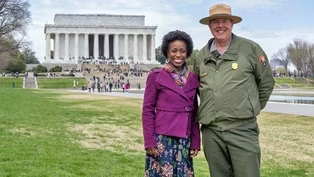
Preview: S9 Ep8 | 30s | Explore the 100th anniversaries of the Lincoln Memorial & the Tomb of the Unknown Soldier. (30s)
Providing Support for PBS.org
Learn Moreabout PBS online sponsorship
- Arts and Music
The Best of the Joy of Painting with Bob Ross
A pop icon, Bob Ross offers soothing words of wisdom as he paints captivating landscapes.














Support for PBS provided by:
WETA Arts is a local public television program presented by WETA