
WETA Arts May 2024
Season 11 Episode 8 | 27m 20sVideo has Closed Captions
Yemen’s repatriated antiquities; Classical Indian Dance; Smithsonian American Art Museum
Diplomats, curators and law enforcement share the dramatic story of 79 trafficked and repatriated Yemeni antiquities currently at the Smithsonian’s National Museum of Asian Art. A student of classical Indian dance style called Bharathanatyam performs her debut. WETA Arts host Felicia Curry sits down with the Smithsonian American Art Museum’s director to chat about the building’s renovations.
Problems playing video? | Closed Captioning Feedback
Problems playing video? | Closed Captioning Feedback
WETA Arts is a local public television program presented by WETA
WETA Arts May 2024
Season 11 Episode 8 | 27m 20sVideo has Closed Captions
Diplomats, curators and law enforcement share the dramatic story of 79 trafficked and repatriated Yemeni antiquities currently at the Smithsonian’s National Museum of Asian Art. A student of classical Indian dance style called Bharathanatyam performs her debut. WETA Arts host Felicia Curry sits down with the Smithsonian American Art Museum’s director to chat about the building’s renovations.
Problems playing video? | Closed Captioning Feedback
How to Watch WETA Arts
WETA Arts is available to stream on pbs.org and the free PBS App, available on iPhone, Apple TV, Android TV, Android smartphones, Amazon Fire TV, Amazon Fire Tablet, Roku, Samsung Smart TV, and Vizio.
Providing Support for PBS.org
Learn Moreabout PBS online sponsorship♪ Hi, everybody.
I'm Felicia Curry, and welcome to "WETA Arts," the place to discover what's going on in the creative and performing arts in and around D.C.
In this episode, in a period of unrest in their homeland, Yemeni antiquities find refuge... Man: If you don't have history, I don't think you would have a future.
Curry: an ancient dance form from India is shared and celebrated.
I want my students to be able to be proud of who they are as Americans, and proud of who they are as Indian Americans.
Curry: and the director of the Smithsonian American Art Museum, Stephanie Stebich, gives us a special tour of recent renovations.
Stebich: Every museum director thinks their museum is best.
I'm feeling pretty confident that we lead in the story of American art.
It's all ahead on "WETA Arts."
♪ Curry: For many people, ancient artifacts provide a deep connection to the past, but governments have to work hard to protect their country's cultural heritage from wanton destruction and looting, especially in areas of the world struggling with civil unrest.
One such government, the Republic of Yemen, is taking an active role in preserving its priceless antiquities right here in Washington, D.C. Now to a major legal case involving the alleged smuggling of ancient religious artifacts.
We cannot accept that terrorists steal cultural goods.
Individuals are trying to sell objects which appear to have been illegally looted and trafficked.
Curry: An epidemic of crime is plaguing the world of ancient art.
Man: Iraq lost more than 15,000 artifacts.
Many of them are extremely important.
Curry: Around the world, looters are plundering objects from cultural heritage sites.
Man: It's easy to dig in some desert and just take these priceless artifacts to sell them if you have markets.
Man: The United States has a strong law enforcement obligation and interest to bring these objects out of the market.
Man: We work around the clock to pursue those individuals that are behind the looting and theft of these artifacts, and trafficking them.
Curry: Special Agent Robert Mancene works for Homeland Security Investigations, or HSI, in the Cultural Property, Art, and Antiquities Unit.
On my phone, I probably have about 15,000 pictures of artifacts that I'm happy to have been able to return.
There are Greek pieces.
There are Italian pieces.
There are Turkish pieces.
Curry: While investigating a transnational trafficking network, Mancene's team found a New York-based gallery owner who was dealing in stolen goods.
Mancene: Over 1,000 objects of many different origins were seized.
Among those, 64 were from the country of Yemen-- those stone, carved heads.
♪ These steles really tell the rough journey of these objects.
The nose is broken.
Tape was attached to them.
They have blue pigment.
It's modern blue pigment.
They tell very much the story of how careless were the smugglers.
Where's the respect of funerary objects?
♪ It's a region that has hundreds of archeological sites.
How do you protect them?
We also need to consider why all these objects are getting out.
Lenderking: Buyers can be a part of cultural trafficking networks, and that's a particular concern for the United States government, is money that's falling into either criminal syndicates or used for the purposes of carrying out acts of terrorism.
These are things that we have to be on the lookout for.
Curry: Returning an artifact to its country of origin is called repatriation.
Al-Hadhrami: We were approached by the U.S. that, "We have these artifacts we wanted to repatriate to Yemen."
For me, it was a happy news, but then I looked at the situation in Yemen.
Curry: Yemen has been in a state of civil war since 2014.
Al-Hadhrami: Unfortunately, all you hear about Yemen is war, conflict, Iranian-backed militia that are just firing at the Red Sea.
Lenderking: The contemporary significance of Yemen is that it's a strategically located country at the bottom of the Arabian Peninsula.
These are areas through which, say, 15%, 17% of world commerce actually pass, and that's one reason why people have fought over Yemen, I think, for hundreds of years.
Curry: The same geography that intensifies conflict now created untold wealth in antiquity.
From antiquity's perspective, all trade has to go through Yemen, and that made powerful kingdoms and civilizations within Yemen.
Catanzariti: The kingdoms interacted with a lot of cultures from the East and the West.
Yemen becomes a crossroad of culture, artistic traditions, economic exchange, you name it.
Curry: The Smithsonian's National Museum of Asian Art's permanent collection contains Yemeni artifacts unearthed by archeologists whose records, as much as the objects themselves, help scholars piece together what life was like centuries ago.
Catanzariti: It allows us to go to the excavation reports and understand these objects.
We know that the lions come from a residence of a trader.
That allows us to better understand how residences were decorated.
♪ The permanent collection that we have has an archeological context.
The repatriated objects do not have an archeological context, and we are losing that kind of information when it's looted.
Mancene: They're a piece of history.
People feel they need to have them, so maybe it's that.
Maybe it's because they're so beautiful.
Many of the objects that you will see in museums were purchased or donated a long time ago, before law enforcement really began to crack down on the art market.
Curry: And the United States has been cracking down not just on smugglers, but on collectors.
Mancene: Working with the Antiquities Trafficking Unit, we were able to execute some warrants at a home of a private citizen, and we were able to seize dozens of artifacts from many, many different countries, and amongst those were these 3 Yemeni artifacts-- an alabaster ram, an alabaster female figure, and a silver vessel.
The silver vessel, we have no idea where it comes from.
It was probably, our assumption again, owned by elite people, but we don't know that.
Mancene: When you deprive a country of their cultural property, you're hurting countless individuals.
Al-Hadhrami: Although we have other priorities now, at the same time, we cannot ignore that our history has been stolen, and if you don't have history, I don't think you would have a future.
Curry: The solution Ambassador Al-Hadhrami proposed was an historic partnership.
Al-Hadhrami: I looked at the situation in Yemen and talked to my government and to the U.S. and said, "You know, I think it would be better at this stage "for these priceless artifacts to just find good institutions that would house them for safekeeping in the U.S." So the ambassador comes to us and says, "Can you help us look after these pieces?"
and we say, "Yes."
It's allowed us to explore in a new way how we can be the very best partners in their ongoing efforts to preserve their cultural heritage.
Curry: The Smithsonian's National Museum of Asian Art's specialists are collaborating with Yemen's scholars to try to recover the secrets these objects could reveal about what life was like centuries ago.
Robinson: The position our museum has taken is that we're going to document those stories.
Less and less will we be presenting objects as if they'd fallen out of the sky.
We're not just putting these items here just for safekeeping anymore.
We're really starting a partnership with the Smithsonian that would preserve Yemeni heritage, preserve this culture, and put them into context.
Curry: On February 21, 2023, the Embassy of the Republic of Yemen hosted a repatriation ceremony.
Mancene: It was a very joyous occasion.
People were very moved to have their objects back.
Al-Hadhrami: I felt relieved that now we could claim that we brought them back home, even though they're staying here in the U.S. for the moment, but they'll be displayed as a temporary loan from the Republic of Yemen.
That actually gives back these pieces the respect they deserve.
Lenderking: This is really a very important way of the United States helping to connect with these countries culturally, and in the case of Yemen, these artifacts are cultural unifiers in a country that has been enmeshed in civil war for the last 8 years.
♪ I think the broader lesson that I hope we're having some success in transmitting is that habits of collecting need to change.
♪ To see Yemen's repatriated artifacts for yourself, visit the National Museum of Asian Art at 1050 Independence Avenue SW.
It's near the Smithsonian Metro stop, and it's open 10 A.M. to 5:30 P.M. every day of the week.
For more information, go to their website at asia.si.edu.
In Potomac, Maryland, Deepti Mukund Navile runs a dance school out of her basement.
She teaches Bharatanatyam, one of 9 classical dance styles recognized by India's Ministry of Culture.
♪ It's a tradition almost 2,000 years old and one that student Neharika Govindarajan is bringing to life.
This is the final rehearsal before a big performance.
♪ Tomorrow, I'm gonna be doing a show of 8 different pieces.
I'm going to be presenting about 2 1/2, 3 hours of dances on different gods and telling different stories.
In January, if you told me this would be happening now, I would have laughed at you.
Curry: Neharika, Neha for short, will be performing her solo debut, called Rangapravesha.
This performance demonstrates that the student has mastered the art form enough to perform on their own and teach aspiring dancers.
Navile: It's a tremendous amount of work.
It's a tremendous amount of practice.
It takes a lot out of you.
I feel that every child has to bring out something from themselves, so I'm like, "This is what I taught you.
Now I want to see what Neha is going to do for you."
Curry: Neha's mother Padma Venkataraman came to the United States from Mumbai, where Bharatanatyam was an extracurricular activity at school.
Venkataraman: I love dancing.
Unfortunately, the way the study and the curriculum goes in India, if you don't start at a certain time point, you don't get to finish the whole thing.
I fell in that block, so I just wanted for my daughter to have the whole breadth of experience.
When I was 4 years old, my mom showed me a picture of Deepti Auntie, and I was like, "Oh, my God, she's so pretty, I want to learn from her."
[Woman speaking Hindi] ♪ Curry: Navile's own Rangapravesha took place in India.
My mom always wanted to learn Bharatanatyam.
Learning dance at her time was a very expensive proposition, so she couldn't learn to dance.
I was 6 years old when my mother took me to Bharatanatyam class.
Dr. Lalitha Srinivasan, she would do only one Rangapravesha a year, so I had to wait my turn.
I absolutely loved all the work that went into that, and I carry all that I was taught forward to my students.
Curry: The choreography is only part of the Bharatanatyam performance.
Neha's parents have hired professional classical Indian dancer Kasi Aysola to do Neha's makeup and hair.
The headdress is done with the South Indian style of thala saman, which is, like, a very ornate type of jewelry they wear on their hair.
Also, they wear a long braid, which is iconic of the aesthetics that are coveted in India.
They have long, drawn eyebrows and eyes in order to project their expressions when you're seeing it from the back of the audience.
Curry: And there is audience.
There are over 4.5 million people of Indian ancestry in the United States, almost 200,000 of whom live in the Washington, D.C., area.
Aysola: The community here is a very dense, also diverse, and welcoming one, so it's unique, I think, to have this level of constant performances, productions, collaborations within the Indian dance community.
Curry: Bharatanatyam dancing expresses Hindu religious themes and spiritual ideas.
We just heard stories about mythology, and we just accepted it and moved on.
When you learn through a dance, you're learning the core meaning.
With Neha, I see her challenge why everything has to be this way, but I also see her willingness to accept what message is conveyed through that medium.
♪ Govindarajan: Sometimes when we dance, we dance to real prayers, and I've actually learned a few prayers, so when I go to temple sometimes, I recite those prayers, and it makes me feel closer to my culture living in America.
Curry: Navile came to the United States in 1992 to work in computer science.
Navile: I started working in NASA, where everybody of every race.
I walk around the corner, some people are talking in Greek.
Another corner, people are talking in Korean, so I never felt othered at that time.
I only started noticing the othering when my child started going to school.
From '94 to 2000, I did the job, and I also ran the dance school.
By 2000, I was like, "I'm only doing my dance."
I am as American as another person, but also I have a culture that I want to share.
I want my students to be able to be proud of who they are as Americans, and proud of who they are as Indian Americans.
Govindarajan: There are a lot of people coming to watch me.
This is a lot of pressure.
I'm representing my culture, I'm representing what I've learned, but also it's fun, so there's really no point in getting stressed because if I do get stressed, I'm not gonna have fun.
I'm stressed.
Don't be stressed.
It's gonna be good, OK?
Sit.
Curry: At the Jewish Community Center in Rockville, Maryland, there are just hours left to prepare the venue.
It's a family event.
It's a community event, and everybody puts in whatever they can.
Aysola: Keep your head this way.
Right after that, I go into the Takadimi.
OK. ♪ Day-day day-did-a day ♪ [Sings in Hindi] Both: ♪ Ta-ki-da ta-ka ta-ki-da ♪ ♪ Ta-ka ta-ki-da ♪ ♪ Day-did-a-day, day-did-a-day ♪ ♪ Day-did-a-day, day-did-a-day ♪ Don't rush.
It's gonna be my fault that I didn't enter the stage.
Why are you so worried about faults and blames and perfection?
It's a performance.
You just have to perform.
Curry: It's a performance that will stream live to relatives as far as Australia, Canada, and India.
She will begin with a traditional offering of flowers to the god of dance Lord Nataraja, who we believe is the cosmic dancer who harmoniously balances life and death on Earth, and then she will begin with an ode to the Mother Goddess.
[Man singing in Hindi] ♪ The centerpiece is about Saint-Poet Andal.
♪ The penultimate piece is this dance where she is the young woman who is going to meet her lover.
♪ Usually, I don't teach it to the younger ones, but I knew she could handle it.
♪ All Bharatanatyam programs end with a Thillana, which is, like, a fast-paced music with lovely rhythm patterns.
♪ We end any performance just like we begin any performance-- with the peace offerings.
♪ [Applause] Venkataraman: She's understood what she's doing, so I'm very proud and I'm very happy.
Navile: It's a whole "mind, body, soul" thing, and I'm glad-- heh, I'm tearing up-- so I'm glad some of it transferred.
I know every time I'm tired, I look to my teacher, and she is still doing it, so she's my inspiration.
Aysola: So many of these young dancers, they do their debuts, and they don't ever dance again.
I hope they all keep dancing after their first solos.
Govindarajan: I honestly can't imagine my life without it.
I just feel really happy that I get this opportunity.
Curry: If you want to learn more about classical Indian dance in the D.C. area, check out the Indian Dance Educators Association at ideadancers.org.
There, you can find teachers across the DMV and check out upcoming events.
You can learn more about Deepti Mukund Navile and her school at dance-dc.com.
The Smithsonian American Art Museum has one of the world's largest collections of art created in the United States, with over 40,000 works by more than 7,000 artists.
Stebich: This is a place of wonder and discovery.
We have scavenger hunts if you want to challenge yourself.
Curry: The museum's director Stephanie Stebich gave us a tour of the museum's newly renovated third-floor galleries, and I got to learn more about the museum's history and her goal to increase representation in its exhibits.
You see, we've got higher ceilings.
We can hang more artwork and our larger artworks, too, that need space.
Oof, this.
Stebich: These are strings of LED lights.
They turn on and off.
When they turn on in a certain formation, they create words, and it was especially commissioned for SAAM, and we love it.
I am so excited to be sitting here in the museum.
What a beautiful space to be sitting in.
There's history surrounding the building, specifically D.C. history.
Can you tell us a little bit about that?
Yes, yes, although most days, I would love to be in a building that was purposely designed and built for art, but this is pretty close.
This building was designed as the Patent Office.
We still have a couple of those patent models here in the building.
Also, this building has had many important uses in the history of our country.
The space we're in right now we call affectionately the Lincoln Galleries.
Lincoln had his second inaugural ball here-- some 4,000 people came; you think about the grandeur of the building-- and it was a Civil War hospital at one point.
Clara Barton was here, who would go on to found the Red Cross, and she was a Patent Office clerk, and Walt Whitman was here.
He was reading to the injured.
He was helping people write letters.
♪ Tell us a little bit about the origin story of this particular museum.
So the Smithsonian American Art Museum was the first federal art collection.
One of the earliest collections that came in was focused on European art.
♪ There was a belief, somewhat mistaken, that the great art was only in Europe, and as more collectors and more museums were established, our mission focused on American art.
How does that transformation happen?
Sometimes it takes time, takes an awareness, sense of nationalism.
Also, it takes research, really finding those early American artists.
As our country changes, we need to ensure that we are representing people in the galleries.
We have deep holdings in African American art that reflects the community in which we sit.
We have an Asian American art initiative.
We've also made bigger efforts to add the work of Native American artists.
We want to make sure that your story is told here, and I think it's very important that this museum have a collection of self-taught and folk art, like craft collections or photography, which is an important part of the American story.
This is artwork by Hank Willis Thomas, one of the most exciting artists working today, and this piece is called "Pledge," and it's an image of children saying the Pledge of Allegiance at the moment of Japanese internment... Wow.
and he has a certain photographic process so when you use your flash, the photograph pops out.
I love that.
Photography was a type of collection that museums disdained, so a lot of museums didn't start their photography collections until the 1970s.
We've always been a little earlier, a little bit more advanced, and with a broader definition of art, particularly American art, in all its beautiful diversity.
I know that you had a transformation here in your modern art wing.
How does that speak to how American art is shifting and changing?
When I arrived in 2017, we needed to do a lighting project replacing our lighting system.
Then it became clear that, well, we probably have to move the artwork to ensure that the lighting system was properly installed, there would be no damage.
Well, then, if we're taking things off the wall, is this an opportunity to rethink how we're gonna tell the story?
For example, more work by women artists.
That is an important story and development of the 20th century.
♪ Stebich: There's a lot to love about Alma Thomas, and "Red Azaleas," it's one of her largest works.
No museum can touch us in the way we tell the story of the Washington, D.C., Color school.
We are so deep in the work of Alma Thomas.
We have some 3 dozen works of her.
She's an artist of great local acclaim, and when she passed away, she made a gift of many artworks to the museum, so she thought it was important that she be well-represented here.
Stebich: I love this artwork.
It's called "Sky Cathedral."
It's all black.
It's about a compilation of found materials-- the legs of a table, back of a chair-- and it's a woman artist.
♪ There are many other museums who have American art.
What differentiates you from them?
I would say the variety, but we also have grouped things together so that they have more meaning.
We bring young scholars on board.
We've conservation labs.
Stebich: This is our Frames Studio.
Frames are really important to presenting an artwork well.
Here are our paper laboratories.
This is where the arts doctors work.
We try to show people how conservators work, what kind of equipment we have.
We put things in the windows so that people can see a little bit of the magic, the before and after.
♪ What are the words you say to folks who aren't museumgoers to encourage them to take a minute to walk in?
I sometimes say, "Do you need an art break?"
Right?
It's like a spa moment.
It's just a time in your day where we're gonna look at something.
We're not gonna think about our schedules or our worries, but how does this artwork make me feel in this present moment?
An artwork will have one different meaning in this building and wrapped around 300 years of art from the United States versus being seen in the Hirshhorn, which is showing contemporary art from around the world.
Every museum director thinks their museum is best.
I'm feeling pretty confident that we lead in the story of American art.
Stephanie, thank you so much for having us here.
We have really enjoyed having this conversation with you.
Thank you.
Curry: You can see the renovated third floor for yourself as well as special exhibitions and events at the Smithsonian American Art Museum at 8th and G Streets NW near the Gallery Place-Chinatown Metro stop.
Check the website at americanart.si.edu for information on current and upcoming exhibitions.
Here's a thought from President Lyndon B. Johnson on signing the law that created the National Endowment for the Arts.
"Art is a nation's most precious heritage, "for it is in our works of art that we reveal to ourselves and to others the inner vision which guides us as a nation."
Thank you for watching "WETA Arts."
Be well, be creative, and enjoy the art all around you.
I'm Felicia Curry.
There was one moment when all 3 of our Edward Hopper paintings were out of the building.
I got calls.
I got letters.
OK. We learned that lesson.
Let's try to keep at least one in the building.
The last two are gonna be my best two.
I'm gonna do really good.
Good attitude.
I'm not gonna mess up.
That's it.
Keep smiling.
We're federal criminal investigators, but, yeah, we have the moniker of Special Agent, so-- I mean, my mommy thinks I'm special, so-- Ha ha!
Announcer: For more about the artists and institutions featured in this episode, go to weta.org/arts.
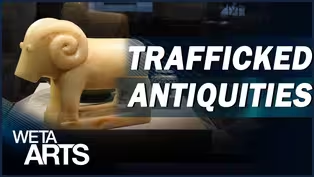
How the United States and Yemen Work Together to Combat Art Crime
Video has Closed Captions
Clip: S11 Ep8 | 9m 12s | Law enforcement officials battle art crime, which has had devastating impacts across the world. (9m 12s)
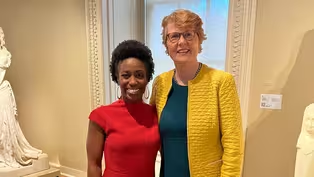
Preview: S11 Ep8 | 30s | Yemen’s repatriated antiquities; Classical Indian Dance; Smithsonian American Art Museum (30s)
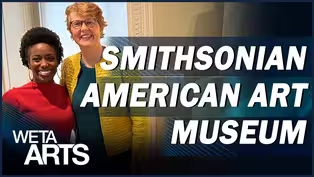
The Smithsonian American Art Museum is Evolving
Video has Closed Captions
Clip: S11 Ep8 | 6m 55s | Smithsonian American Art Museum director shares her vision for the museum's future. (6m 55s)
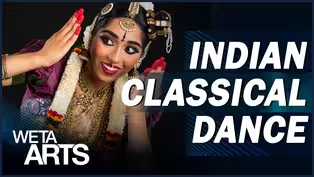
Step into the World of Bharatanatyam, a Classical Indian Dance Form
Video has Closed Captions
Clip: S11 Ep8 | 9m 3s | A Potomac, MD dance studio teaches Bharatanatyam, a classical Indian dance form. (9m 3s)
Providing Support for PBS.org
Learn Moreabout PBS online sponsorship
- Arts and Music
The Best of the Joy of Painting with Bob Ross
A pop icon, Bob Ross offers soothing words of wisdom as he paints captivating landscapes.














Support for PBS provided by:
WETA Arts is a local public television program presented by WETA