
WETA Arts May 2026
Season 13 Episode 8 | 26m 42sVideo has Closed Captions
Preservation at George Washington’s Mount Vernon.
In May, WETA Arts highlights a sweeping renovation at George Washington's Mount Vernon – the latest chapter in a preservation story more than a century and a half in the making. By the mid-nineteenth century, the Mount Vernon estate had fallen into near ruin. The Mount Vernon Ladies' Association not only saved the mansion, but also established a model for preserving historic sites.
Problems playing video? | Closed Captioning Feedback
Problems playing video? | Closed Captioning Feedback
WETA Arts is a local public television program presented by WETA
WETA Arts May 2026
Season 13 Episode 8 | 26m 42sVideo has Closed Captions
In May, WETA Arts highlights a sweeping renovation at George Washington's Mount Vernon – the latest chapter in a preservation story more than a century and a half in the making. By the mid-nineteenth century, the Mount Vernon estate had fallen into near ruin. The Mount Vernon Ladies' Association not only saved the mansion, but also established a model for preserving historic sites.
Problems playing video? | Closed Captioning Feedback
Where to Watch WETA Arts
WETA Arts is available to stream on pbs.org and the PBS app.
Providing Support for PBS.org
Learn Moreabout PBS online sponsorship♪ Hey, everybody.
I'm Felicia Curry, and welcome to "WETA Arts," the place to discover what's going on in the creative and performing arts in and around D.C.
George Washington's Mount Vernon in Alexandria, Virginia, is a site that honors the legacy of this Founding Father.
Each time he relinquished power, first as the commander-in-chief of the country's army, then as the nation's first president, Washington returned home to this plantation.
Even while conducting affairs of state, Washington managed the property, including modifying and expanding the mansion house.
♪ He would later die there in 1799.
♪ Although the house still stands today, its survival has been far from inevitable and a saga in its own right.
♪ [Birds chirping] When Mount Vernon first became a visitor attraction, George Washington was still living at the mansion.
Guests arrived frequently, visiting on more than 2/3 of the days for which records survive, but over time, the house fell into disrepair and eventually teetered on the brink of ruin.
♪ Then an intrepid group of women took over as custodians of the estate and have been preserving it for future generations ever since.
♪ For over 150 years, the Mount Vernon Ladies' Association has been dedicated to preserving George Washington's estate.
Right now, we're engaged in the largest preservation project in our history, a $40 million rehab of the mansion.
We like to think that if George Washington appeared tomorrow he would look at the house and say, "Oh, it's even better than I remember."
Curry: But he wouldn't yet as Mount Vernon's restoration team is racing against time to make Washington's vision a reality in time for a grand reopening only weeks away.
Thomas Reinhart: It's a little nerve-wracking moving big ton pieces of steel close to the house.
We're watching.
Like that's gonna stop it, but prayers, hopes and prayers, but you know, they do it carefully.
♪ Petri: We all know what house projects are for our own houses.
You can imagine what it's like with a 250-year-old house with a million visitors a year, and so that's what we were faced with.
If we were going to protect and preserve this great house for the next 200 years, should we do bits and pieces, or should we look at it holistically and really go in to try to firm up the foundations for future generations?
And that was our conclusion.
The current Mansion Revitalization Project is fixing a lot of problems that came about because of previous fixes, but if the Ladies' Association had not taken over Mount Vernon before the Civil War, it's very unlikely that the mansion house would still be here today.
It was going to fall down.
I love to tell the tale.
Louisa Bird Cunningham was going down the Potomac, and the moonlight was over Mount Vernon, and she saw how dilapidated it was.
She saw that the piazza was being held up by ships' masts, and so Louisa Bird, seeing this great iconic place where George Washington, our first president, lived, wrote to her daughter and said, "If the men of America won't take care of this house, why shouldn't the ladies?"
And indeed, Ann Pamela Cunningham, her daughter, responded to that call and decided to take on the task of saving Mount Vernon.
Curry: The house was in trouble even while George Washington was alive.
Reinhart: The original part of the house, the center section, is built in the 1730s, and it gets extended north and south in the 1770s.
They build a big, entertaining space, the New Room, which really becomes kind of a landmark space in American architectural history.
Washington adopts this European style after the war to show Europeans that Americans can compete artistically, architecturally with them.
As the most famous American, even before he's president, he knows he's gonna have a lot of visitors, so the house grows in that way.
We have a letter from George Washington dated December 3, 1797, where he says-- and I'm only roughly paraphrasing-- "The great girder in my New Room is so rotted that a moderate-sized company would fall into the cellar."
So 20 years from the time that the New Room was built, the floor frame is rotting out.
We found evidence of those repairs.
We found it in the walls.
It's all those little details that get us that complete biography of this place as a place of significance in American history.
Curry: George Washington had the resources to make such repairs.
Bradburn: At the time of George Washington's death, he has 8,000 acres here.
He had multiple cash crops.
He had a gristmill and even a distillery that was creating money for him.
The labor was enslaved labor, as it had been always at Mount Vernon, and he was himself an incredible manager of this estate.
After he dies, the people that inherit this property, they don't have the same resources that George Washington's going to be able to bring to bear, and they also don't have the same acumen and enthusiasm for farming.
♪ With the death of George and Martha Washington, all the people enslaved at Mount Vernon are not gonna be here.
The ones he owned outright are freed in the terms of his will.
Martha's went to her heirs, and they went to different estates because Mount Vernon itself was inherited by the Washington line.
Bushrod Washington inherits the estate.
He only inherits 4,000 acres of the original 8,000 Mount Vernon estate.
It includes the mansion house, but it doesn't include the gristmill, doesn't include the distillery, and Bushrod came in at a time when he was very cash poor, so he had enslaved people, but he had this empty mansion house, and he had this estate that had poor soil.
Bushrod doesn't seem to have that interest in farming or the time.
He is a Supreme Court justice.
He has to go on circuit in addition to going to the Supreme Court.
The price for wheat and flour plummets.
The banking panic of 1819 leads to a depression in Virginia that's not gonna go away for 15 years.
Bushrod had to sell pieces of land.
By the time he passes it on, it's down to about 1,200 acres.
He also sells over 50 enslaved people to Louisiana, where cotton is taking over.
Bushrod is able to amass, you know, some money in some of these sales.
He's able to put a balustrade on the house.
He puts a double-decker porch on the south side of the house, and so he makes it into his home.
He's gonna own Mount Vernon until 1829, when he's gonna hand it off to his nephew John Augustine Washington II.
He was more of a traditional Virginia planter, but he didn't have another salary like Bushrod had as a Supreme Court justice, so he had even a tighter chance to maintaining Mount Vernon in the face of the agricultural depression, less resources, and less acumen.
He dies, and it's inherited by his son John Augustine Washington III, and he's interested in trying soil fixing and a new fishery, different efforts to try to make it pay.
He starts encouraging tourism.
He has a relationship with a steamboat, and he wants tourists to come 3 times a week to Mount Vernon.
He can't make a go of it.
He cannot maintain the house.
He's becoming desperate to sell.
He looks to the United States government.
The federal government really doesn't have a model for taking over this public history site... ♪ and the Commonwealth of Virginia flirts with the idea of making the future Virginia Military institute at Mount Vernon, but that doesn't go anywhere ultimately either.
This is known amongst the broader Washington family.
Louisa Bird Cunningham is connected to the Washington family and encourages her daughter to take up this challenge, and her daughter does, which is extraordinary.
Ann Pamela Cunningham writes a letter that's intended for publication.
It calls upon the women of the South to step up, to figure out a way to save the home of the father of our country George Washington.
It's going to ultimately become the Mount Vernon Ladies' Association of the Union.
They're gonna bring in Northern women, as well, and that, I think, is a much more compelling story, a national effort to save this place, and it's really remarkable.
She starts what is, in essence, a grassroots campaign.
It's pretty amazing.
We've got to remember women couldn't vote at this time, they couldn't own property in their own right, and they really could not charter organizations which could receive charitable gifts, so she has to solve all of those problems as she starts to raise dollars.
How does she do it?
She says, "We are going to go to every schoolchild in America.
"We want to reach out to every American to give "him or her an opportunity to give a little mite," as she says, "in order to help support this great estate and to help us pay" the $200,000 that was required in order to purchase the estate.
♪ The women that are recruited to be a part of the Mount Vernon Ladies' Association are leading socialites.
They're really impressive women in their own right, but they're also married to wealthy men who are connected men, and the Cunninghams have this historical relationship, so I don't think a random group of women could have done the deal.
I think they had to have that special connection to the Washington family.
In 1858, the Ladies' Association are able to make the final payment and take over the home and the estate at Mount Vernon.
They have to repair the piazza before anybody can come.
It is literally rotting, falling off the building, so that's the first big construction effort they do, and so they're able, by February 22, George Washington's birthday, 1860, to open Mount Vernon for visitors.
The original idea of the Mount Vernon Ladies' Association was that they were gonna buy Mount Vernon to give to the nation, essentially to give it to the government to run or to give it to somebody else to run, but obviously, the Civil War ends all those conversations.
♪ Mount Vernon during the Civil War becomes declared neutral ground by first General Winfield Scott and then ultimately affirmed by Abraham Lincoln himself with the Secretary of the Ladies' Association Sarah Tracy having to sneak into the White House across the lines from Virginia to D.C.
to affirm that order.
Soldiers had to leave their arms at the gate, but they could still tour around because Mount Vernon was for all Americans, Confederate or Union.
It's really an extraordinary story.
During the Civil War and really just beyond the Civil War, there's no money really to do any grand plans once the piazza's reconstructed.
You're really just dealing with trying to make sure other things don't disappear.
It is, though, the beginning of this as a historic site.
You've got to provide for food, for visitors.
You've got to provide a visitation experience.
You're not just preserving it to put it in a glass jar so nobody can ever look at it again.
We have to make the house comfortable for visitors, so we need a heating system In the 19th century.
Thomas Edison electrifies the mansion, and it's to save it from fire because they're using kerosene lamps, they're using candles, things that could have sent Mount Vernon up in smoke at any time, but that's an intrusion, right, on the original structure.
It's never intended to have tens of thousands, hundreds of thousands, ultimately millions of people walking through this wooden house, and so, you know, you get bowing, so they put in all these brick piers into the cellar that hold up the floor.
At some point at the at the end of the 19th century, the rise of scientific, synthetic materials happened, and builders and, eventually moving on into the 20th century, preservationists saw these new products as a way to sort of solve the conditions that they might be seeing in old houses.
Curry: The major repairs of the 1930s focused on visible deterioration and functional problems that threatened the building in the short term.
We find now, with 100 years behind us since the invention of, say, Portland cement, which is a very hard mortar, we know that eventually it's gonna destroy a building's foundation.
Michael Ondrick: With historic brick, with lime mortar, your water can evaporate through the lime, but with hard cement, these bricks would tend to load up with moisture, and then when freezing weather came, it would start blowing apart.
Modern mortar tends to kill the structure, if you will.
We're experimenting with old ways of doing things, and they're proving to be the best ways.
You can almost, in some cases, hear the house sigh with happiness when--you know, when we take off latex paint because it can breathe again.
Curry: The 1930s repairs also prioritized returning to a 1799 appearance, removing additions made after George Washington's death like the balustrade and the porch.
The current repairs are also returning to construction methods of George Washington's time.
Instead of using, like, a tongue and groove, which is how modern flooring is done, these boards are just butted up to one another with a wooden dowel.
We saw it in the New Room, which the flooring there is mostly original, so we're doing the same thing here.
Mount Vernon Ladies' Association really was the first historic preservation organization.
They were really making the rules as they went along.
♪ Early on, they were faced, "Well, shall we "take down the house and reconstruct it?
Shall we remove all of the outbuildings?"
These were major, major initial decision points, and they decided, no, we wanted to create the entire estate so that you could really see how George Washington lived and the context of his life.
This was revolutionary.
And as a consequence, because we have the outbuildings, George Washington's Mount Vernon has always been able to provide a very rich context for the visitor, including the context of the life of the enslaved here at Mount Vernon.
We have considerable records.
We've worked very hard to tell that inclusive tale, and that was a byproduct of that very first decision.
Walker: There were a lot of enslaved carpenters where we have a first name, and that's really all we know about them, so it definitely sometimes gets contemplative.
It does make you think about, you know, who these people were, who these craftsmen were.
It's definitely a once-in-a-lifetime opportunity to do the extent of work that we're doing on the mansion.
Peter Seroskie: It's really incredible to put your feet in the footsteps of the guys that came before you.
Washington is one thing, but to be able to see the craftsmanship and how they put this all together with what we would consider rudimentary tools is pretty amazing, And it's possible to also see, you know, where mistakes were made, and we could say, "Oh, these guys were hu"-- as great as they were, you can say, "Oh, they were human just like us."
I would say the hardest part is not to fix something.
When you think of rehabbing a home, you might say, "Oh, let's level the floors" or, "Oh, let's straighten the walls out," but in a house of this historic significance, as soon as you start monkeying with that, you're gonna cause an unintended consequence somewhere down the line, so we just have to put it back exactly as we took it out.
The floors are a really good example.
Like in the New Room, you can see that the floor is really heavily bowed, and we had to put that bow back into the new joists because otherwise your baseboard won't fit because the baseboard is cut to that curve.
♪ Curry: Restoring the house was not only about structural integrity.
When the Ladies' Association took charge of Mount Vernon in 1860, they had a huge task to figure out how to furnish these rooms to look like they did in George and Martha Washington's period.
Petri: When they came to the home, there was virtually nothing left.
There were several fire buckets, there was the key to the Bastille, there was the Houdon bust, and there was a very large globe, but for all intents and purposes, the home was essentially empty.
So the initial response was to basically call upon their friends, call upon their own collections, and to bring pieces that appeared of the period and put them into the house.
Isaac: They also put out queries to try to bring back original objects, but it was a process of decades to find actual original pieces like the desk and Martha Washington's dressing table that come in many years later as descendants bring these back to the attention of the Ladies.
One of those early returning objects was George and Martha Washington's bedstead, and that had descended in the Custis-Lee family, and they sent it back in the late 19th century.
The Ladies, based on recollections, put in restored drapery and then began to fill out the room as best they could tell from recollections, but there's a lot of knowledge that has been lost between the 18th century and the late 19th century.
From the beginning, the Ladies were constantly asking questions, pulling back bits of plaster and pieces of paper, trying to use the tools that they had at the time to understand what was originally here.
In the 1920s and 1930s, Superintendent Harrison Dodge and his team during one of the restorations find some pieces of wallpaper, and they get very excited about that.
They have it reproduced, they install it in the thirties, and then within a few years, one of the wallpaper experts says, "I'm sorry, but that's a Victorian 1830s, 1840s paper."
The Ladies take down the paper in the forties, and after that, since they don't have a clear direction of where to go for the paper, the room remains just whitewashed.
For many years, the philosophy here was, well, if we didn't know absolutely precisely what the wallpaper in particular was, they preferred to leave it blank.
In this modern era, we have the advantage of being able to see the breadth of the evidence in a way that they weren't able to see before.
In the 1980s, we embarked on a round of paint analysis, and they restore the colors in this room of the woodwork to a blue.
We went from being able to see in the 1980s, like, 4 or 5 layers of finish, in the 2000-teens we were seeing about 20 layers of finish on this room and the full history of all the changes.
Architectural conservators who do paint analysis, they do biological analysis, they do chemical analysis so that they can figure out what component parts there are to each of the different paint layers.
They give us the component parts, the binder--in most cases, it's linseed oil-- and the pigments, the colors.
Our paint is handmade, and we use traditional tools to do that.
The visual qualities of hand-ground paint are very, very different from commercial paint that you just pick up.
It's not just a solid, flat, smooth, opaque color.
It's got subtle variation, subtle texture, gloss, and I think that that's what really makes it look different than just out-of-the-can commercial paint.
The paint that I'm using on the ceiling is actually--it's slaked lime.
It's a lime that's burned, and then it's allowed to sit for a number of years before it's even ready to be applied.
In George Washington's time, lime was sourced from shells from the Chesapeake, or it was from limestone in the Grand Valley, you know, that ran all the way from Canada all the way down to Alabama, and so nothing got here easy.
It all came by horse and cart, and it was fired on site, slaked on site, and so the process of putting this building together took a series of events and craftsmen to make it happen.
Using these natural paints and putties and things like that, they weren't invented.
They were recognized after generations and generations, hundreds of years of craftspeople tinkering with it, getting it better, seeing how it worked until you get to a product and a practice and a technique that is tried and true in the truest sense of the word.
I'm really firmly committed to training up the next generation of craftspeople.
We've got to.
If we want to save what has survived to us from our past in America, we need to have people who know how to do carpentry, who know how to do masonry, who understand traditional paints, who understand plaster.
♪ They're the trades that built this place, and they're the trades that are gonna preserve the great resources of our heritage.
♪ Curry: And after years of extensive and comprehensive restoration work, this historic resource is ready to be revealed.
♪ Well, good afternoon, ladies and gentlemen.
I'm Dede Petri, the 24th Regent of the Mount Vernon Ladies' Association, and I am delighted to welcome you to the beloved home of our first great action hero, George Washington's Mount Vernon.
[Cheering and applause] We believe in the power of place and educating the world about the character and leadership of George Washington.
Bradburn: You cannot understand the United States of America's founding without the indispensable George Washington.
How do you understand George Washington?
Well, you can't understand him without Mount Vernon.
We've been that important to the nation for years and years.
Over 100 million people have visited this place since the Ladies' Association was here.
I want to get 3 cheers from all of us for this great project, for George Washington, the father of our country, and the Mount Vernon Ladies' Association.
Hip hip!
Audience: Huzzah!
Bradburn: Hip hip!
Audience: Huzzah!
Bradburn: Hip hip!
Audience: Huzzah!
Bradburn: All right.
Let's go cut that ribbon.
Bradburn: Shall we?
Petri: Ready.
1, 2, 3.
-Yeah!
-There we go!
Huzzah!
[Cheering and applause] Bradburn: Let's get in there.
♪ Petri: We view this as a critical piece of our gift to the nation.
We really are so grateful to the many, many partners who have worked on this, brought their expertise to bear, help us move forward in doing innovative, visionary work when it comes to historic preservation.
Fanscali: I knew we would get everything back together.
The "holy crap" was looking at the schedule and saying, "Are we gonna get it back together in time for everything?"
It's really nice to be able to put everything back in its place and have it look beautiful again.
Bradburn: The work is still going on.
We got a little more fencing, as you see, a little more work to be done in the cellar, but I think this was a tremendous achievement and a big relief.
It kind of dawns on you in a bittersweet way that when we're done no one's even gonna know we've been here, right?
Everything we did from the outside is gonna be all put back together the way it was and the way it's always been, and no one will know the amount of labor and care that went into the project, but that's part of the reward, right?
So, you know, it's, uh-- it's all-- it's just what we do.
Curry: George Washington's Mount Vernon is open 7 days a week every day of the year with a museum, special events, and other attractions in addition to the historic mansion and grounds.
Go to mount vernon.org for details.
Thank you for watching "WETA Arts."
Be well, be creative, and enjoy the art all around you.
I'm Felicia Curry.
Both of us went to college for something completely different because we didn't necessarily know this was a viable career path straight out of high school, and I think that you can work with your hands, get into preservation, and do something on this scale is something that young kids might want to know.
Announcer: For more about the artists and institutions featured in this episode, go to weta.org/arts.
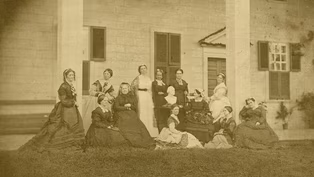
Preview: S13 Ep8 | 30s | Preservation at George Washington’s Mount Vernon. (30s)
Providing Support for PBS.org
Learn Moreabout PBS online sponsorship New Episode
 New Episode
- Arts and Music

Innovative musicians from every genre perform live in the longest-running music series.


 New Episode



 New Episode
 New Episode
 New Episode

Support for PBS provided by:
WETA Arts is a local public television program presented by WETA