
WETA Arts October 2021
Season 9 Episode 2 | 29mVideo has Closed Captions
Nat’l Gallery of Art, artist Nekisha Durrett, dancer Allen Xing, Smithsonian Craft Show.
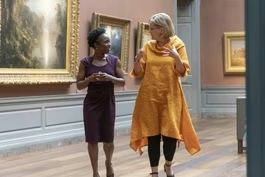
This month, host Felicia Curry visits with Kaywin Feldman, director of the National Gallery of Art in Washington, D.C. Also in this episode – artist Nekisha Durrett foregrounds the underrepresented in her bold installations; dancer-choreographer Allen Xing infuses his dance with his heritage; and the women behind the prestigious Smithsonian Craft Show.
Problems playing video? | Closed Captioning Feedback
Problems playing video? | Closed Captioning Feedback
WETA Arts is a local public television program presented by WETA
WETA Arts October 2021
Season 9 Episode 2 | 29mVideo has Closed Captions
This month, host Felicia Curry visits with Kaywin Feldman, director of the National Gallery of Art in Washington, D.C. Also in this episode – artist Nekisha Durrett foregrounds the underrepresented in her bold installations; dancer-choreographer Allen Xing infuses his dance with his heritage; and the women behind the prestigious Smithsonian Craft Show.
Problems playing video? | Closed Captioning Feedback
How to Watch WETA Arts
WETA Arts is available to stream on pbs.org and the free PBS App, available on iPhone, Apple TV, Android TV, Android smartphones, Amazon Fire TV, Amazon Fire Tablet, Roku, Samsung Smart TV, and Vizio.
Providing Support for PBS.org
Learn Moreabout PBS online sponsorshipHi, everybody, I'm Felicia Curry, and welcome to "WETA Arts," the place to discover what's going on in the creative and performing arts in and around D.C. First, I speak with Kaywin Feldman, the Director of the National Gallery of Art, about her plans for the Gallery amid a national reckoning on race and inclusion... Feldman: Communities are really asking their museums to reflect the way that America looks today.
Curry: a D.C. artist whose work celebrates overlooked subjects... Woman: It took me some time to actually realize that what I was doing was foregrounding these underrepresented individuals.
Curry: a modern dancer infuses his dance with his heritage.
I want my dance can connect with the Chinese-American population, but also for the non-Chinese-American audience.
Curry: And local women have created a fundraising machine through the nation's most prestigious art fair, the Smithsonian Craft Show.
Man: It's harder to get into that craft fair than it is to Harvard.
These stories and more on "WETA Arts."
Kaywin, thank you for joining us here on "WETA Arts."
I am so excited to be in the West building at the National Gallery of Art.
I think I want to start by asking you, I know that the art world has really undergone a lot in terms of calls for inclusivity and relevance to new generations and cultures and cultural sensibilities.
Where do you think the National Gallery of Art is positioned on this conversation?
It's very important that the National Gallery of Art both attract and reflect the nation.
And I'll be honest, we have more work to do to truly reflect the nation.
We were founded originally by Andrew Mellon and opened our doors in 1941.
Mellon really modeled us off of the National Gallery in London.
He really originally saw it as a paintings gallery of European art.
When we were founded in '41, America was 90% white.
And of course, now America is 60% white, and it's projected that within 25 years, we will be majority people of color.
And our collection has not kept up with those changes in demographics.
So we've got some exciting and joyful and big work ahead.
I love hearing you talk about that, sort of the understanding of the work that we all have ahead.
So with that said, what new artists or exhibitions are you excited to show us here in D.C. and the tourists that come through?
In terms of acquisitions, we made our first major acquisition of a work by a Native American artist called "Target: I See Red" by Jaune Quick-To-See Smith.
And it is hanging in the East building on the wall right now and is a beautiful, moving, and deeply important work of art for us in the collection.
One of the many shows to be excited about is an exhibition called "New Woman Behind the Camera" that focuses on some of the early pioneering women photographers that often have been overlooked.
We are currently celebrating the great American artist Alma Thomas, who was born in Georgia, but spent most of her life in Washington, D.C. She lived here for over 70 years.
And she was the first graduate of Howard's art program.
She taught in D.C. public schools.
After 35 years, she retired and really embarked on a great painting career as an older woman.
We have several works in our collection, so it's a partnership with D.C. public schools, D.C. Public Library, the Phillips Collection, Howard, Smithsonian American Art Museum, the National Gallery, among other institutions are all celebrating our hometown hero, she-ro, Alma Thomas.
I love it.
I know that you told the "Post" that you were charged by your board of trustees to put the "national" in National Gallery of Art.
How exactly are you doing that?
Feldman: I have always worked for community museums.
And as I was making the decision to come here, one of my trusted advisors said, "Ahh, the nation becomes your community, and what does that mean?"
And immediately my heart started to race.
So we are just at the start of really imagining all of the ways that we can serve the nation, certainly as you and I have discussed, being even more intentional about truly representing the breadth of America.
We want to think about how we could partner with other communities across the country.
Curry: I was just thinking, in your statement, "Reimagined National Gallery of Art," there is a film that asks the question, what connects everybody?
How do you use a statement like that to sort of chart a path forward for the museum?
Feldman: During the dedication of the National Gallery, President Roosevelt stated that the purpose of the National Gallery was to ensure that the human spirit... Roosevelt: ...human spirit and human mind, which has produced the world's great art and all its science, shall not be utterly destroyed.
Feldman: And he said it in '41, so it was during the second world war.
And I think about what he wanted for the human spirit.
I have always been really interested in the whole concept of wonder and of empathy.
When we experience wonder, whether it's a great piece of music or a work of art, something happens to us.
We realize we are part of something bigger than ourselves.
Whatever your reasons for visiting or the emotions you feel, you can feel connected to other people.
Let me ask you this.
What about your personal favorites, you know, the paintings, the art, the sculpture that really speaks to you personally?
Can you tell us a little bit about that?
My list of what doesn't speak to me would be a lot shorter than what does speak to me.
But my field is originally Dutch and Flemish 17th-century painting.
And I decide which are my favorites, actually, by when I take my walks through the galleries, where do I notice my feet end up most often?
And we have a self-portrait by Rembrandt that I've known for years, but now I get to live with it every day.
And so I often stop by and visit.
And just 3 years before he painted this portrait, he went bankrupt and lost his house and his possessions.
And I can't help but look at the painting and think about the things that he's been through.
So that's always a special favorite of mine.
How does the National Gallery of Art sort of compete with the other artistic venues that patrons can go to?
What do you say to bring people into the museum?
We truly feel like we are a network of museums, and I could actually almost say a sisterhood because most of the museum directors in Washington are now women.
And so we love to work together, and definitely a rising tide lifts all boats.
The National Gallery of Art is free admission.
Lectures, films, concerts, symposi--everything we do is without charge.
So what we're really asking people to do is give us their time.
And the busy lives we all lead, you have to really know that it's a value to come here.
And so offering lots of different exhibitions and programs at the same time.
We often have a lot of family events happening.
And, you know, lots of reasons for people to come.
You just talked about a sisterhood, so I have to say it.
As the first woman director of the National Gallery of Art, I look around here and I think a lot about legacy.
What is the legacy you want to leave for other women in positions of power?
I sometimes say that I was the first woman director at 3 of the 4 museums that I have led in my career, but I will be the last first woman director.
And when I was appointed here, somebody wrote to me and said there's shattered glass laying on the floor of American museums today.
So I'm very proud of that and also feel completely dedicated to helping the women who are coming up in the field.
I'm sort of the last wave of an era of museum directors, and we're starting to see a new generation take over.
And I'm nothing but excited about it.
Thank you so much, Kaywin, for spending time with us today here on "WETA Arts."
It has been a pleasure.
And I can't wait to come back and enjoy the museum with friends, family, community.
We look forward to welcoming you back.
Thank you.
On the National Gallery of Art's website, you can find a symposium celebrating local artist Alma Thomas, featuring former First Lady Michelle Obama.
And check out their upcoming exhibit, "The New Woman Behind the Camera," which runs from October 31 to January 30.
A local artist is making a mark through her installations and also through her students.
I'm Nekisha Durrett, I'm a multi-media artist.
We are at the Martin Luther King, Jr. Memorial Library, and the vestibule contains my dual installation "Prepare to Participate."
We all know the "I Have a Dream" speech.
We probably had to learn it in high school.
At least I did.
It was very important for the library to broaden that narrative and to widen the history.
This piece brings forward a lesser-known moment when Martin Luther King gave a speech at Cardozo High School here in Washington D.C.
The library presented me with the collection of political buttons.
Political buttons are so varied and can be so tied to a person's identity.
And I had this idea that by using the graphics of various buttons, that all of these identities could be wrapped up into this likeness of MLK.
Aside from being a visual artist, I'm also a trained graphic designer.
And so typography is very interesting to me, how we communicate through various type faces and very simple graphics.
I think that when there is a larger-than-life persona like Martin Luther King Jr., there are a lot of people who stand in his shadow who actually were lifting up this movement.
I think that it took me some time to actually realize that what I was doing was foregrounding these underrepresented individuals.
With "Magnolia," taking magnolia leaves and perforating them with half-tone dot patterns.
Those half-toned dot patterns are actually the names of Black women who have been murdered by law enforcement.
There are currently over 30 of these leaves.
These leaves, when they fall and dry, they become about the color of my skin.
I can't tell you the number of times people will email me and say, "I passed a magnolia tree "that I pass every day, "and now that I've seen your work, I can't not think about these women."
So it's this sneaky little way that it creeps into your psyche and hopefully changes you a little bit.
I have another artwork that's on view at the West End Library.
It's in the children's pavilion, and it's called "A Garden Party."
The piece features two children who are reading their books.
And when you look more closely, you see that the wallpaper behind them is springing to life.
I like to think that when kids see this work, that they'll see it differently every time they visit the library.
Like, there will be some little animal they'll see peeking out from the leaves that maybe they didn't notice before.
A couple of years ago, I had a large floor installation at the Arlington Arts Center that was called "Out of the Blue Black."
And it was a circle on the floor that was made up of about 24,000 handmade clay 4-leaf clovers.
That narrative was very personal in nature in that it was a story about how my grandmother's family migrated from southern Virginia to Upstate New York.
At the time, it may not have seemed that huge to my grandparents that they were doing this thing, but they actually did kind of risk their lives to make this move.
The 4-leaf clover was an artifact that I found in my grandmother's belongings.
It was pressed in a book in a little suitcase where she kept little keepsakes from her childhood to early adulthood.
I imagine her picking the 4-leaf clover in Upstate New York when they arrived to safety.
It was like she was preserving a part of her youth, holding on to this bit of safety that they carved out for themselves.
I just always felt like I was an artist.
I was always drawing, always looking at things, always trying to do something a little better with my art.
So like that was kind of my way of expressing my individuality in a way that was acceptable.
So I just kind of held on to that.
I think we are all born artists.
I really do.
There's a point where some of us just stop being artists.
When I finished graduate school, I came back to D.C., and I started making large-scale graphics, printing onto vinyl, and doing window films and vinyl murals for museum exhibitions.
Someone said to me, "You're like the only Black woman in the Smithsonian who's doing work like this."
And I thought about that, and I was like, "Well, maybe there's like one other person or something."
At Duke Ellington School of the Arts, a lot of people assume that I teach in the Visual Arts department, and I actually teach in the Museum Studies department.
So the reason why the Museum Studies department exists is because there weren't any Black people who were in decision-making positions within museums.
It is museum workers who preserve the history.
I think it's important to imbed in the minds of young people the importance of historical preservation.
And so that is what these students are doing.
Many of them do go on to the actual curatorial work.
It's pretty profound.
When the Black Lives Matter movement happened, there were people wondering like, "Where is the leader of this movement?"
And the leader of this movement is in all of us.
And that's one of the things I think is so beautiful about this moment is that there isn't this one person that we can look to.
It's sort of looking within ourselves.
You can see a new Durrett installation called "Air Shaft" in the Phillips Collection in Dupont Circle.
And keep an eye out for a solo exhibition in January at Brentwood Arts Exchange in Brentwood, Maryland.
In 2008, dancer Allen Xing performed at the Beijing Olympic games.
12 years later and a world away, he received the Baltimore Regional Independent Artist Award from the Maryland State Arts Council.
My name is Allen Xing.
I'm the Artist Director of the Xing Dance Theater.
I'm combining Chinese classical dance and folk dance with modern dance.
I grew up in the art community, which is everyone work for the same local art company.
A lot around performing art, dance, singing, play, theater performance.
My parents, they're both actors.
And my mom also was part of the dance team of the company.
My mom took me to the company dance class when I started taking ballet for fun during the summer.
And then got really into that, and my mentor was saying, "Why don't you try to apply to dance school?"
And my grandparents totally didn't like that at all.
So they want me to go study math, study science, go to the regular jobs instead of art.
But I really loved to dance a lot, and I loved the dance form.
You can be able to express my feeling, my emotion.
Curry: Xing applied to one of the most prestigious arts high schools in China.
Xing: When I was 15, I left my hometown Jiangsu and went to dance boarding school for my high school.
I start classical ballet and the Chinese classical dance training from that time.
Curry: Just two years after he graduated, he was dancing with the award-winning Huajin Dance Ensemble and discovering the world.
Xing: We were in the production of "Forbidden Fruit Under the Great Wall," and we toured.
We came to the D.C. area, and we performed in the King Center.
Curry: The tour also made a life-changing visit to Salisbury University on the Eastern Shore.
That was my first time came to the U.S. And then I really loved the school here and the environment here.
I went to Salisbury University for Masters of Education.
And I was in the transition from dancer and into the teaching and administration.
Salisbury University often had the company performance come to visit.
And I remember there was Alvin Ailey, the performance theater, dance theater, came to Salisbury University.
And that was like my first time really sitting there to look at American dance theater, like modern dance performance.
I really loved it.
That's kind of like the moment, like, with me myself, I'm just like, I really love dance again.
I want to go back to stage again.
I started my MFA in dance at the University of Maryland.
And what I learned here is like modern dance, it's not all the same.
I learned from my faculty, from my co-runner, each person have very unique dance background.
So they have their own voice in the dance.
I really start interested in how can I make dance very personal to myself, meaning to myself, and also can connect the community around me.
So that's start, my research focus, which is combining Chinese dance, classical dance, folk dance, and modern dance to create my unique aesthetic.
Curry: Although focused on developing his own dancing, Xing did not lose his passion for dance education.
I taught Chinese dance at UMD... to American-born Chinese students.
A lot of students.
And then they asked the teachers, like, "Why are there so many people came to take the class?"
And they said because their parents want their kids to still connect the culture from China, even born here, they live here.
So they use dance as a form to want their kids to connect to their culture.
And just not the kids.
Their parents, they are taking class as well during the weekends.
So that's kind of like the moment I realized how powerful dance as a tool in this society and how this can impact the local community.
1, 2, 3, 4.
Xing: So I created a dance studio offering the Chinese dance class during the weekend.
I use my dance company to start making art, making dance.
I want my dance can connect the Chinese American population so they can see Chinese traditional dance elements, their Chinese folk dance elements.
But also for the non-Chinese American audience, they see more contemporary modern performing arts can also find the moderness, but also they can see the Chineseness.
This semester's classes are aimed at youth.
In person instruction is in Vienna, Virginia.
Check the website for more information about upcoming classes and performances.
The all-volunteer Smithsonian Women's Committee has raised millions of dollars for initiatives ranging from studying elephant genetics to an exhibit about 1960 sit-ins.
They did it be creating the most prestigious art fair in the nation.
Cissel Gott Collins is among the women documenting the history of the organization.
Gott Collins: The Women's Committee started at a White House dinner in 1965 where someone suggested to Dillon Ripley, who was the secretary of the Smithsonian, that it might be nice if we had a ladies auxiliary to do the sort of thing that ladies do, to escort people around and to be promoters of the Smithsonian to the Washington community at large.
And that's how it kind of started, except these women were not about to just be ladies auxiliary sorts.
Mary Livingston Ripley, the wife of the secretary, called everybody she knew in October of '66, and by 1967, we were giving out grants.
We gave our first one to the Anacostia Museum for books and for a little library and for a sewing machine.
The reason that we do the grants is that the Smithsonian is huge.
They can't do everything.
An example, the Mpala Wildlife Research Center in Kenya.
We gave them a grant to build residences.
In Myanmar, they wanted to put trackers on bats to trace diseases.
We gave them a--I believe it was $27,000 grant for the collars.
It's these small things.
It's a wonderful idea, but if they couldn't get the funding for it from another source, it just wasn't going to happen.
One of the things we used to do to raise funds was to have dances.
We just had a wonderful time getting it all organized, making sure there were enough people there to make some money on this project.
I guess it was in '81 that we started looking around for ways of raising more money.
And Lloyd Herman at the Renwick suggested a craft show.
The first year of the craft show was 1983.
And the funds raised went from being able to give grants in the 70,000 area to a hundred and some thousand.
So it was significant, and it's gone up from there, which is very nice.
My history with the Smithsonian show goes back to the eighties.
I got in and thought, "Oh, this is fine."
The next year, I did not get into the fair.
Gott Collins: The exhibitors for the Smithsonian Craft Show are juried.
Bean: I was a juror for the fair, and the quality of the work is really amazing.
It is some of the most sophisticated work done in the field.
When the jurors jury, they don't have the price points.
So we could have someone like Keith Lewis who does earrings, and they're lovely, and they're about $75 each.
There are ceramic artists.
Their pieces sell for 75, $80,000.
I do love the art part of the Smithsonian Women's Committee.
I have John Iversen earrings.
He's from New York.
Starr Heigenbring's scarf.
She's from New Orleans.
And Holly Anne Mitchell bracelet from Indianapolis.
It is all tiny, rolled up newspaper with little crystals and things around it.
So it looks fancy, but it's just little newspaper rolled up.
And that is her thing.
Woman: What attracts me to the Smithsonian Women's Committee is not the crafts.
It is the opportunity to work on the grants that we award the Smithsonian.
I fell in love with the Smithsonian going to the Museum of Natural History and just feeling like it was just the coolest place in the world with that mastodon in the front hall and the Hope diamond.
All that stuff has always really grabbed me.
The most fun thing about being a member of the Smithsonian Women's Committee is when you go meet with the person who has applied for the grant, which is just so fun always.
You walk in thinking, "What do I care about golden tree frogs or native orchids?"
And after you talk to somebody who's passionate about it, you work on a presentation, and then the whole Smithsonian Women's Committee gets together, and then we vote on what's gonna get funded.
It's really rewarding to work with these women.
It's the working with each other that is so wonderful.
They are interested, excited, energetic, willing, creative, fascinating people.
And it's just--that is probably what's kept me involved more than anything else is the women.
They're just fabulous.
The 2021 Smithsonian Craft Show is being held virtually from October 23 to the 31.
For additional information, visit smithsoniancraftshow.org.
Here's a thought to consider from author Kurt Vonnegut.
"Practice any art-- music, singing, dancing, "acting, drawing, painting, sculpting, poetry, "fiction, essays, reportage, "no matter how well or badly, "not to get money and fame "but to experience becoming, "to find out what's inside you, to make your soul grow."
Thank you for watching this episode of "WETA Arts."
Be well, be creative, and enjoy the art all around you.
I'm Felicia Curry.
Announcer: For more about the artists and institutions featured in this episode, go to weta.org/arts.
Preview: WETA Arts October 2021
Preview: S9 Ep2 | 30s | Nat’l Gallery of Art, artist Nekisha Durrett, dancer Allen Xing, Smithsonian Craft Show. (30s)
Providing Support for PBS.org
Learn Moreabout PBS online sponsorship
- Arts and Music
The Best of the Joy of Painting with Bob Ross
A pop icon, Bob Ross offers soothing words of wisdom as he paints captivating landscapes.














Support for PBS provided by:
WETA Arts is a local public television program presented by WETA