
WETA Arts September 2023
Season 11 Episode 1 | 28m 26sVideo has Closed Captions
Spoken Word to Go-Go; ChalkR!ot’s street art; Woolly Mammoth Theatre’s artistic evolution
WETA Arts and host Felicia Curry are back! This month, experience the power of words at the Spoken Word to Go-Go finals, learn about Chelsea Ritter-Soronen’s transformative street art with ChalkR!ot in Silver Spring, and explore how Woolly Mammoth’s artistic director Maria Manuela Goyanes navigates the challenge of upholding the theater’s legacy while continuing to push artistic boundaries.
Problems playing video? | Closed Captioning Feedback
Problems playing video? | Closed Captioning Feedback
WETA Arts is a local public television program presented by WETA
WETA Arts September 2023
Season 11 Episode 1 | 28m 26sVideo has Closed Captions
WETA Arts and host Felicia Curry are back! This month, experience the power of words at the Spoken Word to Go-Go finals, learn about Chelsea Ritter-Soronen’s transformative street art with ChalkR!ot in Silver Spring, and explore how Woolly Mammoth’s artistic director Maria Manuela Goyanes navigates the challenge of upholding the theater’s legacy while continuing to push artistic boundaries.
Problems playing video? | Closed Captioning Feedback
How to Watch WETA Arts
WETA Arts is available to stream on pbs.org and the free PBS App, available on iPhone, Apple TV, Android TV, Android smartphones, Amazon Fire TV, Amazon Fire Tablet, Roku, Samsung Smart TV, and Vizio.
Providing Support for PBS.org
Learn Moreabout PBS online sponsorshipHi, everybody.
Welcome to "WETA Arts," the place to discover what's going on in the creative and performing arts in and around DC.
In this episode, we catch the final round of a spoken word competition set to DC's very own Go-Go music.
Really it hadn't been done before.
It just took off.
Curry: We head to downtown Silver Spring, where the pavement art can't be missed.
The act of creating on the ground sparks dialogue.
Curry: And I meet with Maria Manuela Goyanes, the artistic director of Woolly Mammoth Theatre, to hear about what they're working on for the upcoming season.
Goyanes: Woolly Mammoth has to continue trying to make projects happen that might seem impossible otherwise.
All these stories coming up on "WETA Arts."
♪ Muriel Bowser: Go-Go.
Crowd: Is DC.
Bowser: Go-Go.
Crowd: Is DC.
Bowser: Go-Go.
Crowd: Is DC.
And today, we're going to let the world know that Go-Go is DC.
Curry: In 2020, Mayor Muriel Bowser named Go-Go the official music of Washington, DC.
A subgenre of funk, Go-Go is the sound behind DC events, from proms to protests.
♪ Put me in the straw of your mind ♪ Curry: It's also the soundtrack for a spoken word competition that's part of a movement to create an arts district in Anacostia.
Woman: Barbecue Battle, can you hear me?
[Crowd cheering] Curry: At the Go-Go stage at the 31st Annual Barbecue Festival in downtown DC, 3 poets gather for a showdown.
Welcome to the "Spoken Word to Go-Go" finale.
Curry: They are the finalists in a competition called "Spoken Word to Go-Go."
I'm a little nervous now, but I'm prepared.
I'm excited.
Right now, I'm just thinking about doing what I know I can do.
I'm prepared for this.
I have lost a lot of sleep in the weeks leading up to this moment 'cause I really want to win this.
Curry: Spoken word means poetry intended for performance.
Try not to do too much damage.
Curry: Performing poetry to a Go-Go accompaniment involves layering words on top of the kind of percussion and bass-driven music pioneered by Go-Go bands like Rare Essence and Chuck Brown and the Soul Searchers.
Crowd: ♪ Ho ♪ Brown: ♪ Uh-oh, uh-oh ♪ Crowd: ♪ Uh-oh, uh-oh ♪ I want you to love DC like Chuck Brown loved his beats.
Curry: Sir Harvey Fitz first entered the contest in 2022, the first year of the competition.
Didn't make it past the first round, but I purposed that the following year, I would study, do my research, and dedicate myself to competing in this.
And here we are in the finals.
Love DC...
The title of my piece is "Ode to DC."
The love I have for it I want everyone else to have for it.
Curry: The poets are competing for a prize of $1,000, bragging rights, and a professionally produced album.
I want to win, but I think even more important than winning is just impacting the people that hear what I have to say.
We were members of the streets.
We were tender in concrete...
The piece is entitled "Backdoor."
It was a time where my family and I were nearly homeless and an auntie of mine, she moved us in in her basement, and the way that we would get into the basement was through the back door.
The poem that I'm using for this competition is called "Dead Man Walking Freestyle."
In a few months, I'll be saying, "I'll do," and when I say those two words, pardon me, wish I was saying them to you.
I don't write about the birds and bees and trees and things like that.
I write about, you know, situations that I'm going through.
Curry: WPGC radio personality Poet Taylor is emceeing the competition for a second year.
The idea of allowing you to bring your thoughts to real life, to the sounds of Go-Go, sound like a good idea to me.
As a kid that grew up in foster care, sometimes it was hard for me to find my voice or how to express how I felt.
Taylor: We have DC and DMV natives that are bringing their best to the stage.
To see these babies on stage inspire another generation of kids to come forth and try being heard and making music in a way they never saw has been magical.
I'm glad that I said yes.
Curry: Performing spoken word poetry to Go-Go music was created by Kristina Noell, executive director of the Anacostia neighborhood's Business Improvement District Organization, BID for short.
I am charged with being creative and providing opportunity for the community that we serve.
I happened to be looking up at a stage and I said, "You know what?
"Go-Go is the music of the city.
"And the stories that are told through spoken word are amazing."
Change hasn't come today.
We need to do spoken word to Go-Go.
Two weeks later, we created a contest and it just took off.
I met Freedomwriter during this competition.
Joezy, we've been in the open mic scene for a few years now.
The spoken word poetry scene here is more lively than a lot of places I've seen.
You can find an open mic spot almost every day of the week.
Johnson: I've been able to tell my story to say, "Hey, use this as a coping skill.
"You don't have to use violence.
"You don't have to be angry.
You know, use your arts, use your mind."
We used to be next to the stars and now those stars are out of reach.
These poets are getting work.
They're getting paid to do their spoken word.
That's what I want to do.
Relationship went on.
Something was wrong.
Curry: Over 20 contestants competed in the preliminaries and semifinals, all performing to prerecorded tracks.
The finalists, however, will perform to music played live by a band called The Experience Band and Show.
The mindset behind creating the tracks was really just trying to create music that had some emotion to it.
It's not really hard to put poetry with Go-Go groove because they was already putting poetry to jazz.
So, all you have to do is really change the syncopation.
♪ ...your love ♪ I believe that the judges will be moreso looking for creativity.
Creativity and really content.
♪ The contest for the "Spoken Word to Go-Go" is getting ready to happen.
Taylor: Our wonderful judges are judging on message, originality, technique, content, form, and overall performance.
Man: What I want to hear from the contestants that day, I'd like for them to show me the passion behind their words.
It's always hard being a judge because there are so many great poets out there.
You want to have somebody be able to bring some great writing and also the performative part where they can actually captivate the audience.
Taylor: Can we please put love and light in the air for Joezy Joe?
Nearly homeless, Auntie moved us to her basement.
We were lucky.
Ain't no cases ever called us.
Praise the father that his daughter raise the sons.
Ain't no guns, there ain't no bullets, ever bullets from her presence.
She was working to get presents in December.
Come around downstairs, 'cause that's where we stay.
No windows to peep, no cable to see.
Only father was Jesus, but it was all that we needed.
Never ask God for more.
Two bedrooms, living room, kitchen, through the back door.
Back door, back door, back door, back door, back door.
Back door, back door, back door, back door, back door.
Back door, back door, back door, back door, back door.
Back door, back door, back door, back door.
♪ Taylor: Ladies and gentlemen, put love and light in the air for Freedomwriter Johnson.
No way.
No way her new dude an upgrade.
Give it 13 months.
She's James Harden requesting a trade.
Houston, we got a problem.
We used to be on cloud nine.
We used to be next to the stars.
And now those stars are out of reach.
New dude.
Good dude.
I shouldn't be saying this.
I'm tipsy, 'cause the rock got me saying this.
In a few months, I'll be saying, "I do," and when I say those two words, pardon me, wish I was saying them to you.
Thank y'all.
Freedomwriter, baby.
♪ Taylor: I bring you your final performer Sir Harvey.
I want you to love DC like Chuck Brown loved his beats.
Like how Marvin loved to sing.
Like 1978 when the Bullets won that ring.
Love DC like fire wings fried hard with mumbo sauce, salt, pepper, ketchup on your fries.
A large half and half [indistinct].
Love DC like how Mr. Henry's loved Roberta.
Love DC respectfully on purpose.
Love DC like how preachers over in Union Temple love saying, "I'm getting ready to soul" in their sermons.
Love DC like how we all know its legacy deserves it.
Peace, y'all.
Thank you so very much.
[Crowd cheering] ♪ Taylor: Your 2023 Spoken Word to Go-Go Champion Sir Harvey Fitz.
[Crowd cheering] Fitz, voice-over: So, plot twist.
I won.
Um, I aced it.
I'm even more speechless than about a hour or so ago.
A check for $1,000.
[Crowd cheering] Fitz, voice-over: This means the world to me.
I rarely compete for anything 'cause my nerves.
[Crowd cheering] This is going to carry me for a while.
It's definitely gonna carry me for a while.
I'm really happy.
Taylor, voice-over: Kristina and the BID, first of all, I love y'all and thank you.
They've managed to do something that sometimes people in the act of wanting to do good forget, and it's invite the people that you want to do good for to the table and simply ask, "What does that look like for you?"
You can find spoken word open mic nights every night of the week, including all 9 Busboys and Poets restaurants and Bloombars at 3222 11th Street Northwest in Columbia Heights.
Also, sign up for the newsletter from the folks working on a new Go-Go museum planned in Anacostia.
Go to gogomuseumcafe.com for more information.
In downtown Silver Spring, a stretch of Ellsworth Drive is being prepped for a makeover.
Refashioning the pavement mural is Chalk Riot, a public art production company specializing in paint and chalk, founded by Chelsea Ritter-Soronen.
Ritter-Soronen: We gotta give it a fresh coat of white paint, and the white just helps make the colors pop once we get into the colors on this design.
We had no intentions of making it a business, and it was just a time that we could get together and just create in public without breaking any laws, without seeking permission, without trying to get paid.
We were just having fun, and that felt like a chalk riot.
Chalk Riot has evolved into, we say, pavement artwork instead of just chalk artwork.
We've become nerdy experts on the types of sidewalks that exist or the types of asphalt that exist, and each of those different types require different art mediums, and each project has different goals as far as how long we want the artwork to last or, on the flip side, how easily it needs to be washed away.
The ephemerality of chalk art is liberating.
It's a reminder that everything we do is really about the experience, because what is permanency anyways?
Curry: The Ellsworth Drive design is intended to stay in place for a year, and it's sponsored by Peterson Companies, which manages downtown Silver Spring.
It keeps things interesting and fresh and fun and unexpected, and it gives the community a chance to see what Chelsea and her team can do.
Curry: Ritter-Soronen met one member of her team, Ann Gill, at the 2019 Women's March, for which they both made protest art.
By training, Gill is an illustrator.
My preferred medium is digital art.
Doing the pavement art, it's a good switch.
I'm learning in a different style because mine is really graphic-y, like line work.
I was like, "Oh, let me learn chalk art "and let me learn how to be a little bit looser with my painting."
My artwork looks a lot better now because of it.
Curry: Chalk Riot artist Samantha Hamilton was a student at American University when she met Ritter-Soronen.
Hamilton: Chelsea came to campus to train students on how to use chalk as a medium for spreading political messaging.
It was a really great way to combine my loves for art and political science.
There's a lot of planning beforehand with actually creating renderings and getting permission from the folks who are commissioning the project.
Ritter-Soronen: It's a physically taxing project.
It's actually really easy to forget how long you've been sitting in one-squished up position.
Suddenly, two hours has gone by and, like, you get all stiff.
Curry: Running an art business is not what Ritter-Soronen had planned as a profession.
I was studying costume design for theater and film and graduated in 2008 at the peak of economic collapse.
I'd hang out with my scene-painting friends, and that's when I really got the bug for painting.
I worked at coffee bars and I worked at wine bar and I started doing, like, signboards for restaurants and cafes and then somebody would ask me, "Oh, who made that?"
And then I could sell my work over it.
I'd be like, "Oh, it was me.
Hire me."
[Laughs] ♪ The original chalk artists are called madonnari, which means a person who is drawing the Madonna.
People would pay their respects for how good the art was or how beautiful the art was by putting coins onto the drawing.
This sparked the tradition that is still around today.
Curry: Following in the madonnaris' footsteps, Ritter-Soronen found success busking in Europe.
Ritter-Soronen: I'd be out creating art and meeting other artists in cities where street art was a huge, huge deal.
It still is a huge deal.
Then I hopped over to the Fringe Festival in Perth, Australia, and there were buskers of all different types, from drag performers to acrobats to me with my chalk.
So, I learned a ton and also got steeped in that culture for the first time where I could ask really vulnerable questions of, like, "OK, how do we make this work?"
When you're at the foot of humanity, when you're at the foot of traffic, you hear everything, you see everything, and just the act of creating on the ground sparks dialogue.
To be able to do that and make money kind of became my dream job.
Curry: After stints in Europe, Australia, Mexico, and California, Ritter-Soronen relocated to Washington, DC.
Ritter-Soronen: I noticed working on the ground here that aggressive driving is serious and it's different than other cities.
♪ Chalk Riot got commissioned by Department of Transportation to do a mural along Wheeler Road.
The people in the community were really sweet.
They, like, came out and got us snacks and they let us use their bathrooms and everything.
But the traffic was really, really dangerous.
And there's two schools on that block.
Projects like that are really inspiring and just, like, gives me that boost to just keep going.
Curry: While Chalk Riot's transportation clients are trying to use art to save lives, property managers like Peterson Companies in Silver Spring are seeking to preserve social space.
We wanted to create a space that helped people feel like they could safely gather and support our restaurants.
Ritter-Soronen: This mural is like a visual cue to the public that you are free to enjoy your lunch on the cafe tables out there, meet a friend for coffee, walk your dog, skateboard, whatever you want to do.
This is a public space and not just a road for cars.
Curry: To celebrate the completion of the Ellsworth Drive mural, Peterson Companies and Chalk Riot host a chalk festival allotting squares of pavement for people to use as their canvas.
Ritter-Soronen: This morning was our first time seeing the mural without all the cones around.
It's so gratifying to see it finally come into fruition and see all the people out.
This is my first time doing chalk art.
I am working on a diamondback terrapin.
I went to the University of Maryland, so, go Terps.
I'm 14 years old and I'm from Wheaton, Maryland.
I think Afros give really, like, flowy, texture kind of vibe, so, to me, I, like, associate that in my head with jellyfish.
When you step out of your home and you see your community livened up with art installations like the street mural and then events like today's chalk fest, this is the reason that you are not shopping online.
By fully exercising that public space and bringing people out and fostering local businesses, public space remains public.
You can find Chalk Riot's work across the city, from a tribute to DC jazz legend Shirley Horn at 6th and O Streets Northwest to a riff on artist Alma Thomas' style near her former home at 15th and O Streets Northwest.
There are pavement art events across the nation throughout the year.
Learn more at chalkartnation.com.
When Woolly Mammoth Theatre's co-founder Howard Shalwitz decided to retire as artistic director, he had been the only person in that role for the company's 40 years.
In that time, Woolly found a home in Penn Square, a loyal following, and national acclaim.
I met with Maria Manuela Goyanes, who succeeded Shalwitz in 2018, to talk about where she's steering this groundbreaking playhouse.
Tell us a little bit about why you chose to come be the second artistic director here at Woolly Mammoth Theatre.
When I got the call about Woolly Mammoth Theatre, I was at the Public Theater in New York.
That's my hometown.
I had a great gig, but I kept thinking about a theater company in the middle of the nation's capital that has a risk profile, like Woolly Mammoth, doing work that is challenging, getting to launch careers for writers.
And I thought to myself, "This is actually a call that I need to take."
What about the history of Woolly was exciting to you?
Howard Shalwitz built something that has two pillars that I really stand behind.
One is esthetic innovation and the other is civic provocation.
Some of the plays that have premiered here have gone on to great success nationally.
"Mr. Burns" by Anne Washburn.
All: ♪ And no one shouted, "Flee" ♪ We've done all of the plays by Danai Gurira, who is brilliant.
Really sort of amazing, exciting writers.
I feel like I've been trying to have a conversation with the audience that Howard started.
That's "Fairview."
That's "Ain't No Mo'."
So, basically, trying to have a space where particularly the Black folks in the community actually see experimentation.
Us leaving this land ain't what's easy, ain't what's smooth, it's what builds.
It's radical that you are here.
You are a first-generation Latinx woman who is running a theater in the middle of Washington, DC.
Tell us all how you got here.
My dad is from Spain and fixed the buses in New York City.
My mom is from the Dominican Republic.
She was a kindergarten teacher.
I had my nose in books all the time and had a big imagination.
And it was a teacher that changed my life who brought us to the Manhattan Theater Club to see "Blue Window" by Craig Lucas.
Allison Janney was in it, and Joe Mantello directed it.
And I'm like, here, 15, 16 years old, looking at it and being like, "I could totally do this better."
I felt my imagination completely turned on and I was like, "Oh, my God, this is like books on stage.
I want to be here.
I want to be doing this."
I went to Brown University and I started doing theater there and I was like, "Mom and Dad, I'm going to get a job.
I promise you I'm going to do it."
And I worked at every theater company I could get my hands on.
I did everything that I could to be seen as somebody who should be working there.
At the Public, I was helping people make their work happen.
Here I get to pick it.
I get to actually open the door and say, "Hey, do you want a production?
Do you want to work on this with us?"
And that feels like, yeah, a dream come true.
For risk-taking shows, What is the success?
And you could talk about also the success of the awards and the accolades.
Don't skip out on those, but-- I was gonna say, winning a Tony Award is not a bad-- Talk about it.
Is not a bad night, let me tell you.
It was actually pretty great.
And what's so amazing about winning a Tony Award for "A Strange Loop" is just how much cultural opinion has changed.
The idea that a Black, queer, gay person of size at the center of a musical could actually attract over 300,000 people in to go see that show, it's, like, mind-blowing.
Man: ♪ I woke up this morning, I told myself to try ♪ ♪ I told myself that I would make no compromises ♪ For me, success is very specific for each show.
Success is Ryan Haddad getting to play his show more than 4 times in a row.
He's an actor with cerebral palsy, and we gave him that opportunity to actually deepen his craft.
I'm not upset about having a disability.
I'm upset about the way people treat me.
Tell us a little bit about the partnerships that you have here at Woolly Mammoth Theatre.
Our first show of the season is a co-production with the Wilma Theater Company in Philadelphia, a play by a Ukrainian playwright named Sasha Denisova called "My Mama and the Full-Scale Invasion."
The show is about Sasha's 82-year-old mother who is living in Kyiv in the Ukraine and has been since the start of the war, and it's all about Sasha imagining her mother on the front lines.
We have a show that has been touring the country-- "Where We Belong" by Madeline Sayet-- about Madeline going to get her PhD in Shakespeare in the UK and having some cognitive dissonance with them about their culture and their lack of understanding of colonialism.
We're also going to be doing this great new play by Vivian J.O.
Barnes, who's from Northern Virginia, called "The Sensational Sea Mink-ettes."
It's like Rockettes, but Mink-ettes, and it's about a dance squad in an HBCU, and it's all about perfectionism and Black womanhood.
We've got a play by Adil Mansoor.
He is a Pakistani- American artist who has never come out to his mom.
I really was moved by Adil's story about trying to get closer to his mom and trying to actually be able to be more himself.
And we also have a partnership with John Jarboe, the artistic director of the Bearded Ladies Cabaret in Philadelphia.
John wrote this amazing cabaret music show called "Rose: You Are What You Eat."
John is trans and queer, goes by she/her pronouns, and her aunt let her know that actually John was a twin on the ultrasound.
And then the twin disappeared.
The whole show is all about gender cannibalism [laughs], and John maybe eating her twin sister and now having an identity that also includes her.
Everything you're talking about in this season is exactly what you said-- risk taking.
Asking the people in the audience to envision the humanity of others in a different way.
What do you envision for Woolly moving forward?
When Howard Shalwitz was leaving, the question was whether or not Woolly Mammoth could withstand a founder transition.
And, for me, we need theaters like Woolly Mammoth to push our artists, push our audiences, push our society to be more creative, more participatory, more engaged, more equitable, more inclusive, more radical.
And so, for me, it's about shoring up Woolly Mammoth so that, you know, in 5 or 10 years, the next person can come in and never have it be a question whether or not Woolly Mammoth should continue to exist.
We are so lucky to have you here.
Maria, thank you for this time.
Thank you and good luck with everything at Woolly Mammoth this season.
Curry: Woolly Mammoth Theatre is at 641 D Street Northwest near Gallery Place Metro.
Go to woollymammoth.net for more information on their programs and for tickets.
Here's a thought from American portrait painter Kehinde Wiley.
"Art is about changing what we see in our everyday lives and representing it in such a way that it gives us hope."
Thank you for watching this edition of "WETA Arts."
Be well, be creative, and enjoy the art all around you.
I'm Felicia Curry.
Announcer: For more about the artists and institutions featured in this episode, go to weta.org/arts.
♪
Chalk Riot's Sidewalk Art Helps Revive Communities
Video has Closed Captions
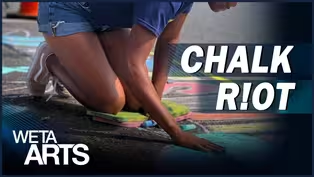
Clip: S11 Ep1 | 8m 23s | Chalk Riot, a dynamic public art company, is transforming downtown Silver Spring. (8m 23s)

DC's Spoken Word to Go-Go Competition Crowns a Champion
Video has Closed Captions
Clip: S11 Ep1 | 9m 45s | Three poets compete in the finals of the "Spoken Word to Go Go" competition. (9m 45s)
Maria Manuela Goyanas Has Big Ideas For Woolly Mammoth
Video has Closed Captions
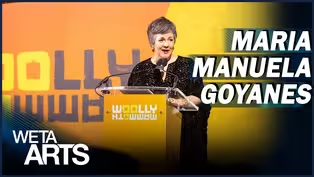
Clip: S11 Ep1 | 7m 57s | Felicia Curry chats with Maria Goyanas, Woolly Mammoth Theater's new Artistic Director. (7m 57s)
Preview: WETA Arts September 2023
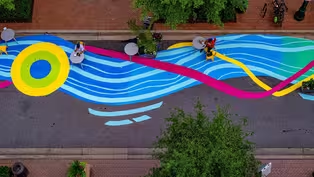
Preview: S11 Ep1 | 30s | Spoken Word to Go-Go; ChalkR!ot’s street art; Woolly Mammoth Theatre’s artistic evolution (30s)
Providing Support for PBS.org
Learn Moreabout PBS online sponsorship
- Arts and Music
The Best of the Joy of Painting with Bob Ross
A pop icon, Bob Ross offers soothing words of wisdom as he paints captivating landscapes.













Support for PBS provided by:
WETA Arts is a local public television program presented by WETA