
WETA Arts September 2024
Season 12 Episode 1 | 27m 26sVideo has Closed Captions
Omnium Circus; Kim Sajet, director of the National Portrait Gallery; Folger Library 2.0
WETA Arts host Felicia Curry presents the inclusive mission of founder Lisa Lewis’ Omnium Circus, sits down with the National Portrait Gallery’s director Kim Sajet for a conversation about which historical figures deserve recognition for their significant contributions, and tours the Folger Shakespeare Library’s exciting new wing.
Problems playing video? | Closed Captioning Feedback
Problems playing video? | Closed Captioning Feedback
WETA Arts is a local public television program presented by WETA
WETA Arts September 2024
Season 12 Episode 1 | 27m 26sVideo has Closed Captions
WETA Arts host Felicia Curry presents the inclusive mission of founder Lisa Lewis’ Omnium Circus, sits down with the National Portrait Gallery’s director Kim Sajet for a conversation about which historical figures deserve recognition for their significant contributions, and tours the Folger Shakespeare Library’s exciting new wing.
Problems playing video? | Closed Captioning Feedback
How to Watch WETA Arts
WETA Arts is available to stream on pbs.org and the free PBS App, available on iPhone, Apple TV, Android TV, Android smartphones, Amazon Fire TV, Amazon Fire Tablet, Roku, Samsung Smart TV, and Vizio.
Providing Support for PBS.org
Learn Moreabout PBS online sponsorship♪ Hi, everybody.
I'm Felicia Curry, and welcome to "WETA Arts," the place to discover what's going on in the creative and performing arts in and around DC.
In this episode, Omnium Circus accommodates all audiences.
Omnium is expanding people's minds by showing them what people with disabilities can do.
We are gonna open these doors in 30 seconds.
[Cheering and applause] Curry, voice-over: The Folger Shakespeare Library reopens... Man: We're not done with Shakespeare, and Shakespeare's not done with us.
I have to show you this amazing portrait.
Curry, voice-over: and I interview Kim Sajet, director of the National Portrait Gallery, about art and history.
Never trust a portrait, I just want to tell you.
There's always a backstory.
It's all ahead on "WETA Arts."
♪ There have been clowns and acrobats for thousands of years, but the circus, with its collection of breathtaking acts, only dates to the mid 1800s.
♪ From horse-riding tricks to sound and light show extravaganzas, circuses continue to seek new ways to delight their audiences.
♪ Man: Let's go.
1, 2, 3, 4, 5, 6, 7, and go.
Curry, voice-over: In Northern Virginia, the circus has come to town, but it's not like any circus you've seen before.
Woman: Company, I just wanted to say thank you.
The show is fabulous.
Woman: Ready?
Curry, voice-over: Founder Lisa Lewis has created a circus revolutionary in its inclusivity.
It's called Omnium, which means "of all."
Lewis, voice-over: 90% of us will face disability at some point in our lives if we live long enough.
[Cheering and applause] Lewis, voice-over: What prevents someone from being able to fully participate in a performing-arts experience?
We believe in embracing inclusion.
Lewis, voice-over: If you're Deaf, we use sign language.
Man: The clown is doing time steps and tap dancing.
He's still in a tutu.
Lewis, voice-over: If you're blind, everything is described simultaneously through a set of headsets which you pick up at the coat check.
We have a touch tour, so those who are tactilely-oriented can feel little, miniature props.
[Applause] There are people for whom noise is very triggering, so we make sure that the decibel level never gets too high.
We leave the house lights on.
If someone gets deregulated and they need to leave to go to the calming center, they need to do so safely.
We create as much access as we possibly can to make sure that everybody is able to enjoy the production... [Applause and laughter] and anything that anybody else needs, if you write me in advance and if we can do it, we will.
Man: So Dick is on stage juggling.
Malik does his dance.
Lewis: Anything you might need from Production is gonna be right next to the green rooms.
OK. Do you need some help with them?
Lewis: Oh, and I need to unpack that one sometime.
Man: Check, 1, 2.
Lewis: Eric's here.
It's good to see you.
OK. Curry: Eric Latcheran of Chantilly, Virginia, works with Lewis promoting Omnium.
He and his mother Gina Latcheran were among the first to discover Omnium when it was founded in 2021.
Gina: I love the circus, but he was scared to death-- the noise, the smells, everything that came along with the circus.
[Honk] Curry, voice-over: Omnium's approach makes it possible for Eric, who has Down syndrome, and his mom to enjoy the circus together.
Gina, voice-over: The lights were on.
There were no loud noises, just fun.
The performers came and introduced themselves, clowns without makeup... Gina, voice-over: or without something that might have been scary.
What color is this?
Pretty bad.
Gina, voice-over: I think the favorite part is that he's made friends.
Gina, voice-over: It's improving his speech.
It's improving his energy level, and that's wonderful.
Come on.
We got to go help your mom.
OK. Curry, voice-over: Not only did Lewis expand the potential audience, she took it one step further.
Lewis, voice-over: I looked in the ring and I thought, "The people in the ring "don't represent the people in the audience.
Why can't that be more connected?"
Curry, voice-over: Including staff and performers, 40% of the people in Omnium have a disability.
Woman, voice-over: I am an actor, director, dancer, artistic director, and producer.
I have osteogenesis imperfecta.
We go...
Yes, so when you're sending me off, do I need to just-- What happens...
If you've met other people with OI, we're the biggest hams in the entire world.
And then I jump out of the chair.
Man: Right.
♪ Richard: Until Omnium, I was very uncomfortable around circus because of the "freak" idea and all of that stuff.
Lisa really takes Omnium and turns that on its head.
Thank you, Suzy.
Richard, voice-over: Lisa convinced me in her authenticity.
I believed in what she was doing... 5, 6, 7, and boom.
Richard, voice-over: and to get to do circus stuff, come on.
How fun is that?
Ooh, it's gonna be so fun.
Lewis, voice-over: It is going to be a fabulous collection of some of the best circus acts in the entire world.
One of our dancers is a 7-time NCAA gymnastics champion, and he does a tap-dance number.
Our aerialist is a beautiful aerialist.
Legs are irrelevant.
I get comments all the time-- "Are you a sideshow?"
"Are you a freak show?"
No, obviously not, but go back in history.
People with disabilities were not given any opportunities, but the circus itself was a big proponent of people with disabilities.
It's really truly special to work together and create and really see the gifts and the talents in each person.
You guys are all such special, special people.
We've got this... Whoo!
Yeah.
Lewis: and what are we gonna do?
All: Change the [beep] world!
[Cheering] Lewis: Go get 'em, everybody!
Curry, voice-over: It's showtime.
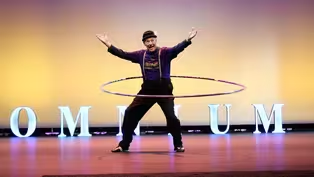
♪ [Applause] Welcome to Omnium, a bold, new circus.
[Cheering and applause] ♪ [Rhythmic clapping] ♪ [Cheering and applause] ♪ [Cheering and applause] ♪ I don't know how to describe it.
Like, it was so, like, perfect.
The jump rope, that was really amazing.
Ha ha!
[Cheering and applause] Gina, voice-over: I see so many friends who are coming back year after year.
Omnium is expanding people's minds by showing them what people with disabilities can do.
It's not reliant upon verbal skills.
It's not reliant upon intellectual skills, and that's such a beautiful, unifying force for people.
For a brief moment in time, we can all connect with our hearts.
Lewis: All right.
Whoo!
Thank you.
Curry, voice-over: You can catch Omnium on February 22nd at the Warner Theatre.
Check omniumcircus.org for details.
[Cheering and applause] There are 21 Smithsonian museums and galleries, and only 11 of these are on the National Mall.
One that's just 5 blocks from the mall is the National Portrait Gallery... Sajet: This is our big signature picture of George Washington.
Curry, voice-over: and it is one of just a handful of museums in the world fully dedicated to portraiture.
Sajet: He was the only president who actually wasn't elected.
Curry, voice-over: Kim Sajet became the director of the National Portrait Gallery in 2013, and I was intrigued by what she had to say about this art form and the evolution of the museum.
Welcome to "WETA Arts."
I'm gonna jump right in.
What is the oldest portrait we have here at the National Portrait Gallery?
Around 1616, 1615, we have some engravings.
They're actually part of a book to document rulers from William the Conqueror until James I.
In the collection, there's a portrait of John Smith, founder of Jamestown.
♪ In that book, interestingly, too, is a portrait of Pocahontas.
♪ Just looking at it, I couldn't guess.
Yeah.
She's literally been whitewashed.
This is a Native American acclimated to colonization.
Fascinating.
Never trust a portrait, I just want to tell you.
There's always a backstory.
Curry: This museum has a rich, rich history and is tied to another museum.
How did the National Portrait Gallery end up here?
The museum that we were based on is the National Portrait Gallery in London, and they were established in 1856.
They're full of kings and queens and princes and princesses, right?
We don't have any of those.
The congressional charter is, collect the portraits of men and women who've made a leading contribution to U.S. history and culture.
Our first book was actually called "This New Man."
There's about 136 portraits in it.
♪ Only 9 women, only 3 African Americans, no Asian Americans.
It is a very limited version of our history, driven by who we've decided to allow to be an achiever.
Two things you just said-- number one, eligibility...
Yes.
and talk to us a little bit about what that used to look like and what that looks like now.
To be in the Portrait Gallery, you had to be 10 years dead, right?
This idea was that it would give us a decade to look back and say, "Who are those people that are "legitimately achievers and had a significant impact?"
And then you actually had to have a portrait.
Paintings were expensive.
Bronze and marble's really expensive.
Photography changes everything.
Everyone could pretty much afford to get a photograph done, whether you were enslaved, you were a soldier, you were a mother, an immigrant-- name your minority group.
♪ How do we get to where we are today?
In 2001, it was decided that we would actually start collecting living people, and so that's been a bit of a game changer.
There was about 285 portraits back in 1968.
We now have about 26,000 portraits.
♪ So I have to show you this amazing portrait.
This is by Michael Shane Neal of Congressman John Lewis.
It looks like somebody was sketching and then going back in with the paint and didn't quite finish.
He did it deliberately because Congressman Lewis said, "The work of civil rights is still unfinished.
We still have a lot of work to do."
What a beautiful thing to have in a collection called "The Struggle for Justice."
♪ You all have all of these wonderful collections.
What is inside those collections that excite you, and how has that added to the storytelling here at the Portrait Gallery?
I'm only interested in exhibitions that tell us something we didn't know before.
"Brilliant Exiles" tells the story of these 60 remarkable, creative women who felt that they couldn't practice freedom in this country because they were a woman, because of their race, because of their religion.
Between 1900 until 1939, they all go to Paris to find themselves.
♪ They meet all these remarkable artists-- like Picasso, Matisse, Steichen-- and they actually absorb a lot of the ideas of modernism.
This idea that somehow American modernism was something that the men came up with, a whole lot of women were really part of that movement, bringing all those lessons back to America.
I want to show you this amazing self-portrait of an artist called Lois Mailou Jones.
She looks confident, self-assured.
Yeah, and she's looking out at you, right, so this is actually pretty unusual, a woman to look you directly at the eye, let alone an African American woman, but the fact that she's looking out at you and she's like, "I'm an artist," so this was a moment of freedom for her.
She talks about Paris and all of these people watching her paint in the street.
She said, "That would never have happened back home."
Beautiful.
Let me show you some more things.
♪ So look at this amazing-- I know.
I know.
This is-- I'm sure everybody's talking about this one, too.
Yeah.
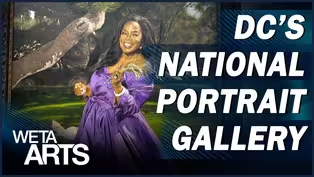
You know, there's Oprah Winfrey.
She is in her peace garden.
She's holding an olive branch, which, of course, is about peace.
I'm sure you get a lot of foot traffic coming in.
Yes.
This is where we hang, you know, some of our most recent acquisitions.
In fact, when we did the Obama portraits, we had, of course, President Obama was in the presidential gallery... ♪ but Michelle was down here, and she caused such a traffic jam that the guards begged us to take her away.
They were like, "Please take her off the first floor," because nobody could get in the doors.
Wow.
You have a lot of celebrity... Yeah.
in this museum.
Do you chalk that up to a time where celebrity means something?
The question of celebrity is a real challenge.
Who are those people that are legitimately achievers in American culture?
It's also about different fields of endeavor because we'd like the next generation to learn from them.
When you see Jose Andres holding a big box of food surrounded by people after a natural disaster, what is that story telling you?
My big goal, though, in the Portrait Gallery, is that it's not what you look like that matters.
It's what you do that counts.
Absolutely, and you're talking about the idea of portraiture is a visual representation of the individuals who comprise our history and what that looks like.
How do you think the National Portrait Gallery is reshaping the notion of national identity based on that portraiture?
Now we collect video art.
It's a very different way of presenting portraiture.
We have theater.
We have music.
Humans are messy, and so I am very keen to sort of broaden the idea of portraiture to be about sound, smell, taste.
It's complicating it, right, but makes it interesting.
Kim, thank you so much for being on "WETA Arts."
We have really enjoyed this conversation, and we can't wait to see what else comes here to the National Portrait Gallery.
Well, thank you so much.
Please come.
It's your museum.
Curry: Located near the Gallery Place-Chinatown Metro, The National Portrait Gallery is open 7 days a week from 11:30 A.M. to 7:00 P.M.
The "Brilliant Exiles: American Women in Paris" exhibit runs through February 2025, and the museum's podcast "Portraits" invites you to join Kim Sajet as she chats with thought leaders about the real people behind art.
Look for it on your favorite podcast platform.
Ladies and gentlemen, we are gonna open these doors in 30 seconds.
Curry, voice-over: The Folger Shakespeare Library on Capitol Hill is home to a massive collection of Shakespeare-related books and manuscripts...
The Folger's open.
Curry, voice-over: and it just got a makeover... [Jazz band playing] ♪ 11 years in the making.
♪ Man, voice-over: The collection that's here at the Folger dwarfs any other collection connected to Shakespeare, who saw the world in all of its complexity and invited people to re-imagine it or to even learn more, and the Folger is a wonderful place to do that.
The collection that's here is rare and precious, and the living presence of this writer needs to be celebrated.
That led to our master plan and the creation of this project to put the pieces together, to engage people with different experiences and in modern context.
The marriage of contemporary with classical is so important because it's a metaphor for Shakespeare, too.
♪ The original mission of the Folger was defined by the founder Henry Folger, who was a great collector of Shakespeare books and manuscripts, and he thought of it as a temple or a retreat for people who wanted to commune with knowledge and with this writer.
What we've become is the research library at our core, but we knew that this place had so much potential as a landing point for arts, humanities, culture, poetry, music.
I mean, this building sings with all of this beautiful architecture, the interior, and reminds you of the world that Shakespeare came up in and produced theater in.
♪ The problem, though, was the building looked like a bank, and it was not physically accessible, and the treasures that we have, the rare books and manuscripts, could be more accessible.
The fact that the Folger was placed in the District of Columbia, the crossroads for so many different cultural influences to engage with, that is the possibility that's opened up when you can actually get into this building and show the things that we have.
The renovation is really a reimagining of a classical building that honors it and its beauty but that also creates a modern context.
♪ It took us some time, I think, before we found that solution of slipping the addition underneath the terraces and making these new open facades that open out onto the new entry gardens, all within the boundaries of that historic building and terrace.
Witmore, voice-over: The landscape invites you down and says, "I'm gonna bring you "into this beautiful, modern entry floor "that has canopied galleries where you can see rare books and manuscripts and you can have experiences."
Woman: Have any of you ever wanted to pull a 300-year-old book and look at it in a room like this?
Because now you can.
Wow.
Man, voice-over: It's terrific in Washington to have a place of pilgrimage for Shakespeare buffs.
I think many British people would be surprised, would be amazed that Washington, DC, is also a major Shakespeare hub.
♪ Curry, voice-over: Although it looks similar to nearby public buildings, like the Library of Congress and the Supreme Court, The Folger is owned by Amherst College, Henry Folger's alma mater.
Henry Clay Folger comes to Amherst College in the 1870s, and Shakespeare at that time is part of the culture there.
His wife Emily Folger attributes a special significance to a moment when Ralph Waldo Emerson comes and lectures at Amherst College.
Emerson said that Shakespeare captures the true sense of humanity.
That ignited Folger's imagination.
He started acquiring this collection.
♪ Witmore, voice-over: Henry Folger and Emily Folger were unrelenting and acquired the greatest collection of original materials connected to Shakespeare anywhere in the world by far.
♪ If you look closely at the founding of the Folger Shakespeare Library, it's very clear that it was a memorial.
It's part of a larger movement in the early 20th century to create living memorials to famous people or events.
♪ A sculpture will look the same, roughly, year after year after year.
An institution will survive, but it will also open up, change, and adapt, and that's why we need institutions, and I think that's why both Shakespeare and the Folger remain important.
Curry, voice-over: The Folger's most prized acquisitions are 82 of the 235 copies of Shakespeare's "First Folio."
♪ Shakespeare's "First Folio" for many years has been in the furthest corner of the deepest vault, and now it's going to be inside the front door.
One of the ways we're going to share different aspects of these books is by turning the entire case into a data visualization.
Each shelf location where a copy of the book is will have a light to show you different things about the books-- which of the copies were owned by women, which of the copies are in the earliest bindings because many of these over 400 years have been bound and rebound multiple times.
You're seeing 82 books, and each one of these has variations that tells us something about the 400 years since these books were first printed.
We take things that are older, that are respected, that have been around for a while, and we figure out how to re-imagine them.
♪ Curry, voice-over: The Folger's Conservation Lab is in charge of ensuring these rare and valuable works can be safely displayed for all to view.
We are now in our Conservation Lab, where Rachel is going to show us a little bit of the work that is done on these materials.
I have here a "Second Folio."
When it came to us, this upper board was detached.
We want to restore stability so it can be safely handled and used.
As you can see, it looks much better now.
It really does.
This is a book from the 1530s.
It's a French schoolbook of Greek and Latin texts.
And this image that you see here is a printing press, Yes.
and so this is within a hundred years after the printing press was first used in Europe, and here's a depiction of one of these books being made, in essence.
Not only are the books important, but who's handled the books is important.
There's a way of using biology to track who's handled this book, where did it go.
The boards that are in a book have tree rings.
Those tree rings have data about climate.
Of course, we answer questions about who Shakespeare was, but we're really interested in everything you can learn from a collection like ours, and that's part of being a curious institution that's opening up and asking new audiences and new participants, including biologists, including climate scientists, students, and grandparents.
We want them all.
[Jazz band playing] Curry, voice-over: The Folger opened its new doors, and people came from far and wide.
It's unbelievable how they could go underground and do this without destroying the building above it.
♪ Woman: This is amazing.
I called and checked multiple times to make sure that all of the "First Folios" would be here because I really, really cared about that.
Woman: It used to be at the Folger, visitors would come in, and they would lower their voice.
It would be very churchlike.
No more of that.
We want to hear people's outside voices or their regular inside voices, so it's thrilling to just be here and kind of soak this up.
Witmore, voice-over: I love this place, and it's created a new way for me to think about scholarship, about the public, about community.
They should come here because we're not done with Shakespeare and Shakespeare's not done with us.
♪ It's an endless story, and I'm really glad we can finally tell it.
The Folger Shakespeare Library is one of the great research libraries in the world, but it is also a cultural destination.
[Applause] Curry, voice-over: Just 4 blocks from Capitol South Metro, the Folger Shakespeare Library is open Tuesday through Sunday.
Learn about theater and music performances, community events, teacher resources, and more at folger.edu.
♪ Here's a thought from Presidential Medal of Freedom recipient, former Texas Congressional Representative Barbara Jordan.
"Art has the potential to unify.
"It can speak in many languages without a translator.
"The arts do not discriminate.
The arts can lift us up."
Thank you for watching "WETA Arts."
Be well, be creative, and enjoy the art all around you.
I'm Felicia Curry.
I'm also very interested in making people cry.
Does that sound awful?
No.
I'm an actress.
[Both laugh] It was an interesting move to put a Shakespeare library and a theater right here-- the Supreme Court, where law is interpreted, and the Congress, where laws are made-- and I think the reason why was because we need history, theater, poetry, and the humanities to be part of an elevated democracy.
Announcer: For more about the artists and institutions featured in this episode, go to weta.org/arts.
Explore the Rich History of the National Portrait Gallery
Video has Closed Captions
Clip: S12 Ep1 | 8m 36s | Go behind the scenes at the National Portrait Gallery in Washington, D.C. (8m 36s)

Omnium Circus Reimagines the Circus for Everyone
Video has Closed Captions
Clip: S12 Ep1 | 7m 23s | Step into a world where the circus is reimagined for everyone! (7m 23s)
Preview: WETA Arts September 2024
Preview: S12 Ep1 | 30s | Omnium Circus; Kim Sajet, director of the National Portrait Gallery; Folger Library 2.0 (30s)

Step Inside the Transformed Folger Shakespeare Library
Video has Closed Captions
Clip: S12 Ep1 | 8m 57s | The Folger Shakespeare Library just unveiled a stunning renovation 11 years in the making! (8m 57s)
Providing Support for PBS.org
Learn Moreabout PBS online sponsorship
- Arts and Music
The Best of the Joy of Painting with Bob Ross
A pop icon, Bob Ross offers soothing words of wisdom as he paints captivating landscapes.














Support for PBS provided by:
WETA Arts is a local public television program presented by WETA