
WGN-TV Poll of June Republican Voters
5/13/2022 | 27mVideo has Closed Captions
WGN-TV poll of likely Republican voters in the June 2022 Primary.
On this weeks Capitol View, Host Jak Tichenor and our panel breaks down a new WGN-TV poll of likely Republican voters in the June Primary that shows Aurora Mayor Richard Irvin leading Senator Darren Bailey by just over 4 points with 37% remaining undecided. Guests include UIS Emeritus Professor Kent Redfield and WGEM Capitol Bureau Chief Mike Militech.
Problems playing video? | Closed Captioning Feedback
Problems playing video? | Closed Captioning Feedback
CapitolView is a local public television program presented by WSIU
CapitolView is a production of WSIU Public Broadcasting.
WGN-TV Poll of June Republican Voters
5/13/2022 | 27mVideo has Closed Captions
On this weeks Capitol View, Host Jak Tichenor and our panel breaks down a new WGN-TV poll of likely Republican voters in the June Primary that shows Aurora Mayor Richard Irvin leading Senator Darren Bailey by just over 4 points with 37% remaining undecided. Guests include UIS Emeritus Professor Kent Redfield and WGEM Capitol Bureau Chief Mike Militech.
Problems playing video? | Closed Captioning Feedback
How to Watch CapitolView
CapitolView is available to stream on pbs.org and the free PBS App, available on iPhone, Apple TV, Android TV, Android smartphones, Amazon Fire TV, Amazon Fire Tablet, Roku, Samsung Smart TV, and Vizio.
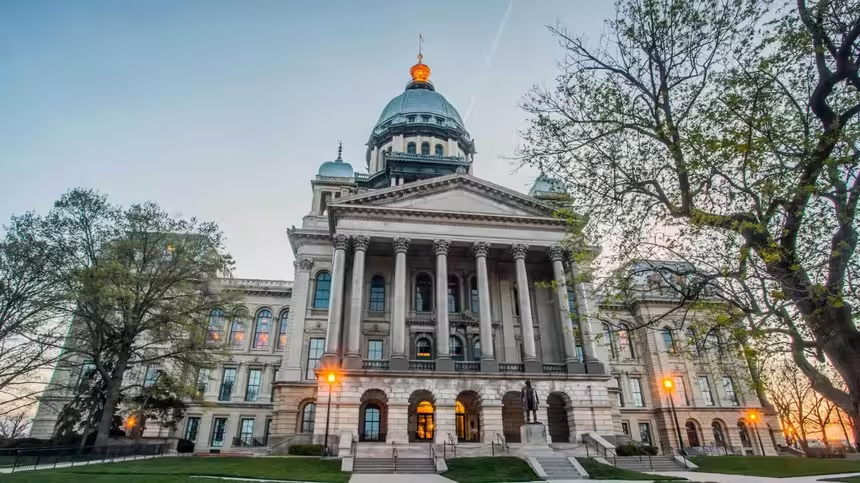
CapitolView
CapitolView is a weekly discussion of politics and government inside the Capitol, and around the state, with the Statehouse press corps. CapitolView is a production of WSIU Public Broadcasting.Providing Support for PBS.org
Learn Moreabout PBS online sponsorship(dramatic music) (camera clicking) (dramatic music) - Welcome to "Capitol View," I'm Jak Tichenor sitting in for Jennifer Fuller this week.
We're joined by University of Illinois-Springfield emeritus professor, Kent Redfield and Mike Miletich, Illinois Capitol Bureau Chief for WGEMU.
It's good to have you both on the program.
- Good to be here.
- Thanks for having us.
- Lots to unpack here this week as we take a look at the Illinois political landscape.
There's a new poll out now in the Republican race for governor.
The new WGNTV Emerson College polling survey of likely GOP voters coming out this week shows Aurora mayor, Richard Irvin, leading the field with 24.1% support followed by Darren Bailey with 19.8%.
That's only a little over 4% of a lead for Richard Irvin who has spent a lot of money so far in paid media trying to boost his recognition factors around the State of Illinois.
What are your main takeaways, gentlemen?
- I think right now it's a bit of a concerning poll for the Irvin campaign.
And frankly, it looks very good for Senator Darren Bailey.
He's not spending nearly as much on ads or getting out there in the community.
I mean, he's able to go Downstate and talk to the voters that line well with him, but every single time you turn on TV or go onto social media, you see Irvin campaign ads.
And this was a bit of a shock for those that have been following because you think that money speaks more than actions, but turns out that this time, they may lean more towards that humble, Downstate lawmaker that lined up well with people who were against COVID-19 mitigations.
That is what led to his campaign success so far.
- There is, now there's 37% undecided, so a four-point lead, got May and June to get to the election, the primary day at the end of June.
So there's certainly time there.
There's some question about what's a ceiling, what's a floor in terms of how much room there is to grow.
The other thing, you don't know without looking at, closer at the poll, they've got it divided regionally in terms of the responses.
And historically, in a Republican primary, you're looking at 45% Downstate, 35% collar county kind of area.
And then the combination of Chicago and Cook, suburban Cook are about 20%.
And so the votes are, if you run well Downstate, that obviously gives you an advantage in terms of what the primary electorate looks like.
Now I mean, those are, I don't know we have some real, any recent numbers on kind of where the vote comes from in Republican primaries, but we know four years ago, Rauner spent $37 million in the primary and Jeanne Ives spent about four.
And that was a 51-48 kind of three, 4% difference.
And so money is important, but the other thing we may not be capturing in terms of some of the ways the numbers are being reported is there's, while Bailey spent about a million dollars out of his campaign fund, his main supporter, Richard Uihlein, has given 3.5 million to an independent expenditure committee that spent about $2.2 million attacking Richard Irvin.
That's the way they're reporting their independent expenditures.
And so it's not quite the disparity that if you just look at what they're spending out of their campaign funds.
And while the independent expenditures from the National Democratic 527 group is obviously not coordinated or messaged with what either the Uihlein independent expenditure or Bailey's committee are doing, it's still, it has an impact.
So good news, bad news, a lot of uncertainty in terms of how you look at it.
- All this comes as Ken Griffin just kicked in another $25 million to Irvin's campaign.
Four points, roughly 4.3 points isn't that much of a lead considering that the rest of the pack really doesn't have a lot of financing other than the independent expenditures that you just rightfully noted, Kent.
- I just, yeah, I think there...
The other thing that was interesting from the poll is that it certainly indicated that in terms of concerns of Republican voters, it seemed to indicate more attention to more concern over the economy than crime.
And that's obviously, they've been playing this, the Irvin camp has been playing the crime issue up and you assume that's gonna be important in the suburbs, but you've got to...
There certainly is clear that people are concerned about the state of the economy and inflation.
- I'm glad brought that up, too, because not much has been focused on the economy at all from these candidates or legislative Republicans throughout this past session.
A lot of the focus going into this campaign year was violence and, of course, the abortion issue, which now has come to a head with the Supreme Court news.
I feel that if one of the candidates steps forward and starts to highlight the economy, it could really help them shift.
One of the only candidates that's done that is Jesse Sullivan, who has kind of been towards the middleman.
If we're talking about the top three, right now, I'm seeing most people talk about Darren Bailey, Richard Irvin, and Jesse Sullivan.
And he's really hitting home at finances and tax breaks and what it's gonna take to keep Illinois in fiscal step.
- Kent, you pointed out at the outset of the program that 37% of the Republican voters are still undecided.
What do the candidates have to do with this point?
And we're only about six weeks out or so from the primary at the end of June.
What do they have to do to move the needle?
Is it going to be hammering down on what they would do with the economy, crime issues and concerns are still obviously a factor there?
- Yeah, I think I'd echo what Mike said that you've got to start talking about pocketbook issues and now, that's gonna appeal to voters' concerns when you project it forward.
The governor's happy to talk about the economy because that doesn't scream inflation to him, that screams state budget, (indistinct), surpluses, funding programs, credit upgrades, pulling us up by our bootstraps out of the Rauner years and stuff.
And so that's all the dilemma primary to general, and now, it could very well be if they get in a debate and Richard Irvin looks squishy on abortion, then if Bailey or Sullivan have enough money to really go out and push that, that can have an impact.
That certainly was what was driving part of the race, the primary race four years ago between Rauner and Ives was the social issues, particularly abortion.
So it's... You have to get through one election at a time and so you have to win the primary, but this stuff plays out.
This sets up the general in terms of whoever is the Republican nominee.
- Mike?
- You're definitely going to have to have everyone answer where they stand on the abortion issue.
And currently, there is one that is staying silent.
Richard Irvin tried to have a press conference on a completely separate issue.
He was talking about the recent audit for LaSalle Veterans' Home with the deadly COVID-19 outbreak that did kill 36 veterans.
But, of course, this was his first media availability in two months.
So every reporter that was there wanted to get to these hot button issues.
And his campaign team was a bit concerned 'cause they wanted people to focus on the core issue at his press conference.
But if you're hiding from the press and not answering questions in regards to where you stand on abortion or where you stand on voting as a Republican, he has never said if he voted for Trump or Biden, Trump or Hillary Clinton.
And we know that he has a previous record of voting Democrat in his primary voting.
So many people are kind of concerned about that.
And the core Republicans Downstate are feeling is he a true Republican?
So those are some key questions that Irvin's team really have to answer.
If it's in another press conference or during a debate 'cause he can't stay silent on these issues if he wants to win a primary in this state, especially with a large crowd there.
- And digging into that poll a little bit earlier, some of those numbers are interesting.
40% of the Republican primary voters say abortion should be legal only in cases of rape, incest, and when the woman's life is endangered.
18 percentage said should be illegal in all cases, 15% say it should be legal up to 20 weeks.
Another 15% say legal in all cases and 13% say legal up to six weeks of pregnancy.
So at some point, when will Richard Irvin tell us what he really thinks about that?
He's basically said that he won't say anything until the Supreme Court actually issues a final opinion.
- Yeah.
And that just, it's the answer itself and then it's the narrative.
Not only people are, they may or may not be comfortable with the answer, but the unwillingness to engage and this looks a lot like Rauner 2.0 in terms of the primary in 2014.
A very simple set of messages and Irvin came out of the box and it's crime and corruption and fiscal responsibility.
And then you just hammer, hammer, hammer, hammer.
And frankly, the same people that are not only is the same person or Ken Griffin was one of the same primary funders of Rauner's campaign, but a lot of the staff that were involved with that campaign and then the Rauner administration are also those names come up when you talk about who are the people that are crafting the messages and doing the strategy for the current campaign.
And so you can't suddenly hold a press conference every morning.
People will get whiplash, but he certainly needs, I totally agree.
I think he needs to get out there and try and be more reassuring or it just feeds into this narrative that he's hiding behind the TV ads and his patrons' money.
- I wanna switch gears in just a moment, but I have to ask about the Trump factor in the GOP race for the Republican nomination.
57% of the voters in that poll said they'd be more likely to vote for a candidate who had Trump's endorsement.
Senator Bailey has been openly courting that endorsement for some time now and Irvin won't even talk about Trump.
How would a Trump endorsement factor into the final outcome at the end of June, gentlemen?
- I think that you are absolutely on the dot there with Senator Bailey.
His team really hopes they will get that endorsement.
Besides several times meeting with the former president, he's taken photos, he's tried to go get signatures on books.
He's having private meetings.
In fact, when he went to Mar-A-Lago in support of Congresswoman Mary Miller, he did have a private meeting with the former president.
And right now he's sort of trying to build up momentum to a possible endorsement here in Illinois like at a campaign-style event.
And it's very interesting to see the separation that that will make here across the state, because you're going to have a lot of Downstate Republicans very excited about that.
But will suburban voters be as excited or will it make them sort of shift away?
You know?
There's been a separation about the state of the Republican Party.
Are they the MAGA Trump supporters or do they want someone that's more towards the middle and still conservative, but a little bit more moderate?
I think that that's gonna be a tough test as we get closer to next month.
- Yeah.
It is obviously has an impact and if you just look at the primaries this week, in West Virginia, you had two Republicans running in a primary.
One was a popular, long-time incumbent who had voted for the infrastructure bill was one of the Republican votes in the House for that.
If any state needs more infrastructure spending than Illinois, one of 'em is probably West Virginia.
And yet he went, the person that got the Trump support won, but then in Nebraska, you had a candidate who was damaged goods who had been accused credibly of sexual harassment assault.
And that was not, the Trump endorsement was not enough to carry him through.
So it isn't a magic slam dunk, but it certainly has a real impact on the core, the part of the Republican electorate that are really solid, core Trump supporters.
- One of the longest-serving members of the Illinois Supreme Court, Justice Rita Garman announced her retirement this week.
Republican fourth district appellate justice, Lisa Holder White has been selected to serve out the remainder of her term.
What do we know about Justice Holder White and how does this new development possibly impact the battle for control over the state's highest court, gentlemen?
- Well, in terms of the immediate future, she's being appointed.
It's too close to the election to trigger putting the seat up for a 10-year term this cycle.
So she will be on, that seat will be up whether or not she chooses to run for the permanent, for a 10-year term.
It'll be up in two years, in 2024 and it'll be on a partisan ballot.
So it's not gonna affect the dynamic of this election, which is we have two seats: the second and the third judicial districts that are, we did a remap, they are significantly different than what they have been historically.
Those two districts are open and the outcome will determine control of the court.
You currently have two Downstate judges that got elected as Republicans, you've got three judges from Cook County who got elected as Democrats.
The Democrats need to pick up one of those to maintain a partisan majority.
I hate to think of the court in those terms.
But if the Republicans get both of those, then they would have four judges elected as Republicans.
Someone who we've mentioned recently, Ken Griffin, spent, put $4 million in the fight to deny Justice Kilbride retention from what used to be the old third district and then had enough money left over to support or attack the Democratic candidate in the judicial district, the fifth district.
And so he's put six point million into that same independent expenditure committee.
And we assume that the traditional Democratic sources of money for Democrats: labor unions, trial lawyers, they're heavily involved with the Kilbride fight.
We're gonna see that again.
And so we could have two really expensive Supreme Court justice races going on at the same time of very expensive, potentially gubernatorial.
And so that seems to be the new reality, which again, I'm not sure how healthy it is for democracy for people to start thinking in Supreme Court judge elections as just like any other election.
And because if it's just any other election, then you assume the winners are going to support their friends as opposed to the judges being on the side of the rule of law.
So this is troubling, but it seems to be the new reality.
- I think a portion-- - That's a good point there.
- Something that shouldn't be overlooked is that this is the first black woman to sit on the state's highest court.
And that this is historic, of course.
We're coming off the heels of Speaker Emanuel Chris Welch being the first black speaker in the Illinois House.
And it's quite notable, too, that it's someone Downstate, not from Chicago.
It's very monumental to see someone from the lower half of the state that's going to represent a lot of women across the state and conservatives, as well, 'cause she's a conservative Republican.
So it's going to be very interesting and I know the (indistinct) Republican party is already celebrating the fact that not only do they have the first black woman on the court, but she's a Republican.
- To Kent's point about how this election may shift control of the Court, what happens in terms of larger issues like pension reform and the like that have been traditionally decided by the Democratic majority in the Illinois Supreme Court?
What happens if it swings to the GOP side of the ledger?
- Things that are fairly clear in the state constitution, like the pension clause not diminishing pensions, the people that want to, that don't wanna fix pensions, they're talking about constitutional amendment, but going forward, let's say there's a collective bargaining right amendment on the ballot.
And that's got some language in there that is not, there's some ambiguity and in terms of what it all means, and who's gonna be interpreting that amendment if it becomes part of the state constitution?
If we've got five or four Republican judges with kind of a more business orientation, you might assume they're less friendly to collective bargaining rights than four Democrats who got elected with the support of not only the Democratic Party, but a lot of trade union and other union support.
And so it isn't... Part of it is, it's balls and strikes, and it's pretty clear what the law is, but there's an awful lot of interpreting, particularly when you get something new like a collective bargaining rights amendment to the state constitution.
So it's important, it's absolutely important.
But the partisan aspects of it and the policy aspects of it, unfortunately that means that people look at those more than they do about whether it's the rule of law and everybody being equal in front of the Court.
- Before we go, I have to ask about Governor Pritzker.
He didn't have the best week either, a highly critical state auditor's report on that LaSalle Veterans' Home came out last week that you mentioned earlier, Mike, that said his administration failed to identify and respond to the seriousness of the outbreak that eventually killed 36 elderly residents at the home.
That is not going to be something that Republicans, whoever wins the nomination, are going to ignore in the run up to the general election in the fall.
- Feels like a little bit of deja vu back to the Pritzker-Rauner campaign, doesn't it?
And we're thinking back to the Quincy Veterans' Home with the Legionnaire's outbreak.
And unfortunately, of course, we're talking about veterans that died and nothing like that should be campaigned on, but unfortunately, that is what's going to happen where we already know that there's going to be tons of ads talking about Pritzker failing veterans.
But it's looking more into which department was really at fault here.
Everyone looked at the Department of Veterans Affairs and a previous investigation by the inspector general for the Department of Human Services specifically looked at that department and no one else, no one within the Pritzker administration or Department of Public Health.
But now we come to find out from this audit, the Department of Public Health were the ones at fault along with Deputy Governor Sal Flores.
Not having that response in a quick amount of time, when the chief of staff for Department of Veterans Affairs, Tony Kolbeck had responded and tried to get in contact with them constantly through several days leading up to the day 12, November 12th, when they finally show up on site.
But he wanted quick action.
And the state failed in that effort.
The governor's trying to deflect and say that Republicans should be at fault 'cause they didn't encourage people to wear masks at that point, which we were at the worst point of the pandemic and could that have helped?
Possibly.
But where does it fall?
Everyone says governor's lead and it's gonna be very interesting to see what he does following this report.
- Kent, we've got about a minute left.
- No, governor's own.
I mean, that's, you've got a four-year record you have to run on and people that work for you make mistakes, you make mistakes.
And so you lay out your whole record and that's certainly, you're not gonna point to that with pride.
I mean it was a terrible time, lots of uncertainty, and voters have to assess the whole record.
It's not only do governor's lead, but governor's own, and that's part of the Pritzker record that I don't think anyone there is proud of, but it's one part of it.
- Gentlemen, thank you so much.
We appreciate your time.
(dramatic music)

- News and Public Affairs

Top journalists deliver compelling original analysis of the hour's headlines.

- News and Public Affairs

FRONTLINE is investigative journalism that questions, explains and changes our world.












Support for PBS provided by:
CapitolView is a local public television program presented by WSIU
CapitolView is a production of WSIU Public Broadcasting.