
WGPR-TV
Clip: Season 49 Episode 8 | 9m 1sVideo has Closed Captions
WGPR-TV | Episode 4908/Segment 1
The country’s first African American owned and operated television station received a special honor during this black history month. Detroit’s WGPR-TV 62, which is now a broadcast museum and Michigan historical landmark, was placed on the national register of historic places. Stephen spoke with the president of the WGPR historical society, Joe Spencer. Episode 4908/Segment 1
Problems playing video? | Closed Captioning Feedback
Problems playing video? | Closed Captioning Feedback
American Black Journal is a local public television program presented by Detroit PBS
WGPR-TV
Clip: Season 49 Episode 8 | 9m 1sVideo has Closed Captions
The country’s first African American owned and operated television station received a special honor during this black history month. Detroit’s WGPR-TV 62, which is now a broadcast museum and Michigan historical landmark, was placed on the national register of historic places. Stephen spoke with the president of the WGPR historical society, Joe Spencer. Episode 4908/Segment 1
Problems playing video? | Closed Captioning Feedback
How to Watch American Black Journal
American Black Journal is available to stream on pbs.org and the free PBS App, available on iPhone, Apple TV, Android TV, Android smartphones, Amazon Fire TV, Amazon Fire Tablet, Roku, Samsung Smart TV, LG TV, and Vizio.
Providing Support for PBS.org
Learn Moreabout PBS online sponsorshipJoe Spencer, welcome to American Black Journal.
Well thank you, Steve.
It's so nice to be here today.
Thank you very much.
So let's start with our deepest condolences here at Detroit Public Television and American Black Journal to you at WGPR for the passing of Karen Hudson-Samuels.
I was stunned as everybody was to learn that she had died and I've said a couple of times over the past week that Karen, and you to some extent, I kinda considered you guys almost co-hosts of American Black Journal and certainly part of the American Black Journal family 'cause you're on so much and you've contributed so much to the work that we do here trying to preserve black culture and history and lift up black voices.
So, just personally, the sense of loss from Karen dying is just really, really hard to imagine.
So again, our deepest condolences to you guys.
Thank you, Steve.
Yes, it's a great loss for me personally 'cause Karen and I have been friends since 1976 when she first started with WGPR, and of course it's a great loss to the museum.
It's a great loss to the city of Detroit because Karen had so much involvement in so many different things.
As you said, she'd been on your show for a lot of reasons, for all kinds of projects that you've been involved in not only with the museum, but also with the Black Historical Sites Committee and just other things that she was engaged in, which had her involved in a lot of things that you found interesting enough to bring on to present to your public.
And so we appreciate that, we appreciate you as well.
And thank you for your condolences.
Yeah, yeah.
And of course the timing, though, of her passing I think reminds us of, again, the power of the work that she did, this designation of WGPR as a National Historic Site.
And it happening in large part because of the work she did.
It absolutely was because of the work she did.
Karen worked tirelessly to to bring WGPR's museum up and more awareness in the public.
And she was the one who started the whole effort to get us designated as such and went to all the meetings and did all of the stuff that she had to do to make it happen.
She did the same thing to get us designated as a Michigan Historical Site.
So it was absolutely her work, and it's huge for us.
And it's just absolutely huge for WGPR to be promoted to that status, to be now be designated as an historical site and to be listed, you know?
I had a meeting, not a meeting, but an interview the other day by way of phone from a person from National Geographics that wanted to do a story now on us now that we're designated as a National Historic Site.
She jammed, she banged it up, and then she dropped the mic.
(laughs) She went on to glory and she will never be forgotten, she will always be a part of what we've done.
And to much of our success has been credited to her.
Yeah.
I feel like I've lived through, with you guys, the journey of the museum from an idea to a sort of opening and now to its existence and now this National Historic Site.
But catch us up where you are with the museum and especially how the disruption of the pandemic has played out for you guys.
Well, yes, we have been disrupted by the pandemic.
We closed at certain times because the radio station closed.
Because you know we are housed in the WGPR FM radio station building.
And so we did have to close, but we are currently open.
We are open every Friday and every first Saturday of the month, so we will continue that.
And in fact, we are now even discussing expanding the amount of days that we're open and we're really gonna make a big thrust to get more people involved so that we can expand the amount of time that we are available for the public to see us, especially with the new designation.
We think it's really important.
Yeah.
And of course, as somebody who grew up here in the city in the '70s and '80s, I have incredibly vivid memories of WGPR TV and all of the groundbreaking television that came out of it.
But just as I said in the open, the idea of the first black owned and operated television station that's right here in the city of Detroit is something you just can't-- You can't overstate the importance of that and of preserving that history for people to be able to go and see and touch now.
Yeah, before Barton, before BET, and so much of the, of the media that we're seeing now, WGPR was the very first.
And you know, we were also the first to do some things that hadn't been done in broadcasting, not in the Detroit market.
For example, we were the first television station to use digital video cameras, that is, for news collection.
Everybody else was using film, we were the first to video.
We were the first station to go on the air 24 hours.
Used to be, you know, 1:00 everybody put up that little signal, you get that-- (imitates beeping) And hey, they were off the air until six, 7:00 in the morning.
We were the first to do that.
And of course we produced a lot of our programming because we had no network affiliation.
So therefore we had to fill our hours with programming of all.
So we did have syndicated programming and we did have films and those kinds of things but we produced an awful lot of talk shows, dance, we had the dance shows, entertainment shows.
Karen, in fact, at one time hosted a program called Black Theater.
And it featured films from the '30s and '40s that were produced and starred black people in them.
So, you know, we just had a lot of programming that nobody else was doing and we'd get a lot more of it.
And as a result of that we also gave a lot of young African-American men and women their first opportunity to be brought into the world of broadcasting, their first opportunity to produce a show, to write a script, to appear on camera, to operate a camera.
And as a result of that, many of these people went on to have wonderful careers in broadcasting.
And I think you know one or two of those people as well that had that benefit and have been a great contributor to black media in this town and to media in general.
Your producer, in fact, is-- That's right.
(laughs) Got her start with WGPR and just a fabulous person, Miss Daphne Hughes.
So, yeah, it's been great, you know, and the journey from the time that we just decided that, hey, that this is the legacy of WGPR should not go into darkness and no one ever hear about it anymore and that we should do something to preserve that legacy, that journey from there to now being designated as a historical site has been a wonderful journey.
And you have been there for a good part of this, Steve, because I think that from our very first public event, which was when we had a fundraiser at the Detroit Historical Museum, you brought us on and you could help to share that and we had a very success night and we just went on time after time with one event after another to eventually come to the point where we are now.
Yeah, yeah.
Okay, well, Joe Spencer, congratulations again on the National Historic Site designation that is a huge deal and a great way to honor not only the museum but of course, Karen Hudson-Samuels, who passed recently.
Thank you very much for joining us here on American Black Journal.
Thank you.
Video has Closed Captions
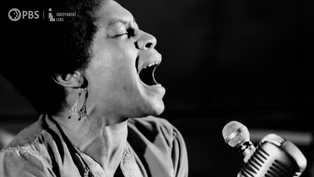
Clip: S49 Ep8 | 2m 46s | Mr Soul! | Episode 4908/Segment 2 (2m 46s)
Providing Support for PBS.org
Learn Moreabout PBS online sponsorship
- News and Public Affairs

Top journalists deliver compelling original analysis of the hour's headlines.

- News and Public Affairs

Today's top journalists discuss Washington's current political events and public affairs.










 New Season
Support for PBS provided by:
American Black Journal is a local public television program presented by Detroit PBS