
What Affects Our Expectations of the Cuisine We Eat?
Clip: Season 2 | 2m 48sVideo has Closed Captions
Learn about the biases encountered by Alta California chefs.
Learn about the biases encountered by Alta California chefs.
Problems playing video? | Closed Captioning Feedback
Problems playing video? | Closed Captioning Feedback
The Migrant Kitchen is a local public television program presented by PBS SoCal
What Affects Our Expectations of the Cuisine We Eat?
Clip: Season 2 | 2m 48sVideo has Closed Captions
Learn about the biases encountered by Alta California chefs.
Problems playing video? | Closed Captioning Feedback
How to Watch The Migrant Kitchen
The Migrant Kitchen is available to stream on pbs.org and the free PBS App, available on iPhone, Apple TV, Android TV, Android smartphones, Amazon Fire TV, Amazon Fire Tablet, Roku, Samsung Smart TV, and Vizio.
Providing Support for PBS.org
Learn Moreabout PBS online sponsorshipI know that everyone sort of expected us to be a Mexican restaurant.
And I think that with that expectation, certain things are taken for granted.
Even like an immigrant Latino, like myself, I have preconceived notions about what a Mexican restaurant should be.
I walk into, you know, your average Mexican restaurant and I am fully expecting chips and salsa at the table, despite the fact that I feel so strongly that it should not be a necessity or requirement.
I mean, so deep are those preconceptions that we have, that they are actually embedded in my own cultural identity.
People are like, "Four dollars for a taco?!"
You should see the shock on their face.
There are some tacos that I have that are nine dollars for a taco.
You know, because it's foie gras, gypsy bacon, and so the product warrants that price.
I remember somebody else was like, "That's kind of a lot, six dollars for a taco."
I got the plate, I put the pork belly down.
Put the condiment, the chile, put a little swoosh.
Put some micros and made it look pretty.
And I was like, "Here, look!
It's a fine dining dish, now would you pay five?"
They were like, "Well, I would pay 14 for that."
When I started in restaurants more than 20 years ago, L.A. was very Euro-centric.
There were a few fine dining restaurants but very rarely would you see a Mexican, or even Latin for that matter, ingredient on a plate or a word on the menu.
And now the ability to cook something that connects to my palate, that connects to childhood memories, connects to something deeper is what's transforming the restaurant scene.
One of my chefs in my early restaurants that I worked in, he would actually say, "You shouldn't speak Spanish if you want to move up in this business.
Spanish is a language of weakness.
Spanish is a language of ignorance.
If you want to be a dishwasher, keep speaking Spanish."
So, sometimes it was that in your face.
I have to turn my back on culture, I have to turn my back on language if I want to progress in this kitchen.
Same thing with Mexican food, I think people think that there is a limit to how creative it can be, there is a limit to how much you can charge for it.
There is a limit to how much confidence and creativity you can put behind your food, and that's not true.
You can stay true to culture, you can stay true to ingredients, you can keep that passion and authenticity, but you can still have a restaurant on Main Street.
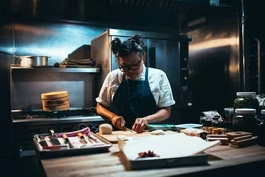
Chef Minh Phan on Finding Her Community
Video has Closed Captions
Clip: S2 | 1m 55s | Porridge and Puffs chef Minh Phan speaks about finding her community. (1m 55s)
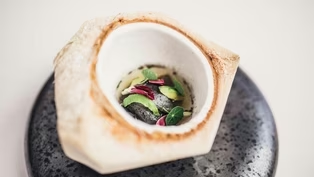
Video has Closed Captions
Clip: S2 | 3m 2s | Find out the traditional Japanese technique used by Seiichi Yokota. (3m 2s)

Actor Talks about the Real Feel of an Indian Restaurant
Video has Closed Captions
Clip: S2 | 1m 38s | Kunyal Nayyar talks about what makes an Indian restaurant feel real. (1m 38s)
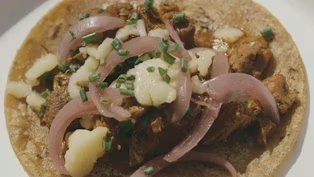 Now Playing
What Affects Our Expectations of the Cuisine We Eat?
Video has Closed Captions
Clip: S2 | 2m 48s | Learn about the biases encountered by Alta California chefs. (2m 48s)
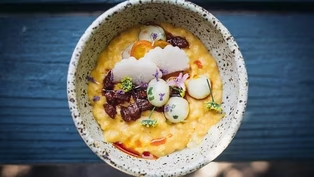
The Migrant Kitchen Season 2 (Preview)
Video has Closed Captions
Preview: S2 | 1m | "The Migrant Kitchen" explores Los Angeles’ food scene and a new generation of chefs. (1m)
Providing Support for PBS.org
Learn Moreabout PBS online sponsorship











Support for PBS provided by:
The Migrant Kitchen is a local public television program presented by PBS SoCal