Chicago Tonight: Black Voices
Advocates on the Lack of Funding for Child Care Services
Clip: 9/11/2024 | 10m 55sVideo has Closed Captions
Child care has become a hot topic in the presidential race.
Advocates in Illinois are pushing for higher wages and better benefits in an effort to retain child care workers.
Problems playing video? | Closed Captioning Feedback
Problems playing video? | Closed Captioning Feedback
Chicago Tonight: Black Voices is a local public television program presented by WTTW
Chicago Tonight: Black Voices
Advocates on the Lack of Funding for Child Care Services
Clip: 9/11/2024 | 10m 55sVideo has Closed Captions
Advocates in Illinois are pushing for higher wages and better benefits in an effort to retain child care workers.
Problems playing video? | Closed Captioning Feedback
How to Watch Chicago Tonight: Black Voices
Chicago Tonight: Black Voices is available to stream on pbs.org and the free PBS App, available on iPhone, Apple TV, Android TV, Android smartphones, Amazon Fire TV, Amazon Fire Tablet, Roku, Samsung Smart TV, and Vizio.
Providing Support for PBS.org
Learn Moreabout PBS online sponsorship>> It's an issue plaguing families across the country and the state of affordable child care in Chicago was under the microscope at a recent city Hall committee hearing.
>> We hear from childcare center workers and family childcare providers who can't afford to support their families who are stressed and saddened by seeing the consequences of turnover and under staffing.
>> Advocates in Illinois are pushing for higher wages and better benefits in an effort to retain childcare workers.
It comes after a center in Bronzeville recently shut its doors.
The CEO says due to a lack of staff.
Here to talk more about this growing issue are Shauna edge?
A senior vice president at Illinois Action for Children, location, McFadden, CEO and executive director of Centers for New Horizons and Be Honest, Carissa director of Montessori Foundations of Chicago and member of the Steering Committee for Childcare Advocates United.
Thanks to all 3 of you for joining us location.
Let's start with you.
Please tell us more about the challenges that you're Bronzeville center that led to its closure.
>> All right.
Some the CEO and executive director of Centers for New Horizon.
We have been around for the last 53 years.
We have a child care center or 43rd in Cottage Grove.
If Ellis, it has been a staple in the bronxville community since 2008 recently had to make the decision to close it due to a lack of staffing.
So what led to the laugh?
Lack of staffing?
There are a number of different different issues that led to it over the last 2 years in particular.
We've been really face with it.
The main challenge of all of our staff really been transfer over to CPS, do sitting universal implementation of preschool.
The air.
So west preschool for all Our staff that were also trained and qualified for those positions accident and pretty much went to the neighborhood schools.
Okay.
would that mean for the families of students who attended the center?
It was terrible.
So the last 2 years we've consolidated class is closing one by one.
And so we just really couldn't afford to operate the sectors like that.
So the families we've had to turn away.
We've never had a problem with enrollment.
Our capacity is 150 families.
We've always been able to meet our enrollment numbers.
The problem is simply that don't have enough teaching staffs operate.
So I've had to refer families to other places.
So families we're able to find additional carousel.
Families were not.
Shawna.
Several people testified at the City Council committee hearing that we just played a clip last week.
What would advocates like to see the city too?
>> think the city needs to become serious about setting aside dollars to invest in the childcare workforce.
I do think.
>> That is real important effort.
I think it will.
It will set an example for the understanding that the child care workforce is the backbone of all of the workforce.
Right?
And we know that parents can't go to work if they if their children are in, you know, safe, accessible places.
And I think we recognize that through COVID and post COVID that we've lost some centers and folks have really been struggling.
Parents had to make difficult decisions about their livelihood, their self-sufficiency because they haven't been able to have adequate care due to some closures of child care centers.
The state has made greater investments, particularly around compensation for childcare workers statewide.
But in the city because the model is slightly different.
It's important that the city steps up in May and likewise makes additional investments briefly for us.
Clarify what that model means because some folks think that childcare money is childcare money.
But the truth is like.
>> Funding to educate or to care for one child comes from several different streams.
Absolutely.
Absolutely.
So in the city, many programs blend.
Great funding between Office of Head Start Dollars which is head start and early head start programming and then Illinois State Board of Education funding preschool for all as well as prevention initiative funding.
That happens throughout the state.
But in the city of Chicago typically goes through the Department of Family and Support Services and folks have contracts with the department and then are able to provide those services to families.
But traditionally, those dollars have not been extensive or enough and they certainly don't go to every CBO in the city.
And so as a result of that, many of them also blend with child care assistance program funds and may have cited minister contracts in order to bring in additional revenues to be able to meet.
basically the needs to maintain their centers.
But what has happened is that because costs have been on the increase, there is less and less money to give directly to staff.
And we know that public so I wanted to get be out in here because the out of what was your reaction and is this a problem that can be solved just by paying workers more money?
>> Yes, absolutely.
If we can compete effectively the teachers at public schools at the traditional schools, we can certainly keep our workers.
>> My staff are not leaving because they feel that CBS is necessarily a better place to work.
They're leaving for the pay and who blames them right?
If they can make $20,000 more $30,000 more a year and have all of summer off.
Of course, they're going to leave.
There needs to be equity if we cannot be competing with each other.
Cps can't be competing with CBO's Kuz CBO's community-based organizations.
We're always going to lose.
We're always going to be on the losing end.
The city doesn't fund us enough.
The state doesn't fund that's enough in order for us to compete fairly and we can't increase our tuition and put it on the backs of our parents.
You know, journey of the time the parents going to suffer the most are the parents that don't qualify for any programs.
They don't qualify for child care assistance.
They don't qualify for Headstart.
They don't qualify for free.
So the families that are just above the cut-off, you know that our $42,000 and over those are the ones that are going to be most affected.
Look, he do you think we can expect to see more childcare facilities closed at the city?
Can't find and not necessarily just the city, but if it's an increase in pay or something is not done lure them to stay at the community-based organizations, I believe so.
So only child, quality early.
>> Learning center is vital for any community, right?
That's one that that's the backbone of having a safe and equitable community.
When you do have that, you can expect a number of different things to flow from right?
A number of >> consequences that I don't think anyone really wants to go down a road of what that would look like so if organizations just can't do it in this way.
Light just like you said.
can bring They want to know somewhere this and it's not just PSA, other places that they're leaving to go find work that they believe pays better.
>> Yes, some people went to Starbucks.
Walmart it really depends.
One of education level, those that qualify to be actually teacher, obviously are going places like CPS.
Those that are we're losing our teacher systems as well because they could be seacoast or Starbucks.
Walmart we just can't compete.
So enough.
You know what?
What does all this say about the value that is being placed on the work of because anybody who's raised okay to watch the kid knows it's not But does this say about the value that's being placed on and childcare workers and the work that they do?
>> While it still remains to you know, undervalued folks to look at it often is babysitting.
It's sort of a mindset bat.
You know, historically, we know that childcare was born out of slavery and so was free labor.
And so it's predominantly done even today by women of color.
And as a result of that, there's never really been an effort to recognize their contributions really to society or to recognize the value of the work itself.
It's very complex work.
These are children that that need constant attention.
We know so much more now about brain development that we've ever known.
And we know that the first 5 years are instrumental in lay the foundation for the rest of life for lifelong learning.
And so it's really important that we invest in that period of time in a young child's life.
And we invest in that by making sure that that child care workers get the compensation and benefits they deserve so that they can be present, not stressed about how are they going to pay the next bill?
How are they going to feed their families, right?
They need to be able to put their whole being into that work to do it well, and we should honor that as a society, to go ahead.
and also it's it's not the child care worker or didn't really talk to the workers at the public school level.
It's only the child care worker at that.
>> Community-based organization.
I will because the teachers at at Public schools, they make that money.
They make, you know, 60,000 plus has a base salary from the day.
get a degree, you know.
So it's.
The week tradition.
We look at community-based organizations that it is less the traditional school less than CPS because honestly is the city of Chicago really value the workers.
They would have equitable pay for a teacher at a CBO and a teacher at a traditional school.
And to be clear and I want to get you as well.
To be clear, obviously, the teachers who are going to work for CPS, they then become members of the Chicago teachers union.
So they've got the union contract.
Basically that has been negotiated for them.
That you know, that that go ahead.
sometimes it's more of an appetite for that, right?
This more attractive.
>> And it is Israeli is disheartening to know that you have the exact same qualifications is your peer and you can make $20,000 less.
And shot.
We've got just a couple seconds left.
I mean, you know, we just talked about the hiring freeze that the city has implemented.
We know they're facing a big budget deficit this year and again next year.
What can be a few seconds?
Well, I think the city really needs to take a hard look on how they support all workers.
And that is by providing accessible, affordable child care for all.
>> And the only way to do that is to figure out a way to make investments.
I recognize the city has a deficit, but I do feel that this needs to be a priority, long term, long-term priority.
What would you like to see done with the show?
The same like putting our money where our mouth What's really important if this is an important than what could help come from the federal government.
>> Absolutely.
But there are already investing, we mentioned before city of Chicago gets a block grant from the state of Illinois.
But they distributed to CPS first and look at community-based organization second, so the way they've distribute that block, Grant needs to be revisited to set
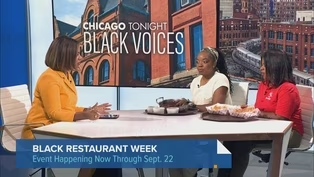
Black Restaurant Week Returns to Chicago
Video has Closed Captions
Clip: 9/11/2024 | 7m 55s | There's still plenty of time to explore new restaurants. (7m 55s)
Providing Support for PBS.org
Learn Moreabout PBS online sponsorship
- News and Public Affairs

Top journalists deliver compelling original analysis of the hour's headlines.

- News and Public Affairs

FRONTLINE is investigative journalism that questions, explains and changes our world.












Support for PBS provided by:
Chicago Tonight: Black Voices is a local public television program presented by WTTW