
What Does It Mean To Be Legally Blind?
Season 4 Episode 8 | 26m 46sVideo has Closed Captions
A show about how accessibility, community support, & awareness aid people w/vision loss.
Join Nashville PBS host Jerome Moore as he explores the real life experiences of individuals living with vision loss, offering insight into the challenges they navigate and the strength they bring to their daily lives. This conversation highlights the importance of accessibility, community support, and greater awareness for people who are blind or have low vision.
Problems playing video? | Closed Captioning Feedback
Problems playing video? | Closed Captioning Feedback
A Slice of the Community is a local public television program presented by WNPT
Support provided by:


What Does It Mean To Be Legally Blind?
Season 4 Episode 8 | 26m 46sVideo has Closed Captions
Join Nashville PBS host Jerome Moore as he explores the real life experiences of individuals living with vision loss, offering insight into the challenges they navigate and the strength they bring to their daily lives. This conversation highlights the importance of accessibility, community support, and greater awareness for people who are blind or have low vision.
Problems playing video? | Closed Captioning Feedback
Where to Watch A Slice of the Community
A Slice of the Community is available to stream on pbs.org and the PBS app.
Providing Support for PBS.org
Learn Moreabout PBS online sponsorship- No, no, we're not gonna do that tonight on television.
(upbeat electronic music) (Jerome and guest laugh) "A Slice of the Community" is made possible by the support of the Community Foundation of Middle Tennessee.
(upbeat electronic music continues) (audience applauding) Hello and welcome to another episode of "A Slice of the Community."
I'm your host, Jerome Moore.
Today, we're live in studio joined by April Meredith and James Brown.
How y'all doin'?
- Great.
- Great.
- Glad to be here.
- I'm glad y'all here.
I'm excited about this conversation.
And just the title itself, right, What Does It Mean To Be Legally Blind, right?
As a person that is not legally blind, I had to do my research, you know, but also dive into some curiosity.
And so I wanna start off with this question for both of you all of your vision loss journey.
Everybody's vision loss journey isn't the same, the vision loss isn't the same and how you got there.
So I wanna give you all a chance to give a intro to that journey.
And I'll start with you first, April.
- Yes, thank you.
So glad to be here.
Thanks, Jerome.
Yeah, this is a great question.
In my case, my blindness journey somewhat started in fifth grade when I got my first pair of eyeglasses.
My eyesight diminished over time.
And then when I turned the age of 30, I was diagnosed officially with retinitis pigmentosa, which is a degenerative eye disease that is progressive.
And so over time, I am now older than 30, and I have extremely limited light perception only now.
- Okay.
- But I was actually born with 20/20 eyesight.
And because it is a genetically inherited eye disease, I was actually born with it, I just didn't know until an adult age.
- [Jerome] Okay, how about you, James?
- So at around seven years old, my parents noticed that I couldn't see as well as the other kids, and immediately was diagnosed with retinitis pigmentosa.
And mine came on a little bit quicker.
So when I was seven years old, I think I had around 20/80 vision.
And that basically means that whatever you could see at 80 feet, I could see it 20 feet away.
- [Jerome] Okay.
- Every three years, it got worse.
And by the time I was 21, I just had light perception, which means I could see shadows and light.
And so kinda been in that place for about 30 years now.
- Okay, and so those are similar but unique, you know, as far as age, and when it comes on, and then how, you know, parents handled the situation, but it seems like it was noticed pretty quickly and you all was able to, you know, figure out how to adjust to that.
And I wanna get into that, that adjustment, that navigation, with family, with friends.
How did that journey and path in blindness or vision loss affect your life?
I'll start with you on that one, James.
- So, you know, the journey is an interesting one.
And I think a lot of it has to do with emotional acceptance.
- [Jerome] Mm.
- If you look, if you survey the American people, which has been done, they'll tell you that blindness is the most feared disability that there is.
So for a blind person who kinda knows that they're going blind but they don't know that they're blind but they really are because they can see some things, but if you're standing five feet away from 'em and you hold up your hands and say, "How many fingers am I holding up," I couldn't tell you.
But then I wasn't blind either, so I didn't have the emotional acceptance until I was about 21 years old.
- [Jerome] Okay.
- Until then, I was trying to pass as a sighted person.
Some of you know what it's like, as an African American, to try and pass as something that you're not, and I was trying to pass as a sighted person.
So when I hit MTSU, I decided I'm gonna be blind, I'm gonna use a white cane.
And once I did that, it opened up my life to be who I really was.
And I was able to go out at night.
- [Jerome] Right.
- I didn't look like some fraternity guy who started drinking at seven o'clock in the morning because I ran into a fence that they put up on campus the day before.
So just saying that, "Okay, I'm blind," even though I got a little bit of vision, really helped me and allowed me to be successful 'cause then I was able to start using those non-visual techniques that can cause a blind person to be able to live a life they want.
- Right.
How about you, April, on that journey as a childhood and, I guess, that emotional acceptance.
- Sure, absolutely.
That definitely is a integral part of sight loss.
I spent the first half of my life functionally sighted.
I had corrective lenses.
I did eventually go legally blind, meaning I had 20/200, or worse, eyesight in my best eye.
It was actually 20/300.
But I still could function without accommodations or significant changes in my life.
When I did experience substantial sight loss, it definitely impacted my personal and professional relationships.
- [Jerome] Okay.
- I had to come to an emotional and psychological acceptance to embrace my blindness and learn to live with new technology, with adaptive skills, and also go on an open journey with my family and friends.
Definitely, just like any hardship, it filters out who's your true loved ones and who aren't.
I did lose some friends.
- Okay.
- I did lose some respect from some family members just because they saw me as less once the sight loss was substantial.
And even when regaining my independence and embracing my blindness and living my life fully again- - [Jerome] Right.
- I tell people I went darker psychologically than I did, will ever do, physically.
- [Jerome] Right.
- So even when learning those new tools and techniques and technologies, it was integral to my recovery really that I have peer support through other blind peers, such as people like James, who's been in my life since 2013.
Learning how to live life as a blind person takes accepting blindness.
- Yeah.
And just a fun fact for the audience members and people watching, me and James actually went to the same gym block, fitness gym, and worked out, you know?
(chuckles) And so just the full circle moment and just seeing like, hey, you know, James is doin' everything that I'm doin'.
You know, he might be lifting a little more weight than me.
You know, just a little bit, just maybe a tad bit, I don't know.
But I wanna dive a little bit into that making sure community members don't see those with vision loss or blindness as less, right?
Yeah, how can community navigate that balance in making sure that just because you have a sight handicap, you know, that doesn't handicap you from enjoying life, that doesn't handicap people from respecting you, that doesn't make people feel like they should respect you as less, or that you are less, what are those conversations like?
What are those balances like when you run into that, or maybe run into someone who may be trying to treat you as such?
And I'll start with you on that one, James.
- So I think people need to realize, first off, is that when they shut their eyes and they try to imagine what blindness is like, it's like that just for a moment.
And when you become blind, you go through a thing called vocational rehabilitation and you get blindness training, hopefully.
And the governor has messed that up here a little bit the past eight years in Tennessee.
But, like, we can do things everybody else can do, but blind people do them a different way.
We do them non-visually.
Like this morning, I woke up, I made some eggs.
You know, you throw the eggs on the skillet and you hear that sizzle, and that's the moisture evaporating.
And as the egg cooks, the sound gets less and less and less.
So I'm able to tell, "Oh, the egg's almost finished."
- [Jerome] Okay.
- And then, you know, when I totally wanna make sure, I touch the egg, and it's solid.
And so you'll never know this if you just shut your eyes.
Because you'll just immediately think, "Oh, I'll never be able to cook.
I won't be able, you know, to walk to the mailbox."
But blind people, for thousands of years, have worked out these non-visual techniques.
And, you know, we actually create non-visual techniques every day.
- [Jerome] Right.
- So I think once a person starts to realize that my life is much like theirs, I just do things differently, then that changes perceptions.
- Okay.
How about you, April, anything to add to that?
- Sure.
One thing that I would really want the community to know is that disability doesn't equal incapability.
And where I am now on my disability or blindness journey, most likely will not be the same next year, this time next year, or in five years.
- [Jerome] Right.
- I'm capable of adapting.
I'm capable of learning.
It does take some specific techniques or technologies, training.
We do have support systems, just like anybody else needs in their life to be successful.
But in order to do that and to have a community respond appropriately and respectfully to that, I think conversations like this- - [Jerome] Right.
- Events, when you happen to come across somebody, if you are open to a conversation, feel free to ask questions.
- [Jerome] Right.
- The only way to learn is to engage with people who are disabled or have those other experiences, and explore things like PBS specials, you know, that address the specifics of life and the environments of people with these conditions or disabilities.
- I'm gonna stay here with you with this question, April.
- Mm-hmm.
- I think misconceptions, right, is probably a word that probably should come up.
What is probably the biggest misconception that you run into that people may have, if you have one?
I know there's probably many, but if you have- - [April] There's a lot, yeah.
- If you have one that you feel like you may come across more than others that people may have about those that have vision loss or that are blind.
- There are a lot.
(Jerome laughs) One of them that I oftentimes hear is that, "If you lose eyesight, then you gain, automatically gain hearing keenness."
- [Jerome] Oh, like superpowers.
- Like a superpower.
- [Jerome] Oh, so that doesn't really happen.
- That doesn't really happen.
(Jerome laughs) The reason why I can notice the subtle changes of the sound of a sizzling egg or the traffic pattern is through training, through practice, and it's all intentional.
- [Jerome] Mm.
- It's not better hearing, it's better listening skills.
- [Jerome] Okay.
- [James] It's learned.
- And it's learned.
- [Jerome] Okay.
- It's learned through adaption, through techniques, through, oh, I'm sorry, and, like I said, a lot of practice.
So I think the biggest thing is that.
It's not an immediate superpower that we get, but also that don't be afraid.
- [Jerome] Yeah.
- Don't be afraid that when you see somebody that's disabled.
We're human.
- [Jerome] Right.
- [James] Yeah.
- James, you have a companion with you tonight, you know?
- [James] I do.
(Jerome laughs) - You have a service animal.
Can you walk us through what is it like navigating with a service animal, especially with those who may not have proximity to service animals and may just not understand how that relationship works with a person who has vision loss in a service animal?
- Yeah, so the service animal concept is, there's a lot to it.
- [Jerome] Right.
- Whenever you train with a dog, I recently got this boy about a month and a half, two months ago.
And for a solid 10 days, we were tethered to each other.
So we never left each other's side.
And the purpose of that is to get that bond so the dog will basically know that you're in charge of each other basically.
But a dog is very different than a cane.
A dog, you just say, "Ford, find the steps.
Ford, find outside," "Find the door," "Find the elevator."
And so, "Straight to the curb.
Find it, find it."
And he's reacting as I'm using this tone.
- Right, he's reacting.
(chuckles) - But- - He's like, "Now?"
(chuckles) - And so I would say it's more than just a form of mobility because it's a relationship too- - [Jerome] Okay.
- [James] Because you're together so much.
- [Jerome] Right.
- I can remember when I lost my first service dog due to cancer.
I can remember being at work.
I work Downtown Nashville, worked there for 23 years.
And so we were just together all the time.
And so we were at work, and I remember, you know, him just not being there.
- [Jerome] Right.
- And it felt like I was missing an arm or something because you are together so much, and the teamwork that you develop, and the relationship is just so amidst.
It's probably like if you know what it's like to have a pet and you lose that pet, but just multiply it a few times.
- [Jerome] Yeah.
- But dogs are really fast, so I can get places.
And I'm kind of a (fingers snapping), "Let's go," kinda guy.
- [Jerome] Right, right.
- And so I can say, "Dog, straight to the curb," and he'll go, and he'll go fast.
And a lot of times I'm having to wait on my sighted friends, so, "Hold up, hold up, steady."
And so it's a very unique experience.
And I can't lie, it is good to be able to lean down at any given time and get a good lick from your puppy.
(Jerome and April laugh) So there are some benefits to being blind.
- And what are some of the maybe typical dos and don'ts?
Because, you know, you have kids or other people with dogs, so a natural thing that many people have in general as pets.
And people, you know, pet dogs and other animals and things like that.
But with a service animal, it might be a little different.
Or is there a difference when interacting with a service animal, somebody has one, and you see them outside in community?
What are some typical rules of engaging with such a service animal?
- Yeah, and a lot of people misunderstand these rules, because there are a lot of rules with service dogs.
- Right.
- You don't wanna pet them, you don't wanna make eye contact with them.
- [Jerome] Okay.
- You don't wanna smoochy bear them.
"Oh, pretty puppy."
You don't wanna do any of that stuff.
- [Jerome] Okay.
- Because what that does is ultimately distracts the dog.
- [Jerome] Okay.
- And if there's a pattern of distraction that happens everywhere you go, then the dog's gonna run you into stuff.
He's going to create a learned pattern that you don't really want and can make a person unsafe.
- Okay.
- So a lot of people don't understand, "Well, why does your harness say don't pet the dog?"
- [Jerome] Right.
- And, you know, "You're just being cruel to the dog."
No, this dog has a great life.
- [Jerome] Right.
(chuckles) - "This dog goes to Hawaii," stuff like that.
So- - On TV, you know, on the stage.
- On TV, gets to go downtown.
- Right.
- I mean, basically these are working dogs.
They love to work.
That's their life's mission.
- [Jerome] Right.
- [James] If they don't have that, then their life is not quite as fulfilled as it could be.
- [Jerome] Right.
- So this German Shepherd is truly living the life he wants right here, yes.
- Yeah, yeah, way better than Air Bud.
You know, Air Bud, you know, didn't make it to Nashville PBS, you know?
- [James] Right.
- April, you having a cane and using a cane, I'm curious on spaces like the airport, restaurants, and those things, navigating those spaces, what is that journey like, but also what are some things you've noticed accessibility-wise that maybe we can do better as community members in those settings, in those buildings that will make navigating those spaces easier and more efficient for you?
And, ergonomically, better for using the cane as well.
- Sure.
Well, one thing is when I am using my cane, just as with James when he's using a guide dog, I don't want my cane pet either.
Some people, unfortunately, will want to grab my cane if I'm asking, "Could you tell me where," you know, not point out physically, but in words where the restroom is.
- [Jerome] Right.
- Or where an elevator is, or am I going the right direction to the right concourse?
- [Jerome] Okay.
- Things like that.
Some people have the idea that they're supposed to then pick up the end of my cane and point that way and- - [Jerome] Or pull you by it.
- Or pull you by it, or physically adjust your shoulders to face the right way and stating, "I just don't know how to say it with my words."
- [Jerome] Mm.
- So I would love people to be more open to that kind of disability sensitivity training.
- [Jerome] Yeah.
- So, you know, airport personnel, restaurant owners and staff, and, you know, reach out to their centers for independent living.
Reach out to their disability-related advocacy organizations.
- [Jerome] Like Pathfinder.
(laughs) - And reach out to their local, yeah, and in Tennessee, reach out to Pathfinder.
- [Jerome] Yeah, yeah, yeah.
- And by doing disability sensitivity training, that would be a big help.
But as far as when I do do my navigation, yeah, the taps, the sounds that it makes, I'm feeling the different types of textures of the ground and surfaces that I'm walking on.
I'm hearing where I need to go.
So trying to get me to avoid a doorway versus me feeling the width of the doorway so I can make sure I safely maneuver in between the door frame, those are important signals for me.
That's not me making a mistake with my travel, that's me utilizing my skills and my tool, my cane, to do that.
That said, I do wanna mention sighted guidance.
That's where a person may rely on a human to gently guide them from one place to another instead of utilizing a guide dog or a cane.
In very, very tight spaces where I might not wanna be bothering other patrons in a restaurant, you know, and the cane can get stuck in between chairs, and things like that, I don't mind.
- Or you could be beating people up.
You know, just beating people ankles up, you know?
(Jerome laughs) It's not gonna beat anybody up.
It's not gonna harm a car if I'm tapping a car to let them know I'm going behind it in a parking lot.
Yeah, it's not, no, yeah.
- That's a great point though, 'cause a lot of people panic when you're using your cane.
They're like, "You're gonna run into that wall."
No, no, my cane- - [April] No, my cane will.
- My cane is gonna hit this wall.
- [April] My cane will tell me.
- And then I'm gonna turn.
- [April] Yeah.
(chuckles) - So, you know, one thing I would love people to know out there is that part of the cane's function is to discover what's around you.
- [Jerome] Okay.
- Because, you know, we wanna be able to mentally map a room.
Like, I think the door's over there, I remember coming off the stage over here.
You know, I told you I've worked downtown for a long time, so I know, you know, all the streets were in parallel.
It's a grid.
You got Charlotte, you got Deaderick, you got Union, you got Church, Commerce, Broadway all running parallel.
And, of course, second, third, fourth, fifth, all those.
So you know everything to uphill from Broadway is north- - [Jerome] Right.
- And below Broadway is south.
And so you mentally map everything out in your head.
And when you start doing that, as long as you're facing the right direction, you're okay.
- [Jerome] Yep.
- If you're a little bit off, then, you know, it could get a little bit squirrelly.
But that's one of the things that blind people do develop, that's one of the pathways that start to develop, are these mental maps.
- [Jerome] Right.
- And it's pretty cool when you start to think about it.
- When people come in contact, whether it's you all or other individuals that have vision loss or blindness, what are some of the things that you hope they see beyond just your vision loss or blindness?
I'll start with you, April.
- So one thing that some people in the community may hear is, when you're talking about people on the autism spectrum or with ASD, that if you've met a person with autism, you've met a person with autism.
Just one person.
It's the same concept with the blind community, blind and low vision community.
If you've met one person with retinitis pigmentosa, you've only met that one person.
- [Jerome] Right.
- We may have some similar, you know, experiences or backgrounds that James and I, you know, can connect on, but we're still individual and unique human beings.
- [Jerome] Okay.
- And so if they're coming up to, like, me specifically, I want them to see a human.
I hope that I portray a person that is loving, sensitive, respectable- - [Jerome] Okay.
- and open to meeting a new friend.
Something that used to get in trouble with my parents when I was a kid is I would say, "A stranger's just a friend you haven't met yet."
(Jerome and James laugh) My dad didn't like that so much, because I was always very friendly.
But it's still me, you know?
- [Jerome] How about you, James?
- So there, yeah.
- I don't think it's much different.
I think it comes down to that I'm a person, I'm not just blind.
Blindness is a characteristic.
And, sure, it's a pain in the, you know, what characteristics sometimes.
- [April] Absolutely.
- But, you know, James is also a dad, a grandfather, you know, a TDOT employee.
- [Jerome] Right.
Workout partner.
- James goes to the gym.
- [Jerome] Yeah.
(April laughs) - You know, James sings at church, all those things.
- You have to sing.
Your name is James Brown.
- I feel good, yeah.
- You have to sing.
(all laugh) You have no choice but to sing.
- So I want people to know that if you get to know a person who's blind or in a wheelchair or autistic or any other diverse set of characteristics- - [Jerome] Right.
- that you will start to know them as a person and not their disability.
- Last question of the night.
So you have 30 seconds, April.
If there's one thing that you wanna mention about vision loss or blind community, what would that be?
- That we are humans, we are people, we are not less than, and that we have the right to opportunities, to live our lives the way we choose.
But we need help and support and advocacy and allies to ensure that we all do have an equitable chance to live the lives we have, 'cause we do have societal barriers and stigmas that leads blind people to have the highest unemployment and underemployment rate of all people with disabilities.
- 15 seconds, James, same question.
- Blindness is a spectrum.
Not all blind people see just black and white.
There's a lot of blind people who can see some stuff- - [Jerome] Right.
- But that doesn't mean they can see everything that they need to.
And so I would just say don't judge a book by its cover there.
- Let's give it up for our guests tonight, y'all.
(Jerome and audience applauding) And I wanna thank you all at home who's watching another episode of "A Slice of the Community."
If you like to watch more, please download the PBS app or check us out on our YouTube channel at youtube.com/nashvillepbs.
Thank y'all, yep.
(audience cheers) (Jerome and audience applauding) (April speaks indistinctly) - You got an excited dog.
(upbeat electronic music)
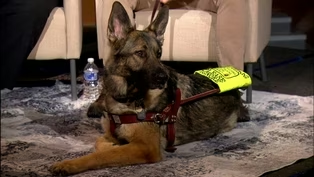
What People Don't Understand About Service Dogs
Video has Closed Captions
Clip: S4 Ep8 | 1m 33s | What people don't understand about service dogs. (1m 33s)
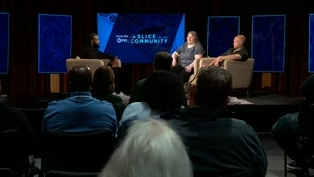
Do Blind People Have Super Hearing?
Video has Closed Captions
Clip: S4 Ep8 | 1m 34s | Do Blind People Have Super Hearing? (1m 34s)
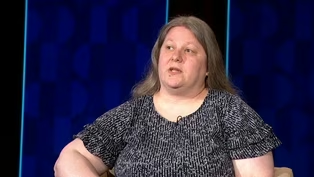
Going Blind Revealed Who Truly Cared About Me
Video has Closed Captions
Clip: S4 Ep8 | 1m 56s | Going Blind Revealed Who Truly Cared About Me. (1m 56s)
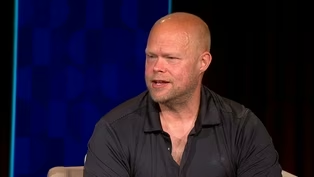
I'm Blind... But That's Not Who I Am
Video has Closed Captions
Clip: S4 Ep8 | 1m 5s | I'm Blind... But That's Not Who I Am. (1m 5s)
Providing Support for PBS.org
Learn Moreabout PBS online sponsorship New Episode
- News and Public Affairs

Top journalists deliver compelling original analysis of the hour's headlines.

- News and Public Affairs

FRONTLINE is investigative journalism that questions, explains and changes our world.
 New Episode
 New Episode
 New Episode
 New Episode
 New Episode
 New Episode
 New Episode
 New Episode
 New Episode
Support for PBS provided by:
A Slice of the Community is a local public television program presented by WNPT