Traverse Talks with Sueann Ramella
What Does Peace Mean To You?
5/24/2022 | 37m 41sVideo has Closed Captions
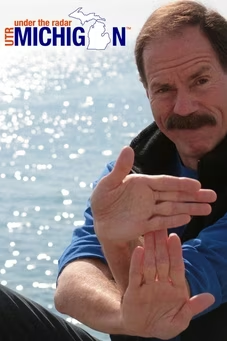
Peace campaigner and humanitarian, Kwabi Amoah-Forson, travels the world promoting peace.
Kwabi journeyed across America, in a baby blue Mitsubushi van known as The Peace Bus asking people what “peace” means to them. In this episode, find out what Kwabi thinks the three pillars of peace are and how as a society we can achieve peace. Listen wherever you get your podcasts.
Problems playing video? | Closed Captioning Feedback
Problems playing video? | Closed Captioning Feedback
Traverse Talks with Sueann Ramella is a local public television program presented by NWPB
Traverse Talks with Sueann Ramella
What Does Peace Mean To You?
5/24/2022 | 37m 41sVideo has Closed Captions
Kwabi journeyed across America, in a baby blue Mitsubushi van known as The Peace Bus asking people what “peace” means to them. In this episode, find out what Kwabi thinks the three pillars of peace are and how as a society we can achieve peace. Listen wherever you get your podcasts.
Problems playing video? | Closed Captioning Feedback
How to Watch Traverse Talks with Sueann Ramella
Traverse Talks with Sueann Ramella is available to stream on pbs.org and the free PBS App, available on iPhone, Apple TV, Android TV, Android smartphones, Amazon Fire TV, Amazon Fire Tablet, Roku, Samsung Smart TV, and Vizio.
Providing Support for PBS.org
Learn Moreabout PBS online sponsorship- [Sueann] What do you wanna do with your life?
Is that really the right question, or is it who do you want to be?
Hits differently, doesn't it?
And let's say you're a really good listener, and you've heard from all sorts of people, and you realize the one thing we all want.
Kwabi Amoah-Forson knows the answer, and he's trying to help manifest all of our desires for peace.
Kwabi has the Peace Bus, and drove to DC to see President Biden.
Did he make it?
In this episode of "Traverse Talks", I'm Sueann Ramella.
(upbeat music) Kwabi Amoah-Forson, - [Kwabi] Yeah.
- [Sueann] Kwabi, where'd you get your name from?
Tell me about your name.
- [Kwabi] Yeah, my dad's from Ghana, West Africa.
- [Sueann] He's from Ghana?
- [Kwabi] Mm-hmm.
Never been though, never been.
I've never been, but I definitely planning on going.
My name means fire.
The tribe's called Ashanti, and the language is called Twi, that's T-W-I.
And in this language, when kids are born, you're named after the day of the week that you were born.
And so I was born on a Tuesday.
And so my name's Kwabina, that's my name.
- [Sueann] Kwabina.
- [Kwabi] That's my name, but no one calls me Kwabina, not even my parents.
No one calls me that except for my brother, right.
- [Kwabi] When he's mad at you?
- [Kwabi] No, just, I know right?
I know.
A shortened version of that is Kwabi, and there's different variations of it.
Like Kobe, Kobe Bryant, like me and Kobe have the same name, but it's just a different variation, yeah.
- [Sueann] Yeah, in Ghanaian culture, I mean, do you know much about your Ghanaian side?
- [Kwabi] Not really so much.
So my dad, he immigrated here from Ghana and he faced a lot of adversity just coming here into this country, and trying to work himself.
- [Sueann] And being a black man?
- [Kwabi] Correct, I know, right?
It's a mystery.
No, yeah, for sure, right.
- [Sueann] It's a mystery.
- [Kwabi] Right.
And so when he had kids, he was really big on having us be as Americanized as possible.
So he didn't teach us the language.
He didn't want us having an accent or anything.
He wanted us to have as many "privileges" as much as possible, so.
- [Sueann] As an American.
- [Kwabi] Right.
So we went to good schools.
He didn't teach us anything about his culture so much, unless I read it in a book or something like that was the only way that I learned about my Ghanaian heritage.
I've never met most of my relatives.
I talked to my grandma once on the phone, in my entire life.
And she died two years ago at like 96 or something years old, yeah.
- [Sueann] Then I assume he also didn't talk and go back very much.
- [Kwabi] He did.
- [Sueann] He, did and he left you here.
- [Kwabi] He lives there now.
He lives there now.
He built an estate.
So he has a couple houses and a plantain farm, and a pool.
He's building a pool right now.
He's gonna leave it to my brother and me after he passes.
- [Sueann] But without equipping you knowledge of the culture, so you can get in there and blend a little bit.
- Right.
- [Sueann] You're gonna stick out like Americans.
You need to talk to your daddy.
- [Kwabi] I know.
(Sueann laughs) I mean, we talk often, like he's in my life.
We talk, but it's just, I don't know.
He just was really big growing up on like- - [Sueann] Be American.
- [Kwabi] Yeah, you're American.
- [Sueann] Yeah, well see, okay, so here's the thing.
I have questions about that specifically for America.
So we have this, we're supposed to be this melting pot, which we all know isn't quite right.
Parts of us are losing important aspects of our culture, that whether we realize it or not have an impact on our personalities, or what we do.
And now, but it's a mystery, it's cloaked, right?
But the person is still alive who can give you some hints and clues to who you really are.
So do you plan on having that conversation with your dad?
- [Kwabi] Oh my gosh.
Okay, I do plan on having that conversation.
I don't know when that will be.
It has to happen soon.
He's been actually, when we been talking lately, he's been like, "Kwabi, so you're coming to Ghana soon."
And I'm like, "Oh yeah, like when I can find the time."
And he is like, "Yes, you need to come here soon."
And so I think- - [Sueann] He's getting there.
- [Kwabi] He's getting there.
He's getting there, and when I arrive, I can only imagine the emotion that is gonna overwhelm me as I go to his home, meet all my relatives.
Like I'm emotional just thinking about it.
- [Sueann] I'm emotional feeling you thinking about it.
You get off that plane and it's as if parts of your epigenome are just bursting.
- [Kwabi] Right.
- [Sueann] With please connect me to this.
(Kwabi laughs) That's incredible.
'Cause in my family, my mother's from Korea.
She's alive, I see her a lot, but we don't really get deep into her background because there's some pain there, maybe the same with your dad.
It's just something keeps him blocking from it for the good of you.
- [Kwabi] Right.
- [Sueann] Right?
And I understand that.
But at the same time, I'm like, yeah, but I could be more understanding of a human if I knew your story and more about your culture, 'cause it affects how you think and how you approach and talk to me.
It's easy for her to say you're just an American, that's why you're such a bad daughter because Americans only me, me, me, me, me, never thinking about family, right?
- [Kwabi] Yeah.
- [Sueann] You feel me?
- [Kwabi] Uh, huh, I feel you.
- [Sueann] Oh my God!
- [Kwabi] Yeah, we're on the same plane for sure.
- [Sueann] We're on the same plane.
So part of us is a little bit hidden and a little bit of mystery.
I hope you get to Ghana soon.
Are you gonna take the Peace Bus?
- [Kwabi] Well, hopefully by the time I go to Ghana, I'll have my Peace Plane.
- Yeah.
(Sueann laughs) - [Kwabi] That's another conversation to be had.
- [Sueann] Kwabi let's talk about the Peace Bus.
How did you get your Mitsubishi and turn it into the Peace Bus?
- [Kwabi] Well, yeah, that's a great question.
Back in 2018, I was in grad school, right?
But I was still sort of trying to figure out what I wanted to do with my life.
I mean, it's interesting 'cause we go to college to figure that out, but I still was like pondering, I'm in grad school at this time and I'm like, "I don't know what I'm supposed to do, right."
So I did something we don't often do in our day and age.
And that was reaching out to an elder in the community.
I don't know if it's 'cause our generation doesn't wanna hear and listen to people who are older.
I don't know what it is, but I felt it upon myself to do this.
So I went to an old academic advisor of mine, very, very wise person.
And I sat down with him and I explained to him my plight like, "Hey, I'm in grad school and I'm still trying to figure out what I need to do."
And he said, "Kwabi, what you need to ask yourself is who do you wanna be?
And not what do you want to be?"
He's like, "You're a very capable gentleman.
You could be a lawyer, you could be a doctor.
You could be all sorts of things, but that's not the question.
What are the principles you wanna embody?
What are the things at your core that you really love and enjoy?"
And I was like, "Whoa, I've never asked myself that question."
And my mind was blown.
And so I took it upon myself.
I took a weekend, got by myself, secluded myself, and really thought about that aspect.
Who do I wanna be as a person?
I was like, "Well, I do know that at my core, I love seeing people from different walks of life, colors, creeds, races, religions coming together for a great cause, it gives me goosebumps to think of this."
And then I was like, "Well, that's like peace, right?"
And I was like, "Okay, that's it."
And I was like, well we know of Martin Luther King.
We know of Gandhi.
We know of these great figures who have done this work in the past.
Not saying that, the work that they had done, hasn't transcended to now.
But I was interested in who's doing this work now?
And I'm researching.
And I came across this guy named Brian Haw.
Do you know who that is Sueann?
- [Sueann] No, tell me.
- [Kwabi] Okay, Brian Haw was a London peace campaigner.
So he is a peace campaigner, and he kept us out a Parliament Square in London, England for 11 years, promoting love, peace, togetherness and good will towards all human beings.
He died out there doing this work, right?
He had a little peace vigil and people would visit all over the world and come see Brian and talk with him about peace.
And I fell in love with this guy's concept.
And I thought, "Well, if Brian can go and do this every day for 11 years and talk about peace, the least I can do is go to my park and start doing this.
So I made these little peace posters.
One said, "Love, peace and justice for all."
The other one said, "War is not the answer, say no to violence."
And went to the park every Saturday, I would sit there in a chair with these posters.
People would come up and ask me what I'm selling.
I'd say, "I'm not selling anything."
- [Sueann] I'm selling peace, brotha.
- [Kwabi] Right, and so I'd be like, "I'm just having a conversation with you about what peace means to you."
And at first it was awkward, but eventually people started opening up, and then it became a culture of this park I was at and I did this for several months, and then I was attacked by a random individual, mentally disturbed.
And it was a very scary moment at the park.
And needless to say, when I came back the next week I was rattled.
So it was a bad incident, but it was good 'cause it compelled me to travel.
Instead of staying at Wright Park in Tacoma, I started going to different parts of Tacoma then to Seattle, then Portland, then Vancouver BC.
Then I went to San Francisco, and then I took my posters to Europe.
I traveled all throughout Europe with these posters, just asking the simple question.
What does peace mean to you?
Now if you ask anyone, what do they want out of life?
Peace is gonna be in the top three things usually.
So that being the case, why don't we talk about this thing we love and want so much more?
- [Sueann] More.
To have it.
- [Kwabi] Right?
- [Sueann] Yeah.
- [Kwabi] So I did this and this is sort of my field work because the ideas I have of peace are not just my own.
These are an overall consensus of the idea.
So I came back home from Europe, I didn't really know what to do with myself.
I mean, I've gained this knowledge, I'm sitting with it.
And then a friend of mine who is a videographer was like, "Hey man, you gotta start making videos."
And I was like, "I don't think that's the move.
I don't think that's the move."
I have it for my own personal gain.
He's like, "Kwabi, what you've learned people need to know what this is."
So I started doing these videos, peace talks or whatnot.
No one liked them.
It wasn't good.
They didn't really transcend with anyone, which is fine, right.
But it's a learning curve, right.
And I'm always doing research.
I came across this guy named Abie Nathan.
Sueann, have you heard of Abie Nathan?
- [Sueann] Tell me Kwabi.
- [Kwabi] Okay, Abie Nathan was an Israeli humanitarian, right?
He was around his heyday was like the 60s and 70s.
And he had something called Peace One.
It was a Peace Plane, right?
And he flew it from Tel Aviv all the way to Egypt to promote better relations between Arabs and Jews.
This guy was phenomenal.
And he actually had a Peace Ship in the Mediterranean.
It was a radio station on the ship and he played music about love and peace and togetherness.
- [Sueann] Yes.
- [Kwabi] And you'd have people from all over the world, come together in unity and have these discussions about how we can come together.
So I was like, "Okay, this guy being amazing.
And all the things that he was doing, I wanna be a peace pilot."
So I started taking flight lessons, right?
(Sueann laugh) [Sueann] Oh shit, for real?
- [Kwabi] Yeah.
I started taking flight lessons and I was doing this for a while and I was like, "Yeah, this is it."
I was in grad school at the time and I didn't have any money, so eventually I had to stop lessons.
And then I thought to myself, well, don't have a pilot's license at this time, but I do have a driver's license.
And that's how the Peace Bus began.
Took my tax return and I bought this Mitsubishi van from this guy named Jake on Vashon Island.
And Jake was awesome.
I was like, "Yeah, I wanna use it for peace.
I wanna create a peace mobile."
And he was like, "That's awesome, man."
- All right.
(Sueann laughs) - [Kwabi] Yeah, I dig that.
So I bought it from him.
I painted it blue, put the Peace Bus on the side of it and started driving it around.
(lively music) - [Ash] Listen to all the episodes of "Traverse Talks" with the PBS Passport.
Members who give $60 a year are automatically subscribed.
Not sure if you have access, call 1-800-842-8991 to check if you have PBS Passport.
(lively music) - [Sueann] Now I have to ask you, I mean, I have a general term of what peace means to me, but I really honestly, for wanting it don't really know much deeper about it.
So tell me what peace is to you.
- [Kwabi] Right, so again, this is a overall consensus of what I've learned through asking the question with hundreds of people.
So there's two things I wanna expound on, one being what a peaceful world could look like more so.
And from what I've gathered, living in a more peaceful society as a society where everyone has their essential needs met.
If we have this, I don't know how it's gonna go about happening.
But if it is able to go into fruition, we will live in a more peaceful world.
Everyone having food, clothes and shelter, these sort of things.
And beyond that sort of from a principal standpoint, there's three different kinds of peace.
There's inner peace.
You get this from a sense of understanding of self, like sort of what we talked about earlier, understanding myself and understanding where my dad came from, these sort of things.
We get this from a sense of religion, sometimes just an understanding of who we are as human beings.
And then there's interpersonal peace.
How can we show love and respect towards our fellow human being?
And how can we do that more readily?
- [Sueann] What if they're assholes Kwabi?
(Kwabi laughs) - [Kwabi] If they're assholes, I don't know.
I mean, there's still a way to, I would say this never in the history of humankind, has one person been upset at another person for listening to them.
- [Sueann] Yes.
- [Kwabi] You find more than not that if someone's upset yelling at you and trying to exude violence in that way, if you stop and just listen, eventually they're just gonna run outta juice, and they'll calm down and they'll be like, "Well, yeah, that's what I had to say."
Okay, I feel that.
Now let me explain myself.
And if we can have this sort of, it's almost like a ballet, it's almost like a dance of peace and understanding what it means to show interpersonal peace, so that's second, right?
And then the third being diplomatic peace, how is China fairing with India, the United States with Russia?
These sort of things.
- [Sueann] Yeah, wow.
I learned so much from you and it's only been like 10 minutes.
(Kwabi laughs) Kwabi, this is fantastic.
How has the reception been where you travel with the Peace Bus?
- [Kwabi] Yeah, it's been great overall.
It's been great.
I've talked to hundreds of people.
I would say, depending on where I'm at in the United States, the reception's different.
Here in Washington State, if we're really looking at peace from a conceptual standpoint, it seems to adhere more towards children.
The adults, maybe their ears aren't so much open to hearing this concept of peace.
Maybe it's been so much, it's almost like been overused.
It seems so open, people don't really know what it really means.
So to say peace like, "Okay, yeah, right.
Like that's the thing in the 70s.
Like what is this, right?"
And then for kids to learn what peace is, they're more open to it.
But across the nation, it's different.
A lot of young adults and adults are really interested in the concept of peace.
Knowing more so it's concrete values, and really having it be embedded in the concept of justice.
And that's sort of been different in crossing around the country and whatnot.
I've rarely seldom come across someone who was like, "Peace, nah, don't want that.
That's not something for me."
(Sueann laughs) - [Sueann] That's very good to hear.
(both laughing) Then you made your way, you called it, I'm confusing it with Manifest Destiny.
You called it?
- [Kwabi] Manifest Humanity.
- [Sueann] Manifest Humanity.
- [Kwabi] And that's on purpose.
- [Sueann] Yes.
- [Kwabi] Manifest Destiny if we know your history, we understand that that was an excursion that took place with the pioneers, traveling from the East Coast to the West Coast, for the sense of fulfilling their destiny of this great nation of America, right?
And consequently, during that excursion, there was lots of violence that occurred.
Lots of land that was taken from Natives, all sorts of disenfranchisement.
So when I was thinking of this concept of traveling from the West Coast to the East Coast, with this message of peace, I thought, well, this is manifesting our humanity.
We're bringing humanism to the people, right?
So this is sort of like a complete opposite of what happened in the 1800s and the 1700s.
And now we are living in this new age with the knowledge that we've gathered to press forward in progress.
And this is sort of this progressive action from the West Coast to East Coast, trying to talk to our Commander in Chief, Joe Biden about the most important subject in my estimation, which is peace.
- [Sueann] And did you get a chance to get on his agenda?
- [Kwabi] I didn't, I sent a letter.
I sent Joe a letter.
I really did.
- [Sueann] Good.
- [Kwabi] Yeah, I didn't get to meet with him, but in the letter it stated that if we are to go about creating a nation that is more geared towards peace, we have to look at the inhibitors of peace, right?
- [Sueann] So, but going back to what you were just teaching is basic needs met.
- [Kwabi] Right.
- [Sueann] And then inner peace.
- [Kwabi] Yes.
- [Sueann] And then talking about our politics.
- [Kwabi] Yes, yes, yes, yes.
Think about this, we're very different.
We're very polarized as a nation, especially now.
And there are things that everyone can rally around and agree on.
Poverty being one.
No matter if you're a Democrat or Republican, if you're liberal or conservative, we all have the understanding that poverty's a bad thing.
We don't want it.
That's something that we can gravitate around and hold on to as a means towards solidarity, also quality education.
There is no one out here unless you're insane, that thinks that kids shouldn't be educated to their highest ability.
No matter where you come from, it makes no sense that a child that's born in one part of town would have less of an education than another kid who's born in another part of town.
When the solutions we desperately need to move forward are embedded in either one.
We don't know which kid is gonna have the cure for cancer.
We don't know.
It could be a kid in a third world country.
And because they don't have the means towards cultivating the potentiality, we all lose.
- [Sueann] And nobody likes to lose in America.
To get us to that point though there's some barriers, right?
We have to set aside some of our own thoughts and processes of what it means for us.
Well, like in education, we can all say, yes, we want children educated, but now we have to get to the dirty part, which is what kind of education are you talking about?
- [Kwabi] Right.
Well, I haven't figured that out so much yet- - [Sueann] Soon.
- [Kwabi] Yeah, soon.
But I could tell you what here in Tacoma, for example, there's a difference between Curtis High School and Lincoln High School.
Not saying both institutions are great, but there's a difference in how the kids are being taught.
The level that they're given as far as education to go to college.
Who's going to college?
Who has access to college?
What are they being taught in chemistry class?
What resources are available to the children in order to cultivate their minds?
There's a disparity there.
- [Sueann] I see.
- [Kwabi] So my thing is yes, looking at like, what is education as far as it being more and better, but there are disparities that we can all see.
And the rates of who's going to college from what high schools and what resources are at these schools.
- [Sueann] Right.
You're making me remember when I was a freshman in college, how many after the first semester dropped out because though they made it, they got there, they weren't equipped with the tools in order to write an essay.
- [Kwabi] Right.
- [Sueann] And I found that so perplexing, didn't they teach you how to write an essay?
No, that wasn't really what happened.
And that's when I realized there was a huge difference.
We all came from the west side of the state, but not all of us learned some of these skills.
So that it's fascinating to me.
And then going back to poverty, where do we begin?
Because I feel as if that is a big barrier toward getting that peace for basic needs met.
- [Kwabi] Right.
So there's two different modes to which I've addressed this issue or thought about it theoretically, okay.
So in America at least we cannot separate racism from the aspect of poverty.
They're intertwined.
And when we address race, for example, it must be addressed in the form of a hospital, as strange as this concept is.
So when you go to a hospital, you see that the person who has cancer is seen before the person who has the common cold, or the person who has their arm cut off is seen before the person who has their finger cut off.
And we have to look at the groups that have been the greatest disenfranchised in our country.
That being in my estimation, the African American and the Native American.
These two factions of people have been greatly disenfranchised.
And then in doing so we look at what could be any form of some sort of solution.
Now we have this, the Black Lives Matter movement which has been great.
This has done great to raise awareness of the atrocities of racism.
And so put 'em in plain sight.
Now we have people who had never even thought of racism being a problem.
And they're like, "Oh, this is a thing.
This might be a thing."
And this is great.
This is awareness.
This is being conscious.
But that's not the solution.
I really think in looking forward and addressing poverty and racism together, there must be an economic development plan for African Americans and Native Americans.
This is not reparations.
It's not something that's just given away, just money for a check.
There are lots of Native Nations that just get checks.
That's not gonna be the solution to bring people out of poverty.
It needs to be intrinsic wealth from the ground up with investments, with tax breaks and market incentives.
For example, in the 1940s, when World War II was over, Japan was economically stricken and the US gave them market incentives, tax breaks these sort of things in order to rebuild the economy to help.
And I mean, we see where Japan is today.
These sort of things weren't given to disenfranchised groups that were going through a similar sense of atrocity almost war-like.
There was nothing to help to rebuild.
And I feel like if we're moving forward, really looking at it moving forward, it needs to be more talking, but also more doing.
- [Sueann] You are essentially asking America to look at itself and become incredibly uncomfortable.
So how do we do that when we face these things that are really deep and painful, when we're not a society who likes to become comfortable?
- [Kwabi] Right, I love that question.
It's a great question.
The best way we can do that is by looking at progress, America likes to be first.
We like to move forward, right?
The only way that we can reach our highest potential as a nation, it is literally impossible unless we do this, is that we make sure that every human being in our nation has a seat at the table of opportunity.
It's a must.
And so in order to do that, we must look at actual rational ways to move forward, and that being a big form of that being economics.
- [Sueann] So then would you like Andrew Yang's idea of a basic universal income?
- [Kwabi] It's interesting.
It's interesting, okay.
- [Sueann] Because would that just be a check?
- [Kwabi] Yeah, right.
As far as what will go about creating this sense of economic justice and economic affluence, I don't know who will do this.
I don't know if it's the government's decision or the government's role to do this, but what I do know, it's a must.
It must happen in order for us to reach our highest potential, and then looking at it from, money's not everything of course, right?
But we live in capitalism, that's where we live.
And that being the case, money is the way in which we can cultivate our potentiality to a certain regard.
I think about the Peace Bus, for example, if I didn't have any money, no Peace Bus.
These ideas in my brain, they wouldn't come to fruition, if I didn't have any money.
We have to have it, right.
That being the case, this must be one way in which we move forward is creating opportunity for people to cultivate their potential through economic gain.
- [Sueann] Yeah, so how do you find your money?
- [Kwabi] Me personally, well, right now I am a healthcare administrator.
That's how I make my money.
It's okay, I'm learning more as I go.
Before I did that, I was a mental health counselor.
So that's what I did for five years.
But then, using my master's degree, went into healthcare administration, I'm able to go to flight school, fund the whole thing myself.
- [Sueann] Oh, good.
- [Kwabi] I will have the Peace Plane, that's coming.
I hope to be in the sky by 2025.
- [Sueann] Love it.
(engine revving) (dramatic music) - [Connor] Did you know, you can find us on NPRs podcasts?
Just look up 'Traverse Talks' at npr.org and enjoy.
(dramatic music) - [Sueann] Back to your mental health time.
What were you seeing was a general theme, especially with the homelessness population?
It's a big deal here in the Northwest.
- [Kwabi] Right, people not having their needs met.
And I feel like, okay, so it's systemic and how we go about addressing that, and I'll keep on reiterating it, is creating a basis of economics for those who have been disenfranchised.
For example, we'll take safety, the concept of safety, right?
Everyone wants to be safe, everyone, right?
No matter if you're rich or poor, young and old, black or white or whatnot, we all wanna feel safe.
To go home and to lay on your pillow, and not feel that someone's gotta come into your house, take what you have or mess with you.
That being the case, oftentimes we rely on this thing I like to coin as band-aid safety, that being we want more police, or we want more guard dogs, more security systems, better things in place to separate us from people who may be indulging in crime or being disenfranchised.
People who are homeless on the street.
We wanna separate ourselves from them to help and protect ourselves.
But that's not real safety.
Real intrinsic safety is creating a better quality of life for all people, right?
For example, a lot of people who, some people who are affluent, not a lot, some people who are affluent do not care about those who are poor.
That's a given fact, they just don't care, but they should care for their benefit, right?
They wanna live in a community where they don't have to look over their shoulder.
They can go to any part of town and walk safely down the street, right?
In order to do that, it behooves them to invest in those who have been disenfranchised.
Investing in education, right?
If you have a school that's better, has better books, they pay their teachers well, that way when kids are more educated, they can have more avenues to take, to reach their potential.
Now, I mean, not everyone's supposed to go to college, right, and that's fine.
Not everyone's supposed to become a scientist, but everyone should have a means towards keeping themself afloat, right?
And the more resources we can put in school, the more money the better off these children will be, and being able to be their best selves.
And consequently, the crime rate will go down.
Another thing is feeding the children, right?
- [Sueann] I have never understood why lunch and breakfast isn't free.
- [Kwabi] Right.
- [Sueann] It just blows my mind in the most affluent country we can't seem to grasp this concept.
- [Kwabi] It is gnarly, it really is.
And when kids are fed, this gives a relief in economics for the family, right?
- [Sueann] Oh, I'm with you on that.
In fact, silver lining of the pandemic for where we are in Idaho is breakfast and lunch was being delivered for children.
The buses would come and drop off the food, right?
And thank God because Idaho has a dismal percentage of children who go hungry all the time.
And it's like, Idaho's too proud sometimes to say, "Yeah, we need help here."
Then I had to think about myself because we have the means we don't need to partake, but I felt as if I needed to, to normalize this.
It is okay for us to go and eat lunch and partake in this because we are all in this together.
Instead of feeling like, no, no, no, we don't need to do that, we can do something else.
So a normalization of even the little food, whatever they call libraries, instead of a book library, it's a little food library have popped up.
- [Kwabi] I've never even heard of that.
- [Sueann] Oh, it's so beautiful.
There's so many wonderful people in Moscow.
So they have the little free libraries, and then someone started making the little free food pantry.
So you would go and there'd be little snacks or food or cans, all kinds of things people put in and people take out.
And my daughter, and this is what happened, we're out and about, and she saw it and she wanted the chips.
(Sueann laughs) And I was like, "No, honey, you don't need that."
And then she's like, "But I'm hungry."
And I had an older friend with me who said to me, "If she is angry, that's what it's there for.
Let her take it."
And then my friend also said, "We need to normalize this.
This is a need, we can need it, take it."
And I was like, "Yes, mind shift."
- [Kwabi] That's powerful.
The Peace Bus in the beginning stages of 2020, I started the Breakfast Fund during that time COVID hit.
So that weekend I was in bed scrolling the News Tribune website, looking at several articles.
And I saw an article about the schools, right?
Tacoma School District, how many parents weren't able to get to the designated areas where these schools were having the food, right.
It's great that they were able to supply and have areas where people could come get food.
What about the parents who can't drive?
And I thought, "Well, being that the Peace Bus is local humanitarian aid, what if I could deliver food to them?"
But then I was looking up on the internet and I was like, "I don't have the permits to deliver spaghetti and things like that."
You know?
So I was like, "Okay, well I can do non-perishable items, it's a loophole there, right?
Like cereal.
And then that's where I was like, that's what I'm gonna do, I'm gonna deliver cereal, breakfast cereal.
And so from March to July, I got up every morning during the times when the milk man would go out and deliver milk, I'd be out there delivering breakfast cereal.
Parents could text me and then they could let me know their address, and I'd meet them where they're at wherever they were, as long as it was in the greater Tacoma area.
And I'd deliver breakfast cereal to the doorstep.
- [Sueann] And you had people who did, yeah?
- [Kwabi] Yes, oh my God.
It was over 350 families.
- [Sueann] I'm so happy to hear that because I also feel like there are times where we don't ask for help or admit we need it.
- [Kwabi] Right.
- [Sueann] And then we deny ourselves what somebody is so willing to give.
- [Kwabi] Right, I would say I love marketing.
I don't consider myself an activist, I'm not.
I'm a peace campaigner.
I am the one who's gonna raise awareness of peace to the highest that can go.
That being the case, the way we market peace is different.
In the sense of giving to others, it wasn't as if I was giving cereal to those who were disenfranchised or poor or whatnot, it was a culture we were making of giving.
I'm showing up with the Peace Bus.
It's bright, it's vibrant, we're giving out cereal.
It was a fun thing.
It wasn't like, "I need help.
Let me call the Peace Bus and see if it can come down."
It was like, "Oh, this guy's giving out cereal because it's a need as we all need this."
And it was become sort of like a fun thing.
- [Sueann] And it normalizes it!
- [Kwabi] Right.
- [Sueann] Oh my gosh, I'm loving this.
How do you get people who see, and agree with you, these are important concepts, but no action and implementation to it.
- [Kwabi] Yeah, so I reiterate this notion the way we get people involved is honestly to reiterate the fact of progress.
That there's no way that we can progress in the future to get humanity, to be at its highest height without having peace, be an implementation of our society or the fabric of our society.
It's the only way.
Now we can digress.
We can go backwards, but I don't think anyone's in the business of going backwards, right?
- [Sueann] Oh wait, wait, wait.
But when there is those failures of digression there is opportunity for capitalism to make money off that fear and off that insecurity.
- [Kwabi] Yes, that's true.
And that's what the concept of band-aid safety is.
Yes, if we do go back and there are people who benefit off of those who have been disenfranchised, that will work for a certain amount of time, but looking at the future holistically of a human race and moving forward, we must create more opportunity for everyone.
That's the given fact, it's the only way we're gonna move forward.
- [Sueann] Kwabi, but how do we get people to empathize with others, and honestly give a shit about other people?
- [Kwabi] Well, okay, that's a good question too.
There are people that we're not gonna able to reach in regards to empathy that I don't have empathy, for anybody, anybody anywhere.
That's fine.
What I'm saying is if you are selfish, yes.
Be selfish, but realize that for yourself, it is for your benefit to help those who have been disenfranchised.
- [Sueann] I'm trying to imagine this conversation tonight with my father, when I tell him about you and about this idea, you know, dad, it'd be better for you, you wouldn't have to have this gate in front of your house if you made sure the children were fed.
And you actually went out there and gave them the money and made these programs happen.
- [Kwabi] Right, and it's even beyond safety.
Safety's great, but it's even beyond that, take something, for example, cancer, we're all affected by it.
Steve Jobs, he had all the money in the world, it still was a problem for him, but the cure for that lays dormant in a child, who is in poverty and because they don't have the means towards reaching that level, to be able to put that into the world.
- [Sueann] You have so much faith in humanity.
How did this happen with you?
How did your parents raise you?
- [Kwabi] That's a good question.
- [Sueann] And your demeanor and vibe is very welcoming and loving and you seem joyful.
Yeah, how'd you do that?
(Sueann laughs) - [Kwabi] Thank you, I appreciate it.
That's a great compliment.
My mom was really big about teaching me and my brother about civil rights leaders, all through my childhood Martin Luther King, Bayard Rustin, all these individuals.
My mom was really big on teaching us, Nelson Mandela as well.
And this was sort of the depiction I had of success.
Whether I realized it or not.
So my angle of approaching the world was always from a concept of like, okay, well, we see this at face value, maybe from looking at history, let's dig deeper to see what was really going on.
And then looking at solution-based thinking, I never stopped to think, oh, this is a problem, well, that's just how it is.
Like, okay, that's a problem, how can we fix it?
What can we really do in order to mend that gap, right?
And this is sort of that was my upbringing all throughout my childhood.
And also there's no limits, right?
My dad, he has a doctorate in engineering.
My mom has two master's degrees and a year on her doctorate.
She's a psychologist.
My brother has a master's in education.
He's a vice principal for one of the high schools out here.
It just never was an idea that you can't do anything you wanna do.
And I know a lot of people are limited by that.
A lot people have these barriers in their mind of like, "Okay, well, I'm here, now I'm gonna stay here."
And for some that's okay.
I'm not asking everyone to get a blue bus, and drive it around and smile at people and throw up peace signs.
That's not for everyone, but whatever you want to do know that it's possible.
If you wanna be a baker and open up a bakery, you can do it.
If you want to be president United States, you can do it.
And I think time and time again, we look at humanity and see it things that seems so impossible.
And then someone does it and you're like, "Oh, I guess it's possible."
- [Sueann] Think it, and it's possible.
All right, a question about race.
Were you ever accused of being too white because you're educated and you feel so optimistic?
- [Kwabi] All the time, all the time.
That's daily life, yeah, for sure.
- [Sueann] For like who and why do they do this?
- [Kwabi] I think that any articulate person of color and more even specifically an African American who is articulate, who is explaining themselves with confidence is a threat, right?
And they'll do it a ever they can in order to demean that person.
And I really feel that if you're true to yourself and you don't let other people influence you to the great extent to prevent you from being your greatest stuff, that is an achievement.
And that's what I'm trying to achieve for myself.
- [Sueann] I feel as if you have to have some bravery to do that because the stones can hurt real bad.
- [Kwabi] Right.
- [Sueann] So when somebody has a key accused you of this to try to suppress that in you, how do you get yourself feeling better again?
- [Kwabi] That's a great question as well.
Well, the mission's more important than me.
- [Sueann] But this is awfully close to socialism thinking here, Kwabi.
So what would you say to people who would be critical of, "Whoa, whoa, whoa, you're getting too dangerous to communism."
- [Kwabi] Yeah, right.
By no means, am I thinking that my ideology is anywhere near socialism or communism or anything like that.
What we're talking about is opportunity, and opportunity it transcends in capitalism.
It transcends socialism, all these isms.
This is the way of us reaching our highest potential.
It is not a divisive thing.
It is the only way for us to come together is creating opportunity.
And that can be done in the system we have currently.
Also, and if anyone else knows of a system that's working efficiently with a massive amount of people, that's not capitalism.
I'm curious to know.
At this point, and from what I've learned so far, though capitalism is evil.
Is evil!
There's lots of people who are greatly disenfranchised by capitalism.
I don't know of another system that creates the amount of wealth for the most amount of people, other than capitalism.
But I know that there is, but we don't have it yet.
But someone who is disenfranchised, someone who is- - [Sueann] Who is a child.
- [Kwabi] Right.
- [Sueann] Who needs to be fed.
- [Kwabi] Right, has that solution for sure.
- [Sueann] We're gonna figure it out.
- [Kwabi] For sure.
- [Sueann] So now what else is on your agenda?
- [Kwabi] Yes, the next thing for the Peace Bus.
Well, I mean, looking into the Peace Plane, yes, that's happening.
- [Sueann] Yeah, where are you gonna fly?
- [Kwabi] Oh, well, that's always been the goal.
I will be the first person to circumnavigate the globe in promotion of world peace, to raise awareness of the atrocities that are going against peace, being poverty and homelessness and racism, these sort of things.
But to create a massive excursion around the world to raise awareness of these things, to get the people, the leaders together, to have the most important discussion of peace, that's the goal, right?
So it's a stunt essentially to get people interested in peace.
And that's been my life's goal, my life's dream.
Everything that I do is for that trip.
- [Sueann] You're feeling me up with so much hope.
I love it.
I'm just so caught up in your enthusiasm and your energy.
- [Kwabi] It's easy to talk about the most important subject of the whole world.
It's easy, peace is everything.
It's everything.
- [Sueann] Kwabi, you're brilliant.
- [Kwabi] Thank you.
(both laughing) Thank you, thank you.
(gentle music) - [Sueann] That was Kwabi Amoah-Forson with the Peace Bus, and one day the Peace Plane.
Could look up his work at thepeacebus.org, and spread the good humanity by sharing what you learned with Kwabi or from other 'Traverse Talks' episodes.
And thank you so much.
I'm Sueann Ramella.
(gentle music)













Support for PBS provided by:
Traverse Talks with Sueann Ramella is a local public television program presented by NWPB