Here and Now
What Wisconsin's 2026 Governor Candidates Say About Mining
Clip: Season 2400 Episode 2435 | 5m 50sVideo has Closed Captions
Candidates in the 2026 race for governor on state laws that regulate mining.
Republican and Democratic candidates in the 2026 race for governor of Wisconsin describe their stance on potential changes to state laws that regulate mining as exploratory drilling is conducted.
Problems playing video? | Closed Captioning Feedback
Problems playing video? | Closed Captioning Feedback
Here and Now is a local public television program presented by PBS Wisconsin
Here and Now
What Wisconsin's 2026 Governor Candidates Say About Mining
Clip: Season 2400 Episode 2435 | 5m 50sVideo has Closed Captions
Republican and Democratic candidates in the 2026 race for governor of Wisconsin describe their stance on potential changes to state laws that regulate mining as exploratory drilling is conducted.
Problems playing video? | Closed Captioning Feedback
How to Watch Here and Now
Here and Now is available to stream on pbs.org and the free PBS App, available on iPhone, Apple TV, Android TV, Android smartphones, Amazon Fire TV, Amazon Fire Tablet, Roku, Samsung Smart TV, and Vizio.
Providing Support for PBS.org
Learn Moreabout PBS online sponsorshipseat on the High Court for the spring election of 2027.
Last week, we reported on exploratory mining happening again in northern Wisconsin.
The company, Greenlight Metals is looking for gold and copper and other minerals in Taylor County.
After the repeal in 2017 of Wisconsin's old mining law, Wisconsin's prove it.
First law, otherwise known as the mining moratorium, was passed in 1997 and required mining companies to demonstrate where anyone had safely operated a metallic sulfide mine for at least ten years, and also where a mine had been safely closed for ten years.
The mining company and environmental groups disagree on whether that standard could be proven if it was still in place today.
In 2017, Republicans in the legislature, led by then state Senator Tom Tiffany, eliminated those provisions as part of our continuing series examining the biggest issues in the race for governor "Here& Now".
Senior political reporter Zac Schultz asked the candidates about mining.
>> Roughly Greenlight Metals the Wisconsin chapter of the Sierra Club.
And the friends of the yellow River are well aware.
Control of the legislature and governor's office could flip this fall, meaning the regulations governing mining in Wisconsin could be up for debate.
We asked the leading candidates for governor what they thought about mining in Wisconsin, and if they would seek to change the current regulations.
>> You know, I think that we've seen decades of us ignoring people's rights when it comes to some of that land, whether it's our tribal nations in the state and also ignoring the economic, I'm sorry, the environmental impact on some of our areas.
Natural resources in Wisconsin are the basis of our economy.
We have to protect them, while at the same time we have to use them responsibly.
We have to make sure that our mining laws are in tune with current mindset around how we protect people's rights in in the land and protecting the environment with making sure that we keep using the resources in a responsible way.
>> There has to be community buy in and community input for people who have made their homes in a, in an area, you know, 20, 30 years passed down generation to generation.
I think that folks should have some input on what happens in their backyard.
And all I'm saying is have the conversation.
That's the important part.
When we have those those times where we're mining may come up and in a part of the state.
Yeah, well, talk to the community.
Like let's talk it out because the only thing that happens is more resentment.
If that conversation doesn't happen.
>> I am staunchly opposed to the type of mining as well as drilling.
When it comes to line five.
I have been vocal about my opposition there.
I think the dangers that this is presenting to communities who have already seen services be cut, their schools, you know, closing.
I think that having this type of, you know, this type of harmful.
These types of harmful groups coming in to impact local environments and the quality of life.
It's, it's really unfortunate.
And I think it's very important that we look at how to hold these corporations accountable.
>> What I think we need to do is to make sure we have a really good environmental assessment for permitting for those mines, and to make sure that we are talking with the local communities.
If tribal nations are involved, we are having those open conversations with them and making sure that we're not having the environmental impact that would be negative for Wisconsin.
>> I think one of the most important things that we have in Wisconsin, a differentiator that we have in Wisconsin versus other places around the country, is the natural beauty, the ability that we have to go out and enjoy Wisconsin.
And that's not a partizan issue.
That's not an ideological issue.
That's a a vision that we share for the state.
And so as we think about anything that would do any potential harm to the state of Wisconsin, I think we need to be very cautious about that.
I think there are issues around economic development that I think we need to try to find that right balance.
And if it's time to revisit that issue or it's time to have that conversation, I'd be all for it.
>> I thought we did a good job of writing the last mining bill for two reasons.
One is we made sure that we had the toughest mining law in the United States so that we are going to protect the environment.
We also provided for local control.
I think it's really important for locals to be able to have input in regards to these projects.
But this is something I mean, we've got a long, great history.
I mean, we have a miner on our flag, right?
And we have a long, proud history of mining here in in Wisconsin.
>> Well, it's about working with the local municipalities, working stakeholders that are on the ground and making sure that the work group that we can put together are giving us the best information possible to make the best decisions.
That's going to have a huge impact that can have a huge impact on the environment, as well as a new industry here in the state of Wisconsin.
And so you have to take that on a case by case basis and really working with all the stakeholders to make sure that we're making the best decision possible.
>> I think the current law has worked well for us.
I want to see mining companies prove first before they open up a hillside and pollute our water, that they're going to be able to extract things in a safe way that is consistent with our natural resources management and our management and our
Here & Now opening for March 13, 2026
Video has Closed Captions
Clip: S2400 Ep2435 | 1m 7s | The introduction to the March 13, 2026 episode of Here & Now. (1m 7s)
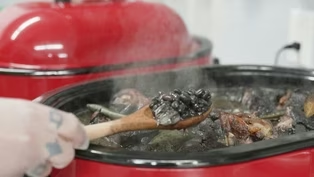
How Ukwakhwa's Seed-to-Table Effort Celebrates Native Food
Video has Closed Captions
Clip: S2400 Ep2435 | 5m 47s | Ukwakhwa uses Indigenous foods to support local communities in the Oneida Nation. (5m 47s)
Iranians in Wisconsin Share Worries on the Middle East War
Video has Closed Captions
Clip: S2400 Ep2435 | 4m 18s | Iranians living in Wisconsin share their perspectives as U.S. airstrikes continue. (4m 18s)
Maria Lazar, Chris Taylor on Wisconsin's 2020 Vote Lawsuit
Video has Closed Captions
Clip: S2400 Ep2435 | 3m 20s | Maria Lazar and Chris Taylor on the 4-3 decision to reject "Trump v. Biden" in 2020. (3m 20s)
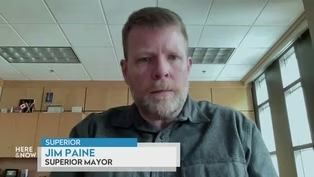
Mayor Jim Paine on Funds for the Blatnik Bridge in Superior
Video has Closed Captions
Clip: S2400 Ep2435 | 5m 52s | Jim Paien on more than $1 billion in funds for reconstruction of the Blatnik Bridge. (5m 52s)
Providing Support for PBS.org
Learn Moreabout PBS online sponsorship
- News and Public Affairs

Top journalists deliver compelling original analysis of the hour's headlines.

- News and Public Affairs

FRONTLINE is investigative journalism that questions, explains and changes our world.












Support for PBS provided by:
Here and Now is a local public television program presented by PBS Wisconsin