
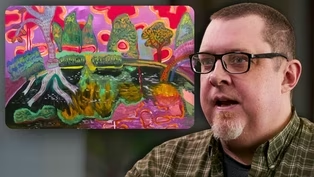
What's Behind Seth Butler's Emotional Art?
Season 11 Episode 3 | 28m 45sVideo has Closed Captions
Explore Seth Butler’s surreal paintings, Kinderhook’s Super-Stories, and music from Chris Sanders.
Meet painter Seth Butler and explore his fantastical landscapes. Discover how Super-Stories in Kinderhook uses murals and workshops to empower artists of all ages. Then, enjoy a heartfelt performance by Chris Sanders and The Better Days on this vibrant episode of AHA! A House for Arts.
Problems playing video? | Closed Captioning Feedback
Problems playing video? | Closed Captioning Feedback
AHA! A House for Arts is a local public television program presented by WMHT
Support provided by the New York State Council on the Arts (NYSCA), M&T Bank, the Leo Cox Beach Philanthropic Foundation, and is also provided by contributors to the WMHT Venture...
What's Behind Seth Butler's Emotional Art?
Season 11 Episode 3 | 28m 45sVideo has Closed Captions
Meet painter Seth Butler and explore his fantastical landscapes. Discover how Super-Stories in Kinderhook uses murals and workshops to empower artists of all ages. Then, enjoy a heartfelt performance by Chris Sanders and The Better Days on this vibrant episode of AHA! A House for Arts.
Problems playing video? | Closed Captioning Feedback
How to Watch AHA! A House for Arts
AHA! A House for Arts is available to stream on pbs.org and the free PBS App, available on iPhone, Apple TV, Android TV, Android smartphones, Amazon Fire TV, Amazon Fire Tablet, Roku, Samsung Smart TV, and Vizio.
Providing Support for PBS.org
Learn Moreabout PBS online sponsorship(gentle music) (upbeat music) - [Narrator] Explore the otherworldly landscapes of painter Seth Butler.
Make art in Columbia County at Super-Stories.
♪ I'll keep the story short ♪ - [Narrator] And catch a performance from Chris Sanders and The Better Days.
It's all ahead on this episode of AHA.
- [Announcer] Funding for AHA has been provided by your contribution and by contributions to the WMHT Venture Fund.
Contributors include the Leo Cox Beach Philanthropic Foundation, Chad and Karen Opalka, Robert and Doris Fisher Malesardi, and the Robison Family Foundation.
- At M&T Bank, we understand that the vitality of our communities is crucial to our continued success.
That's why we take an active role in our community.
M&T Bank is pleased to support WMHT programming that highlights the arts, and we invite you to do the same.
(intriguing music) - Hi, I'm Matt Rogowicz, and this is "AHA: A House for Arts," a place for all things creative.
Seth Butler is a painter based in Greenwich, New York, who creates fantastical landscapes portraying the abstract nature of perception.
(intriguing music) - I'm a highly visual person, and I guess I have kind of a creative nature about me.
My paintings are primarily based on landscape, but they have a fantasy tilt to them, and I've been at this practice on a serious basis for, I would say, at least the last 10 or 15 years or so.
So growing up as a kid, my mom was always painting.
When I was in middle school, she opened up an instructional art business.
The family moved to Helsinki, Finland after that, and there was quite a bit of art-making going on there as well.
I got more caught up with, you know, skateboarding, snowboarding, BMX, all that kind of stuff when I was in high school, but my major in college was always Art, and I really came back to it again later on when I wasn't really progressing in those kind of action sports and realized that I really missed the passion of working on paintings, working on drawings.
I had a lot of stuff that I wanted to express, and just found that I was coming up with tons of material, either through drawing or painting, that just needed to be out on the surface.
(intriguing music) Just from the influence of my mom, my family being into landscape painting, that's where I picked it up, but it wasn't that I could just do it straightforwardly.
I had to alter the colors, change the patterning, change the perspective, you know, find different atypical colors in other colors.
You know, there's orange in brown, there is purple in gray, there's light blue in green in some ways, so you can go on and on with what you're looking at and see these different colors, and really bring them out so that it has either a shock value or creates a perspective which you didn't expect before.
(intriguing music) There's not a lot of ways to categorize it necessarily.
I would say impressionist landscape or fantasy-driven landscape.
You could even say that there was an outsider art or folk art quality to it as well.
I'm not a fan of when you're working on a fantasy painting to go and invent the background.
Even though I have a vivid imagination, I tend to want some kind of reference to look at so that I can create the whole composition.
A lot of times in the fantasy paintings, there is some figuration there, you know, cartoon-type characters, figuration, animals.
Even the plants would be having this sort of notion like Christmas decorations on a huge tree, or visible stars, or a visible crescent moon, that kind of thing, so that you're getting a nighttime effect in a daytime composition.
(intriguing music) I want to be able for people to get a sense of beauty out of it, maybe a little bit of some wonderment.
I really do get a lot out of the process of showing the work.
I want to share it.
I don't even care if it means, you know, lugging 20 canvases to a gallery.
I want people to enjoy the work, ask questions, and kind of contemplate.
You know, when you have a noted painter or artist in general and you know their work from a textbook or from an art book, but then you go to a museum showing of theirs and you see something different that you normally wouldn't see in the books, you're so pleasantly surprised and love to see that work.
So for me, the idea that I can create myself makes me aspire to the works that I see outside of here, like in a gallery or museum.
You start to look at it in a certain way and think, "Okay, maybe I could do this like that," or you strive to be at that level, I guess, and it's the striving, the kind of hopefulness that lures you in.
(intriguing music continues and ends) - Super-Stories is an amazing nonprofit art center in Kinderhook, New York, focusing on community storytelling through public art, workshops, and partnerships.
Jade Warrick recently spoke with founders Ramiro Davaro-Comas and Grace Lange to see what inspired them to create this makerspace.
- Welcome, Ramiro and Grace.
Welcome to "House for Arts."
- Hey, thanks for having us.
- Hey.
Nice to see you.
- Super excited to talk everything arts.
We have a lot of passions in common, so I'm ready to dive right in.
So let's start with Super-Stories.
So I guess paint us a picture.
What is Super-Stories, and what do you guys do?
- Super-Stories is an arts education nonprofit founded and run by the two of us.
We have an all-ages maker space in Kinderhook, New York, where we host a variety of programs.
So we've got an afterschool experimental art club for kids.
We've got structured mixed media workshops.
We have an adult art club that meets monthly, and we do weekend free programs for families, and so those are like a combination of these drop-in open-ended maker hours where people can come in and just like explore with materials and hang out with other creative people, and then more structured workshops that are led by us and local teaching artists, yourself included.
- Yeah, exactly.
I love Super-Stories.
Great space.
- That's right.
- So you both started as studio artists.
Your career was in studio art, and you're doing a lot of like, you know, gallery work, things like that.
What was the moment you decided that you wanted your art to do more than just hang on a gallery wall?
What brought you into, I guess, more of the Super-Stories space?
- Well, I think really just getting out there and painting murals and working with communities, at least for the mural aspect of the organization, was what really pushed me to do that, and, you know, our process is just trying to, for our mural projects, is to center the schools and the community members, the students in the entire piece and have them come up with the ideas and do everything from coming up with a sketch to actually painting the murals on the wall.
And in the, I think, three years that we've been an organization, we've painted 50 murals and worked with around 10,000 students, which is a lot.
So yeah, it's crazy, but that's just the mural part of our program.
- 'Cause you guys, well, again, you have the makerspace and the mural part.
And what's like a little bit of your background real quick?
Like, Grace, what's your background?
- Yeah, my background is I have undergraduate degrees in Illustration and Literary Studies, so I basically say I like stories and pictures, and I have a graduate degree in Educational Psychology.
So there was a point where I was like making art by myself all the time and I started feeling like maybe my art skills could lend themselves to being a little more useful out in the world, and that's when I really pivoted more towards art education and felt like I needed to spend time with kids, and now I'm at a place where like that's fed back into my own practice as an artist, and we both have this kind of cool balance of making our own art and making art with kids.
- Yeah, and what about your background too, Ramiro.
Gonna give... - My background, I mean, I studied Hospitality and Tourism Management and Business, so that was the background that I came into the art world, and then I did a lot of artist residency programming in management, and eventually started an artist residency program, and then I'm here with Super-Stories, and it's been a great ride.
- I know.
You said 10,000, like, students served.
- Yeah, it's crazy.
Yeah, yeah, yeah, yeah.
- So you now work with people and communities so much, like that's like a main piece of your practice now.
Why is that fulfilling to you?
- I mean, I feel like a big part of my journey towards working with kids came from during COVID.
We were with our young niece and nephew every day, and I just got so into coming up with fun projects for them, and realized how much I like being with kids and how much I like helping them bring their ideas to life, and so I think it's just really wonderful to be in a position where you can empower kids to feel like their ideas matter and their ideas are worth pursuing.
And then I think what's been so fulfilling about our space is the community-building side of it, which I didn't even expect when we got into it, but I have found that our space is one in which people who don't always go towards arts programming feel comfortable coming in, and they get to bond as a family, bond with other families, get in touch with their own creative sides.
And, I mean, you're an artist.
Like we all know that having that tool can transform your life, whether you come to it as a kid or come to it later in life, and I think it's just so powerful to feel like we're able to give that to people.
- That's very beautiful.
- I think for me it was starting to paint outside, and then really working with communities, and painting murals for and with communities, and like reflecting their stories, their values, the iconography that they wanted to see, and like, and them on a large scale.
So to see themselves and their ideas on a large scale was transformative.
And then they were so happy, and that made me so happy, and I'm like, "I need to keep doing this," you know?
- (chuckling) Yeah.
Now, is that something that you like, do you see this a lot in the fine arts world, or is there like a little bit of a disconnect that you guys have seen?
- Hmm, like community work, I don't know.
I think there is overlap sometimes, but I do see that sometimes, you know, it's more prestigious or it's looked up more to sell in galleries and to do that kind of marketing stuff, where working with communities is just so much more personal.
And yeah, I could see a divide, but I also, I can see the importance of it.
Everybody needs it.
- Yeah.
- Well, I feel like when I was more of a studio artist and like going to art school, it seemed like there was a clear divide between art educators and fine artists, but the more we've ventured into this world, I've really seen how many full-time professional fine artists are also teaching artists.
They maybe are not in a school every day, but they're doing workshops and they're sort of lending their expertise out, and I think it's the kind of thing maybe you don't notice if you're not looking for it, but then once you start looking for it and seeing it, it's just really exciting, because there's so many people doing cool things, and there's just this openness with sharing their process with people that I didn't feel as much when I was like just kind of in the fine art lane, you know?
- Yeah, and now you guys are kind of like creating a movement too, because now you're having artists who are probably fine artists, studio artists too, look up to what you guys are doing as fine artists, as studio artists who are working in the community, and then being inspired by what you're doing, and not feeling like they're stuck, and like, or siloed in one lane.
Like you kind of are inspirational for artists who are kind of up-and-coming, to be like, "I could do that too," and not feel bad about it and not feel pigeonholed.
- Well, thank you.
I mean, I think it's like, it's valuable for artists to do for themselves, just in how it opens your mind, and I think the best way to realize what you know is to teach it to someone, and like break down the steps that are so second nature to you.
So I think even if an artist, you know, just does one workshop once, and they're like, "Oh, maybe teaching's not for me," I think that's still a good experience for them, and it'll feed back into the way they work.
- Exactly.
Having different perspectives.
- Yeah, I agree with that, and I think it's really what has been the question for me is like, "Well, what kind of legacy do you wanna live?"
You know?
Like, do you wanna leave something where like only one person gets to see your painting, or do you wanna work with hundreds and hundreds of young people, and, you know, inspire them to be able to bring their ideas to life through a workshop or painting a large-scale mural.
- Yeah, so I've heard you guys say murals are like the quilts of the neighborhood.
How do you weave your, like, very, like these doodles?
You have, like, these kid-like doodles, and like figures, and ideas.
How do you weave these all into one piece?
Like, that's a lot.
Like, how do you do it?
(chuckling) - Well, you know.
Like painting a mural is a lot of work.
It's difficult.
I think really the hardest part is determining the style we're gonna work in, and that is always determined by the community that we're in, whether it's a school group or a community organization with older adults.
We always start off with a brainstorming session, so we always want to make sure that we are receiving imagery, and sketches, doodles, lists of ideas that they wanna see on the mural, so that we can actually represent their ideas on this wall.
We then create a sketch, and then after the sketch, and after it's approved, we invite everybody from the community or the school to have an actual part in painting of the mural.
And that process kind of like demystifies like the magic that mural painting is, 'cause people see a wall, and then the next day there's a mural, and they get to learn the entire process, and through that get to see that they can actually do this.
We're just kind of like the vehicles for their ideas.
- Yeah, and I love like, even if it's, like, just like two like paint strokes, they're like, "Oh my god.
I painted that."
- They always say, like, "Oh, I painted that," you know?
"I did that part," or, "I did that part."
And it's awesome, especially working with really young students, 'cause they come up with amazing drawings.
- They really do.
It's very impactful work.
So with your makerspace, when you run the workshops, it's like such a space of healing.
You know, people can escape from the stressors of life, as you said, parents get to bond, children get to make new friends.
How do you foster that environment?
How do you create that environment of community and connection?
- Well, I mean, I think the first way is just by being welcoming, having a majority of our programs being free, and having them be drop-in so people don't need to sign up.
People just feel really welcome coming in, and they feel like anybody is invited and welcome in the space.
Everything we do is based on a philosophy of art education that's called Teaching for Artistic Behavior, which is about promoting like the habits of professional artists rather than just trying to master skills.
So we're teaching kids, or we're making space for kids to experiment, to try to fail, to problem-solve, to figure things out for themselves, and to make all of the decisions about what they're making rather than trying to replicate, you know, a sample that we've done.
Even when we have workshops where we're teaching a specific process that does require following steps, we make sure that everyone knows, like they can kind of take those steps and do what they want with it, and I feel like the power there is that, first of all, it's a space where people feel like they just get to make decisions, and for kids especially, that's huge and empowering.
I also think it invites in the kinds of people who maybe don't make art that looks like the teacher's sample, right?
So they just feel like this is a space where they can be successful and like anything can be considered art.
And I also think it promotes transferable skills outside of the art world, like persistence, planning, time management, reflection, collaboration, all of these things that are not art-specific, that are just going to help like kids grow up into well-rounded, creative people.
- Yeah, and teaching them how to play, like being playful, you know, the joy of play.
- Totally.
And no one's judging what they're making.
I'm not grading things.
We really try not to say like, "Oh, that's really good."
You know, we'd rather... We ask questions like, "How did you come up with that?
How did you do that?"
And I love when a kid asks you to do something for them.
We're like, "Oh, actually I feel like you can figure that out yourself."
And then when they do, they're so stoked on it.
It's just like, it's really cool to be able to create a space for that.
- [Jade] Yeah.
It's really cool.
- Yeah, they're like, "I did it," you know, "I was able to do it."
It's amazing to see that, every single time.
- And they come up with the weirdest things too.
- Yeah.
It's awesome.
- And it's, like, just so much more interesting than, you know, a bunch of kids copying my painting of a dog, right?
And there's total value in learning how to follow instructions and copy a painting of a dog, for sure, but the things they make are just so unexpected and weird.
- I can only imagine.
- And like pure, you know, 'cause it's like young people making this stuff.
It's amazing.
- Pure imagination.
- (chuckling) Yeah.
- Yeah, like we have bins of just like basically garbage, and they love it so much.
- I'm thinking, like they go hard in there.
- Yeah, yeah.
- They really do.
Well, all right, well, thank you, guys.
I'm definitely gonna have to stop by.
If folks are in Kinderhook, make sure you stop by Super-Stories, check it out.
Your workshops are free or low-cost?
- So all summer long we have free Saturday maker hours from 10 to 12.
Everyone is welcome to come in and get into it.
In our website, we have a calendar about other programs as well.
- [Jade] Oh, awesome.
- Almost all of our, or all of our artist workshops are also free.
- Oh, that's amazing.
- So we have, you know, when you came, everybody also came for free.
- Yeah, very accessible.
Well, thank you for joining us, Ramiro and Grace.
I'm super glad to have you, and I'll have to stop by soon to visit.
- Thank you, Jade.
- Thank you so much.
- Thank you.
- [Announcer] Please welcome Chris Sanders and The Better Days.
♪ Took a ride in my jeep on a sunny summer day ♪ ♪ Top down and radio up, 'cause it makes me feel okay ♪ ♪ Got my hand out in the wind, the other on her knee ♪ ♪ Down some empty back road never felt more free ♪ ♪ Lake George to Saratoga, someday Schenectady ♪ ♪ Lucy Falls to scour the cove, and even Albany ♪ ♪ Cutting through Steepletown into Mechanicville ♪ ♪ 'Cause I'm Upstate jeepin', and I'll never get my fill ♪ ♪ Headed east or headed west, it don't much matter to me ♪ ♪ As long as there's a single lane ♪ ♪ It's the curves make me happy ♪ ♪ From time to time I even find a dirt road to explore ♪ ♪ Hit the bank, fill the tank, and go driving even more ♪ ♪ Lake George to Saratoga, someday Schenectady ♪ ♪ Lucy Falls to scour the cove, and even Albany ♪ ♪ Cutting through Steepletown into Mechanicville ♪ ♪ 'Cause I'm Upstate jeepin', and I'll never get my fill ♪ ♪ Headed north or headed south, I never really know ♪ ♪ Which way the road will take me or direction I will go ♪ ♪ All I now is when I get there, peace and harmony ♪ ♪ I know that I've ended up right where I should be ♪ ♪ 'Cause I go from Lake George to Saratoga ♪ ♪ Someday Schenectady ♪ ♪ Lucy Falls to scour the cove, and even Albany ♪ ♪ Cutting through Steepletown into Mechanicville ♪ ♪ 'Cause I'm Upstate jeepin', and I'll never get my fill ♪ ♪ Yeah I'm Upstate jeepin', and I'll never get my fill ♪ (country rock music) (country rock music) ♪ Cars are going faster ♪ ♪ Lord knows I'm not immune ♪ ♪ My wheels ain't fell off yet ♪ ♪ But I feel they might just soon ♪ ♪ Going nowhere fast, too much left to do ♪ ♪ Been keeping busy just to keep my mind off of you ♪ ♪ But I'm too tired to cry, too broken too ♪ ♪ Don't know what to do with all these feelings left for you ♪ ♪ It would just be too damn sad ♪ ♪ If I found the strength to try ♪ ♪ So I keep the story short, I'm just too tired to cry ♪ ♪ Nights are growing longer and the days are shorter too ♪ ♪ The storms are getting stronger ♪ ♪ My skies are not so blue ♪ ♪ Can't seem to get away from the sights in my rear view ♪ ♪ So I keep it moving till I end up somewhere new ♪ ♪ But I'm too tired to cry, too broken too ♪ ♪ Don't know what to do with all these feelings left for you ♪ ♪ It would just be too damn sad ♪ ♪ If I found the strength to try ♪ ♪ So I'll keep story short, I'm just too tired to cry ♪ (country rock music playing) ♪ But I'm too tired to cry, too broken too ♪ ♪ Don't know what to do with all these feelings left for you ♪ ♪ It would just be too damn sad ♪ ♪ If I found the strength to try ♪ ♪ So I'll keep the story short, I'm just too tired to cry ♪ ♪ So I'll keep the story short, I'm just too tired to cry ♪ (intriguing music) - Thanks for joining us.
For more arts, visit wmht.org/aha, and be sure to connect with us on social.
I'm Matt Rogowicz.
Thanks for watching.
(mid-tempo music) - [Announcer] Funding for "AHA" has been provided by your contribution and by contributions to the WMHT Venture Fund.
Contributors include the Leo Cox Beach Philanthropic Foundation, Chad and Karen Opalka, Robert and Doris Fischer Malesardi, and the Robison Family Foundation.
- At M&T Bank, we understand that the vitality of our communities is crucial to our continued success.
That's why we take an active role in our community.
M&T Bank is pleased to support WMHT programming that highlights the arts, and we invite you to do the same.
What's Behind Seth Butler's Emotional Art? | Preview
Preview: S11 Ep3 | 30s | Explore Seth Butler’s surreal paintings, Kinderhook’s Super-Stories, and music from Chris Sanders. (30s)
Providing Support for PBS.org
Learn Moreabout PBS online sponsorship













Support for PBS provided by:
AHA! A House for Arts is a local public television program presented by WMHT
Support provided by the New York State Council on the Arts (NYSCA), M&T Bank, the Leo Cox Beach Philanthropic Foundation, and is also provided by contributors to the WMHT Venture...