Unspun
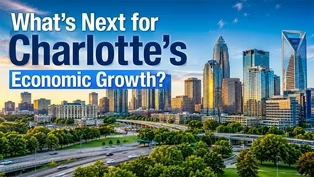
What’s Next for Charlotte’s Economic Growth? | Unspun
Season 2 Episode 229 | 27m 17sVideo has Closed Captions
Charlotte's economic growth faces new challenges as development reshapes the city.
For decades, Charlotte’s economy has been the envy of cities across America. Now, rising construction costs, interest rates and changing demands are reshaping how the city grows. Mixed-use districts, housing, office developments and major redevelopment projects are redefining economic development—and what it takes to keep businesses, entrepreneurs and talent investing in Charlotte.
Problems playing video? | Closed Captioning Feedback
Problems playing video? | Closed Captioning Feedback
Unspun is a local public television program presented by PBS Charlotte
Unspun
What’s Next for Charlotte’s Economic Growth? | Unspun
Season 2 Episode 229 | 27m 17sVideo has Closed Captions
For decades, Charlotte’s economy has been the envy of cities across America. Now, rising construction costs, interest rates and changing demands are reshaping how the city grows. Mixed-use districts, housing, office developments and major redevelopment projects are redefining economic development—and what it takes to keep businesses, entrepreneurs and talent investing in Charlotte.
Problems playing video? | Closed Captioning Feedback
Where to Watch Unspun
Unspun is available to stream on pbs.org and the PBS app.
Providing Support for PBS.org
Learn Moreabout PBS online sponsorship(bright music) - [Announcer] This is a production of PBS Charlotte.
- Tonight on "Unspun," for decades, Charlotte's economy has been the envy of cities across America.
But success brings a new set of questions.
How do you keep economic momentum going when the rules of growth are changing?
We pose that question to two prominent Charlotte developers.
And I'll also tell you the top five issues that can block new growth.
In today's America, welcome to the spin game.
Believe me, I know.
I'm Pat McCrory.
When I was governor and mayor, I played the spin game.
I was played by the spin game.
But aren't we all done being spun?
Let's take the spin out of the world we're in, here on "Unspun."
(bright music) Good evening.
I'm Pat McCrory.
New mixed use districts, office developments, housing, and major redevelopment projects are reshaping Charlotte, even as developers navigate higher construction costs, interest rates, and changing demands for where people live, work, and invest.
Today, economic development is more than just recruiting the next big company.
It's about creating places where businesses want to invest, entrepreneurs who want to build, and talent who wants to stay.
Joining me now are Peter Pappas, one of Charlotte's most experienced real estate developers, and Andre Colins, founding partner of First and Early Partners.
So what does the next chapter of Charlotte look like?
Does it require the same playbook that built the city?
Or a completely new one?
Welcome to both of you, Andre and Peter.
- Governor, thanks for having us.
- Peter, I remember you when I was the new Charlotte mayor, and you were the young Andre developer.
- There you go.
- You were the brand new guy.
Young guy, and now you're the experienced prominent developer in Charlotte, it's an honor to have both of you here.
- Thank you for having me.
- My pleasure.
- So I'm going to get right to it.
What, first of all, is working in Charlotte regarding new development?
And I say this because in 1995, when I was elected mayor, I said, "I'd rather have growing pains than dying pains as a city."
Right now, we are having growing pains, but what's working regarding those growing pains?
- Well, we are, but there, it's positive, the way we're growing because we're attracting jobs.
And I was thinking about this a bit this morning, and I'm going to make sure I get this right, but in the last maybe 30 days, Red Bull in Concord has announced that they're moving forward their plans, a billion dollar expansion - And I might add, that's a regional- - Regional.
- It's not, we're not just talking about Charlotte.
- Right.
- Because growth doesn't recognize politically.
- Well, I think that's the exciting thing is how much the region's growing.
- Yeah.
- Corning just announced in Hickory.
Octapharma in Rock Hill, big announcement, over a billion dollars.
Prismana, North American, in Catawba County.
So the whole region's growing, that's the positive.
And I think a lot of the growth we've experienced in Charlotte is because we've had that young, talented workforce.
And that's why you see a lot of companies moving here because we've got the talent.
- So what's working is we're creating jobs and opportunity.
And Hickory, for example, 25 years ago was a dying city, because all the mills were leaving.
And now, Hickory is booming right now, and doing well.
Andre, what is working regarding economic growth from a young perspective like yourself?
- I mean, Charlotte is fully discovered now.
I mean, we have talent.
So many opportunities as Mr.
Pappas mentioned just now.
In terms of economic development, our leaders are doing a great job.
And I think in collaboration with the community and driving a lot of that growth is what we're seeing.
But as I mentioned earlier, Charlotte is growing, and the talent is here and we're fully discovered.
- Let me ask you, as a younger person, what is your generation looking for regarding new economic development and quality of life?
- Opportunities.
Younger generation is truly looking for opportunities to grow, to actually earn.
Again, you're in an environment or, we're in a time where you have all these different, the job market looks a lot different from what it was 10, 20 years ago.
You have social media influencers making millions and millions of dollars.
So that outlook's just a little different.
But there's still those that see a lot of value in having those traditional jobs, even though it's changed a bit.
And Charlotte, we're delivering those opportunities, and companies are moving here.
And the talent is following that per se.
So in terms of housing, having the ability to have somewhere affordable, I think we've been on the right path there in providing some level of affordability for housing as well.
I think right now for housing supply, what that looks like is we might seem a little oversupplied.
But I think everything will catch up and normalize with time.
And I think with that, we'll see a lot more growth.
Because we're, again, I think - - [Pat] Yeah.
- The number now is we're growing.
- We've seen, Andre, we've seen cycles of this during my 38 years in Charlotte, or 40.
Where one minute we have too much housing, the next minute we don't have enough housing, whether it be multifamily, or development.
You and I have seen various periods where a lot of developers went under because we had overdevelopment and then their loans were called and boy, times were tough.
- Oh, definitely.
- So what, Peter, what are the challenges of a growing region like Charlotte?
From Hickory to Concord, to Rock Hill, to Charlotte?
- Well, I'd probably put it in three different areas.
I think transportation funding is always a challenge because with growth, comes more traffic.
We've had some success here recently with the referendum last fall to provide more funding.
A lot of that thinking more outside of Charlotte, a little more regionally.
So that's exciting.
That's a good step in the right direction.
But I think it's always about building consensus around a vision.
And it's challenging, but it can lead to a lot of great things.
But you do have each municipality, in control of their own zoning and planning.
So building that consensus regionally and thinking a little broader, it takes a lot more work.
But I think it also can lead to a lot of good opportunities.
- Andre, my vision for Charlotte was to have the best big city opportunities, but retain small town quality of life, especially in our neighborhoods and safety and good education.
But job opportunity that will go beyond generational.
- [Andre] Yes.
- Activities like yourself.
So as a developer, I know your company was involved in the Wake Forest Med School, for example.
That was something new.
Coming aboard on our hospitals and so forth and getting Wake Forest to move their med school.
Are those the type of new things we need to completely diversify in?
- Definitely.
So, I mean, that project itself is probably considered one of the largest demand driver for Charlotte, behind the airport, arguably.
And we need more of that.
It's demand drivers.
That's where you see a lot more development happening, a lot more community being developed.
So yes, to answer your question.
A lot more of those opportunities will drive a lot of growth.
- I'm glad you mentioned the airport, 'cause I would say the airport's probably the major economic driver for Charlotte during the last 50 years at least.
Peter, the biggest issue that's tough on developers is what I call NIMBY, not in my backyard.
Once I move into my new neighborhood, I don't want a neighborhood next to me.
I want to be the last neighborhood along Providence Road or along Colony Road, or you name the road, north Charlotte and so forth.
Is NIMBY still a major issue?
- It is, but it's interesting when you listen to the neighbors in terms of what they want.
A lot of times, it's a better plan, better design.
I hear more from the communities we work in that they want more services, particularly around retail and restaurants.
So to some degree, the dynamic has shifted away from "I don't want anything, but I want my community to be a little more multi-use, a little more mixed use, have a broader offering, because I like it here, I want to stay here."
And so what makes that area special and attractive are those amenities.
And the amenities now are walkability to restaurants, grocery stores, open space.
So that dialogue is really becoming more of the discussion than just no.
It's more about, how do we do it better?
Which is, I think when we work like that, we get a better plan.
- The dilemma is more regulations cause higher costs, but I institute new regulations when I was mayor in '95, upset John Crosland.
He was so mad at me that I required sidewalks on both sides of the street, new developments, and along new thoroughfares.
Like when Providence Road was widened to four lanes, I said, "We're going to have sidewalks on both sides."
And everyone's going, "No one's going to use those sidewalks."
I said, "Well, they're using them on Queens Road right now."
- [Peter] Right.
- But I had a lot of developers very upset with me.
But in the long run, I thought that would increase the values.
But Andre, there's a fine line between regulations that add too much costs, and regulations that maybe protect the investment.
Where do we draw that line?
- I think you had a good point earlier.
I mean, there's definitely a fine line there.
Because again, we talk about not in my backyard-ism.
I think what we're seeing is a lot of folks are resistant to change, but at the end of the day, I don't think they understand.
I think offering more opportunities to provide more education to educate them.
Just as Peter mentioned earlier, it's just having the conversation, have the concession around it, will drive a lot of decisions around what that looks like per se.
- Peter, you're building some high rise things.
And it used to be just high rise buildings were only in downtown Charlotte.
Now the south end has major high rise buildings still going up.
Midtown, you're building a building right now, a major apartment or a condo complex right there, which was, by the way, used to be a dead center of vacant, I think it was the first mall in North Carolina there.
Now it's revived.
- Interestingly, the Charlottetown Mall was the third enclosed mall in the country in 1959 - - [Pat] Wow.
- Built by Jim Rouse, who was a real pioneer in the development business.
Our company's not doing the high rise, but as you know, we did all the Target and the Best Buy and the office, and worked cooperatively with the Mecklenburg County to open up the Little Sugar Creek to uncap it to build a greenway.
And I think that, again, points to people enjoy that greenway.
They enjoy walking.
And you've got Trader Joe's right there.
- Tony Zeiss and Ruth Samuelson, I got to give them some credit.
I was mayor that time, but - - Big change.
- I agreed to get rid of the Exxon gas station and move it at that, but huge change going all the way to South Carolina.
But the high rise buildings now are in South Park, are Ballantyne.
They'll move the university, sooner or later.
Is there some rules we should make on high rise buildings?
Or do we let the major business districts get as much density as we can?
That was part of the plan.
Along the corridors, major density, the business center's density.
But in between, we protect the residential neighborhoods.
Now I have a little problem with the new policies of residential neighborhoods, but that's changed, I guess.
Do you see more high rise buildings coming?
- Well, I think you do in areas like Ballantyne, where you have a concentration of jobs.
- [Pat] Right.
- And those folks that work there want to be able to walk to their office potentially.
And you want more retail there that you need more housing to support it.
And so I think in the appropriate places, where you've got the transportation - - And appropriate design and so forth.
- Design's always the key.
I think a lot of people underestimate how important the design is to the community.
- Yeah.
- And really how their perception is.
- We even had the Wake Forest Med School right next to Dilworth, but it's kind of separated by some major roads and barriers.
- Yeah, I would agree 100% there.
I mean, we only have so much land to develop on.
And as our city grows, there has to be some level of density that needs to happen.
And as Peter mentioned, if they happen in the right place.
- [Pat] Yeah.
- I think that's what's truly drive our growth here.
- In the remaining minute and a half, the next big NIMBY thing that's come out of nowhere, it wasn't around when I was mayor or governor, data centers.
Where, I mean, all of a sudden, we have moratoriums of the city, state, every state's going through, even Texas is going through a data center debate.
In the remaining minute, is there going to be a compromise on this?
Because people want to use the data, but they don't want it next door to them.
Typical NIMBY.
- Well, the technology moves so quickly.
And that's driven a lot of demand for the data centers and perhaps not enough.
The market hasn't had enough time to think about where are the best locations for those uses.
The market will.
And we'll sort it out because the demand's there.
- The NIMBY argument hasn't changed at all, regarding that versus quarries, regarding multifamily, since I was in office.
You two have brought a great perspective to development in the region, and I appreciate you being on "Unspun."
Thank you very much.
- You're very nice to have us.
Thank you.
- Thanks for having us.
(dramatic music) - All right.
The "Unspun Top Five Countdown" starts right now.
And the top five things are the NIMBY issues that stop growth.
First of all, what is NIMBY?
Not in my backyard.
So what are the top issues that stop growth where people don't want this in their backyard?
Starting out with number five, lack of connectivity and road capacity.
When you move to a certain area, you go, "Okay, I got enough roads for me, but I don't want a neighborhood built next to me and my neighborhood because there's not enough road capacity and connectivity to get out of my neighborhood.
In fact, I want a stoplight now."
And then we have stoplight after stoplight after stoplight.
Congestion.
That's the problem.
Number four, flooding due to increased development.
The fact of the matter is, more impervious space, which includes the roof of your house, causes floods downstreams maybe into the next neighborhood.
That's why the city requires on commercial developments what we call retention ponds.
You know those ponds next to South Park Mall?
That's required by the city.
It's not a natural pond.
It's from the flooding.
Number three, value of the new development.
This is especially as it relates to affordable housing.
Everyone's for a new development or affordable housing, unless it's next to your neighborhood, which is higher value housing than the neighborhood being built next door.
If that occurs, you go, "Wait a minute, that's going to affect my housing price.
I don't want that."
More NIMBY.
Number two, tree and barrier issues.
The fact of the matter is when something's built next to you, especially if it's commercial industrial, and you live in a residential neighborhood, you want barriers, you want trees protected.
You don't want to hear the noise next door.
Have you heard of the word data centers?
That's what they're concerned about, is the noise next door to residential neighborhoods.
And number one, the density of development.
As we grow as a city, downtown isn't just getting the high-rise towers.
South Park, Ballantyne, are getting high-rise towers, right next to residential neighborhoods.
Well, how would you like to live in a residential neighborhood in which a high-rise tower blocks the sun from your backyard?
All of a sudden, you become a NIMBY.
(dramatic music) Time now for our One-on-One segment.
Joining me this time is reporter Alex Sands from Axios.
Welcome.
First of all, I want to compliment Axios.
It's a great new news provider for the Charlotte region and all of North Carolina and South Carolina.
We appreciate it.
- Thank you so much.
I appreciate that.
- So we're going to talk about economic development, and some of the challenges there.
I don't know what questions you're going to ask me, but that's the exciting thing about this section of One-on-One.
- Well, I got to listen to the developers, so I found it very interesting.
But I mean, we are one of the fastest cities in America right now.
I think the fastest.
How are you feeling about the way that the public sector is doing right now at managing that growth?
- I think the only thing that's lacking in the public sector is maybe a 25 to 50-year vision on how we're going to grow and explain that to the public.
We have kind of mini plans in each area of the city.
Some in the region.
But I think at this point in time, like we did 30 years ago, we developed a 25-year land use plan, and transportation plan.
And everyone could see it for the entire region.
I think we're missing that right now.
I think the new mayor has a wonderful opportunity to go, "What do we want the region to look like 25 years from now?
What will it look like if we do nothing, and what will it look like if we put good plans in place?"
I don't see that out there at this point in time.
Do you see that out there right now?
Maybe I'm missing it.
- I mean, I know we just had that big UDO overhaul and we're still seeing some - - UDO.
Explain what UDO is.
- The Unified Development Ordinance.
We had a giant overhaul of that a few years ago.
I don't think we've fully seen the impacts of that yet besides the duplexes and triplexes being filed.
But I'm also curious, just how much of a hand do you think we should, the city, or the county should have in some of these housing projects?
- Well, that's the million dollar question because as you know, with NIMBY, everyone's for affordable housing until it's near them.
And that includes both Democratic and Republican representatives.
They all go, "Let's build affordable housing, and high density projects, but I want it in the other guy's district.".
That's been going on for 50 years now.
So that's going to be their major challenge.
It's not just a financial thing.
And we need to define what affordable housing is.
Are we talking about dealing with people who are homeless?
Are we talking about working families?
Are we talking about middle class families, like, and teachers and police?
We need to define what we mean by affordable housing, and who is the real customer.
And I think that's a question the media needs to ask because we're all over the board.
Always has been, frankly.
And I think it needs better definition so the taxpayers know exactly where their money's going.
- What about working with some of those developers, working with the private sector?
Do you think that the Charlotte way is still alive and well, or do you think that we're starting to see that deteriorate?
'Cause I know there have been a lot of public-private partnerships that have struggled to make it across the finish line recently, including I'm thinking I-77 is a huge fight right now.
- I think what we need to do when we develop, get that private public partnership, we need to first do our homework.
Can the developer afford the risk?
Does the developer have a good track record in other areas of either Charlotte or the region or the country?
I know when I was mayor, we had a couple of developers, we were converting mills on North Davidson area, and when we hired them, we thought they knew what they were doing.
They didn't know what they were doing and we took a big loss.
Others did an incredible job.
One thing I did as governor was give tax breaks to revitalizing old buildings.
That's another thing I wish we'd do more of in Charlotte.
Instead of tearing down the old buildings, I think there's a way we can revitalize the old buildings and keep a little bit of history, in areas that used to be old mill towns.
Plaza Midwood was an old mill town.
- [Alexandria] Yeah.
- Think about it.
I want to make sure we keep that small town environment, for example, in Plaza Midwood.
- I want to talk a little bit more about 77.
That's the very hot topic right now.
Charlotte tried to kill it, and then Raleigh wants to bring it back.
They're saying you're gotta spend, you're going to have to give us tens of millions of dollars for the work we've done so far.
What do you make of that as someone who's been in Raleigh and Charlotte?
Do you think that there's some overstepping happening?
Or do you think that's the right course of action?
- I think we need to hear from the governor.
The governor, the headlines, and all the newspapers have been, DOT says they're going to take away money.
- Yeah.
- Well, guess who runs DOT?
The governor.
In fact, when I initiated and took a lot of heat for it, may have lost election, the I-77 toll lanes.
It didn't say DOT toll lanes.
It said McCrory toll lanes.
It's the governor that's in charge, and I think the governor is going to have to work with the community in going, "Really?
Are we going to take your money away?
Or can we make a deal with the DOT board?"
I think there's going to end up being some negotiation versus threats, both with the board, and maybe even with the legislature.
You got to remember, a lot of votes come from Charlotte, the next governor's election.
- Do you think Josh Stein is possibly doing anything behind the scenes, just - - Probably very quietly.
It's the McCrory impact.
No one wants to get tagged with toll lanes.
So Roy Cooper didn't talk about it for eight years, and yet they still planned it under the Roy Cooper's DOT.
Josh Stein's kind of inherited it, the way I inherited it from Beverly Perdue.
- [Alexandria] Yeah.
- I went ahead and did it because that was the plans.
Josh is in a tough political stage right now, especially after these next elections.
Will it become a issue for the next gubernatorial issue?
And he doesn't want to lose Charlotte voters, but what are the alternatives?
- Yeah.
Do you think there are any alternatives?
Do you think widening is the right path forward?
- I don't think we have any choice.
It's unless we just, I mean, it's not going to get any better.
It's only going to get worse.
I mean, that's just a fact.
And that's what I always said about light rail down South Boulevard.
I always said there's not much room to widen I-77.
- Yeah.
- And that still is true today.
One more question, quick one.
- What would your advice be to Governor Stein?
- Get down here and communicate with all sides, and come up with a compromise.
Come up and gain some trust that the state's a partner, not just a person who's making threats.
That's going to be a big challenge at this point in time because this is political dynamite for everybody.
Appreciate your work with Axios, and I appreciate you being on One-on-One.
- Yeah, thanks for having me.
Appreciate the opportunity.
(dramatic music) - During my first year as mayor, way back in 1995, I said something that I still believe today.
Every city is either going to deal with growing pains, or dying pains.
Both are difficult, but if I had a choice, I'd rather deal with growing pains.
So we made a decision.
Instead of waiting for growth to overwhelm us, we're going to prepare for it.
We invested in new water infrastructure, road bonds, more buses, light rail, and we developed a 25-year transportation and land use plan designed to make sure we grew the right way.
The idea was to put greater density around employment centers and along transportation corridors, places where people could live closer to jobs and transit.
At the same time, we adopted new tree ordinances to protect our tree canopy and required sidewalks and new developments and along new road projects.
But perhaps the most important part of the plan was something that doesn't get talked about much today.
Protecting the single family neighborhoods in between those high density corridors.
Those neighborhoods weren't an accident.
They were part of the plan.
They gave families places to live, children places to play, and neighborhoods a sense of identity in a city that was rapidly changing.
Now, several years ago, that philosophy began to change.
Charlotte started allowing more multifamily development and multiple homes on lots that had traditionally been reserved for a single home.
The problem is that more housing doesn't automatically mean more affordable housing.
If demand continues to rise, and the cost of land, construction, and financing continues to increase, simply allowing more units doesn't guarantee that the price will come down.
And in some neighborhoods, we're seeing another consequence.
The character and integrity of established neighborhoods is changing dramatically.
So here's my question.
Did we really solve the affordability problem?
Or did we simply change the neighborhoods?
Now I'm not suggesting Charlotte stop growing.
We're going to grow, and that's a good thing.
But I think we should grow intentionally.
Sometimes the answer to the future isn't another new idea.
Sometime it's going back and looking at it, an old idea that worked, and then re-imagining it.
Let's not confuse growth with progress.
Well, that's the truth as I see it.
I'll see you next week on "Unspun."
(bright music) (bright music continues) - [Announcer] A production of PBS Charlotte.
What’s Next for Charlotte’s Economic Growth? |Unspun
Preview: S2 Ep229 | 30s | Charlotte's economic growth faces new challenges as development reshapes the city. (30s)
Providing Support for PBS.org
Learn Moreabout PBS online sponsorship New Episode
- News and Public Affairs

Top journalists deliver compelling original analysis of the hour's headlines.

- News and Public Affairs

FRONTLINE is investigative journalism that questions, explains and changes our world.
 New Episode
 New Episode
 New Episode
 New Episode
 New Episode
 New Episode
 New Episode
 New Episode

 New Episode
 New Episode
Support for PBS provided by:
Unspun is a local public television program presented by PBS Charlotte