
When the Economy Changes
10/30/2026 | 26m 47sVideo has Closed Captions
Dozens of NC towns lost their biggest employer. These three did something with what was left.
When a mill or a plant closes in NC, the town feels it for generations. Explore how Kannapolis built a biotech research campus on the site of the largest single-day layoff in state history, how Henderson County turned 19 miles of abandoned railroad into the Ecusta Trail and how Surry County families replanted tobacco land as vineyards.
Problems playing video? | Closed Captioning Feedback
Problems playing video? | Closed Captioning Feedback
ncIMPACT is a local public television program presented by PBS NC
When the Economy Changes
10/30/2026 | 26m 47sVideo has Closed Captions
When a mill or a plant closes in NC, the town feels it for generations. Explore how Kannapolis built a biotech research campus on the site of the largest single-day layoff in state history, how Henderson County turned 19 miles of abandoned railroad into the Ecusta Trail and how Surry County families replanted tobacco land as vineyards.
Problems playing video? | Closed Captioning Feedback
Where to Watch ncIMPACT
ncIMPACT is available to stream on pbs.org and the PBS app.
Providing Support for PBS.org
Learn Moreabout PBS online sponsorshipncIMPACT is a PBS North Carolina production, in association with the UNC School of Government.
Funding for ncIMPACT is made possible by - Quality public television is made possible through the financial contributions of viewers like you, who invite you to join them in supporting PBSNC.
- Across North Carolina, many industries that built our small towns have been disappearing for decades.
We'll explore what three communities did with the foundations those industries left behind.
♪ Welcome to ncIMPACT.
I'm Anita Brown-Graham.
For most of the 20th century, textiles built Kannapolis, and the mills employed generations of the same families.
When that industry left, it took a lot of those jobs with it.
Today, a new kind of partnership has put that very ground upon which those buildings stood, right back to work.
We head to Cabarrus County to see what it took to rebuild.
- In 2003, Kannapolis lost more jobs in one day than any city ever had in North Carolina.
- This has been a devastating blow to the city of Kannapolis into this entire area.
More than 4,000 textile workers lost their jobs when the city's biggest employer shut down.
20 years later, the city looks completely different, but whether it actually recovered, that's a harder question.
We're here to find out.
David Dill owns West Loop Local, a bar and restaurant on West Avenue in downtown Kannapolis.
He also runs the Kannapolis location of Sabor Latin Street Grill, a few doors down.
Both businesses are short walk to Atrium Health Ball Park, home of the Cannonballers.
- They built a beautiful facility that draws people not just during baseball season, but draws people here year round with event schedules, meetings and such.
It's been a real boon for the community.
- The ball park sits on the site of the former Cannon Mills across the street, a research campus, along the sidewalks, new apartment buildings going up.
David brags about this place now, the hometown he ran from at age 18.
- It's like I'm getting out of here as soon as I can, try to make it.
You know, went off to college, moved into the Charlotte area and found work there.
You know, it was definitely when I looked at my future, I didn't see Kannapolis in it at that point in time.
- But Kannapolis and the mill that created it was a big part of David's past.
Generations of his family and thousands of other families worked at Cannon Mills, which opened in 1908.
- Anybody that grew up in Kannapolis knew somebody that worked in the mill.
Both of my parents did.
My mother worked in the offices.
My father worked on machinery, repair and things of that.
- From 1908 until 2003, the mill was the town.
800 acres across two counties.
Cannon built 1,600 houses for its workers and a hospital.
Then it closed.
Downtown didn't take long to follow.
- You come down here and windows are boarded up, marquees are dark.
You know, it has an abandoned feel to it.
- But what Kannapolis lost that day wasn't just jobs.
It was everything the mill did for this town.
- It was a shock to us on the council.
And it was also a shock to all the other elected appointed officials in the community that depended upon this mill.
They were absolutely shocked at 4,000 plus people got laid off in one day.
And they dreamed that somebody was going to come in and pick up the pieces and go back into business here and all of them were going to go back to work again.
Sadly, that didn't happen.
- The mill sat empty, turning Kannapolis into a ghost of itself.
David Murdock had owned Cannon Mills once before.
Mill and Downtown both.
He sold the mill in 1985 but kept downtown.
And he'd held on to it ever since.
Then in December 2004, he bought the mill site back and announced plans to demolish it.
- I can remember on the day that everything had been removed except the two smoke stacks that were left on all sides here.
When they were going to demolish the two smoke stacks, there was hundreds of people standing there watching.
Tears dripping off their chin saying, "I'm just so sad it's finally going away."
- When the mill died, downtown businesses withered.
Just six businesses survived from the 100 plus that was here when the mill was active.
- But Murdock didn't just tear the mill down.
He had a plan for what came next.
Murdock's wife had died young.
He believed nutrition had something to do with it.
So he decided to build a research campus on the ground where the mill used to be.
- He said, "I'm invested in my whole estate in developing this campus.
And this was a godsend."
- In 2008, the North Carolina Research Campus opened.
University signed on and researchers moved in.
The NC Research Campus hosts nine academic institutions.
Among them, UNC, NC State, North Carolina A&T, North Carolina Central, Duke, and Rowan Cabarrus Community College.
Nutrition and food technology companies like General Mills also conduct a research here.
- It's probably about 300 or so researchers and graduate students, other staff working there.
Certainly has the capacity to be much higher than that.
- For these new workers, Kannapolis did not have the amenities you see today.
In 2015, downtown offered little to no restaurants, entertainment, shopping, or housing choices.
Only AD came downtown.
- All of our downtown buildings, a lot of boarded up buildings.
Just wasn't a great look.
And it wasn't sending the right signal to the universities, to the university researchers.
This is a place that you really want to be a part of.
- The campus had brought scientists to Kannapolis.
There was nowhere for them to eat dinner.
So around 2015, Kannapolis bought its own downtown from Murdoch.
- Now that you buy it, you're sort of like the dog you chase is the bus, and now you got it what you do with it.
And so we said, "We need a plan."
The plan called for them to start with something people wouldn't even see.
All the infrastructure was bad.
It was all worn out, broken, terracotta pipes that were put in during the war and didn't have metal pipes to put in.
So we needed to revitalize our infrastructure.
We put a fence up around downtown for two years.
And it was the longest two years of my life.
The plan also called for creating anchors that drive people to downtown, including the ballpark.
Atrium Health Ballpark that we're sitting in now, this was the anchor and this was the catalyst for everything.
- Legg estimates the ballpark draws close to half a million people a year, counting baseball and everything else.
- At this point, we have about 1.3 million people coming to our downtown in a year.
That is a huge jump from where we used to be.
I'd say around 2021 that number was a little bit under a million, so we've increased, you know, almost 40% since then in the last five years.
- The ballpark worked.
Nobody knew yet if people would spend money anywhere else in downtown.
In 2021, Deal signed a lease when almost nobody else was opening a restaurant here.
- You could tangibly feel the effort that went around it and it was pretty easy to get swept back up in.
- Downtown is filling up about 90% capacity and many businesses are locally owned with downtown residents to support them.
Downtown have come back to life at night.
What happened there during the day was a different story.
Kannapolis is not a county seat, so there's no courthouse, no county offices and downtown also lacks much office space.
It's the one piece of the plan they haven't gotten.
The research campus has a similar problem.
They just can't fix it in the same way.
- But a lot of vacant land still left that are owned by different parties.
So we don't have as much control there.
- Despite the challenges, other communities have started calling Kannapolis City leaders for their advice.
- It really is critical for other communities to know that they can do it too.
It won't be easy.
We had to make a lot of hard decisions.
- Darrell Hinnant started at Cannon Mills in 1975.
He was still there 28 years later the day it closed.
Since then, the city got his downtown back.
What happens next is still up to them.
For ncIMPACT, I'm Melody Hunter-Pillion.
[Music] - Well, not every town gets a new employer on the old site.
In Henderson County, what the mill left behind was 19 miles of abandoned railroad.
A partnership of residents, a conservation group, and local government spent nearly 15 years turning it into something new.
We head to Hendersonville to see how far they've gotten.
- North Carolina has thousands of miles of dead railroad sitting dormant across the state.
A community in western North Carolina is turning one abandoned corridor into an economic engine, and towns across the state are starting to fight over the ones that are left.
But can a dead railroad actually bring an economy back?
[cheers and applause] Families with baby strollers, joggers, cyclists, and walkers have replaced trains on this rail corridor in Hendersonville.
New businesses and old factories and former freight houses line the vacated tracks.
[coffee machine whooshing] - We see a lot of walkers, of course, lots and lots of bicycles.
A lot of electric bikes, oh, my goodness.
- Lori Rodriguez and her two daughters own Southern Streams Coffeehouse.
It's a popular stop along the first six miles of the Ecusta Trail, running from downtown Hendersonville west to Horseshoe.
[coffee machine whooshing] - On the weekends especially, we'll see families that maybe grandma and grandpa's in town or grandma and grandpa are having their kids come from out of town, and we're seeing, like, big groups of families walking the trail, which is really neat.
- Lori Rodriguez's family installed bike racks outside for trail users.
They transformed the interior spaces of a former industrial warehouse into nooks, where customers visit, lounge, and work on their laptops.
But when Lori opened the coffeehouse doors in 2023, the Ecusta Trail was still in the works, with an uncertain timeline for opening and bringing in business.
- People were just waiting for that time when the trigger was gonna be pulled.
[cafe ambience] - About one mile east on the trail, Robert Gunn at Ecusta Market and Cafe also waited and worried.
He banked his business on the rail trail.
- In the back of my mind, I mean, there was always a question of, "Is this actually gonna happen?"
- But the trail didn't happen overnight, and it almost didn't happen at all.
- It took almost 15 years of conversations and political momentum that grew out of the citizens to get where we are today.
- For more than a century, the rail line delivered goods to manufacturers across Henderson County and Transylvania County.
When the mills closed, so did the railroad.
- Over time, the users of that rail line declined.
And then in 2003, the Ecusta paper mill, which was the last real user, which is located in Transylvania County, closed their doors, leading to really not a whole lot of any use by the rail line or any sort of commercial enterprise on the trail.
- The unused rails felt like a dead end for residents.
They wanted a plan and a new economic path after the Ecusta paper mill closed.
- A group of individuals from both counties, it crosses into two counties, Henderson and Transylvania, got together in the late, before 2010, and started talking about, "Hey, this trail, it doesn't look like any other industry's coming.
This could be a great rail trail."
- A group of residents from both counties formed Friends of the Ecusta Trail and pushed the county to act.
What were some of the bumps in the road, would you say, that your organization learned that you could teach others so that if they're thinking the same thing, maybe the path will be easier?
- The first bump in the road is the railroad.
Getting the railroad to agree to a rail bank, there's a process.
The key was something called rail banking, a federal designation that kept the corridor intact and opened the door for a trail.
- And that was the whole purpose of the law, was to actually preserve those rail corridors into the future.
So we are the owner of that rail line today.
- Henderson County holds a remaining 147 years on the corridor lease.
The County Tourism Development Authority, along with state and U.S.
lawmakers, helped secure grants, all of which took time.
And for the businesses already banking on the trail, waiting had a price.
Robert Gunn was one of the first to bet on the success of the trail.
He refurbished a building at the old Lenox Station, choosing the location specifically for the trail.
He didn't expect to have to wait.
- We knew the trail was coming, or the trail was open.
I remember sitting in that market at the counter.
It was just me sometimes, the whole day, I was the only employee.
We had cut back hours 'cause it was just, it was just not busy enough.
- But then the trail opened in July, 2025.
(crowd cheering) - When that pavement hit the trail, I think they actually paved it maybe a week before the official opening.
As soon as there was even like a mile of pavement, people just jumped on it.
They were just on it all day.
- Gunn says the trail turned business around for Ecusta Market and Cafe.
They now employ 40 people.
- We thought it was gonna be more of a mom and pop, like 15, 20 employees maybe.
And as we opened everything and realized how many people it took to run it, I mean, it's a big thing.
Like we got, you know, there's multiple families that live in Hendersonville that this is their way they support their family.
- The harder question is, what kind of economy this actually builds?
Will it be able to replace the economy that was there before with industry?
- It will replace things, but it will be different, right?
The type of work is going to be different.
The type of investment's going to be different.
But I think what we're already seeing today is that we're driving an economy that is through tourism and through more of a commercial style development rather than an industrial development.
- Location is part of the pitch.
Hendersonville sits well inside the day trip radius for several major cities.
- Now that we have the trail, of course we are getting tourism from really all over.
I mean, I meet people all the time from, people coming from Greenville, Charlotte, just talked to a few, a family from Georgia that came specifically to ride the trail, you know, like it's a draw for sure.
- The trail is also pulling people across town into neighborhoods they hadn't visited before.
- We've heard a lot of people really excited when they see there's a coffee shop here that they hadn't known that we were here before.
And I think a lot of the people from the other side of town that's coming to this side of town now, you know, they're discovering some things that they didn't know that Hendersonville necessarily had.
- Beyond the economy, Robert says the trail is changing how people in Hendersonville live.
- This is the social hub, but part of their socializing is now being outside, moving their body.
People meet here, go on walks together.
- Six miles of the trail are complete, but the communities that sit along the other 13 miles of the trail are still waiting.
From Horseshoe, the trail continues west for 13 more miles through neighborhoods, shopping areas, parks, and farmland, ending in Brevard.
Henderson County is finishing its five remaining miles with state DOT.
The completion date is projected for 2029.
With many miles of dead tracks in North Carolina and the need for economic boost, Lynn Huffman reminds other communities that turning rails to trails takes perseverance.
- That's probably the most important thing.
And open communication.
- The trail may never match what the old mills employed, but it's building a different case for Henderson County's economy.
- So I think that in its own way, the trail could be a driver for bringing in, maybe not a massive manufacturer, but some of the smaller companies because the way of life here is so nice.
- In Henderson County, the railroad stopped running decades ago.
What's moving on that land now is slower, quieter, and still being figured out.
I'm Melody Hunter-Pillion for ncIMPACT.
Not every comeback is built.
Some are grown.
In Surry County, tobacco money was drying up.
A community college and two local winemakers bet on a different crop.
We head to Surry Community College to see how that bet has paid off.
This dirt used to be tobacco country.
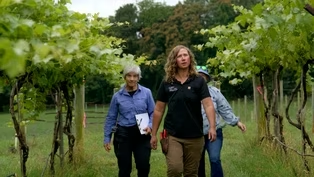
When that economy collapsed, a community college decided the same land could grow wine grapes.
Nobody knew if wine could replace what tobacco built.
20 years later, the region has over 100 wineries.
It's a federally recognized wine region, and it has the only college in the Southeast with its own bonded and licensed winery.
We're here to find out if that's enough.
Sarah Bowman teaches people how to grow grapes.
- At lag phase, what we're looking for is a little bit of resistance when I cut through the berry.
- Her classroom is a four-acre vineyard in Dobson, North Carolina.
Before it was a classroom, this field was somebody's livelihood.
- This land that the college foundation purchased used to be in tobacco production.
More than likely, it was a family-owned operation for a number of years, and then at some point, that family decided to get out of tobacco farming, and the land became available.
- Tobacco and grapes are farmed completely differently.
The one thing they share is that both of them do well here.
- They're quite different as cropping systems.
So tobacco is an annual crop, and grapes are a perennial crop.
But there are some things about the Yadkin Valley that make the location suitable for grape growing.
- Farms across the Yadkin Valley made the same swap.
In 1998, tobacco companies settled with states across the country.
North Carolina put part of its share into a foundation.
The Goldilneaf Foundation helps farmers move to something else.
For families that had already decided to stop growing tobacco, the switch was easier than starting from nothing.
- Some of the benefits of that are that the land is already owned, it's already cleared, and that really is a big part of the risk of getting into grape growing, is finding the property.
- Every one of these families now had a crop they didn't know how to grow.
So Surry Community College built a program around it, how to grow the grapes, how to turn them into wine, and how to market and sell it.
Charlie and Ed Shelton had just opened Shelton Vineyards down the road, and they put up the seed money for the program.
- They were our visionaries, and I would say they recognized from other regions that there was a necessity for an educational facility to support the growth, economic development, right, of a region, and to provide staff, people who are interested in doing these types of jobs, to grow the region.
- The Shelton's also led the push for federal recognition.
In 2003, the federal government made the Yadkin Valley an official American wine region, the first one in North Carolina.
- Getting the AVA in 2003 is a very early milestone for us that I think raised our reputation, the sense of legitimacy of this area as a wine growing region that somebody could depend on when they were looking for quality.
- Eventually, the college built its own winery, a license-bonded operation, and the only one at a college in the Southeast.
- At the college, we do make wine, of course, and we sell it all as well under our label called Surry Cellars.
So students are involved in that whole process of selling the wine as well.
(metal clanging) - The college is the heart of the program for all kinds of reasons.
- We have second-career folks who have come in who actually want to start a business, some folks that want to go into the winemaking business or wanna just work for a winery, and then others that are just here because they've retired and they're looking to have a hobby.
- More than two decades later, the program is still running, but the people in it are not the people it was built for.
- I had a lot of folks that had tobacco land that had transitioned to grapes.
So they transitioned to grapes, they had tobacco land, maybe they had tobacco land in the family, and then they were transitioning over to grapes, they planted grapes, they heard that it was a good thing to do, and they were like, "Okay, now I have the grapes planted.
"What do I do?"
- Grab a berry.
You don't really need a knife, but just-- - The original students were farmers who already had the land, learning a crop they'd never grown, but that's not who fills the classroom now.
- We still get folks from family farms, but we're getting, I think, a wider swath of folks now who just have interest in wine and farming.
- They've noticed the vineyards and wineries developing over the years, and they wanna know more.
So they come here to learn, they come here to decide if that's the career path that they wanna go in.
- Christopher Habershaw came to the program on his way out of the military.
- I was getting ready to retire.
I was looking for something to keep me occupied during the daytime.
- Growing up, did you ever envision you'd be working in this field?
- I grew up on a family farm, so we had cows and chickens and pigs, things like that.
So didn't think I'd be on a tractor, riding a tractor, spraying vineyards.
But yeah, I knew I'd like to work with my hands, so I would do something like this.
- He graduated in 2021.
He's worked at three vineyards since.
- Everybody has different techniques, and it's great 'cause I can take a piece of every one of their ways to create my own way.
- Amanda Greiner is taking classes here now.
She and her husband moved up from the Triangle in 2025 and bought a vineyard in Elkin.
- Just getting into the whole winemaking has kind of been a dream of mine for a long time.
So when we saw the opportunity, we jumped on it.
And having the support of something like Surry Community College in the area has been really, really helpful.
- So the wine is here and people keep coming to learn it, but how much is it actually worth?
Well, wine is still a small piece of what Surry County grows.
The last farm census put fruit, grapes included, at about $3.5 million.
Tobacco is still bringing in about nine.
What actually took tobacco's place here wasn't wine.
Chicken and eggs alone brought in $271 million.
But there's also money in wine that never shows up on a farm report.
- Tourists are usually dollars from elsewhere getting spent here, and so that's great.
Using other people's money is always a preference when it comes to local income.
A lot of folks who went from Charlotte, who went from Raleigh, spend the weekend up here, do a lot to add to our economy, stay in a hotel, buy food at restaurants, and just partake in our local economy.
And so that's a very key extension of this part of our agricultural system is the tourism economy based off of it.
- Statewide, the wine and grape industry produces and generates more than $6 billion a year and supports close to 45,000 jobs.
- You work really hard, you put a lot of effort into the product, and there's nothing more rewarding than getting to share that with people and really tell a story about how that wine came to be.
- Wine and grapes may never be able to replace what tobacco built, but it has put the land back to work, and it gives people a reason to visit.
For "ncIMPACT," I'm David Hurst.
(upbeat music) - Every story on "ncIMPACT" starts the same way.
People in a community see a challenge to the future and they decide to take it on together.
That's what the show is all about.
Thank you to the local leaders featured in this episode, who so generously allow us to share their work and dreams.
And of course, thank you to you, our audience, for watching and engaging.
I want to hear from you.
Tell us what your community is doing or how we can help, because that's what we do best in North Carolina.
We work together.
(upbeat music) ♪ - "ncIMPACT" is a PBS North Carolina production, an association with the UNC School of Government.
Funding for "ncIMPACT" is made possible by... - Quality public television is made possible through the financial contributions of viewers like you, who invite you to join them in supporting PBSNC.
Preview | When the Economy Changes
Video has Closed Captions
Dozens of NC towns lost their biggest employer. These three did something with what was left. (20s)
Providing Support for PBS.org
Learn Moreabout PBS online sponsorship New Episode
- News and Public Affairs

Top journalists deliver compelling original analysis of the hour's headlines.
 New Episode
- News and Public Affairs

Today's top journalists discuss Washington's current political events and public affairs.


 New Episode
 New Episode
 New Episode
 New Episode

 New Episode
 New Episode



Support for PBS provided by:
ncIMPACT is a local public television program presented by PBS NC