
When the Gig Is Up
Episode 26 | 26m 46sVideo has Closed Captions
Nontraditional workers navigate life without the security of health & financial benefits.
In this Aging Matters, we meet various musicians to see the benefits and drawbacks of nontraditional employment. Many musicians flock to Music City with the goal of making it in the industry. A few get the big record deals, but most musicians work gig to gig pursuing their dream without the security that a traditional 9-5 job affords, especially when it comes to insurance and retirement benefits.
Problems playing video? | Closed Captioning Feedback
Problems playing video? | Closed Captioning Feedback
Aging Matters is a local public television program presented by WNPT
When the Gig Is Up
Episode 26 | 26m 46sVideo has Closed Captions
In this Aging Matters, we meet various musicians to see the benefits and drawbacks of nontraditional employment. Many musicians flock to Music City with the goal of making it in the industry. A few get the big record deals, but most musicians work gig to gig pursuing their dream without the security that a traditional 9-5 job affords, especially when it comes to insurance and retirement benefits.
Problems playing video? | Closed Captioning Feedback
How to Watch Aging Matters
Aging Matters is available to stream on pbs.org and the free PBS App, available on iPhone, Apple TV, Android TV, Android smartphones, Amazon Fire TV, Amazon Fire Tablet, Roku, Samsung Smart TV, and Vizio.
Providing Support for PBS.org
Learn Moreabout PBS online sponsorship(gentle music) - I love music.
I love playing, I love singing.
I love trying to entertain people with it.
- I love the stories and I wanted to write the stories of my life and my family.
- We did it because we loved it.
And we weren't concerned too much with the business.
- I didn't really know how to do anything else, and I never worked any other job.
- When the business slows down, which it will, it can become a challenge.
- We want to compensate them fairly for their talent and time and energy.
- If you are a freelancer, if you're self-employed, it's really important to talk to someone and get your ducks in a row.
When people take control of their finances, it's better for everyone.
- You can create something that has lasting value if you do it the proper way.
When you make a record, and you do it under a union contract, the possibility of getting paid again and again and again for that exists.
(music fading) (no audio) (lively music) - [Presenter] Major funding for "Aging Matters" is provided by the West End Home Foundation, enriching the lives of older adults through grant making, advocacy, and community collaboration; the Jeanette Travis Foundation, dedicated to improving the health and wellbeing of the Middle Tennessee community; the HCA Healthcare Foundation on behalf of TriStar Health.
Additional funding provided by Jackson National Life Insurance Company.
(lively music) (no audio) ♪ I will never leave you ♪ ♪ I will never die ♪ - Well I'm just a girl from the great state of North Carolina that had a dream.
I loved music.
I was fascinated by probably every genre of music, by brilliant songwriters and producers and entertainers, and wanted to follow that dream.
And I wanted to bring joy and happiness and light to the world.
That was specifically everything I ever wanted to do and I wasn't gonna let anybody stop me.
♪ I'm your dream ♪ I sing everything, but I loved country music because I wanted to write the stories of my life and my family.
And living in North Carolina, coming from a little farm, sitting there with my aunts watching "Hee Haw," I just loved it.
It just seemed more homogenous to me.
♪ I'm your dream ♪ I was a nursing assistant.
I was telling one of the other assistants, I really want to go to Nashville and just check it out.
I'm gonna go out and stay a week, I think.
And there was a resident there that when I was leaving the room said, "You need to go to Nashville."
So I was like... (lively music) She said, "When I was a young woman, I played the Stradivarius violin in Vienna, Austria."
She said, "I gave all of it up and got married and had children."
She said, "And I could be in Vienna, I could be touring right now."
She said, "My husband's dead, my children don't even come to see me."
She said, "Go to Nashville."
She said, "If you don't, you're gonna regret it the rest of your life."
So that had a lot to do with it right there.
- Check, check, check.
- I had never really understood what a Writers Night was.
And they would get up and tell the stories of why they wrote the songs.
I'm like, I love this.
Oh God.
- If you've never been to a Writer's Night, everything you're gonna hear tonight is original music.
- I would just sit there and listen, you know.
And I listened to people talk about their rejection, how many times they were told no, over and over.
I listened to them talk about rewriting, co-writing, tearing it apart, write it from a whole nother direction.
I listened to all that and I'm like, I love this.
I just totally love it.
So from the first time that I ever went, I was bit.
(audience clapping) I got accepted the first time I ever performed.
So I performed at the Bluebird many times.
(gentle music) I met a lot of resistance when I would play my country music on Music Row.
When I would, you know, approach, you know, a publisher or something, they'd go, "Well, why would you want to do this?"
And I said, "I love country music."
"But this is not about you.
This is not about you people.
This is not about your kind."
So I started the Black Country Music Showcase because I figured that if I was being treated this way, I wasn't the only person.
And I responded to a story in "The New York Times" that questioned Nashville, why don't you have more diversity in country music?
And the powers that be that ran the music industry said, "We can't find any black people that wanted to do country music."
And I knew (laughing) I knew a lot of people.
And so I said, "Frankie, you know what?
You ought to challenge this story."
I'll never forget the night of the first showcase.
And I just got up and said, "We are known for jazz, rhythm and blues, screaming gospel, rap, hip-hop, but we are also a part of country music.
'Cause I, at that point, had went back and researched it and I had a fact sheet and the story from "The New York Times" in every seat in the Bluebird.
(audience clapping) This is why we're here tonight, y'all.
♪ News travels fast ♪ ♪ As a lightning flash ♪ I said, you know, "I want you to know we do exist.
We have hillbillies in our race, okay?
They're good country folks."
And that's how everything really started.
♪ They make it their business ♪ ♪ To pass it around ♪ I had my first showcase February 16th, 1997.
And then we just kept going after that.
We probably went, I'd say seven or eight years.
And then my son's life took over my life.
You know, having him in a school like Montgomery Bell Academy is a seven day a week job.
All boys prep school, subject of the movie "Dead Poet Society."
You know I said, "Okay, Frankie, music or your son."
And it broke my heart.
But I also wasn't getting the response that I wanted from the music industry, from Nashville.
I wasn't getting support from Nashville.
It was just too much.
It was too much.
So I focused on my child, but it was always in the back of my mind.
Four years ago, I was just trying to figure out, what am I gonna do with my life?
My son, thank God, is grown.
He has a job.
He can speak the king's English, I've done all I can do, you know.
And I thought, I don't know what I can do in music, you know, especially at my age.
(pondering music fading) I was sitting there and I was thinking, "Man, Frankie, you probably just wasted your life."
And I get this call from "Rolling Stone Magazine."
And they said, "Dr. Cleve Francis told us about you."
And I said, "Really?
What did he tell you?"
"He said that you challenged the country music industry."
"Yeah, I did."
They said, "Frankie, you really did that?"
And I said, "Yeah I did it."
And they said, "We can't even imagine what a black country music show would sound like."
I said, "It sound just like country music!"
They said, "Oh my god.
Frankie, we got a story.
We got a real story here."
27 pages.
It's just a difference, man.
I mean, it's just a difference in hearing another opinion about what you're doing.
(guitar music fading) ♪ Yeah ♪ ♪ Honey, you are my shining star ♪ - I joined The Manhattans in October of 1970, and I stayed with the group until 1987.
♪ Right here where we are ♪ - And I pursued a solo career for about five or six years.
And then we had a reunion in '93 that was supposed to last for just a month or two.
And here it is, 2023.
(laughing) (audience cheering) The venues for us have gotten smaller.
You know, the tours have gotten smaller.
But we still perform.
And there's an audience for us.
And a lot of our fans have passed our music down to their children.
A lot of artists back in the day when I started singing and before, we did it because we loved it.
And we weren't concerned too much with the business.
And that's how a lot of artists got lost.
They work, they make great money, they have hit records.
And don't pay your taxes.
You got to pay your taxes!
(laughing) (lively guitar music) - A lot of gig workers and freelancers don't really know their options.
One of the barriers is taxes, understanding how self-employment taxes work, and just understanding kind of the extra burden that you have to pay your taxes whenever you are self-employed.
The Financial Empowerment Center provides one-on-one free financial counseling.
We work with people to make sure they have the right benefits, insurance, talk through taxes.
These are just things no one really understands well because we weren't really taught how to navigate this system, which is really something that affects everyone.
- 'Cause Uncle Sam will let you go for a while, and then 5 or 10 years later, you get a letter, well we're gonna possess your house, your bank account, your children, your firstborn, your second born (laughing) and then you're wondering what's going on, you know.
- This is just another reason, if you are a freelancer, if you're self-employed, it's really important to talk to someone and get your ducks in a row.
When people take control of their finances and thrive, it's better for everyone.
- I was so caught up in working, I got to get the job done, I have to sing.
And there was nobody taking care of the business portion.
There were times we worked in certain places where we were supposed to get paid.
And you see the promoter walk out the door.
You on the stage performing and the promoter walks out the door.
And you can't find them, you know.
And we went through all of that.
♪ Let's just kiss and say goodbye ♪ - There was a problem with royalties, and that's a part of the R&B Foundation, what they do with artists that has gone through that, they assist them.
I got assistance from them one time and it was like a blessing.
It was during like right after the pandemic.
And we got assistance and it was no problem.
They were there for us.
(lively guitar music) - The Rhythm and Blues Foundation is a nonprofit organization that was set up to help specifically rhythm and blues artists who recorded music from the 1950s through the 1990s, who find themselves in need of either monies for financial assistance for bills, like rent, utilities or other things, or they need financial assistance for medical bills.
The Rhythm and Blues Foundation was founded in 1998, primarily by my aunt, Ruth Brown, who had some issues with the recording industry.
And her main issue was that many of the artists from the '40s and '50s were never compensated for their recordings by the record labels.
And so, in the latter part of her career, she decided to do something about it.
So with the help of Attorney Howard Beagle, and others, they essentially took on the music industry, and lack of a better word, exposed that the music industry was not compensating rhythm and blues artists for their recordings.
And from out of that came the Rhythm and Blues Foundation.
It's a very important organization because, like I said, it assists the artists that are down, you know, who can't take care of themselves or need finances or bills paid, you know, medical, you know.
It's a wonderful thing.
(lively guitar music) An artist's brand and how we look up to them should never be diminished because they had a moment, you know, where they're not able to maybe take care of something that they normally would.
They have the show, and then they have their lives.
And their lives from the show they put on stage is very, very different.
They have to go home to their families.
They gotta go to the mailbox and open up their rent, mortgage payments, light bills.
And when the business slows down, which it will, for everyone, it can become a challenge.
You know, a lot of artists were performers and musicians and not necessarily the owners of their master recordings or the owners of the publishing.
And the real reoccurring revenue for all these hit songs that we all know and love really comes from the massive recordings and the publishing.
- And now with the digital era, with music being sample, being streamed, streaming is terrible.
Because the residuals that you get, sometimes you get residuals that the check is less than the stamp cost.
I've gotten a check, residual check, I forgot which song it was, for 3 cent.
- In today's world of streaming music, you'll often see in industry publications how artists just feel like they're not properly compensated in terms of how much they get per stream.
But I will say in this day and age, there's a lot more transparency in terms of an artist knowing what they're getting paid, how they're getting paid, what their contracts actually look like.
(audience cheering) - You do these television shows, these award shows.
You get a buy-out, you might get a thousand dollars for that night.
But what about when it's played back again, and you see yourself on television on different settings, and then you don't get no money?
(gentle guitar music) - I just like to work.
I like to play.
It takes, (Dan sighing) it takes my head in a different place.
It gives me a peace that is, to use a biblical term, a peace that goes beyond understanding.
By the grace of God, I've always been able to work, and I always knew in the back of my mind that I was gonna be playing in clubs.
I knew I was gonna play, I didn't really know how to do anything else.
And I never worked any other job.
It still is one of the things that just drives me.
♪ He is a baby that crawls ♪ ♪ James Dean on the run ♪ I would say it would be good to join the Musicians Union because of the fact that Nashville is pretty famous for low pay but a lot of work.
- No one has to join the union.
It's always been about respect for musicians and creators.
It's really about being part of something that's bigger than yourself.
Because to take on the music business as an individual is not impossible, but it's a lot more difficult.
And we can help people bypass some of the mistakes that people like me made because we didn't know any better.
- Just for example, when I was living in Detroit, I was working as a single, four nights a week.
Now this is in 1979, I was making $750 a week.
That was really, really good money anywhere.
I was a member of Detroit local, but the union was not very strong there.
When I moved to Nashville in '79, I think my first job was $10 a night.
However, Tennessee is a right-to-work state.
But there is a scale you're supposed to use.
But because it is a right-to-work state, it's hard to enforce that.
But it's a good way to network.
And I think most of the people, especially my age who have been here a long time and have worked the road with big artists like Reba and Carrie Underwood and people like that, you know, they're members.
You know, it's a unity sort of thing.
- A lot of what we do is related to intellectual property.
Because when you make a record and you do it under a union contract, the possibility of getting paid again and again and again for that exists.
I did a concert with Don Williams at Giants Stadium, I was ecstatic!
Giants Stadium!
I've made it.
And unbeknownst to me, they had filmed it.
And whole thing was under a union contract, so I got a, you know.
I was on TV, I was ecstatic about that.
"Hey mom and dad, check it out."
And then I get a check for like a thousand dollars.
It's like, wow.
I did a gig, a great gig and I got paid.
And now I'm on TV and then I got paid, wow!
It's really great to feel like anything you do has the potential to come back again, as opposed to when you just take the cash and go, "Yeah, thanks."
That's all you're ever gonna see.
These are things that could not happen without the Musicians Union.
And so I'm grateful to be able to kind of just point out in a friendly non-combative way that, hey, we're trying to help people.
(group drumming) We work very closely with a great organization called Music for Seniors, and we give them a dynamic musical performance, which works both ways.
It's a way of giving back to the community.
And it's a great feeling when you're helping musicians by getting them work, but it's also work that's having an effect in the community.
I mean, that's huge.
- Music for Seniors is a 501c3 nonprofit.
Our main mission is to connect area musicians with older adults through engaging, entertaining, and interactive music programs.
It takes a really special person to be able to do this work.
There's three main things to consider when we bring on new musician partners.
And that's simplicity, dignity, and compassion.
(thumping percussive music) (musicians whooping) (lively guitar music) - I love music.
I love playing, I love singing.
I love trying to entertain people with it.
And I'm very fortunate to been able to have for a long time now made a living doing something I love.
(guitar music ending) Hmm!
I still play a lot of different kinds of gigs every week.
Sometimes I'll play a country gig playing the bass, or lead guitar for somebody else, backing up somebody.
I play occasional jazz or old pop music gigs.
(lively guitar music) I do a lot of solo gigs where it's just me and my guitar.
(lively guitar music) - We do pay all of our musician partners to do this work.
We want to lift them up and really reward them and compensate them fairly for their talent and time and energy.
We do stress that it is a kind of a civil service, and a community engagement first, and a gig second.
- I met the creator, the founder of Music for Seniors, Sarah Martin McConnell.
And she asked me about it and I said if she's doing it, I'm gonna try it.
(quirky music) Part of Music for Seniors is going out to long-term care places, part of it is hosting concerts and bringing people to the concert.
And I had done some long-term care facility gigs when I lived in New York.
Not very many, but I didn't get it.
Sarah taught me that it's a spiritual program.
You need to bring a giving spirit to these situations.
So I had that in my mind and thinking, you know, foolishly thinking, I'm really gonna give them something.
Because they're so important and I'm so cool.
Turn out, I was getting more.
And, you know, if you can engage with somebody, that's meaningful for both people.
Then it slowly dawned on me, 'cause I'm not fast, every music opportunity should be a spiritual experience.
Even playing in a honky-tonk where they're just shouting at each other and drinking beer and not paying attention, it's an opportunity to open that door.
Not just seniors, not just people who aren't getting out anymore.
Everybody needs that.
So Music for Seniors has taught me how to do, to make more out of every time I play music.
How about that?
That's heavy.
- Music has power.
Music has power to bring people together.
But you can then take it and spread it out and help other people.
And why wouldn't you want to do that?
(lively guitar music) - Music changes everything.
I will never stop singing, playing, writing music, entertaining people, telling stories, cracking jokes, because I've seen the effect of it all to people.
I've seen the effect of it from even little kids, you know, to senior citizens.
I've seen it.
(lively guitar music) - That was my calling.
I wanted to be a doctor, I wanted to be a heart specialist.
But that wasn't my destiny.
But in some of the interviews that I've had that I've talked about that, they said, "Well, you're still a heart specialist.
You sing love songs, you bring joy and happiness."
So, I'll take it.
♪ It's tough to admit when you're wrong ♪ - I like to play, I like to be in front of people.
I like to meet people.
♪ Go on ♪ It makes me forget about the things that trouble me.
♪ I'd change it all if I could ♪ - If I'm not playing music, I'm not really myself.
- I know that I've been blessed.
I will always sing.
I will slow down but I won't retire.
- If I die in Nashville and all I was was a girl that played on the piano in the restaurant, and sit in the corner of the Bluebird, that's enough.
I'm just glad to see it and be a part of it.
- It's a hard lifestyle.
But if you love it like I do, (chuckling) it's not like you had a choice, so welcome to the club.
(guitar chord fading) (gentle guitar music) (gentle guitar music continues) (gentle guitar music fading) (lively music) - [Presenter] Major funding for "Aging Matters" is provided by the West End Home Foundation, enriching the lives of older adults through grant making, advocacy, and community collaboration; the Jeanette Travis Foundation, dedicated to improving the health and wellbeing of the Middle Tennessee community; the HCA Healthcare Foundation on behalf of TriStar Health.
Additional funding provided by Jackson National Life Insurance Company.
(lively music) (dramatic music)
Video has Closed Captions
Clip: Ep26 | 2m 30s | The Nashville Financial Empowerment Center offers no-cost one-on-one financial counseling. (2m 30s)
Video has Closed Captions
Clip: Ep26 | 2m 30s | Music for Seniors connects musicians with older adults through interactive music programs. (2m 30s)
Video has Closed Captions
Clip: Ep26 | 2m 30s | The Nashville Musicians Association promotes respect for musicians and their content. (2m 30s)
Video has Closed Captions
Clip: Ep26 | 2m 30s | Rhythm & Blues Foundation is an organization dedicated to assisting Rhythm & Blues artists. (2m 30s)
Video has Closed Captions
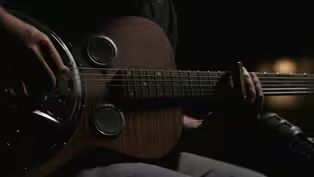
Preview: Ep26 | 30s | Nontraditional workers navigate life without the security of health & financial benefits. (30s)
Providing Support for PBS.org
Learn Moreabout PBS online sponsorship
- News and Public Affairs

Top journalists deliver compelling original analysis of the hour's headlines.

- News and Public Affairs

FRONTLINE is investigative journalism that questions, explains and changes our world.












Support for PBS provided by:
Aging Matters is a local public television program presented by WNPT