
When We Had Wings - Lawhon, McMorris, and Meissner
Season 8 Episode 12 | 14m 1sVideo has Closed Captions
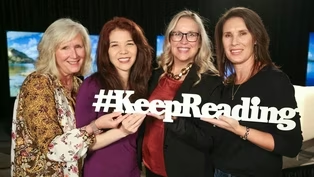
Lawhon, McMorris, and Meissner talk with J.T. ELLISON about their book WHEN WE HAD WINGS.
Lawhon, McMorris, and Meissner talk with J.T. ELLISON about their book WHEN WE HAD WINGS.
Problems playing video? | Closed Captioning Feedback
Problems playing video? | Closed Captioning Feedback
A Word on Words is a local public television program presented by WNPT
When We Had Wings - Lawhon, McMorris, and Meissner
Season 8 Episode 12 | 14m 1sVideo has Closed Captions
Lawhon, McMorris, and Meissner talk with J.T. ELLISON about their book WHEN WE HAD WINGS.
Problems playing video? | Closed Captioning Feedback
How to Watch A Word on Words
A Word on Words is available to stream on pbs.org and the free PBS App, available on iPhone, Apple TV, Android TV, Android smartphones, Amazon Fire TV, Amazon Fire Tablet, Roku, Samsung Smart TV, and Vizio.
Buy Now
Providing Support for PBS.org
Learn Moreabout PBS online sponsorship(bell dings) (typewriter clacks) - Hi, I am Ariel Lawhon.
- I'm Kristina McMorris.
- And I'm Susan Meissner, and this is "When We Had Wings."
- This novel begins the day after the Japanese bombed Pearl Harbor.
So these nurses from the United States and their Filipino counterparts were serving on military bases in Manila.
And the day after the Japanese bombed Pearl Harbor, they bombed Manila.
and so these women went from what was a paradise assignment to war overnight.
From tending sunburns to serving under combat conditions in less than 24 hours.
They weren't prepared for it, and honestly neither was the government that sent them there.
(soft dramatic music) - We knew we wanted a World War II story but we wanted to find an event that hadn't been written about many times over.
and we wanted to find women who played a pivotal role in that event, maybe even a heroic role.
and I stumbled upon a documentary about military nurses who had been nicknamed the Angels of Bataan.
and I didn't know that they had such amazing roles to play, that even as prisoners of war, probably the first military female prisoners of war, that they continued to nurse people in the most terrible of conditions and they never lost their resolve or their resiliency.
and because they kept people's eyes trained on hope, they were seen as angels and well beyond what happened on Bataan.
It was for the entire time of everyone's imprisonment that they were seen as angels.
- One of the things I find fascinating about historical fiction in general is the whole concept of some of it's real, some of it isn't.
How did you blend fact and fiction?
- Well, that's the whole thing what we do as historical authors is always trying to figure out what serves the story.
and so for us we created three nurses that were three different types.
so US Army, US Navy, and then a Filipino nurse.
We fictionalized our characters, but they were all inspired by real nurses that did serve, that were incredible.
There were about 80 of them.
and the fact that they all survived what they went through, through the Japanese occupation, being POWs, through starvation, through every kind of jungle tropical disease that you can imagine and then were told by the US government not to talk about their experiences.
so really not to spotlight the fact that they had been abandoned and left behind.
(soft dramatic music) - Do any of you have a personal connection to the characters that you wrote?
- All of us.
- We all do.
- Yeah, we all do.
Since there were three different types of nurses and three different writers we knew the thing that made the most sense was for us each to pick one and it was easy for me to pick the Navy nurse Eleanor.
My father-in-law was a career naval officer, my son was in the Navy, and I'm from San Diego, that's my native town, and San Diego is a Navy town.
and so it was very easy for me to kind of fall into her head space and create a character who joins the Navy on a whim because her heart got broken and she's looking for a way to get far, far away from the broken pieces.
and so she's about as far away as someone can get, 8,000 miles away from home, when she begins this new life.
- For me, my character, Penny Franklin, she's the US Army nurse, and I made her Texan for a reason.
My husband is Texan, my parents are Texans, two of my kids are Texans.
I love the species, and I'm fluent in Texan.
but the Army connection, my father was military police during Vietnam and my grandfather was a lieutenant colonel during World War II.
and I have so much respect for Texans in the US Army that it made perfect sense for me to create Penny out of that cloth.
- So Angelita was, or is, the mother of one of my closest friends growing up.
so I like to say that you are never friends, close friends, with one Filipino person.
If you know that, you are friends with many.
- Everyone.
- It is, it's because it's a whole community and their family.
and somehow all the cousins live within a three block radius and you know, celebrations, every holiday is an excuse to cook for days and that everybody just grazes all day long.
and that's how I grew up at their house.
and so because of that, Lita then spoke to me personally.
I definitely wanted to take on that nurse because of that connection and also because as you know from the story that Lita is a mestiza and so she is what they consider half Filipina and then half Caucasian or in this case, you know, half American.
I'm half Japanese, my father is an immigrant from Kyoto.
My mother is Caucasian, she's Irish English.
and so because of that, that was just a natural fit as soon as they said "Which one wants to take you know, the Fil," I'm like, "Please, please me."
So yeah.
- Well, and her situation creates a different dynamic in this story.
She's treated very differently than Eleanor and Penny.
- Yeah, absolutely, she is, and because she's half and I remember growing up as a kid trying to figure out exactly where I belonged, you know, kind of riding between two different cultures.
and so that immediately was something that I could connect to.
(soft dramatic music) - Eleanor's broken-hearted and has enlisted to escape a doomed romance.
Penny has lost everything and Lita needs to prove herself.
These are excellent conflict points.
How did you make the characters come alive on the page?
- For me, I need to dial in to what makes a character think, what they fear, what they love, what makes them do something, what makes them act, react, all of that.
and there's different ways of making a character come alive.
For me, I like to use the Enneagram wheel.
- Really?
- I figure out what number she is or he is and that gives me a, it gives me a place to begin 'cause I'm a two on the Enneagram wheel and I don't want all my characters to sound just like me or read like me so when I've assigned my characters a number like that, it gives me a place to begin so that they have, they come ready to the story with some built-in personality traits.
And then I've lived in Minnesota, she's from Minnesota.
I borrowed a lot from my father-in-law's experience.
He had never seen the ocean when he joined the Navy in 1943.
So clothing her personality, I borrowed from a lot of different people.
my own experience, borrowing from other people that I've watched.
And then I've never had my heart broken like she had.
but I've seen what it's like to lose out on love.
even if you never had it that when you thought you did and then lose it, it can hurt.
- With Penny, the things that are most important to me, my husband and my children, if I boil it down those are the things that are most important to me.
so what if she had them and I took 'em away and I started a character in reverse.
And who would I be if I'd, like you said, if I'd lost everything or at least lost everything that I thought that I had or that was coming.
and I love this idea of a woman, heartbroken tragedy just goes, "I'm gonna start somewhere new.
I'm gonna start over.
I'm gonna escape.
I'm escaping the pain.
I'm escaping this history and this life that I loved."
And then you find yourself at war.
- And with Lita it was that she, I started with the conflict first and then I back up and figure out why that is bothering her, what secret she's keeping, what shame that she's carrying and very often, and I like to trace that back to some kind of trauma, some kind of conflict that happens in all of our lives whether it's childhood or when you're a teenager and you say things you don't mean.
And you know, in this case that, you know, as you know that there's something like that with the story.
(soft dramatic music) - Penny has a really interesting dilemma presented to her.
If she gives herself to him, then everybody's gonna be taken care of.
The little girl that she is, - There'll be food, her friends will not get sick.
Like- - That's an impossible choice.
- It is exactly in the new- - Yeah.
- That's the point.
- That's the point.
Because there's no good choice.
- There's no good choice.
- There's no answer.
- Do you think the women that were there they were being given those choices?
- So here's a fascinating detail and the women that came back were very, very adamant about this.
The assumption was that because the Japanese had taken them that they were all assaulted.
The Japanese were really horrible to women and they weren't, this is not a spoiler, they weren't.
And they came home and all of the interviewers would be like, "Oh, well I bet this happened."
And they'd be like, "Stop.
No."
And part of this, and this is important because the Japanese did not know what to do with female military officers, they were sent to civilian internment camps.
They did not get sent on the baton death march with all of the men.
So their experience, well, not better, was different in that they were surrounded continually by thousands of civilians.
They were able to maintain ranks within these camps and in a lot of ways protect and look out for each other.
So that threat existed absolutely the entire time.
But I think it's important to respect the women's stories because they weren't, and it, of all the things that they had to deal with and our main biography that we used for research purposes, at least a dozen of them in various interviews were like, "That didn't happen.
A lot did, but not that."
But the threat remained.
And sometimes that lingering hard threat is every bit as dramatic and scary as reality.
- Oh sure.
You just don't know what's gonna tip 'em over and the next thing you know.
- And what's around the next corner.
- Yeah.
- Yeah.
- Oh well, you know, you had a chance to play long.
- Yeah, and I'll chime in really quick just because this is something that I had just read about recently too, was while I believe that's true from based on our research, they're also the stories though that you start uncovering that that may not have been the case for the Philippinas.
And that is like the civilians that live there because during the Manila massacre it just got very ugly.
You know, that if you're not familiar with it.
- Yes.
- But you are now, the Japanese then were losing, they were told to surrender, or at least not surrender but to leave and evacuate.
And there was some that just refused even though they knew they were gonna lose.
But it was a revenge action.
And so they really did just start massacring people, Filipinos especially, and then assaulting women.
And the problem is with that I guess is, well, many problems with that of course.
But the point was revenge but also they viewed the Filipinos as even more of traitors because they were Asians that were going against them.
They should have a loyalty toward their emperor.
And so they were treated even worse because of that.
- Well, and Christina can talk to this as well.
The Filipino nurses were separated from the US military they were not sent to civilian internment camps.
They were sent to prisons.
Their experience was very different.
And she'll tell you more.
We had a really difficult time finding out the details of their experience.
It was just, it was gone.
- Where did you find it?
- It was hard to find really anything.
We got pieces from any kind of books that we could find like "We Band Of Angels" was fantastic.
She would mention the Philippinos in there.
We would just kind of go online find any kind of journal entries I could find.
I mean, it was very hard to sort of piece together.
We had to do our best, I had to do my best with Lita as far as that goes.
So, you know, but it became even more important then to be able to tell their story.
So we did know though about the loyalty oath that they after they were captured, they were given a choice.
They were separated from the others and said, "Basically we're imprisoning you and you have two choices.
You either stay imprisoned indefinitely or you sign a loyalty oath to the emperor of Japan," after all these horrible things that just happened and they'd seen their family members, you know, hurt.
They had bombs that were dropped on the hospitals, you know, that were marked with Red Cross.
- Yeah.
- Crosses.
So they'd seen all of those things happen and a lot of their family members were fighting as gorillas that in the jungles.
And so a lot of them were dying there too.
And yet they were supposed to then say, "Yep, you know, we serve Japan instead."
So it's one of those things that signing a piece of paper feels like nothing.
And yet it means everything.
(soft dramatic music) - I couldn't tell who wrote what.
- That's great.
- Which is absolutely incredible in a story like this with three so very different women.
How did you maintain a narrative voice throughout the story?
- Lots of hard work.
(all laughing) So the process for this, we approached it in a way we'd never done.
Susan wrote her chapters initially.
She really laid down the tracks for the story.
She kind of gave us our beginning, all the points we needed to get to the end.
My character came second and because of her geographical location, she is the one where she's constantly, the others are coming through her particular camp.
And so my character served as a bridge for the relational aspect and the continuity of that.
And then Kristina landed the plane for us at the end and got it done.
- Yeah, and I joke about that saying it's when they handed off to me at that point, I finally had time to work on it 'cause I just finished another novel.
And so I joke that, I'm like, "Okay, I already had a view of how I was going to ski down this slope," and I'm like, "Okay, you know, there's flags, perfectly flags.
And they're all placed perfectly."
And then by the time you came to me, I'm like, "That wasn't there before.
And that wasn't there before."
And I'm like, "Nobody put that rock there before."
And it was such a good challenge in the best of ways.
And we spent a lot of time on the telephone and solving problems, but also it made the book better.
And so it was really exciting.
It was very fun.
- Ladies, thank you so much for being here.
This was so much fun.
- Thank you for having us.
- Thank you.
- And thank you for watching "A Word On Words."
I'm JT Ellison.
Keep reading.
(bell dings) - Research.
It's what we do.
- What we do.
- This is our wheelhouse.
- It's what's for dinner.
- [Ariel] Finding the details that make a moment in history come alive.
(soft dramatic music)
When We Had Wings - Lawhon, McMorris, and Meissner | Short
Video has Closed Captions
Clip: S8 Ep12 | 2m 30s | Lawhon, McMorris, and Meissner talk with J.T. ELLISON about their book WHEN WE HAD WINGS. (2m 30s)
Providing Support for PBS.org
Learn Moreabout PBS online sponsorship













Support for PBS provided by:
A Word on Words is a local public television program presented by WNPT