
Where We Live
Season 4 Episode 2 | 23m 1sVideo has Closed Captions
ART inc. explores the art behind the places we live.
ART inc. explores the art behind places we live, from a secret mall apartment to brutal buildings, as well as the changes to all of our homes.
Problems playing video? | Closed Captioning Feedback
Problems playing video? | Closed Captioning Feedback
Art Inc. is a local public television program presented by Ocean State Media
Where We Live
Season 4 Episode 2 | 23m 1sVideo has Closed Captions
ART inc. explores the art behind places we live, from a secret mall apartment to brutal buildings, as well as the changes to all of our homes.
Problems playing video? | Closed Captioning Feedback
How to Watch Art Inc.
Art Inc. is available to stream on pbs.org and the free PBS App, available on iPhone, Apple TV, Android TV, Android smartphones, Amazon Fire TV, Amazon Fire Tablet, Roku, Samsung Smart TV, and Vizio.
Providing Support for PBS.org
Learn Moreabout PBS online sponsorship(intriguing western upbeat music) - [Narrator] Coming up on "ART inc."; The Art of Home, Brutal Buildings, and Providence, Florence, and Floods.
(static crackling) (static whirring) - [Reporter] If you want to know what's going on... (intriguing groovy upbeat music) (water splashing) (birds chirping) (crows cawing) (groovy upbeat music) (audience applauding) (static whirring) (street bustling) (cars honking) (intriguing groovy upbeat music) (static whirring) (static crackling) (intriguing upbeat western music) - A person in New York City from India who saw me on the street and said, "You lived in the mall."
I was like, "How do you know this?"
He's like, "This was on the Indian news channels."
I was like, "Why?"
And he's like, "Because we love malls."
I was like, "What?!"
(intense upbeat-rock music) (door thudding) (guitar strumming) (timer beeping) Hi, my name is Michael Townsend, I'm a public artist and community art teacher.
Public art is exactly what it sounds like, it's making art in the public.
I draw on buildings with tape for a living.
So my great joy in life is collaborating with other artists to use the medium of tape to take over buildings and transform public spaces.
Home is obviously a very different thing for every person.
Home is effectively the space where you are allowed to be yourself.
- When I started to make "Secret Mall Apartment," you know, I think for a lot of people also who hear this story, they hear this story about, like, these crazy people that lived inside the Providence Place mall, and lived there for four years.
And you hear that story, and you're just like, "What?
That's so crazy.
What an insane prank.
- The joy and sort of the, like, light promise of the late '90s, early 2000s is that there was a cheap, big space for you in these industrial mill buildings.
If you're willing to be a pioneer who's gonna move into a space that may have been empty for decades, and turn it into an incubator for your art, that was a possibility.
- And I think one of the things that connects people, and connects, like, humans, and makes us sort of different, is that we're all kind of want to be creative souls, whether it's in their home or even in their office.
- And it's only a mile away from the mall, they saw our neighborhood and all these sort of, effectively, I put this in quotes, "empty mill buildings" as a place that could be turned into a strip mall, a new shopping center of some kind.
And, in order to make that happen, you're gonna need a lot of parking.
And as soon as you say the word parking, you gotta tear buildings down.
In rolling conversations, things like, "Oh, well, if we lose our homes, we should just live at the mall," turns into like, "Well, maybe."
(intriguing funky upbeat music) I would set off from Fort Thunder and run straight down Harris Avenue.
And Harris is a beeline to the mall.
So as the mall is being built, I'm watching every single beam of this mall go up.
The building is fitting onto a plot of land that has a river going underneath it, railroad tracks going underneath it, and it has a entrance ramp to a highway that creates a curve.
It's impossible, maybe, (chuckles) for an architect to build a building of that size and not have some abandoned, unused spaces.
So you're all of a sudden getting out of your traditional rectangle world, and you gotta start introducing some triangles, and maybe some crescents, and that's enough to create a space that ultimately is gonna become the apartment.
Few items we had was a flashlight.
And so, without that flashlight, there was no way we could have found that space.
To see it was to sort of recognize that you were witnessing a place lost to time, and that it was ripe for exploration, ripe for, ultimately, development.
Yeah, the most surreal part of living in the mall is that everything you do becomes dangerous.
So you are like just eating cereal in the morning, but it's dangerously, you know?
(chuckles) Putting on socks, but it's dangerous.
So that additional layer of suspense that things are gonna fall apart at any time, and that that might happen while you're just doing something really, really mundane, is the surreal part of it.
(bright orchestral upbeat music) When I was arrested, at that moment, becomes the act of curation.
And, in the act of curation, you are effectively declaring it a story or a narrative or an art object.
And Adriana and I took, you know, great pains in the months afterwards to sort of curate how the story was going to be told.
I ran into the director, Jeremy Workman, while I was doing a big mural in Athens, Greece.
- And I was filming for another documentary, and I was out there and I was at a building.
- I was on top of an opera house that had a big glass structure on top, I was doing a tape art 360 here.
- It'd be like sunsets and sunrises on the facade of the building.
And I was so blown away.
I was just like, "I have to meet the person that did this."
- We struck up a friendship.
And when he finished his documentary with Lily, he called me up and he is like, "Hey, I'd love to do a documentary about that."
And I was like, "That sounds good.
Are you willing to do the deep dive with all the other artists with historical background about Eagle Square, and the mall, and the city, like, you're gonna have to fall in love with Providence a little bit to make this story good."
And, in less than 24 hours, he had already gone through all of it, and he's like, "You have the footage for a movie here."
(mellow orchestral music) Art, art objects, art paintings, acts of incredible beautification, are purposeful enough, but in my own practice, I've always been very interested in an additional layer of addressing community concerns, or giving a voice to people who may not feel like they have a voice, and using these big buildings and public spaces as a way to exercise that experiment.
(mellow guitar music) (static whirring) (upbeat western music) (intriguing grandeur orchestral music) (tone beeping) (grandeur orchestral music) - [J. Hogue] I think brutalism is a real encapsulation of what we thought the future would be.
(tone beeping) It's a very different aesthetic.
Our eyes have been trained to value a certain kind of architecture.
(grandeur orchestral music) - [Ben] You may have heard about brutalism for the first time recently, but what really is it?
- And the Oscar goes to "The Brutalist."
- "The Brutalist."
- Adrien Brody.
(audience cheering and applauding) - [Ben] It's the style of architecture at the center of the Oscar winning movie, "The Brutalist."
But behind these buildings were architects like Paul Rudolph, designing what they thought the future would look like.
(grandeur orchestral music) So, I'm on a walk with J. Hogue, the creator of ArtInRuins.com, to look at some of these examples of brutalist architecture here in Rhode Island and understand why they look this way.
(grandeur orchestral music) J, what exactly is Art in Ruins?
- [J. Hogue] Art in Ruins is a website I started about 20 years ago.
And the point for me has been really to document the architectural change and the landscape around Providence.
- And why do people go on your website?
- I think part of it is nostalgia.
There's always a little bit of romanticism to it.
These places mean things to people, and they mean all sorts of different things, but they're still really important part of life that needs to be captured.
- [Ben] So, J, this is our first stop.
- [J. Hogue] Yeah.
- [Ben] Where are we?
(intriguing techno-synth music) - [J. Hogue] So we're in front of the Beneficent House.
(intriguing techno-synth music) - [Ben] Designed in 1963 by Paul Rudolph, the Beneficent House is one of the few brutalist buildings that's still standing in downtown Providence.
(intriguing techno-synth music) What makes a building brutalist?
- I think we have to remember, at the time, architects have always been really invested in technology and new construction methods, and brutalism, at the time, came about because concrete was affordable and plentiful, and could do things structurally that couldn't be done before.
(bright orchestral upbeat music) - [Ben] And what specifically was Rudolph trying to do in creating these shapes within this building?
- [J. Hogue] The square, blocky forms are very stark, the structure itself feels very powerful.
There is some edginess and rawness to it, but the brick, I feel like, does give it a lot of warmth that a raw concrete treatment may not have done otherwise.
(tranquil upbeat music) - How did they fit this into a historic neighborhood like downtown Providence?
- By demolishing everything that was here.
This was undoubtedly part of a big urban renewal project in the 1950s and '60s that gave them the ability to knock down large parcels of land and rethink them.
(tranquil upbeat music) - J, what's the next piece of brutalism you wanna show us?
- Yeah, the next place I'd like to show, you know, I feel like this is a really great example, a positive example, of brutalism, Cathedral Square, I feel like is the opposite of that.
It's more on the failure end of things, they had great intentions, but they didn't quite play out.
So I think that's where I'd like to take you next.
- Let's go see it.
(intriguing orchestral music) What is this corridor space we're walking in right now?
- Yeah, we're walking through a pedestrian mall, or the remnants of a pedestrian mall, that actually included all of Westminster Street behind us.
(intriguing upbeat music) - [Ben] Do we have the civic plaza that they envisioned?
- No, unfortunately not.
(intriguing upbeat music) They, at the time, really felt like retail, and shopping, and those newer activities would be replacing industrial activities, which the city was really built on.
Actual retail shopping in downtown dwindled, and the pedestrian wall didn't help keep those stores open.
(intriguing upbeat music) - What is it used for today?
What do you see when you come here?
- Not used for too much.
It feels large and empty most of the time, instead of as active as what they had wanted.
(intriguing upbeat music) - [Ben] How does this space fit into the brutalist style?
- There are undertones of brutalism here.
With the buildings surrounding us, we can see they're very blocky, not a lot of ornamentation, really square.
- J, you've showed me some brutalism you like, you've showed me some brutalism you don't like.
Where are we going next?
- Sure.
Yeah, I'd like to show you some brutalism that's not there anymore.
We'll be going to the site of the former John Fogarty Memorial Building.
- Let's hit it.
- Okay.
(intriguing upbeat-rock music) - All right, J, we're almost here.
- Yeah.
- What are we about to go look at?
- So, I'll show you some pictures of the building that used to be here, and probably read some comments as well.
I think it helps paint the picture of sometimes why brutalism can get a bad rep. (intriguing upbeat-rock music) - When was this place demolished?
- It was demolished in 2017, built in 1967, and they put a pretty big hotel up in its spot instead.
- [Ben] Was there much of an effort to preserve the Fogarty building?
- There was, actually.
There was a group that held a "funeral," quote-unquote, for it, at the time when it was clear that they were not gonna be successful with it.
Architecturally, it was interesting, 'cause it was a form of brutalism as well, it was another example of the way that I think a lot of municipal government buildings used that style of architecture to kind of make a statement that they were modern, and bring this style of architecture to them that felt very new at the time and very cutting edge.
- So what have you heard from people about what the Fogarty building meant to them?
- Yeah, I've got a few comments about it.
So the first one from someone named Ann; "For those of us who worked there as caseworkers, it was a place like none other, and it was the saddest of days when it was razed."
And then on the opposite side, from John, "This building used to facilitate the state welfare office.
Growing up pretty poor, me and many I know can remember spending many grueling hours in early '80s, sitting, playing in multicolored plastic chairs in a vast waiting room."
I really value the comments that I get from people, because that's someone who's worked there, used that facility, visited time and time again, they have a completely different experience.
And so, I like to hear the different kinds of connections that people have with all of these places.
(intriguing orchestral music) - So this was the old Bonanza Bus Terminal?
- [J. Hogue] Yeah, it was a centrally located bus terminal for people coming in and out of the city.
(intriguing orchestral music) In the '90s, when they started to remake downtown, yet again, it was decided that a convention center would be a better use of the space.
But it was a interesting example of mid-century modernism meeting brutalism.
(intriguing orchestral music) - [Ben] Are we in danger of losing most of our brutalist structures in Rhode Island?
- I think we could be, yeah.
I think if people don't start to look at them, as they're becoming 50 years old or older now, the same way that we look at historic structures from the 1880s, 1900s, we could lose quite a few more of them.
(intriguing orchestral music) - Does Providence have especially rich heritage of brutalism?
- We don't have a lot of examples, but I think what we have going for us is a very strong preservation mindset.
So I think that fabric is really what's the most important thing to probably try to preserve.
(intriguing orchestral music) (street bustling) (static whirring) (upbeat western music) - [Launch Commentator] T-minus 10, nine, eight, seven, six, five, four, three, two, one, zero.
Ignition.
Liftoff.
(rocket roaring) Liftoff.
(flag flapping) - There is a NASA astronaut named Nicole Stott, and she wrote a terrific book, and she talks about spending a great deal of time circling the Earth at the International Space Station.
And the key line in the book, and really the theme of the book, is we went into space to discover the Earth.
So beautiful photographs that are taken by the astronauts who are orbiting really tell us a lot about how the environment is changing.
So I think that is a really huge value to everyone, in every country, to see how things are changing.
And it's really our collective responsibility to be aware of that and to see what we can do about it.
(dynamic jazzy orchestral music) "What we do as journalists is create a first draft of history."
So Lewis Hine was really one of the early and most famous documentary photographers.
It was because of him that photojournalist really had a path to follow, as far as what they did and why they did it.
So the documentary work that he did, particularly when it came to children working in mills, and some of the work he did was in New York and through New England, it really showed people who were newspaper readers, the dangers involved in, you know, the type of work that was being done, and it showed how things needed to be changed.
(paper rasping) (intriguing orchestral music) - Looks great.
Young man.
- Yeah, yeah.
- Look at that.
- The Providence Journal reached out to me, I was recently retired, and they said, "We have a big project and we thought of you, would you like to do it?
And I did, and I got connected with Joyce Acciaioli Rudge, who is a person here in Rhode Island, she's done other projects like Splendor of Florence previously.
- So we are surrounded with the most amazing vintage photographs from the Providence Hurricane Carol in 1954, and the Great Flood of Florence in 1966.
I had access to the David Lee's archives because I have shown his photographs in exhibit before.
So putting the two together just worked.
and people are really enjoying it.
So it shows that there is life after tragedy, that there is restoration that can take place.
- Art conservation is the preservation and conservation, keeping it the way that it is, or if it's damaged, trying to fix that damage.
(mellow orchestral music) - So this is a Speed Graphic camera, the type that Providence Journal photographers used in the 1950s to document Hurricane Carol.
So it was only one picture at a time, and it was challenging for those photographers to actually be out there in that kind of weather, making the photographs that you saw as part of our exhibit.
- These photographs tell the story, these photographs are gonna let people see, you know, the way Kennedy Plaza looked underwater, and all of these department stores that are no longer here, but, you know, you can see how Westminster Street and Boston Street, how they all looked back in 1954.
(page rasping) - The Providence Journal photographers have been covering and documenting life in Rhode Island for almost 150 years.
(page rasping) The oldest photos in the photo file at the Journal, which is about a million, and that's an accurate number, a million individual photos, extend back to the 19th century.
And our publisher at the time, Janet Hasson, called me in and said, "How would you feel about doing a book?"
And I said, "I think it would be terrific."
And she asked me one question, she said, "Is it gonna be good?"
And I said, "Oh, it'll be good."
So the first volume of "Rhode Island Memories" really started from the 19th century and went to 1939, and it became very popular.
And, immediately, they signed me on to do two more volumes, Volumes II and III, the '40s, '50s, and up to 1999.
It was a terrific way of showing to the people of Rhode Island, their history, their family history, places that not only they've gone, but maybe their ancestors, their parents or grandparents have gone.
(waves crashing) (mellow orchestral music) I like to think that now, the fact that we've saved that material, and a hundred years, a thousand years from now, maybe, historians will look back and say, "This is how people lived, and it was a valuable document to see that work."
(mellow intriguing orchestral music) (mellow intriguing orchestral music continues) When I was in Miami, I had the honor of meeting Astronaut Frank Borman.
He was the commander of Apollo 8, which was in December of 1968, I was a kid in school at the time.
What was really memorable about that flight was the photograph that was taken by one of the crew members, Bill Anders, and it was on the cover of Life magazine.
And the word iconic, I think is used a little too much these days, but it really was an iconic photograph of the crescent Earth hanging in space with the lunar horizon in the foreground.
Frank Borman said to me, "It really made us aware of how tiny the Earth is in terms of the universe."
And that photograph, in particular, makes the Earth look like a beautiful blue and white Christmas ball.
And so, that's something very special, and it should be special to all of us, and be aware of the fact that we're here to preserve the Earth.
(waves crashing) (intriguing orchestral music) (static crackling) (static whirring) - [Narrator] Thanks for watching, and we'll see you next time (static whirring) on "ART inc." (static whirring) (static crackling) (static whirring) (static crackling) (intriguing western upbeat music) (intriguing western upbeat music continues) (intriguing western upbeat music continues) (intriguing western upbeat music continues) (intriguing western upbeat music continues) - [Narrator] Watch more "ART inc.," a Rhode Island PBS original series now streaming at ripbs.org/artinc.
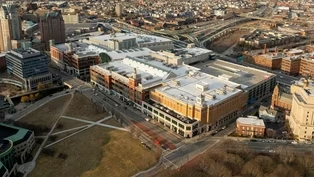
Video has Closed Captions
Clip: S4 Ep2 | 6m 42s | Explore themes of artist housing displacement through Michael Townsend's unique view. (6m 42s)
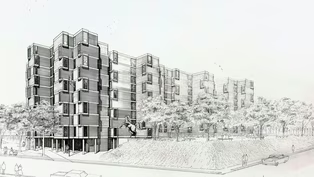
Video has Closed Captions
Clip: S4 Ep2 | 8m 47s | In Providence, a small number of its Brutalist Buildings are still standing. (8m 47s)
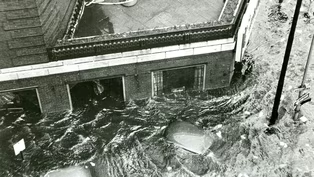
Video has Closed Captions
Clip: S4 Ep2 | 6m 48s | Learn about the history of documentary photography. (6m 48s)
Providing Support for PBS.org
Learn Moreabout PBS online sponsorship

- Arts and Music
The Best of the Joy of Painting with Bob Ross
A pop icon, Bob Ross offers soothing words of wisdom as he paints captivating landscapes.













Support for PBS provided by:
Art Inc. is a local public television program presented by Ocean State Media