
Where We Live
Season 8 Episode 8 | 26m 1sVideo has Closed Captions
Homeowners, designers and artists reveal spaces reimagined for inspiration and new life.
North Carolina homeowners, designers and artists reveal spaces that have been reimagined to bring inspiration and new life.
Problems playing video? | Closed Captioning Feedback
Problems playing video? | Closed Captioning Feedback
My Home, NC is a local public television program presented by PBS NC
Where We Live
Season 8 Episode 8 | 26m 1sVideo has Closed Captions
North Carolina homeowners, designers and artists reveal spaces that have been reimagined to bring inspiration and new life.
Problems playing video? | Closed Captioning Feedback
How to Watch My Home, NC
My Home, NC is available to stream on pbs.org and the free PBS App, available on iPhone, Apple TV, Android TV, Android smartphones, Amazon Fire TV, Amazon Fire Tablet, Roku, Samsung Smart TV, and Vizio.
Watch My Home, NC on YouTube
Enjoy a unique look at the food, music, people and culture that make North Carolina our home on the My Home, NC YouTube channel.Providing Support for PBS.org
Learn Moreabout PBS online sponsorship[piano intro] - [Host] Where we live and how we define home is very important.
North Carolina homeowners, designers and artists reveal how spaces, whether homes or old buildings, are reimagined in remarkable ways.
It's all on "My Home," coming up next.
[gentle music] - [Host] All across the state, we are uncovering the unique stories that make North Carolina my home.
♪ Come home, come home ♪ [gentle music continues] [soft music] - When I get an idea, I wanna do something.
I don't think about how to do it.
I just kind of get out and do it.
I get obsessed with projects, and I can't let go of it, and it causes me to spend hours doing it.
I've always worked with my hands.
I repaired scientific equipment, refrigeration systems, bakery equipment.
I never did any art.
As a repair guy, I could creatively think about how to solve problems, but this kind of takes it to a whole nother dimension.
My name is Gene Dillard and we're in Durham, North Carolina, probably better known as Northgate Park.
And this is my home.
Welcome.
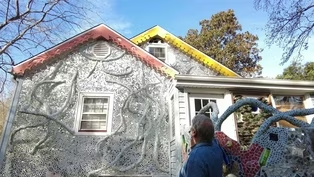
[soft music continues] [soft music continues] I moved into this house about 2000.
I started with the metal sculptures in the front yard, and I just progressed with projects.
Ran Smith, a friend and I, we mosaiced the first big piece that really stuck with me and I've been bitten by the mosaic bug ever since then.
About 2015, I started with my house.
Some people say "Why'd you do this?"
I said "Well, I thought it would be cheaper than going to counseling, but I'm not so sure now."
[laughs] All of this stuff has been done with handheld tile nippers.
Shout out to my tile nippers.
Yep.
I spend a lot of time out here in the backyard working on my projects, busting tile, building new structures.
What do the neighbors think?
What did they really think or what did they tell me?
[laughs] [upbeat music] - We've lived in this house for 40 years.
He was moving into my neighborhood.
I had been here.
I think what he does is wonderful.
It grows and changes constantly, and I love it.
Gene called me once in a while and would ask me to distract people.
He said "Would you come over and talk?"
I did.
I did that for him a few times.
So then I considered myself to be a docent.
- Carol obviously was here while he was building everything and she started giving tours herself.
So she prided herself on being docent.
Well I came along and started doing tours.
We got a little competition.
She won.
She's docent number one, I'm docent number two.
I wanted to start documenting what Gene is doing here because it's just a spectacular piece of art.
When he retired, he really started working on the wall and finishing off the house.
This is definitely a working outdoor studio, but they draw so much attention.
People come by, they see the house, they love it.
They're scared to walk up the driveway, and I thought it would be nice to have something to hand people, pointing out little details of his work that may be missed because people are overwhelmed by seeing this house.
- The bottle wall, the chimney on top.
- [Vincent] The surfing dude, the mermaid.
- This was supposed to be like an ocean scene.
- His dragon feeding his mailbox.
The wall with the giant heads from Rapanui, they're Easter island heads.
- He's made sculptures out of rebar.
He uses cement to make trees.
- I poured concrete into bundt pans.
I spent all one winter making stars in my living room.
- [Vincent] It's a lot of mosaic, it's a lot of sculpture.
Found objects.
- I really don't know what I'm doing.
I'm just decorating my cave.
[door creaking] [gentle music] I have a lot of these heroes that have a lot of solitude.
They don't live with a lot of people.
I think what stands out more than what they created was the amount of time that they put into it.
Like Simon Rodia, he worked probably 35, 40 years on this by himself, and he was just a tile setter.
What he created is undoubtedly remarkable.
Spent tremendous amount of time doing it.
It's not like just painting a picture or making a pot or something like that.
But they've devoted their whole life to it.
- He told me when he started here, I do this to keep my hands out of the work of the devil, and it keeps him occupied.
He always told me at first, I'm not an artist.
I'm not an artist.
I just make things and I finish things.
And he does do that.
- This is the third wall of the house I did.
This was 500 hours of work it took me to do this from beginning to end.
I'd work all day and I'd come home and I'd probably be out here to 10:00 at night working.
There's a lot of things when I start a project, I don't really understand how it's going to evolve because I'm not a real big planner.
And like when I built this, I didn't realize how playful the lighting would be.
And at various times of the day, the concrete will be illuminated through with color because of the bottles.
Once I got the tepee done, I came and I stood right here and I looked over this way and I said "Oh, doggone it.
I'm gonna have to build a fence."
This fence took me three years to make, and I decorated it for a year.
Now this is what the fence looked like before I started decorating it.
These are the first two heads I made.
And now I kind of like the contrast.
I like to show people.
This one's a cyclops because that's kind of me because I'm blind in one eye.
I can't see it out of my right eye.
So that was kind of a self portrait.
I graduated high school hardly being able to read and write, and they kind of just kept pushing me through because I didn't cause trouble.
And I can read and write now, but it was not an easy trip thing for me to learn.
So this is kind of my ode to reading, you know, and the weird dance I had with it.
I did Ninth Street Bakery's equipment for many years.
And Frank Farrow and his wife, Mo Farrow, started Ninth Street Bakery and they gave me this bottle of whiskey for Christmas 30 years ago.
And I never drank it.
I had it in the garage and I painted it with polyurethane to protect it.
And I stuck it in my wall.
[bright music] - One of the things about Gene's art is that it's very private.
This is a private home.
This is his own workshop outside.
And this is what he enjoys doing.
- It's his.
And I think he doesn't do it for any game but his own.
I think he does it because he likes doing it.
And it's not for sale, nothing is for sale.
- He's never sold anything.
He's given a couple of things away, but he doesn't even do that much, he doesn't do that at all.
- You can't be asking him to do other things.
Don't you see how busy he is?
- I do not sell my art.
This is really just about me having fun and pushing boundaries inside myself that I didn't know I had.
I've worked all my life as a repairman for money, and you never have enough.
And yeah, I don't have enough, but this is something I do just because I enjoy it, it rocks my world.
[upbeat music] [upbeat music continues] [gentle music] [gentle music continues] - [Chris] I'm Chris Collier.
- I'm Beth Collier.
And our home is Washington, North Carolina.
Well we really love the area and how it's so close to the water and it's just such a beautiful place.
I kind of think of it as a sleepy southern hidden gem.
We love the historic properties.
- The building we live in now was once Taylor Hospital and it was of course built by the Taylor family probably around the turn of the 20th century.
The hospital served the local community.
- Did I buy a hospital?
You know, you bought a hospital, and you have to explain we were in a small eastern North Carolina community and it's not this 50,000 square foot building.
- How did it come about that you decided to buy the hospital?
- We were actually looking for some property.
We were gonna build a house and the property is what we were looking for in the historic district.
So we planned on just mainly tearing the whole building down and everything.
And then we started looking at this part of the building anyway and decided we could subdivide it and make it something useful and retain some of the historic character of it too.
- It's a hard task, but it was a labor of love.
And so I feel very fortunate to be able to live here.
[upbeat music] This area right here is housing all of my wallpaper, fabric samples.
I do interior design work, and so this is where I bring my clients.
- I am a designer for VanCollier, and it is a interior design and home furnishings company.
We not only live here, but we have our business here as well.
It's when you walk up to our foyer, that was once where the ambulances brought the patients.
But also we have the elevator.
- So this is where they would bring the patients in and they would take them up to the, you said that surgery was on-- - [Both] The third floor.
- Can we see?
- Yes.
It's heavy.
- [Chris] And it is totally manual.
- So Chris, can you hold that so I can?
We thought about taking it in and really taking all the paint off and we thought people like to see a little bit of how it really was.
- It looks like they painted it over the years.
- They have, you could see the different colors.
Hospital green.
- [Heather] What would've been going on?
- This is the hallway.
- This is the central hallway.
And it ran from end to end like from the front going to the back.
This used to be a nurse's station, so it was a series of desks that wrapped around, it was a small space, like a kind of a galley kitchen almost space.
- We have older people in our community who were born here, had their children here.
So they have been the ones who have kind of guided us through and said this was the birthing room and this was the operating room and this was the different areas that we didn't know.
- [Chris] Our den in the back was the birthing room, and then where our bathrooms and pantry, that was actually the central hallway.
- So your grandfather and your great-grandfather, both were doctors at this hospital?
How uncanny is that?
- I know.
We knew they were both doctors here in town.
They were not based in the hospital at all.
They did perform surgery and things like that.
- My grandmother was a patient here.
My memories of this place are very fond, and I would come here to visit.
- The front yard of our property, we have a large gingko tree.
It's over 100 years old.
- The leaf is beautiful and so it was easy to use that and incorporate that in our line.
[upbeat music] Ran out, they sold all the bronze, and so we just take these in now.
- Hello.
- Hey.
- Hello, how are you?
- We thought we'd bring some extra.
So glad y'all sold all those other ones so fast.
Being an old historic building, for us to be able to be caretakers here, we're just basically stewards and hopefully someone later will take it on and take good care of it.
- [Narrator] Once upon a time, there lived a brilliant architect who dreamt of a world that uplifted culture, arts, and intellect.
An advocate for social justice and equity, he pursued a north star so bright to illuminate black genius in its transformative might.
He knew the power of creativity, to uplift and to heal, to pave a spiritual path, to transform and review.
His legacy lives on beyond his time on this earth.
For with his family, he acquired an old church.
Restoring the space with imagination and heart, transforming it into a beacon, a north star for Durham art.
[gentle music] - NorthStar Church of the Arts is a nonprofit.
What we're really trying to do is center the voices of artists of color, uplift queer artists of color, making sure that they have a space to highlight their work that is innovative, safe, and welcoming.
- This is a place of open wide acceptance, creativity, and joy.
Using the arts as a way to elevate the human spirit and to bring up our community together.
- NorthStar is not that church.
NorthStar has really redefined and enlarged and expanded, not in any way devoid it, but just expanded on that meaning.
- This is a church where we celebrate and center poetry, where we dance and sing and make art and make music.
We use these tools to bring people together so that we can see each other in our wholeness.
- We welcome everybody.
This is not a place where we are gonna allow denominations to divide us.
We're gonna allow art to connect us.
- Phil and Nina Freelon, I like to think of them as Durham icons.
Phil Freelon was an incredible architect and his wife Nnenna Freelon is a six time Grammy nominated jazz singer.
♪ Our love will last beyond July ♪ ♪ Oh July, yeah, ♪ ♪ July ♪ - The building was built in 1930.
It was originally designed as a house of worship for the deaf and the hearing impaired here in Durham.
The church was originally called Ephpha, be opened.
Ephpha, be opened, and that's what NorthStar is, a place where you can be opened as you are, not needing to transform, not needing to be something different, but to just be open that human spirit.
[gentle music] - I think it was 2015, my parents made an offer on the building., That was prior to my dad's diagnosis of ALS.
He was diagnosed in 2016, just a few months shy of the opening of the Smithsonian National Museum of African American History and Culture, which by all accounts is a crown achievement of any architect's career to open a building of that magnitude on the National Mall that has such significance to black people and black culture and American people and American culture.
So when the church came back on the market in 2017 after he was diagnosed with ALS, there was a different perspective.
- We knew that he had a prognosis of three to five years, so we bought this place on faith.
Legacy is one way to continually engage and remember what a person meant when they walked the earth.
Phil was about uplifting the human spirit through the built environment.
I mean, he would say that over and over and over again.
His firm, the Freelon Group, specialized in places of memory, places of history, public projects.
You can walk around Durham, you could do a feel-free long architectural walk and point out the many buildings that he had an imprint on.
He changed Durham, he really did.
- My dad's legacy is a lot of things, and NorthStar is an important part of that legacy.
So many of the things that he cared about, he cared about art, he cared about visual art, he cared about music, he cared about community, he cared about giving back, he cared about black people.
These are all things that you see in abundance when you walk into NorthStar.
[upbeat jazz music] - [Nneena] We do just about everything.
Dance performances, lectures, artist talks and panels, screenings, tons of concerts, visual art exhibitions, wellness markets.
There is a connection to art and spirituality and healing.
We're trying to provide that in addition to that community that you get from traditional religion.
We hold something called Sunday Service, which does sound like church I think to a lot of people, and it might feel like church to some people.
But every third Sunday of the month, we have an opportunity for people to come together in a similar way that you would at church with community, fellowship, snacks, tea.
And we usually have an artist in the community who wants to talk about what is inspiring them right now or what work they're creating right now.
- If there's anywhere in the world where Harriet Tubman's dreams can be fulfilled most visibly, most palpably, most collectively, it is right here.
- We are coming from an art-centered theology.
Creativity is that thing that ties us to the great, I don't care what you call it, Buddha, God, Jehovah, I don't care what you call it.
I don't care if you don't call it anything, atheists, you too, come on in.
- I think Durham is like the city where you can have a NorthStar and call it a church and you don't have Baptist and Methodist and Episcopals running up in going like "You ain't no church."
It has defined itself on its own terms and on the terms of people who may not have been accepted or readily invited or felt comfortable in a traditional faith-based space.
[gentle music] I think about the Underground Railroad and I think about sanctuary and people fleeing and not necessarily fleeing from a bounty hunter, but maybe just fleeing from trauma.
Fleeing from not being able to show up in your true voice.
Fleeing from not feeling seen in your community.
And NorthStar has provided that foundation.
This historic building is a magical space in our community that is an invitation, an invitation to those of us who may feel othered, who may feel on the fringe as artists as queer black people.
- The North Star in African American folklore is a symbol of freedom because in the Underground Railroad, enslaved Africans who are running away to escape bondage and oppression would look at the North Star and know exactly where to go.
If I follow this star, I'm walking towards freedom away from slavery.
It is a compass that points us in the direction of where we want to go.
What is our map to social justice?
What is our map to arts advocacy, to social emotional intelligence, to creative community?
These are the things that our North Star guides us towards.
- The arts offer an opportunity to express in non-verbal ways, in ways that connect us.
And sometimes we can't hear each other through language, but we can hear each other through art.
And so NorthStar is that we're not asking you to change anything.
We're asking you to come in peace and let the rest take care of itself.
[birds chirping] [gentle music] ♪ ♪ ♪ ♪ ♪
Video has Closed Captions
Preview: S8 Ep8 | 20s | Homeowners, designers and artists reveal spaces reimagined for inspiration and new life. (20s)
Providing Support for PBS.org
Learn Moreabout PBS online sponsorship













Support for PBS provided by:
My Home, NC is a local public television program presented by PBS NC