
Who Gets To Speak for Nashville?
Season 5 Episode 2 | 26m 46sVideo has Closed Captions
A candid conversation about who shapes Nashville’s stories and how the media tells them.
Join Nashville PBS host Jerome Moore in conversation with Nashville Scene editor-in-chief D. Patrick Rodgers, Pod Bless Nashville’s Braden Gall, and Tennessean columnist Andrea Williams. Together, they explore how identity, race, politics, power, perspective and access shape Nashville’s stories and what responsibility the media has in telling the story of who and what Nashville is.
Problems playing video? | Closed Captioning Feedback
Problems playing video? | Closed Captioning Feedback
A Slice of the Community is a local public television program presented by WNPT
Support provided by:


Who Gets To Speak for Nashville?
Season 5 Episode 2 | 26m 46sVideo has Closed Captions
Join Nashville PBS host Jerome Moore in conversation with Nashville Scene editor-in-chief D. Patrick Rodgers, Pod Bless Nashville’s Braden Gall, and Tennessean columnist Andrea Williams. Together, they explore how identity, race, politics, power, perspective and access shape Nashville’s stories and what responsibility the media has in telling the story of who and what Nashville is.
Problems playing video? | Closed Captioning Feedback
Where to Watch A Slice of the Community
A Slice of the Community is available to stream on pbs.org and the PBS app.
Providing Support for PBS.org
Learn Moreabout PBS online sponsorship- No, no, we're not gonna do that anymore.
(upbeat music) - [Announcer] "A Slice of the Community" is made possible by the support of the Community Foundation of Middle Tennessee and R.H.
Boyd.
(upbeat music) - [Audience Member] Yeah, woo.
- Hello, and welcome to another episode of "A Slice of the Community."
I'm your host, Jerome Moore, and today we're live in studio joined by D. Patrick Rogers, D.P.
(laughs) From the Nashville Scene, and also Andrea Williams from the Tennessean, and Braden Gall from Pod Bless Nashville Podcast.
How y'all doing?
- Great.
- Y'all doing great?
Y'all feeling good?
We was pumped up in the green room.
If y'all don't know, we had a real enthusiastic conversation before the show that we now lead into the show, but I'm going to get right into it, right?
The topic is, you know, who gets to speak to Nashville, right?
Who gets to speak to Nashville?
And I'll start off with you, Patrick.
Nashville scene, editor in chief.
- [Patrick] Yep.
- When you think about how stories are covered, who do you feel is underrepresented?
Who do you feel is maybe doing a lot of the talking when we talk about who gets to speak for Nashville?
- Right.
I think in, and thanks for having me, Jerome.
- Yeah.
- I think in Nashville, as with anywhere, it's the people who have the resources are the ones who have the opportunity to speak more often.
And those without the resources don't.
I mean, you look at, you know, if somebody can afford a comms director, a publicist, a media specialist to send press releases, those are the people who are getting to have a larger, louder voice in the conversation.
Something I say in the newsroom sometimes, it's an MO we try to have, we're not always perfect about it, is I don't want to just talk about communities.
I want to talk to communities.
- Right.
- So often the people who are under-resourced are the ones who don't have as loud a say in the conversation.
- Right.
Y'all want to add to that?
I know I gave it to Patrick.
- I think the resources also doesn't mean just money, right?
Like, it could mean time, it could mean relationships, it could be a lot of different things.
And so if you've got access to the right people, if you've got extra time.
- Right.
- To come stand at the council and yell about whatever it is that you have time, I mean, that's a luxury that not a lot of people have.
So I think it's not just money.
That's what I would add.
- Yeah.
- It's more than that.
It's time, it's relationships, it's everything.
- Yeah, yeah.
I agree with all that.
And then also just from a publication perspective, I'm at the Tennessean.
I know that what I bring to the paper is different from what somebody else sitting in my same seat is gonna bring because I come from a different community.
So I'm aware of stories or folks that we need to talk to, sourcing and all of that, that someone else might not be, just because they're not connected in that way.
So I think it's also not even just waiting on someone to come and say what needs to be said, but are we going out and talking to the right people?
Do we know?
Do we have the people in position who know to go out and talk to the right people?
- And how do you all, I guess, what is it that discerning, comes in far as people who are covering Nashville versus people who really understand, right?
What Nashville is.
Braden?
- Well, I think a lot of what I'll, a lot of what I think and feel about all these topics tonight are gonna be kind of through the lens of technology and how the internet is sort of breaking our communication model.
It's breaking our brains.
It's breaking reality.
It's such a huge downward force on everything that we do.
And so if you're talking about like, who, you know, who tells the stories?
Well, it should be the people of Nashville, and then the reporters and the journalists and the media who are trying to, you know, tell the truth, hold power to account, and inform the public.
But that's not what the internet dictates to any of us in our jobs or our businesses.
It's who's yelling the loudest.
It's who's the angriest.
It's two groups of people that totally disagree.
We all have our own echo chamber.
Like, technology is having such an enormous impact on who's covering what, how we're talking about it, where we're talking about it.
- Right.
- And it, to me, it's destroying like, the discourse, and why conversations like this are so important.
- Right.
You got anything to add to that?
I think the technology piece- - Yeah.
- 'Cause I guess we all have to use it.
- Right, right.
- In a sense.
I want to go back to something you said earlier about your experience, Andrea.
- Yeah.
- How it's different, right?
- Yeah.
- You're a Black female journalist.
- Yeah.
- Right?
Your experience in America and life is different.
- Yeah.
- Than some of your other counterparts.
How does that look and take place on your journalism, and reporting also on maybe other notable Black folks because we understand historically how Black folks have been represented in the media hasn't always been correct.
- Yeah.
- Factual, in the best light.
- Yeah.
- Unintentionally and intentionally at times.
- Yeah, yeah.
I mean, I, for me, it's just about telling the truth.
So sometimes that means that even if I'm talking about Black people, I got to say something some of the Black folks might not like, right?
But that's how we tell the truth.
It also means that if we're talking about a subject that maybe, you know, Patrick is covering over at the Scene, and maybe Braden's talking about his podcast, I'm looking at it from a different lens, right?
Like, we're all talking about the same thing, but we're talking about it in a different way.
In the green room, we're talking about education, right?
And so everybody's going to come to that conversation, mostly, and this is human nature, it's not a negative, but we bring our experiences to every conversation that we show up in, right?
So he's talking about what it's like to have two, you know, white girls in elementary school in Nashville.
Patrick don't have kids at all, right?
So you've got a son right now in an elementary school in MMPS.
Meanwhile, I am a Black woman.
I have four kids.
I've got three teenagers.
So even just that alone, we can talk about the same thing in different ways.
And so that's what, when I say bringing something different to the table, it's me being a Black woman, sure.
It's also just me having a different set of life experiences.
- Yeah.
- It's me having different children that are navigating the same, in theory, the same space as Braden's kids, but not really, because they have their own experiences that they bring to the table.
So it's all of that, but really everything is grounded in telling the truth.
We got to tell the whole truth.
- Right.
And Patrick, Nashville is changing, you know, rapidly.
Power looks- - I noticed.
- Power looks a little different, right?
- Right.
- And when we talk about who gets to speak for it, for Nashville, who get to speak for the city, where does that rely on when it comes to that power structure?
Who actually gets to talk?
Is it the politicians?
Is it the developers?
Is it the tourists, right?
Is it those who are migrating from larger cities?
What are you seeing in that kind of sphere of who's getting their voices heard and who, people think, are running the city from their voice based on what they're experiencing?
- Right.
I think, you know, going back to the resources question, a lot of times it's like, you see two very different Nashvilles.
One's the sort of story that's being pitched, and one's what we all live in our day to day lives.
And I think developers have a huge part of that, corporate interests, people with money.
And you know, but it's not always the case.
I mean, you see a recent story about the data center that was going to be built next to the zoo, and, you know, for all intents and purposes, this is, you know, a company with a lot of money and the resources and the ability to do that, but a very large group of Nashvilleans very loudly spoke up and opposed it.
So sometimes that's what it takes, sort of a groundswell, because, you know, up until that point, it probably just would have happened.
And it may still.
The Metro Council has passed legislation trying to limit data centers.
There's still a lot of issues at play there.
But so often these bigger interests are the ones that are sort of sculpting a story, whether or not that's really the one that we see in the day-to-day.
- Right.
Let's go to sports, 'cause we all love the Titans here, right?
Win or lose.
- Oh, I didn't know.
I'm sorry.
Yes.
- Get on board, Andrea.
- Let's not go there.
All right?
All right?
Let's not go there.
All right.
Love our Titans.
- We had the lead in the fourth quarter.
- Hey, I'm team Black quarterback.
- Oh my.
- My kids get on me, because I'm like.
- Here we go.
- Do they have a Black quarterback that's 184?
Like, literally, so.
Sorry.
- Braden.
Sports.
- We've had a lot of Black quarterbacks, actually.
When we talk about sports a lot of times, you know, they try to separate sports from politics and culture, but that's kind of, that's kind of changing, right?
Especially in a city like Nashville, stadium and everything getting built.
And just having a sports team, NFL sports teams in general, in your work in media, especially on the sports side, how are you seeing that shift in the storytelling perspective of how sports teams are representative of their cities depending on how they react or don't react to certain things that's happening in their city?
- I think... You say it's kind of coming to the forefront now.
I would kind of push back on that, I think - Okay.
- I think, I don't like using the word politics in sports.
I would call it social issues in sports.
- Okay.
- Which are just things that affect all of us in general.
And if you go, you can go Olympics in the '30s in Germany, you can go Olympics in LA, you can go Rishad Matthews for the Titans taking a knee after his brother died in Afghanistan.
Like, you can't talk about sports without talking about society, about people, about experiences.
And so to suggest that they should be separate in any way, I've always thought is hilarious, because it's just not a thing.
Now, is there a time that people that are listening, like, when I'm doing sports talk radio, do I know that people are looking to get away in their car for 10 minutes on the way home?
And do we need to be having every day, like, these deep, meaningful, important conversations?
Probably not.
I know that they wanna argue about the quarterback or the third down call or whatever.
So we got to give, there is a getaway there for some people.
But at the same time, if it's an important issue, like, sports has always kind of pulled society forward a lot of different ways.
You know, again, I've written 12 book reports on Jackie Robinson.
So it's like- - Yeah.
- It's always been a part of being a sports fan.
And if you ignore that, I don't think you're being a sports fan.
- Yeah.
- I just don't think you are.
And I was being lucky enough to go into locker rooms, like, I was in Titans locker room today and the diversity of people and experiences and ideas and where they're from and what they think about the world, it's like the locker room is such a cool, special, wonderful place.
- Yeah.
- And everybody's on the same team doing the same thing, so.
But in reality, like, the world is the same.
It's complicated, but you can't tell me that sports and social issues don't, are not directly tied.
I think people have learned how to monetize it.
- Yeah.
- With technology and more modern means of kind of, you know, driving people crazy, making them angry, and getting them arguing with each other over different things.
- Right.
A question for all three of you all, that I'd love for y'all to respond to is what stories are not being told?
What stories you may seen that people are hesitant to broach because of the person that may be the centerpiece of it, or because politics or because of just power in general?
You know, I always like to believe that, you know at this moment in time, it's not a place to be silent, right?
It's not a place to be lukewarm.
You have to take a stand, pick a side.
And so I'm curious in how you all do y'all's jobs, how do you all take that approach, but also from a macro approach of just Nashville, you know, are we doing a good job in doing that, telling them stories?
Or are people kind of, you know, being a little silent when they should be a little louder?
(group laughing) - I wanna hear her answer.
I'm sure we all have answers to it.
- I know what I'm supposed to say.
No.
Yeah.
So I mean, I've been writing about education, K-12, specifically education here in Nashville.
I mean, since I started at the paper, but certainly more recently.
And it's important to me because I think there are stories we can tell that are the truth, but they're not the whole truth, right?
And so again, when I'm talking about coming to the table with my experiences, you know, there is me being a Black woman and the actual experiences that I've had as a parent navigating the school system and seeing how hard it's been for me, the challenges that I face, my family has faced, and then thinking about, well, man.
I'm educated, you know, I am a journalist and author for a living, and we do well.
You know, my husband does.
We have had challenges when we, you know, what society says we shouldn't, right?
We are doing the things we're supposed to do.
We're a two parent household and, you know, all these kinds of things and we've still struggled.
So what does that mean for the people who don't have these quote unquote advantages that every, you know, the people that email me and say, "Well, of course the kids can't read, Andrea.
There are no fathers."
Right.
- As soon as the father leaves, the kid can't read.
They shouldn't be wearing Jordans and they shouldn't be watching TV at night and why do they have an iPad, right?
But, and this is legitimately what people say, but there is a story there in that these children are objectively being failed.
Why are they being failed?
And more importantly, which is what I've really been getting to most recently, is why do we not care?
Why is there not a line wrapped around Bransford every day?
Why are we not, to your point about the data center, what happened after the ice storm?
We know how to get mad.
We know how to get upset.
We are just not upset enough about the fact that two thirds of kids cannot do math or read on grade level in this city.
So yeah, and every time you have that conversation though, it is a direct affront to the power structure who has allowed it to be this way for so long.
And I tell people all the time, there's not a billion dollar industry anywhere that we would just kind of turn our backs on and not come to the table with immediate skepticism because there's too much money on the table.
Right?
Any other billion dollar industry company, we're like, nah, you know.
We know Elon's up to something, because it's just too much money, right?
And we know human nature and we know how American capitalism works.
We know all these other things.
Well, education, and that's not specific to Nashville, education is a capital B business, whatever you get through.
And so there are people that are benefiting from the structure who are well paid, whose interests are not at all tied to educating children.
That's a problem.
We should all be pissed.
All the time.
- And so if I'm not a journalist, right, and if I'm a community member, and I am pissed about education.
Yeah.
- About sports, about social issues, and I don't see that being represented in my community podcast, column, paper, magazine, what should I do as a community member?
What can I do?
- I mean, I- - And that goes with, that's- - Yeah, I'll jump back in because I want to hear from all these people.
Like, please, like.
- Yeah.
I'm just curious.
- 'Cause what I find, too, and this kind of goes back to, again, who gets to speak up, right?
Who's got the resources, whether they be financial, but even just time, you know.
All of these, I think when, and we all know this, because we've all had our own challenges, right?
And when you feel really beat down by life, 'cause life be lifing out here, it is hard to crack out of that shell and figure out a way to navigate, to call for the help that you actually need, right?
So what ends up happening is that the loud people, a lot of time, not recently, 'cause there's enough people speaking up, enough former educators, which I'm just so excited about, I'm hoping that this is a movement that actually leads to change.
But what does happen a lot of times is that there are people who will email me who will explain away the situation, right?
- Okay.
- And so we are not actually hearing from the people who most need the help, because those are the people that most need the help.
- Okay.
- So yeah, I am saying, please.
My email is public.
Like, I'm on Twitter.
Please reach out.
But also, again, I am showing up.
Every day trying to think about the people who are not reaching out to me because they are just trying to get the light bill paid.
And they ain't thinking about emailing no reporter, right?
So that's what I'm trying to do, but absolutely, I wanna hear from those people all the time.
- How does that work for you, Patrick, and you, Braden?
- Well, I also want to speak a little bit to the logistics of the previous question you had as far as like, how are we telling stories and how are they getting out there?
I mean, there's a point in time where every major American city had multiple publications.
- Yeah.
- With multiple reporters in public meetings, school board meetings, council meetings every day.
And again, you know, again, using my catchphrase there, resources.
You know, when every newsroom has gotten smaller, publications have folded, people have more things to cover with less time and less opportunity, things are happening in those public meetings, in those back rooms, in those council meetings that isn't being reported on.
- Yeah.
- A good thing about the technology Braden was talking about is everybody gets a little megaphone.
Everybody has the opportunity, but it also just absolutely crowds the marketplace.
And we don't know, you know, you might see one Instagram account that's like, data centers are bad, and another one that's like, data centers are how we rescue the future.
And I'm like, you know, nobody's fact checking these things.
- Right.
- So it's just very hard for people to have the media literacy to pick their sources, and you don't just necessarily turn to the newspaper like you might have 50 years ago.
- Yeah, kind of the original question, sort of like support local journalism is probably the shortest way to answer, because reporting on real stuff is expensive, time consuming, it's hard.
- Okay.
- And so it takes a lot of effort, time, money to do it right.
And while I agree the megaphone in everyone's pocket has done wonderful things for people being able to share things quickly and, hey, shine light on this issue or shine a light on this situation or this is what's happening in my backyard or whatever, there's tons of value in that connecting people that maybe needed that connection and didn't have another way to find it.
There's all kinds of value in that.
But at the end of the day, it's still up to an editor and a reporter and an editorial process to put something out that has been fact checked, that has gone through editorial, that is good for the community.
And again, the three that I think we all probably agree on are, we're gonna tell the truth, we're gonna inform the public, and we're going to hold power to account.
I think that's the job.
And so I think there's, you're talking kind of a little bit about institutional dynamics where, in Nashville, I don't think we want to admit this, but the institution, I know that's kind of a buzzword in politics, but like, it's a very insular business.
The Metro government, the Metro Council, education.
It's arts.
You pick a department, they're all in it together.
And it's hard to break into that, and technology's another factor in all this.
- Well, that kind of leans on kind of what I wanted to follow up next with, that the institution of Nashville, a lot of people are moving here, is romanticized in a different way, right?
Are we telling... This has been a phrase, I don't know where it come from.
This Nashville way.
Are we telling, are we telling the Nashville way truthfully when we talk about speaking for Nashville?
Patrick?
- Who's we?
- You know what I'm saying?
Well, we as in, I think, institutions, right?
- Yeah.
- I think institutions.
Are we really telling the truth about it, or are we, because we love Nashville so much, we want people to, you know, to love our city.
You know, we a big name now, but are we really getting down to the crevices of what Nashville really is beyond Lower Broadway, the tourism, the fun?
- Not really on a significant level, I don't think.
I mean, but you know, you ask 10 journalists, you'll get 10 answers.
What Andrea's doing is powerful in making a difference.
Braden's talking about these things, but like, you know, is what we call parachute journalism, when somebody kind of drops into the community and talks about it rather than to it, that is kind of the national story of Nashville.
I mean, how often do you see a story about Nashville on national media and it's like, we want to talk about this, you know, community that banded together to make a difference in their neighborhood, or how often is it, you know, this is how many tourists spend X amount of dollars on beer on Lower Broad.
It's probably the last- - Isn't that how this whole thing got started, right?
Was a parachute in from the Times to write, tell the world that we're it city, like that was- - Well, it's 'cause we pitched it, though.
- how this whole thing got started.
- Nashville pitched it, though.
Nashville told, sold the story that we were it city.
And so when, I don't know if you're going to talk.
- [Braden] No, no.
- Do I care?
No, I'm kidding, I'm kidding.
No, because when I hear the Nashville way, I think about the book, "The Nashville Way," which was all about Nashville putting on this facade and acting like it was something other than what it actually, we're not Birmingham, even though we are still bombing elementary schools and still bombing Z. Alexander Looby's home, but we're not that, right?
And it is all spin and it is all narrative and it's all press.
And so that very much exists because that is what Nashville was built on, right?
It takes people, and I won't even say institutions because I think for all of the reasons that they have mentioned about technology and wading through the muck of that and then corporate interest and where is the money from.
And then also I will just be completely upfront at the Tennessean, I'm checking page views daily.
Please read my stuff, because we got to hit page view goals, right?
So there are all of these factors that make it difficult.
And this is me being glass half full as much as I possibly can.
- [Jerome] Okay.
(Andrea laughing) - And saying, I don't think anybody is maliciously not telling the stories, but I think all of this other stuff gets in the way that makes it harder.
You have to be so intentional.
You have to have the willingness to hit the wall of the systems of Metro government and MMPS and all of that, and then turn around and do it again and turn around and do it again and turn around and do it again when it is easier to do what Nashville has always done, which is spit shine this thing real, real good and be like, yo, we chilling.
Look at all them cranes in the sky.
- Yup, look at the machine go.
- Yeah.
- I think there's a question also, not to remove blame from the press or from media in terms of how we cover things and what we do, but there's also a chicken or the egg with the attention.
And if people out there work, to your point, I read it, I clicked on it.
- Yeah, sure.
- Your point about like, hey, we got outraged about data centers.
Hey, we got outraged about NES after the storm.
Where's the outrage about one and a half billion dollars and kids being underserved?
Like, that to me is such a clear explanation of, hey, we can do the best job we can.
We can pay for great reporters.
We can do great reporting.
We can have great conversations with important people.
But if the people aren't interested in that stuff, at some point we've gotta acknowledge that the thing that they're interested in is the white snow leopard at the zoo.
- That's right.
- And it's on a vertical video.
Again, not to go back to technology, but how do we take real deep, meaningful things like education, I would put the affordability crisis with zoning at the top of the list as one of the major issues in the city, and like, people's eyes glaze over when you start talking about why zoning is the thing that is causing all these problems.
The council's not doing anything about it, even though it's their main job.
And so how do we get that to people in a way that engages them and gets them interested and active?
'Cause it's some of the most, like, it's not boring, but it's just so deep in the weeds, it's so granular and it's hard to sell to people when they have no time.
They're working on their jobs, too, and this is so much easier to do.
- So from my community organizer brain hat, what is the action step for community then in the role that they can play to get them.
Is it the views?
Is it the shares?
Is it to be more intentional, to tune in?
Like, what part do they play in making those stories more amplified?
- Isn't that the question you actually asked?
Can't think of it now.
- How much agency does the audience have is sort of the question that I ask a lot of times.
It's like, well, because in sports, there's a lot of people yelling back and forth about, well, it's just clickbait.
It's just ragebait.
You're just trying to get us to click on it and you're just trying to get attention for yourself, blah, blah, blah, blah.
It's like, if y'all stopped clicking on it, we would make stuff that is different, but that is how it works.
And that's not everybody's fault.
Again, we just laid that out, right?
People don't have the time, the money to be reading 5,000 words on the zoning history.
Like, that's not a thing that happens.
- Say what?
- Right, exactly.
- Because we do that.
- That's right.
So how do we, I mean, that is the question.
Like, there is no clean answer to that.
I think there's some media outlets in the country that are working hard to try to figure that out on how to staff up like, modern media, but try to do real reporting inside of that media.
It's gonna keep changing and keep evolving quickly.
- Last question for you all.
As we running down the time.
Well, we're going extended time.
Yeah, this has run by fast.
But when you all hear like who gets to speak to Nashville, who gets to speak for Nashville, who do you all want to see more do that in general?
I'll start with you, D. P.
- Who do I want to see speak for the city more?.
You know, it's, Andrea, we were, everybody's been talking about it.
It's the people who like, are working 12 hours, 14 hours, 16 hours, you know, they may not have time.
We've had to learn how to kind of game the attention economy to grab people's interest in hopes that they will latch onto a story that might not be as like, sexy or as interesting as a, you know, a snow leopard that's endangered.
- Andrea.
- Yeah, no.
- 10 seconds.
- I agree with that 100%.
And I will say I'm always looking, practically speaking, always looking for pitches for columns from guest columns from people in the community.
- 10 seconds.
- Whatever they said.
Perfect.
- Email us.
- Well, the conversation's not over, so we'll continue the conversation with community engagement.
Let's give our guests a round of applause.
Appreciate y'all.
And we thank y'all at home for watching another episode of "A Slice of Community."
Again, this conversation's not over.
If you want to review more, please download the PBS app, or check us out on YouTube right now at youtube.com/@NashvillePBS.
Appreciate y'all.
(upbeat music)

Nashville Is Really Good at Hiding Its Problems
Video has Closed Captions
Clip: S5 Ep2 | 1m 45s | Is Nashville just really good at spinning its own story? (1m 45s)
Who Gets a Voice in Nashville?
Video has Closed Captions
Clip: S5 Ep2 | 50s | Who gets a voice in Nashville? (50s)

You Can’t Separate Sports From Society
Video has Closed Captions
Clip: S5 Ep2 | 1m 40s | You can't separate sports from social issues. (1m 40s)
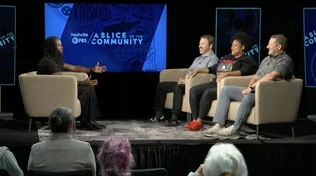
Who Gets to Speak for Nashville? Promo
Preview: S5 Ep2 | 30s | A candid conversation about who shapes Nashville’s stories and how the media tells them. (30s)
Providing Support for PBS.org
Learn Moreabout PBS online sponsorship New Episode
- News and Public Affairs

Top journalists deliver compelling original analysis of the hour's headlines.

- News and Public Affairs

FRONTLINE is investigative journalism that questions, explains and changes our world.
 New Episode
 New Episode
 New Episode
 New Episode
 New Episode
 New Episode
 New Episode
 New Episode

Support for PBS provided by:
A Slice of the Community is a local public television program presented by WNPT