Whole People
A New Response
Episode 3 | 26m 46sVideo has Closed Captions
Traumatic experiences can deeply damage children. But we now understand this issue better.
Traumatic experiences injure children and can put them on a path toward troubled adulthoods. Explore how one Minnesota county is working to change that. Produced in partnership with CentraCare.
Problems playing video? | Closed Captioning Feedback
Problems playing video? | Closed Captioning Feedback
Whole People is a local public television program presented by Twin Cities PBS
Whole People
A New Response
Episode 3 | 26m 46sVideo has Closed Captions
Traumatic experiences injure children and can put them on a path toward troubled adulthoods. Explore how one Minnesota county is working to change that. Produced in partnership with CentraCare.
Problems playing video? | Closed Captioning Feedback
How to Watch Whole People
Whole People is available to stream on pbs.org and the free PBS App, available on iPhone, Apple TV, Android TV, Android smartphones, Amazon Fire TV, Amazon Fire Tablet, Roku, Samsung Smart TV, LG TV, and Vizio.
Providing Support for PBS.org
Learn Moreabout PBS online sponsorship(dramatic music) - My understanding of epigenetics is that if your body develops under certain circumstances, then that's what your body gets good at dealing with.
So if your body is developing in high-stress circumstances going back generations how does that intersect with intentional choice and what happened today?
When would you like to pay for this and what would you like to pay for?
Would you like to pay for this counseling, making sure that people are fed and have a warm place to live?
Or would you like to deal with the homicide, like the one that happened this last weekend, where we had kids who had been taken away from their parents at a young age and not surprisingly things ended poorly.
- 2014, we were approached with the idea of starting the Child Response Initiative.
Maybe a young person who's witnessed something traumatic or they were victimized themselves.
That led us to learn more about the ACEs Project, the Adverse Childhood Experiences.
- We are responsible for ensuring the health of our communities.
So 155,000 people are our responsibility, keeping them healthy and safe.
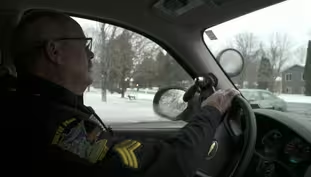
- Part of my role is monitoring the radio for children who are in distress or traumatized, maybe in a domestic violence situation.
I'm able to hear that, contact the officer, and then meet the family, meet the children, start that relationship and start the process of getting them connected with services.
Unfortunately, we get a lot of referrals and a lot of kids who have experience in significant trauma.
But that's what this is all about.
(slow piano music) - [Narrator] Whole People, A New Response is a TPT Partnerships co-production with CentraCare Health.
(slow piano music) - The way that I explain ACEs to the average person is if bad things happen when you're young, your body and your brain literally form to match your environment.
So if you're constantly living in crisis, your body and your brain form to deal with crisis.
Why does the criminal justice system end up being involved in this?
Because if people are raised in crisis and literally created in crisis, they end up continuing in crisis because that's what they know and that's where they end up coming through child protection, criminal justice probation through my office.
(slow dramatic music) Putting people in prison because they've done bad things and I can prove them beyond a reasonable doubt takes care of the bad thing they did and that person.
It doesn't take care of the rest of the world that's still here dealing with this tomorrow and the next day and the next year after that.
What we find with the ACEs, was an ability to tie that together so that we're not only dealing with a crisis, but we're dealing with the whole life.
- There are 10 categories of adversity.
Five of them have to do with abuse and neglect, physical, emotional, and sexual abuse.
And then there are five categories of family dysfunction.
A member of the family living in the household dealing with serious mental illness, a member of the household dealing with an active drug or alcohol problem, a member of the household who's been incarcerated, domestic violence in the household, the occurrence of a divorce.
And those 10 categories of adversity were not chosen by chance or even just by logical analysis.
The original authors and researchers did a thorough review of the existing literature and determined these were the types of adversity that there was already some evidence to suggest that these may have an impact on people's long-term health outcomes.
We need to protect our children.
We're escalating, it's becoming more critical.
We're responding to more and more situations of individuals who are in mental health crisis, both juvenile and adult, today than I remember when I first started my career.
Sex trafficking is a big problem up here.
We had a homicide this past weekend and involved two young men who's lives are one's lost and the one's destroyed.
As you look into a little bit of their background you see, I have no doubt that both of these young men had a very high ACEs score.
- Adverse childhood experiences are the most basic and long-lasting cause of health risk behaviors.
- The way to help children most effectively is to be helping their parents.
- Parents are the mediators of stressful events on kids.
- 25 years drowning out some poor childhood experiences with drugs, alcohol, cigarettes.
- [Man] What's the heaviest you've ever been in your life?
- In excess of 400.
- [Man] And how and why did you get so fat?
- Well I was abused sexually by my uncle and once again I used food as a comfort.
- It's great to be aware of the risks that kids face but if we didn't do anything about it, we would be in big trouble.
(dramatic music) - Can you tell that I was sexually abused routinely, that I was neglected, starved, beaten, probably not.
You would have to ask in order to find out and that's not the sort of thing that people typically ask about.
- I used to get beat up all the time, all the time.
When I got the weight on it didn't happen.
- We continue to create a system of pain and trauma that is on a sociocultural level.
- This was a project brought forward by some of our behavioral health people.
Much of the work that they were identifying was really around abuse-related issues drug and alcohol use, depression in particular, anxiety and recognizing all the impacts that that can have on health.
- I learned of a conference called the Midwest ACEs Summit.
- I learned it at the ACEs training.
I can tell you where I was sitting in Chicago the first time I heard it.
- I reached out to Janelle and said "You wanna go to this conference in Chicago with me?"
She not only went, but she pulled together a group of people from around Stearns County.
- I didn't really know a lot about ACEs when I was asked to go to this conference.
And there was a part of me that was like, "Why am I doing this?"
(slow dramatic music) Waite Park Police Department, we had over 300 transports last year for mental health type holds and when I ran the numbers for a smaller agency I was kind of surprised.
Right adjacent to the city of Saint Cloud and we started comparing who we were having interactions with.
We were having contacts with the same people multiple times.
10, 12, 15 times in a 30 to 60 day period and it was eye opening.
We're cops, we're law enforcement.
We investigate crime, we arrest people.
That is true, that is part of it.
But we're not counselors.
Law enforcement government we're certainly not in the best position to parent kids.
- The public health system saw a connection between this topic and one of the major initiatives that Stearns County Public Health was working on.
- What we want are parents that are understanding things like what's the natural development of a child.
And then to promote that child's health either in their growth and/or discipline.
Kids do need to be disciplined.
But what's appropriate, what's age appropriate.
We're in the middle of the state and I'm gonna say we're probably middle of the road as a community.
- Despite the reputation of Stearns County as this super conservative, even people who are extremely fiscally conservative get you can pay now or you can pay later.
We are going to pay, we are going to pay when you have kids that are coming out of these type of environments.
- What do you wanna pay for?
Do you wanna pay for incarceration?
Stiffer sentences, from my opinion, doesn't necessarily deter criminal behaviors.
Can we do some things on the front end?
- We can see these things coming.
It is not mystical magical that if things go poorly at one point in your life, unless something actually changes, it's gonna continue to go poorly.
That's what the ACEs is, is recognizing that, physically, mentally, emotionally.
- The names of all the children that have been referred to what's called Trauma Informed Care Services.
So the way I always explain it, it's therapists who are specially trained to deal with children in trauma.
- We have a problem here and the problem is that we have children who are being adversely affected and devastated by trauma, by occurrences of domestic violence, maltreatment, neglect, assault, what have you.
- Stearns County has the nation's only repeat felony domestic violence court.
Most domestic violence courts deal with first-time offenders, low-level offenders, with the idea that we're going to change these behaviors.
We found that the biggest draw down on our criminal justice system were the frequent flyers who are just in and in and in the system.
She's not finding a way out of that, now the kids are getting involved.
So we deal with the worst of the worst.
We've had fathers and sons in at the same time.
We've had brothers in at the same time and now we have social workers who are specifically addressing the kids that are in those families to help mom with the parenting issues.
This isn't an isolated event, this has been going on for years and years and years with the same family.
- The children part of this from the domestic violence perspective people get that.
They don't get why she doesn't leave.
It's so much more complicated than that.
This is her life.
We're dealing with one event that law enforcement has been called to, to see if we can prove beyond a reasonable doubt that he hurt her at this moment in time.
The complete control that he has over her life, whether or not she can leave, whether or not she can have a job.
When we listen to the jail phone calls, he's getting her evicted from the house, selling the car, cutting off her credit cards, killing the cellphone from his jail cell.
She's gotta think about way more than what's going on in this moment for her to leave.
We know that, for example, through the Child Advocacy Center we can all find some ways to tie in what's gonna happen with the kids.
It's her whole life, we're dealing with one moment in time.
(slow dramatic music) - One of the first referrals I ever had.
Can I take off my coat?
Was a mom who had repeatedly been victimized.
The batterer had violated the DANCO, Domestic Abuse No-Contact Order 20 times.
Need help?
- You're already grown up.
- So she was living in fear.
Her daughter who was, I don't want to describe her age, but was really struggling in school, at home emotionally, feeling fearful to even walk outside of the home because she might be confronted by this individual.
Lack of focus, lack of clarity, lack of concentration, which can really profoundly affect a child in school.
If you're having this stuff at home and then you come to school and try and concentrate and focus, it's incredibly difficult.
Ended up connecting the daughter with a therapist.
In the course of about three months, progressed emotionally in terms of her security and well-being within school, her ability to be more vulnerable with mom, and just nurture that relationship, which mom was overjoyed.
As well as mom ended up volunteering and really was empowered herself.
- So if you think about this as a river, this is typically what we use.
Child protection is on the back end at the bottom of the river and they're trying to pull people out of the river.
Primary prevention which is where public health likes to sit went all the way up the river and said why are they even falling in in the first place and what do we need to put into place to prevent them from even falling into the river.
- Welcome, we are at the Central Minnesota Child Advocacy Center.
It's a one-stop approach for child abuse investigations.
Before this place if a child was sexually abused, that child would have to go from agency-to-agency to retell their story of what happened to them, which was very traumatizing for them.
And after they felt like they weren't believed because of how many people they had to share.
So now they can come to one place.
Sexual abuse, physical abuse, some sex trafficking, that is definitely going around in our area.
The medical exam's on-site.
So again, this is a little bit different in the past because children would have to go down to the metro area to complete that exam.
- The whole issue of mental health and crisis response for law enforcement, we've been dealing it, with for a long time.
- With the medical exams, if we need to collect any evidence for the investigation we can do that.
As well as we have a camera, to be able to take any photos of any bruises or anything.
And law enforcement, they get all of that the day of the visit.
And so a little bit different from before where they may take a week or so to get all this information.
So when they leave they have all the evidence or photos or anything that they need to start their investigative process.
It's hard not to walk by this and see the little infant scale that we have here.
- You're not gonna probably prevent it all, but if we can figure out some ways to intervene early enough in a young person's life then maybe just maybe we can pull them back from the edge.
- The county attorney was interested, Saint Cloud Hospital all very interested in trying to address adverse childhood experiences.
We sorta came together knowing that this was something that needed to be done and started a collaborative.
- The children that we see as far as the age group is 0 to 18.
And so we often do have little, if it's infants or babies or toddlers come in.
And we probably have seen around 35-40 children under the age of two at this point, which kinda breaks your heart to think of someone that small being hurt, but that's the reality.
So these are the forensic interview rooms.
So we have two interview rooms.
So this is where the child will meet with one individual, one person to tell their story.
So we ask them to come in, they're with one person, we audiotape it, videotape it.
A lot of children can't really say what they're feeling so we can use the board as far as for drawings.
The team, meaning law enforcement, child protection, medical.
We are watching the video live as it goes.
And so the interviewer will wear this Apple watch.
We can communicate with the interviewer while it's going.
So we get the information that we need at one time when they're talking.
So example would be if we need to know if there was clothes on or off, we can text that to the interviewer.
Also we use dolls and the dolls again are used for some of the younger children that if we need them to show to can you show us what happened.
And sometimes that's easier for them to share instead of telling.
- The idea of embedding social workers with law enforcement makes a lot of sense to me.
And you're starting to see that nationally.
And we have a little bit of that with Paige in the Child Response Initiative where his office is in the police department.
- One of the things I always say is that I'm not law enforcement, I can't arrest you.
Because there's some stigma about someone associated with the system.
I don't have any authority that way.
I also say that I'm not with CPS, Child Protective Services.
Because that's also a concern that they have.
If you are involved is it gonna affect our, potentially having our children taken from us.
- But it's not just about the investigation, right?
We also have a child here and a family here that are really struggling and really have a traumatic event.
And how can we get them the hope and healing moving forward.
- So this is our advocacy room and what we do in here is we work to support the family.
So currently we have two child and family advocates on staff and our role is to just support family throughout the whole process of the investigation.
We often make referrals to community resources either for mental health, whether that means the child or the caregiver.
Different advocacy programs, different legal services, that kind of thing.
So after each child is done with their interview and medical exam we give them a backpack that's full of hygiene items, maybe a small activity, a blanket and a pair of pajamas.
All of those backpacks have been donated from a local organization called Pockets of Hope.
So this one has makeup in it.
It's got a blanket, it's got a pair of pajamas.
There are some hygiene items in there like deodorant, a brush, that kind of thing.
So most children are very excited when they receive their backpack.
- So when they come to the CAC at this point now all of our professionals are together in one place to help that child.
We all can listen to their story one time and getting the help that they need for that healing process.
- We're slowly kind of breaking down the silos that existed between probation and community corrections and law enforcement and healthcare providers.
- Knowing that we're dealing with the whole scenario, it hadn't occurred to me that so are the doctors.
- A person who's had a lot of exposure to this kind of adversity you might simply say to them, "I see you've been through a lot of tough things, how do you think this has affected you?"
And then you just listen.
(slow dramatic music) - Probably the easiest question to ask is "What's happened to you?"
ACEs had an impact on non-mental health disorders such as obesity or how they take care of themselves for their diabetes or congestive heart failure or a variety of other illnesses.
- If we can reduce that risk and thereby reduce the frequency and intensity of those health problems, we're gonna save a lot of money that we put into healthcare.
Same thing's gonna be true in criminal justice and in education.
You know the education system has to spend a lot of money trying to deal with the social and emotional impediments that kids deal with when they're in a school setting.
- We know from collection of data inside Stearns County for example that cases that end in termination of parental rights, which means literally that parent can no longer parent that child, the government is going to parent this child, the taxpayers are gonna pay for this.
We know for a fact that 22% of our cases that end that way start with truancy, truancy.
Why would we not put time and effort into that.
But I will be honest with you, I'm having a hard time with that, because people don't think truancy is a big deal.
The connections are not necessarily obvious outside the field.
So despite the fact that some things like kids beaten and bleeding and sexually assaulted, they're getting that, but I know for a fact that if you're not going to a school a quarter of those about are going to end poorly too.
So we still have work to do.
- What is the data showing us around illness, death, risk factors?
We actually ask our community what do you think is our overriding issues?
Okay, so if the community, for example in this instance parenting was their top concern, we looked at the data and said yeah, we've got rising child protection issues.
What we did in the last survey, we actually included all the 10 ACEs questions in there.
So for the very first time, we actually have data right from our own community.
- In our area, one out of every six people had an ACE score of four or more.
But if you think about that in one out of every six people that is walking down the street or in the room that you're in or something.
It really, to me it just really strikes you, this is everywhere.
- As we do more work in this ACEs collaborative we'll be able to ask those same ten questions and then say what kind of change?
Did we move the needle, so-to-speak, in a positive way?
Those kinds of things where there may be risk factors, what kind of services do we need to have in place there.
And then when it's happened, how do we help people heal and then also prevent them from, as a parent particularly, having ACEs experience happen in their children.
It's really one of the very few collaboratives we sit on.
We're really looking at that continuum from totally preventing anything from happening to it's happened what do we need to do to make it better.
- How has your eating been through all of that?
- By working together, we can solve problems at a much larger scale, much more impact than doing it separately.
- We can reduce absenteeism in the workplace.
We can reduce the rates of incarceration.
We can reduce incidence of serious illnesses.
We can reduce the rates of out of home placement for kids.
I mean, we've got lots of evidence about how we can save all of our systems and all of our society a lot of money.
And at the same time, make it a much healthier society for everyone.
- We want healthy kids and we want healthy families and we want healthy parents.
And we've got a resource here that's gonna help make that happen.
- How about we actually talk about what we know.
This ACEs training is now part of what the advocates talk about with families.
If we do the right thing, then we might have a shot.
(slow dramatic music) - It's probably one of the best evidence-based practices and philosophies in terms of dealing with children and trauma.
- Have you really, wow?
- Well, I is worn out.
- Talking about five games.
- My goodness, you're good.
There is a response where before there wasn't.
(children talking) - Like very year.
- Really?
They have a place to go and someone that they can trust and believe will follow up.
Look at you, look at, nice (chuckles), put it there nice job.
There is an answer now.
Let's see you dance.
There is a solution.
(inspiring music) Whole People, A New Response is a TPT Partnerships co-production with CentraCare Health.
(bright music)
103 | A New Response | Preview
Preview: Ep3 | 30s | Traumatic experiences can deeply damage children. But we now understand this issue better. (30s)
Providing Support for PBS.org
Learn Moreabout PBS online sponsorship
- News and Public Affairs

Top journalists deliver compelling original analysis of the hour's headlines.

- News and Public Affairs

Today's top journalists discuss Washington's current political events and public affairs.










 New Season
Support for PBS provided by:
Whole People is a local public television program presented by Twin Cities PBS