
Why Beavers Call Wetlands Park Home
Clip: Season 8 Episode 45 | 5m 48sVideo has Closed Captions
The Clark County Wetlands Park is home to hundreds of bird, reptile, beavers and mammal species.
The Clark County Wetlands Park is home to hundreds of bird, reptile and mammal species, including beavers.
Problems playing video? | Closed Captioning Feedback
Problems playing video? | Closed Captioning Feedback
Nevada Week is a local public television program presented by Vegas PBS
Why Beavers Call Wetlands Park Home
Clip: Season 8 Episode 45 | 5m 48sVideo has Closed Captions
The Clark County Wetlands Park is home to hundreds of bird, reptile and mammal species, including beavers.
Problems playing video? | Closed Captioning Feedback
Where to Watch Nevada Week
Nevada Week is available to stream on pbs.org and the PBS app.
Providing Support for PBS.org
Learn Moreabout PBS online sponsorshipA legendary broadcaster and nature documentary trailblazer, David Attenborough, recently turned 100.
And in honor of his birthday and the premiere of the PBS film Life on Earth: Attenborough's Greatest Adventure, Vegas PBS held an event at Clark County Wetlands Park.
Located on the eastern edge of the Las Vegas valley, it's a constructed wetland and includes nearly 8 miles of the Las Vegas Wash, which works as a filtration system for the valley's excess water as it returns to Lake Mead.
It's also a critical habitat for wildlife, including--and this may come as a surprise to you--beavers.
They're actually native to Southern Nevada and were the topic of our panel discussion at Wetlands Park.
(Ben Jurand) It's not entirely clear necessarily how they got here, but the general theory is that when the Las Vegas Wash became an urban river, basically it connected to the Colorado River, and that's where the beavers live and come from.
So they made their way up the Las Vegas Wash.
We provide all of the trees and raw materials for them to make a living out here, and they've been fruitful and multiplied.
-Lauren, with what you know about beavers, how is it possible that they are surviving in this desert climate?
(Lauren MacLeod) It's funny because they're actually adapted in a lot of ways that our desert animals are also adapted.
So some of that is attributed to their behavior.
They're nocturnal and they live underground.
So most of our desert animals are adapted, whether it's living in rock crevices or burrows, to get to that cooler underground space.
But beavers are doing the same thing along river banks and along the shoreline habitats where they're digging those holes to stay in that cooler temperature.
And of course water, too.
I mean, water is a great place to cool off as well.
So they have kind of a combination of resources going for them.
-How would you describe their role in the ecosystem here?
-Of course, the beavers are wetlands' engineers.
They are the ones who are able to change an environment and make it more conducive for a lot of different animals and a lot of different plants.
-That's in other areas-- -Well-- - --but here?
-So basically, because we need to allow the water to flow--this is a constructed wetlands--so we have created a lot of habitat out here with lots of different trees.
If we allowed the beavers to dam up all that area, a lot of the stuff downstream wouldn't make it.
So we basically have to take-- We have to undo a lot of their work.
-Every morning?
-Every single morning.
We've got, actually, part of our crew goes out there and pulls out all of the stuff that they put on their dams to get the water to flow.
They come out the next night, put it all back, and it's just a continuing cycle.
[laughter] -But they are great architects, right?
Lauren, how are they modeled in modern-day, well, architecture and in nature?
-Yeah.
I mean, I think it's only in, you know, the 20th century and present that we've realized just how effective beaver dams are at maintaining and regulating a healthy ecosystem.
And so people have realized this and have actually begun implementing this in various areas in our country where they build essentially an artificial beaver dam.
So it's something that's built off of natural material, you know, weaved willow and things like that, that adapts in the same way that a beaver's dam does, because we've seen just how efficient it can be in maintaining our ecosystem.
-Okay.
So they're working at night.
And if you want to see them, you can try, right?
You offer beaver walks?
-Absolutely.
-What time do people have to get here?
-Very early.
So we start our beaver walks before the sun comes up; they start at 5 a.m.
We do have two scheduled this summer.
One is on June 13, and one is on July 11.
Both of them are at 5 a.m., so if you're interested in seeing beavers, that's probably the best time to do that.
-Okay.
And I tried to do it on a very condensed timeline this past week.
I got here-- Well, I was supposed to get here at 5:45.
I got here at 6:00, and we didn't see any.
-You just missed them.
-We saw beaver tracks.
We heard them.
We didn't see any.
But I'm bringing this up because it highlights even more the important work of Sir David Attenborough in that he and his crew were around the world patiently waiting to get some of these images of animals that people would never have seen.
Here, though, at Clark County Wetlands Park, you kind of rely on volunteers.
-We have over 120 active volunteers here, and they act as our eyes and ears out in the park in a lot of ways.
So we do have different folks who like to just go out on the trails.
They bring their cameras.
They report conditions, but they also record the wildlife that they see out here.
-Okay.
Just a couple more things.
This may be Beaver 101 for some of you, but will you tell our viewers about their teeth?
-Yeah.
Yeah, absolutely.
So if you haven't seen a beaver in person, you've probably seen photos of them.
And usually those photos feature those iconic two front buck teeth that they have.
And they are teeth similar to many other rodents that never stop growing.
And so one of the benefits of chewing wood, as beavers do, is to file down those teeth naturally.
But it also allows them to continue to chew wood and contribute to their diet and also to their engineering practices.
-And because of those teeth, if you walk around the wetlands, you will notice that there are trees with a barrier around them because you don't want them damaging trees.
-Yes.
-Okay.
So you're keeping them out.
All right.
Thank you both so much for joining Nevada Week.
-Thank you.
-Absolutely.
Thank you.
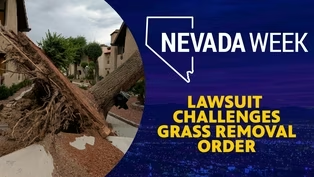
Lawsuit Challenges Grass Removal Order
Video has Closed Captions
Clip: S8 Ep45 | 12m 52s | Nevada’s turf removal mandate faces a lawsuit claiming the water-saving effort is killing trees. (12m 52s)
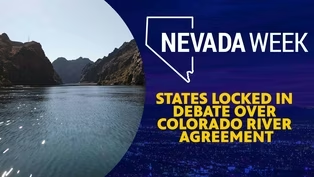
States Locked in Debate Over Colorado River Agreement
Video has Closed Captions
Clip: S8 Ep45 | 6m 39s | With a federal deadline looming, Colorado River states debate how to split the dwindling supply. (6m 39s)
Providing Support for PBS.org
Learn Moreabout PBS online sponsorship New Episode
- News and Public Affairs

Top journalists deliver compelling original analysis of the hour's headlines.
 New Episode
- News and Public Affairs

FRONTLINE is investigative journalism that questions, explains and changes our world.
 New Episode
 New Episode
 New Episode
 New Episode
 New Episode
 New Episode
 New Episode
 New Episode
Support for PBS provided by:
Nevada Week is a local public television program presented by Vegas PBS