
Symphony of Art: Sculpture, Education, and Enchanting Cello
Season 9 Episode 4 | 28m 45sVideo has Closed Captions
Explore sculptor's studio, SPAC's Ed VP Dennis Moench, & Laura Melnicoff's performance.
Discover sculptor William Fillmore's eerie creations and the stories that drive them. Explore the world of arts education through a compelling interview with SPAC's VP of Education, Dennis Moench. Dive into the enchanting world of cello music as Laura Melnicoff brings Gaspar Cassadó's Preludio-Fantasia to vivid reality.
Problems playing video? | Closed Captioning Feedback
Problems playing video? | Closed Captioning Feedback
AHA! A House for Arts is a local public television program presented by WMHT
Support provided by the New York State Council on the Arts (NYSCA), M&T Bank, the Leo Cox Beach Philanthropic Foundation, and is also provided by contributors to the WMHT Venture...
Symphony of Art: Sculpture, Education, and Enchanting Cello
Season 9 Episode 4 | 28m 45sVideo has Closed Captions
Discover sculptor William Fillmore's eerie creations and the stories that drive them. Explore the world of arts education through a compelling interview with SPAC's VP of Education, Dennis Moench. Dive into the enchanting world of cello music as Laura Melnicoff brings Gaspar Cassadó's Preludio-Fantasia to vivid reality.
Problems playing video? | Closed Captioning Feedback
How to Watch AHA! A House for Arts
AHA! A House for Arts is available to stream on pbs.org and the free PBS App, available on iPhone, Apple TV, Android TV, Android smartphones, Amazon Fire TV, Amazon Fire Tablet, Roku, Samsung Smart TV, and Vizio.
Providing Support for PBS.org
Learn Moreabout PBS online sponsorship(lively music) (upbeat music) - [Matt] Visit the studio of sculptor William Fillmore.
Celebrate the artist in everyone with SPAC's VP of Education, Dennis Moench, and catch a performance from Laura Melnicoff.
It's all ahead on this episode of AHA, A House for Arts.
(upbeat music continues) - [Presenter] Funding for AHA has been provided by your contribution and by contributions to the WMHT venture fund.
Contributors include The Leo Cox Beach Philanthropic Foundation, Chet and Karen Opalka, Robert and Doris Fischer Malesardi, and The Robison Family Foundation.
- At M&T Bank, we understand that the vitality of our communities is crucial to our continued success.
That's why we take an active role in our community.
M&T Bank is pleased to support WMHT programming that highlights the arts, and we invite you to do the same.
(smooth music) (smooth music continues) (singer vocalizing) (graphics whooshing) - Hi, I'm Matt Rogowicz and this is AHA, A House for Arts, a place for all things creative.
As soon as I saw the work of sculptor William Fillmore, I just had to find out why he makes such twisted sculptures.
They're dark, scary, a little funny.
I can't even describe them.
Just take a look.
(mysterious music) - I'm Billy Fillmore.
I make intentionally creepy stuff.
(mysterious music continues) I really like to take the things that I don't like about society or the things that I've experienced, and I try to replicate that in 3D materials.
In the end, it's all about trying to make work that makes people stop and wonder, "Why the hell would anyone make that?"
(mysterious music continues) When I was a kid, I was terrified of my closet in my bedroom, and I didn't know why.
In fact, my parents have these really funny pictures of me sleeping in the hallway.
Or I would go to Mike's room, my brother's room, and I'd sleep with him.
And then eventually my brother was so tired of me coming and waking him up and sleeping with him that they put a lock on his door and then they have a picture of me sleeping in front of his door.
'cause I was so terrified of sleeping in my room.
I remember looking into the closet and seeing the void, and I was so afraid of the possibilities of what could be inside of there.
(spooky music) (shriek reverberating) And so I was so afraid of that closet.
And I think my aesthetic and my taste kind of built around that terror that now I feel like I am no longer afraid of the closet.
But now I've become the thing in the closet.
(gentle music) Just Put Him Back, (laughs) it relates to my birth story.
I was an in vitro baby, and this was in 1980, and an in vitro baby cost $10,000.
(chuckles) And so my dad never let me forget how much I cost.
And during the time of my birth, it was just a very traumatic event.
I guess there was at some points, they asked my mom, you have to choose between yourself and the baby.
(gentle music) So I was finally birthed.
And (chuckles) the way it's told to me is the umbilical cord wrapped around my belly.
And so I was covered in green shit and none of my hair follicles had been like sloughed off, which is normal.
All of your hair follicles grow when you're born, but some babies are born with all their hair follicles still attached.
So from head to toe, I was covered in orange hair and green shit.
I was so gross that my mom's first words to me was like, "That's the ugliest thing I've ever seen.
Just put him back."
So I think that that is one of those perfect kind of stories where my artwork comes from, where it's beautiful on one hand and how much trauma and suffering had to occur.
But then it's really funny on the other hand that you went through all this trouble, and you just get a red-haired, green shit covered baby.
I get along.
I love my parents.
Mom, Dad, I love you.
And we get along great, but they were kind of the first institutional rule setters for me.
And I never understood why.
I got a bachelor's degree in business administration, and there's nothing worse than graduating with a degree that you didn't actually want.
And the day after I graduated, I went to my first visiting artist lecture.
And the artist's name was Justin Sweet, who is a concept artist.
And I'd never seen anybody make the stuff that I was consuming.
So he made a lot of concept art for like the Chronicles of Narnia, Lord of the Rings, some video games that I had played, comic books.
And it just kind of blew my mind.
And after that, the next semester, I just started going back to art school.
There's two parts of me that I always am questioning.
One is my 13 year old self who was in the middle of puberty and being punished for being different or not understanding the rules.
And the other part of me that I'd like to listen to is my deathbed self.
I'm imagining myself in my nineties or hopefully like later than that in a hospital bed trying to look back on my life and hoping that what I did was worthwhile.
So between those two parts of my personality, I find myself trying to make work that appeals to both of them.
So I've worked here at Russell Sage College on New Scotland, and right now I live like a mile and a half away and I always walk.
And when I'm walking, I'm not looking for stuff, but stuff seems to find me.
So I walked by a church that's down on New Scotland and in the grass was this doll that definitely looks like it survived a fire or something like that.
But its porcelain head is still intact.
And I saw its mangled body and I was just like, "That is the ugliest thing I've ever seen, Like I was to my mom."
I pick it up and its eyes are closed.
When I pick it up, its eyes open, and I was just like... And its eyes are just terrible looking 'cause they survived the fire.
But it's just the weirdest creepiest thing ever.
And so when I brought it back, I didn't want to just sit it on a shelf so I ended up making a box for it.
And in my mind, I was imagining what would my grandma, the grandmother who said I was the cutest thing she'd ever seen, what kind of box would she like to see it in?
And so I went to Joanne's and found it like the prettiest, nicest fabric.
So the tension between a traditional doll that's been mutilated, not by me, just found it and then putting it in a curio cabinet box as if it's some kind of precious object was just really fun.
For me, I like affecting other people, but the main audience for me is me and those two characters I talked about like my 13 year old self and my ancient deathbed persona.
By paying attention to those two, what it's really doing is making sure that I'm not being depressed about what I made, and I'm not anxious about what I could make.
And it's always kind of pushing me to make the best work that I can make now.
- I'm sure most of you have been to the Saratoga Performing Arts Center to see a concert at some point, but there is another side to SPAC that needs to be highlighted.
Each year, SPAC's educational programs reach more than 50,000 students to inspire young minds and celebrate the performing arts.
Jade Warrick spoke with Dennis Moench, SPAC's VP of Education, to learn more.
- Hey, Dennis, welcome to the House for Arts today.
- Thanks, Jade.
- So I know you have a background in performance art, but I would love to get your...
I guess more expand on your creative background for the audience and I to know a little bit more about what has Dennis done.
- Yeah, (chuckles) well, that's a really good start.
So I grew up in this area.
I was lucky to grow up here.
I lived in Lake Lucerne first and then moved to Queensbury with my family and was always into music and theater.
So got involved at a very, very young age, and then turned that into a career.
I decided to continue my studies.
I went to NYU, studied drama at the Tisch School of the Arts.
And then soon after I got out of college, I landed my first talent agent and started acting in New York City.
So I was going into Off-Broadway shows and Broadway shows, and then touring the country and North America with various Broadway productions.
And it was just such a thrilling experience for me, and it's really what formed me in so many ways and then... - Actually, let's back up.
Let's back up.
I want the audience to know exactly what Broadway plays were you in and how did that look like?
- Yeah, well, so I started off in the Off-Broadway world, I guess, in New York City.
So I was in Fame the musical and then did a production called Altar Boys.
I was the Jewish member of a Christian boy band.
So it was a really funny spoof (Jade laughs) on like boy bands back in that time.
And then I started getting into Broadway shows.
I did Mary Poppins on Broadway for a long time, and then toured North America with it.
Went from Canada to Mexico and everywhere in between.
- Wow.
(chuckles) - And it was just awesome.
And then I could say one of the pinnacles came in 2014.
I was cast in the revival of Les Miserable on Broadway and, you know, got to perform on the Tony Awards and open the show and play a number of different roles in the show.
So I was the Thenardier understudy.
So I got to go on for him, which was so fun, so many times.
And it was just, when I got to that point, I was like, "Wow, this is what I wanted to do for so long, and I'm so lucky and fortunate that I got here."
- What attracted you to performance art and stage work?
Like anything in particular, like what about it brought you joy, and why did it bring you joy?
- I mean, so many things, but I would say like the two main things are, number one, just that magic spark that you feel when you are in the moment.
For me, that was just a so addictive.
I just didn't wanna stop.
The other thing was community.
It was for me, as a young kid, you know, I was not the typical young male boy, I guess you could say.
(both chuckling) Very, you know, different from the rest.
So I found my community through the arts really.
And that's where, you know, my people were.
And really that helped develop my self-esteem and self-confidence and so many other things as a young kid which is so important, you know?
- It really is.
It really is.
The arts really does help lots of youth, you know?
- Yeah.
- Even myself, I found myself fully immersed when I was younger, and I'm like, "I do not know what I would do if I wasn't introduced to art, you know, early on.
- Same, yeah.
Yeah, I'd be lost.
- I would've been miserable.
- Yes.
(both chuckling) - So it's very important.
- Yeah.
- So what made you make the switch to focusing on arts education and why?
- I felt like I got to a point where I was like, "I feel good about what I've accomplished as an actor."
The other thing was I really wanted to have kids.
So I'm married, my husband and I, were living in a 600 square foot apartment in Brooklyn so we just kind of did the math and like, This isn't gonna work," you know?
(both laughing) And we know that it's great to have a support system when you have kids.
- Yes.
- So eight years ago we moved up here to be closer to family for that reason.
Now we have two young kids, young beautiful kids we adopted.
- That's amazing.
- Yeah.
- And is there something about arts education that brings you joy, like internal joy?
Like what about it attracted you to it?
- Yeah, I kind of fell into it because I didn't really know, to be honest, what I was gonna do when I moved back here.
And I was just looking for somewhere where I could put my creative energy, you know, so what does that mean, in the capital region?
And I just happened to work at SPAC for a summer season.
They were looking for people.
And at the end of that summer, I was asked to stay on full-time and just build education programs.
And I had never done that before.
I was terrified.
And you know that saying like, when you're terrified, you should do it.
Like, you know?
- Yes, immersion.
- Exactly.
(Jade laughs) So I just jumped in and fell in love with it, and I became so passionate about it because I think, for the most part, because I get to now provide children that experience that I had as a kid, what really transformed me and formed me into who I was.
- So as the vice president of Education for SPAC, which is Saratoga Performing Arts Center, how do you utilize that position to foster positive change within the arts, I guess, education sector within Upstate New York?
- Well, that's a great question.
So I think first and foremost, what I sought to do was to really get out in the community, meet everybody I could possibly meet and just find out what people needed and what other organizations needed.
So I met with so many nonprofits, the Boys and Girls Clubs, the YMCAs, the, you know, Girls Incorporated and ended up meeting with more than 140 different nonprofit organizations and eventually working with them all.
And the first question I always asked them was, you know, how can we bring the arts to the populations that you serve?
And then we just came up with programs that essentially did that.
You really have to know what people want rather than just imposing on them, like, "This is what I think you are going to like," you know, it's like no, you know?
(both chuckling) - That's not how it works.
- So I end up doing very little like musical theater because there is such a wealth of that here.
There are so many musical theater opportunities for youth and for adults.
So I ended up going in other directions that is not really my primary background as an artist because that's where the need was.
- So how do you build accessibility pieces into some of the programs that you run?
I know you run a lot of programs for like youth and adults, if you wanna glance over those, but how do you make this accessible for all folks?
- So I think that is every educator's biggest challenge and mission.
It's so important and a lot of...
It takes a lot of work, a lot of educating yourself, of course, because things are always changing.
So you can't stop learning about how to make things accessible because we are learning as a society ourselves how to be more welcoming and be more inclusive to everybody.
So really making sure you are constantly educating yourself is, I think number one, the most important thing.
And the other thing is, again, knowing your community and finding out who lacks access to what you're providing and why that is.
So if it's transportation and that's all that's preventing some children from getting into an arts program, how do we provide transportation?
You know, if they just don't feel welcome in the class because they don't wanna wear like a leotard and tights, that's not comfortable for them, we provide classes where there is not a dress code like that.
Like you wear what you are comfortable with.
So it's all about creating those environments where people feel welcome and safe.
- So what are some programs and events that you wanna let the audience know about that you got going on?
- In the fall, on September 11th, our fall semester at the SPAC School of the Arts begins.
So people can register for music, theater, dance classes for all ages, all abilities- - That's amazing.
- at the SPAC School.
- And don't you have a tuition supporting program as well?
- Yes.
Thank you.
Yes.
- There you go.
- So, again, we wanna make sure that these programs are accessible to everybody.
At our School of the Arts, we do have to charge tuition because of the nature of that programming.
But we have a tuition assistance program that is fully funded and is open to anybody who needs that support in order to access the classes there.
- Well, that's awesome, Dennis.
Thank you for taking the time to talk to us today.
I'm super happy to visit SPAC soon.
- Great.
Thanks, Jade.
- Thank you.
- Please welcome cellist Laura Melnicoff.
(dramatic music) (dramatic music continues) (dramatic music continues) (dramatic music continues) (dramatic music continues) (dramatic music intensifies) (dramatic music) (dramatic music continues) (dramatic music intensifies) (dramatic music) (dramatic music continues) (dramatic music continues) (dramatic music continues) (gentle music) (lively music) (lively music continues) (lively music continues) (lively music continues) (lively music intensifies) (dramatic music) (dramatic music continues) (lively music) (lively music continues) (dramatic music) (dramatic music continues) (lively music) (lively music continues) (contemplative music) - Thanks for joining us.
For more arts, visit wmht.org/aha and be sure to connect with us on social.
I'm Matt Rogowicz.
Thanks for watching.
(contemplative music) - [Presenter] Funding for AHA has been provided by your contribution and by contributions to the WMHT venture fund.
Contributors include The Leo Cox Beach Philanthropic Foundation, Chet and Karen Opalka, Robert and Doris Fischer Malesardi, and The Robison Family Foundation.
- At M&T Bank, we understand that the vitality of our communities is crucial to our continued success.
That's why we take an active role in our community.
M&T Bank is pleased to support WMHT programming that highlights the arts, and we invite you to do the same.
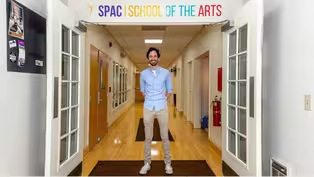
Beyond the Stage: SPAC's Education Initiatives
Video has Closed Captions
Clip: S9 Ep4 | 9m 16s | Explore SPAC's educational magic with SPAC's VP of Education Dennis Moench. (9m 16s)
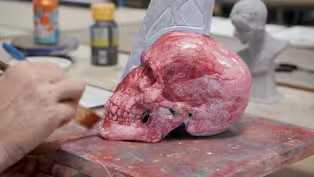
Exploring the Creepy Sculptures of William Fillmore
Video has Closed Captions
Clip: S9 Ep4 | 6m 17s | Explore sculptor William Fillmore's unsettling creations. (6m 17s)
Melnicoff Performs Cassadó's Preludio-Fantasia: 1st Movement
Video has Closed Captions
Clip: S9 Ep4 | 5m 26s | Cellist Laura Melnicoff mesmerizes with Gaspar Cassadó's Prelude-Fantasia. (5m 26s)
Melnicoff Performs Cassadó's Preludio-Fantasia: 2nd Movement
Video has Closed Captions
Clip: S9 Ep4 | 4m 27s | Cellist Laura Melnicoff mesmerizes with Gaspar Cassadó's Prelude-Fantasia. (4m 27s)
Providing Support for PBS.org
Learn Moreabout PBS online sponsorship

- Arts and Music
The Best of the Joy of Painting with Bob Ross
A pop icon, Bob Ross offers soothing words of wisdom as he paints captivating landscapes.










Support for PBS provided by:
AHA! A House for Arts is a local public television program presented by WMHT
Support provided by the New York State Council on the Arts (NYSCA), M&T Bank, the Leo Cox Beach Philanthropic Foundation, and is also provided by contributors to the WMHT Venture...