Journey Indiana
Wild Indiana
Season 7 Episode 1 | 26m 46sVideo has Closed Captions
IU's Deam Herbarium, Limberlost Swamp, Brown County State Park, and Wyandotte Cave.
Come along on a Journey as we explore Indiana's great outdoors. Meet pioneering botanist Charles Deam and visit the IU Herbarium, take a tour of Limberlost Swamp, trek through Brown County State Park, and explore an underground mountain at Wyandotte Cave.
Problems playing video? | Closed Captioning Feedback
Problems playing video? | Closed Captioning Feedback
Journey Indiana is a local public television program presented by WTIU PBS
Journey Indiana
Wild Indiana
Season 7 Episode 1 | 26m 46sVideo has Closed Captions
Come along on a Journey as we explore Indiana's great outdoors. Meet pioneering botanist Charles Deam and visit the IU Herbarium, take a tour of Limberlost Swamp, trek through Brown County State Park, and explore an underground mountain at Wyandotte Cave.
Problems playing video? | Closed Captioning Feedback
How to Watch Journey Indiana
Journey Indiana is available to stream on pbs.org and the free PBS App, available on iPhone, Apple TV, Android TV, Android smartphones, Amazon Fire TV, Amazon Fire Tablet, Roku, Samsung Smart TV, and Vizio.
Providing Support for PBS.org
Learn Moreabout PBS online sponsorship>> Funding for "Journey Indiana" was funded in part by: the WTIU Vehicle Donation Program.
Proceeds from accepted donations of a car, or other vehicle, make this program possible.
Most vehicles are accepted, and pickup can be arranged at no cost.
Learn more at WTIU.org/support.
>> Charitable IRA rollover gifts.
Individuals aged 70 and a half or older may make a tax-free charitable distribution from their IRA to WTIU.
Consult your advisor and visit Indianapublicmedia.org/support for more details.
>> WTIU sustaining members, committing to regular monthly contributions, providing WFIU and WTIU with reliable, ongoing support.
Becoming a sustainer is one of the most effective ways to support public media.
>> And by viewers like you.
Thank you!
♪ >> Today on "Journey Indiana," let's appreciate the Hoosier state's great outdoors.
Meet a pioneering Indiana botanist.
>> He's documented for us the Indiana that was, in order for us to appreciate it and hopefully do a better job of conserving and protecting it going forward.
>> Explore Limberlost Swamp.
>> You get out here and you -- you can't dwell on your problems.
It all puts it in perspective for you.
>> Travel through Brown County State Park.
>> We're in one of the most beautiful places in the entire state of Indiana.
And it is such a great location to see the seasons change day by day.
>> And descend into epic Wyandotte Cave.
>> You are about 422 feet below the surface, and from the bottom to the top of the stalagmite is about 130, 140 feet.
>> That's coming up on this episode of "Journey Indiana."
♪ >> First up, the story of Charles C. Deam, groundbreaking botanist and Indiana's first state forester.
♪ There are hundreds of species of plants native to Indiana, forming a complex, living tapestry across the Hoosier state.
And nearly no one explored this rich landscape more thoroughly than naturalist Charles C. Deam.
Between 1896 and 1952, Deam collected and cataloged tens of thousands of plant specimens from every county and every township in Indiana.
>> Deam's choice of focusing on Indiana was a good one.
For one thing, the state has a very long north-south dimension, and that meant that you cover a number of very different ecological regions of the Midwest.
Obviously, his choice was largely because that's where he lived, but it was still a very good one.
>> Today, the bulk of Deam's collection is housed at the Indiana University Herbarium in Bloomington, Indiana, and it's still being put to good use.
♪ >> What is a herbarium?
It is a plant library.
And so it is a research resource for folks like myself.
We can study the specimens in great detail.
You would be amazed at the amount of information that is preserved within that flattened, dried specimen.
Indiana University Herbarium has about 160,000 specimens.
At least 50,000 of those are Charles Deam's specimens.
And then Stella Deam, the wife, contributed another several thousand.
So they are obviously together, you know, represent almost a third of our collection even today.
>> Before he was a legendary scientist, Deam was a successful druggist from the small northeastern town of Bluffton.
>> In an effort to ease work stress, he started taking daily walks with his wife Stella; however, Deam, a noted workaholic, couldn't be entirely idle.
And so he began collecting plants as he and his wife strolled.
It ignited a deep and enduring passion.
>> Once he got started on something, he went the whole way.
Later in life, his motto was, you know, botany is my game, and I play it hard.
Type A personality to the hilt.
>> Deam was largely a self-taught scientist, but his efforts were far from amateur.
>> Deam is very complete in including not only the twig with mature buds, leaves, both -- showing both upper and lower surface and also, though, the nuts of the plant, because those could be very critical for identification or for adequate study of the structure of this particular plant.
Once you've got a specimen preserved and mounted in this fashion, they can last for hundreds of years.
>> Like a rugged weed, Deam's reputation as an ecological expert took hold.
In 1909, he was named Indiana's first state forester.
His chief task was to rehabilitate Indiana's forest lands, which had been ravaged from decades of overaggressive farming.
The steady paycheck and necessary statewide travel supercharged Deam's botanical exploits.
Soon, he was collecting thousands of plant specimens in a single year, from all corners of Indiana.
And this at a time when intrastate travel was a patchwork at best.
>> Initially, he had to travel by interurban railroad or horse, or on your own two feet.
But in 1915, he was able to finally get a Model T Ford and rigged it up to be his weed wagon.
I've been sometimes amazed at how many places he would be within just a single week.
>> Deam's massive collection of specimens formed the scientific bedrock for several influential botanical books, most prominent was "Flora of Indiana."
>> He was aware that we didn't even know what plants existed in the state.
But he also was interested in their distribution in the state.
Trying to understand what was the habitat that they required.
Where were they to be found in the state?
And, of course, what were the rare species of the state?
So he's documented for us the Indiana that was, in order for us to appreciate it and hopefully do a better job of conserving and protecting it going forward.
>> In that spirit of appreciation, in 2014, Indiana University embarked on a five-year effort to digitize the entirety of the herbarium's specimens.
Today, the fruit of Deam's labor is available online to anyone at the press of a button.
>> Yeah, how would Deam feel about this new digital world?
Yeah, I think he would be, you know, quite excited about it, with the caveat that he would still want people to experience nature firsthand.
He became very appreciative of that.
So he'd be, I think, thrilled by the digital world, but not if that's the only way you experienced it.
>> Now, let's explore the Limberlost Swamp and state historic site with naturalist and historian Curt Burnette.
>> Getting out here would be just like it was for me or anyone else.
You get out here, and you can't dwell on your problems.
There's birds calling.
There's cicadas.
Oh, there goes a snake.
Look at that cool plant.
It all puts it in perspective for you.
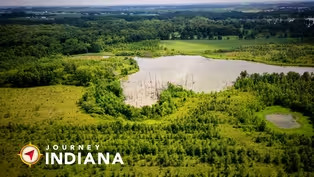
>> Way out in the very northeastern corner of Indiana, near the tiny town of Geneva, lies an 1800-acre wetland preserve known as the Limberlost-Loblolly Watershed.
More than a century ago, these lands captured the imagination of Hoosier novelist and naturalist Gene Stratton-Porter.
>> This is the areas that Gene Stratton-Porter photographed, wrote about, studied, walked around in, set some of her novels in.
So this very much is a spiritual place for her.
She saw the forest as God's cathedral, one of God's cathedrals.
And so everywhere she went in nature, I mean, she definitely felt the spirituality of it and saw how it related to how she worshiped it.
>> Today, if you wander around this wilderness area, chances are pretty good you'll come across Curt Burnette, naturalist and historian, of the Limberlost State Historic Site.
Curt sees a strong relationship between himself and Gene Stratton-Porter, through their shared connection to these very same natural surroundings.
>> Her main source of knowledge was experience.
She'd go out and spend thousands of hours, from childhood on, observing birds, how they built their nests, their calls, what they fed their babies, how they acted with each other.
I've always loved animals and nature.
I grew up on a farm myself.
And then after a degree in wildlife science at Purdue University, I became interested in working in zoos.
And I did go down to south Louisiana and live for 22 years where I became a swamp and alligator expert.
So I have a very good understanding -- I can relate to Gene slogging through the swamps.
I did that myself so much.
>> Near the turn of the 20th century, Gene Stratton-Porter became one of Indiana's wealthiest and most famous Hoosiers through her novels, published nature studies and wildlife photography.
Likewise, Curt finds the same inspired glory in the trees and critters that inhabit this wetland oasis.
>> I definitely could relate to -- to the things she did, her appreciation of the things, her observations.
But as I spent more time, I started realizing that there was a feel to it.
I live in the modern world, and I've got all the modern things.
But when I'm out in nature, just walking around, then it's -- it's just where I feel like I most belong.
When I came and took this job as the naturalist here at Limberlost, I had -- was going through a very rough period in life, very rough.
And I came here and felt like I was starting to heal, that this was a healing place spiritually, because I was, you know, at the bottom, and come here and I just feel the place and I started feeling better and I felt like I fit and was contributing.
And so for me, the Limberlost truly was a place to heal and get back to a good place in life.
And I'm standing next to what we call one of the giants of Rainbow Bottom, this very large Sycamore tree, which could possibly be up to 300 years old, based on its size.
>> Like Stratton-Porter, more than a century ago, Curt sees himself as a fellow storyteller, promoting a sense of collective effervescence, a shared wonder and joy of our natural surrounding, by giving guided tours to help today's busy world better connect to nature.
>> One of the things I do is lead hikes out in the nature areas.
And it's so cool to see kids who, of course, their lives -- all of our lives are staring at screens now, computer screens, phones, televisions, whatever, and to get them out here, away from those things and start pointing things out, because once you do, and they realize there's a lot to see, they become excited.
To me, now, this is a place, you know, I'm older now and I'm semiretired and this is a great place to be.
I actually live in a rented house on the edge of the Limberlost Swamp Nature Preserve.
So I like to tell people, I have an 850-acre backyard.
Gene Stratton-Porter was one of the most famous and influential Hoosiers who ever lived, and not only just Hoosier, but an American citizen who took -- and took Indiana around the world through her novels.
And influenced people around the country and the world with her magazine articles and her stands on things like conservation.
I love it so much, and I'm excited.
And if I'm excited, I'm going to get you excited, and that's the goal.
Get excited about being out in nature so you want to come back.
♪ >> Next, we're wandering the rolling hills of Brown County State Park.
♪ >> Southern Indiana's Brown County State Park is one of the most visited in the Hoosier state, garnering about 1.2 million visitors each year, and it's no surprise why.
We're in one of the most beautiful places in the entire state of Indiana, and it is such a great location to see the seasons change day by day.
>> Beautiful, accessible, and full of surprises.
This park is a must-visit for nature-loving Hoosiers.
♪ >> The first things visitors may notice when arriving at Brown County State Park are the rolling hills and lovely views, and for those, you can thank the ancient glaciers that once covered much of North America.
>> The most recent glacier, the Wisconsin Glacier, did end a little bit north of where we are here at Brown County State Park.
It did contribute quite a bit to the landscape here as the water receded and the valleys kind of formed themselves.
We get these very steep sorts of hillsides that aren't really found in most areas of the state.
It is very similar to going to a mountain range; although, of course, the scale, it does not compare to a real mountain range.
>> It wasn't so long ago that these hills weren't so magnificent.
In the 1800s, most of the trees here were cleared for farming, but that deforestation led to severe erosion and a decrease in soil quality.
Farming efforts in Brown County were largely abandoned by the turn of the 20th century.
>> It's quite a thing once the farms began to close, that we would now be standing in the largest state park in Indiana with a rather mature forest.
>> As the land healed, Hoosier leaders saw the value of this place, and in 1929, established Brown County as the fourth state park in Indiana.
At nearly 16,000 acres, it is by far the largest.
Fortunately, there are a number of ways visitors can appreciate this picturesque park, with 20 miles of paved roadways, you don't even need to get out of your car.
>> Being able to drive through it, you can -- you can still see.
You can stop and -- and there's spots where you can stop and get out and be able to look and enjoy the peace and quiet.
>> It's really nice and peaceful.
And it's nice to look at the trees and catch this time of the year where the leaves are falling turning colors and everything.
It's real pretty and nice and serene.
>> It's beautiful just to -- just to see how they preserve all these little birds, all of these trees.
And we were just reading about how they maintain the natural resources here.
So that is very impressive.
>> But if you've got some more time, there are 21 miles of hiking trails to enjoy as well.
>> Brown County State Park does have an excellent trail system, regardless of what style of hiking you want to do.
If you are looking for just a short little scenic hike, around one of the lakes is doable in only a little over an hour at the most extreme case.
However, we do offer some other trails.
Due to the size of the park, we do have trails where you can go to valleys that are fairly secluded.
Trails 11 and 10, for example, can take you down into valleys where you can't hear manmade noise unless you brought it with you.
>> But for a unique look at Brown County State Park, you might want to consider the view from the back of a horse.
There are more than 20 miles of trails set aside just for horseback riding.
And if you are new to the equestrian way of life, the Saddle Barn will get you started.
>> These excursions really are for absolutely anyone.
We take all experienced riders, inexperienced riders.
We love to introduce new people to horseback riding.
I feel like it's the best therapy in the world.
>> We offer two trails for our guided trail rides, a 2.2 and a 3.3.
Our horses are incredible.
They are so patient.
They take excellent care of their riders.
They know exactly what to do and how to do it, but we give you a tutorial so that you know how to steer, you know how to ride comfortably.
And throughout the entire trail ride, our guides are extremely experienced and they are very, very patient.
And so we really just try to make it absolutely so much fun.
>> And if thrills are your thing, why not explore some of the park's more than 100 miles of mountain biking trails.
>> When they originally started building the trails, they kind of had a plan and a mission to build trails that were accessible for a wide range of skills.
We have everything from very easy, kind of flowy kind of loops, and everything to some of the more technically advanced, more rocky sections, and things like that, that really challenge a more advanced rider, and everything in between.
>> This is a bronze level mountain biking trail system, and not too many people are aware of that.
You know, there are some close parks in Indianapolis, you have Fort Ben and Southwestway, and -- but they are very small trail systems.
You've got one loop to do, and you know, 100 miles worth of trails, it's a really -- you know, just extensive system.
>> In the end, whether it's by foot, car, bike, or horse, there's no wrong way to explore this one-of-a-kind Hoosier destination.
>> Brown County State Park and the nearby town of Nashville are often compared to Gatlinburg and Great Smoky Mountains National Park.
We have the forest and the hills and the views.
Nashville has the restaurants and the art galleries and the museums.
And together, it is a pretty excellent little Hoosier vacation.
>> And last, let's venture underground to the famous Wyandotte Cave in an excerpt from our latest documentary "Journey Indiana: Underground."
♪ >> Located just a few miles west of Corydon, Wyandotte Cave has been wowing visitors for more than 150 years, but that's only a small part of the story.
>> The Native Americans that were in the cave were prehistoric.
There's no recorded history.
The only thing left is the signs of their use in the cave, torch fragments and petroglyphs and things like that.
Pat and Cheryl Munson, is a husband and wife anthropology team out of IU, that did studies in the 1980s and '90s at Wyandotte.
And they carbon dated some artifacts in the cave as many as 4,000 years ago.
♪ These early explorers also found useful materials in the caves, like flint, chert and aragonite.
And there's evidence that these were traded extensively.
>> Wyandotte flint, as well as aragonite, has been found as far as 500 miles away.
As far away as Iowa, as far south as into Tennessee and southern Illinois and Ohio.
>> European settlers re-discovered the caves in the late 1700s or early 1800s.
In 1819, the Rothrock family moved from New York to Harrison County and purchased thousands of acres.
Included in their new Indiana home, a largely undiscovered natural wonder.
>> But they didn't really think much of the cave itself, as far as having the cave or know what to do with it.
They bought it primarily for the timber.
Timber was their big industry, and the gristmills on Blue River.
>> That all changed with a significant discovery in 1850.
>> A section of the cave was found and explored that contained Monument Mountain and several miles of cave passage.
Word spread even more, and more and more people started coming, I want to see your cave, Mr. Rothrock.
So he decided, well, maybe I ought to start a venture and start charging people that want to come see my cave.
>> With that, one of the earliest commercial caves in the United States was open for business.
>> They didn't become millionaires with it, but it was reasonably successful.
The hey day of the cave when they had it was probably in the late 1920s, definitely the '30s, '40s, '50s.
During a lot of those years, they would have 40,000 to 50,000 visitors at Wyandotte Cave.
>> And it remained a show cave under Rothrock family ownership until 1966, when the State of Indiana bought it.
The Indiana Department of Natural Resources manages the cave today and continues to show it as a show cave.
>> We have basically two cave tours that we present to people.
We have little Wyandotte or the small cave tour, which takes about a half hour to go through.
♪ >> You get to see a lot of the formations that a cave is known for.
♪ >> If you want more of what we consider a rugged tour, you have our two-hour route, which is in Big Wyandotte.
>> So the cave stays at a natural 52 degrees all year round.
So it's gonna be a little chilly.
Some of you guys might find that really nice.
And some of you guys might want a sweatshirt.
Everybody, stay to the side.
We got another tour coming through here.
>> And you get to see more of the big rooms, and it's what Wyandotte is known for, is the bigger rooms.
>> This is the longest single room that we have in the cave.
From the entrance that we just walked into, to the exit that we're gonna leave at, it is 400 feet all the way across.
It's quite a ways.
It's like a football field and a third.
♪ >> You get to see what's known as Monument Mountain.
That room is about a quarter mile in circumference.
You are about 422 feet below the surface, and from the bottom to the top of the stalagmite is about 130, 140 feet.
Our main thing is getting people underground and seeing the cave.
Once we getpeople down in the cave, they're telling their friends, family, hey, you gotta go back and see this.
So it's something that if you haven't seen, you need to come and check out.
>> Well, that's about all I have for you guys.
So thank you for coming.
>> Thank you!
>> Thanks for watching.
We'll see you next time on "Journey Indiana."
♪ >> Funding for "Journey Indiana" was provided in part by: >> The WTIU Vehicle Donation Program.
Proceeds from accepted donations of a car, or other vehicle, make this program possible.
Most vehicles are accepted, and pickup can be arranged at no cost.
Learn more at WTIU.org/support.
>> Charitable IRA rollover gifts, individuals aged 70 and a half or older may make a tax-free charitable distribution from their IRA to WTIU.
Consult your advisor and visit Indianapublicmedia.org/support for more details.
>> WTIU sustaining members, committing to regular monthly contributions, providing WFIU and WTIU with reliable ongoing support.
Becoming a sustainer is one of the most effective ways to support public media.
>> And by viewers like you.
Thank you!
Video has Closed Captions
Clip: S7 Ep1 | 5m 45s | Tour the Limberlost State Historic Site in Geneva, Indiana. (5m 45s)
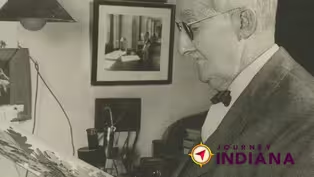
"Botany is My Game": How Charles Deam Catalogued Indiana's Plant Life
Video has Closed Captions
Clip: S7 Ep1 | 5m 21s | Charles C. Deam collected tens of thousands of plants from every corner of Indiana. (5m 21s)
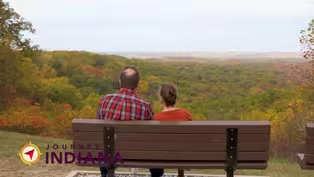
Rolling Along: There Are So Many Ways to Enjoy Indiana's Largest State Park
Video has Closed Captions
Clip: S7 Ep1 | 5m 59s | 1M+ people visit Indiana's Brown County State Park each year. It's not hard to understand why. (5m 59s)
Providing Support for PBS.org
Learn Moreabout PBS online sponsorship













Support for PBS provided by:
Journey Indiana is a local public television program presented by WTIU PBS