
Wildlife, Angling, Easy Riders and Mandy
Season 4 Episode 9 | 26m 47sVideo has Closed Captions
Wild horses, adaptive biking, ethical fishing, and conservation at Gold Butte National Monument.
Explore Nevada’s wildlife, trails, and waterways with Outdoor Nevada. Visit the Spring Mountains to learn about wild horses, try adaptive mountain biking near Blue Diamond, get ethical angling tips with the Nevada Department of Wildlife, and meet a park ranger protecting Gold Butte National Monument.
Problems playing video? | Closed Captioning Feedback
Problems playing video? | Closed Captioning Feedback
Outdoor Nevada is a local public television program presented by Vegas PBS
Wildlife, Angling, Easy Riders and Mandy
Season 4 Episode 9 | 26m 47sVideo has Closed Captions
Explore Nevada’s wildlife, trails, and waterways with Outdoor Nevada. Visit the Spring Mountains to learn about wild horses, try adaptive mountain biking near Blue Diamond, get ethical angling tips with the Nevada Department of Wildlife, and meet a park ranger protecting Gold Butte National Monument.
Problems playing video? | Closed Captioning Feedback
How to Watch Outdoor Nevada
Outdoor Nevada is available to stream on pbs.org and the free PBS App, available on iPhone, Apple TV, Android TV, Android smartphones, Amazon Fire TV, Amazon Fire Tablet, Roku, Samsung Smart TV, and Vizio.
Providing Support for PBS.org
Learn Moreabout PBS online sponsorshipToday on Outdoor Nevada, we learn about our relationship and responsibility to the Nevada wildlife.
Then I hit the mountain bike trails with an inspiring group of riders like you've never seen.
From there it's back to the river to learn a little something about angling, and finally, you'll meet a new friend of mine.
All today on Outdoor Nevada.
♪♪♪ Nevada.
It's an adventure waiting to happen.
Waiting for you.
What do you say, you ready?
Because I am.
♪♪♪ (John Burke) There are parts of Southern Nevada where a wide range of wildlife roam the land.
One of these places is the Spring Mountains in the Willow Creek area.
I met up with Jonathan from the U.S. Forestry Service to learn more about the local inhabitants and the area.
Now, I've never been in this specific area before.
I'm kind of mad at myself about that, because it's so beautiful.
Where exactly are we?
Tell me more about this.
(Johnathan Stein) Yes.
A lot of people that have come to the Spring Mountains National Recreation Area have only really ever been to Kyle and Lee canyons, and that's all they know.
We're outside of the Cold Creek community here at Willow Creek, and we've only seen one other person and it's absolutely beautiful today.
-It's absolutely beautiful.
It's crisp, the air is so clean.
It's such a gorgeous area.
Now, what about this particular creek here?
What is this?
-This is Willow Creek itself that comes out of the mountains here and just is really a provider of life.
We have all kinds of birds and animals and plants and insects, and obviously this tree.
-What kind of tree is this?
-This is a cottonwood.
They love water so he's in the perfect place, and obviously he's eating healthy.
-That's the biggest cottonwood tree I've ever seen.
It's so big, we ought to name it.
This ought to be called the Jonathan tree, I think, this thing.
-I don't know if I could take credit for that one.
He's been here a lot longer than I have.
-Hey, you talked a lot about life in this area and the animals.
What animals are here?
-We have all kinds.
Just today we've seen deer and elk.
We have wild horses, wild burros, and then as we go down, we have mountain lions, foxes, coyotes, all kinds of species of birds, even down to the smallest insects, butterflies, ants, all kinds of things.
-Let's talk about if you encounter some of this wildlife, what should you not do?
-I definitely say you need to give them a healthy respect.
Respect their space, respect their bubble.
A lot of the animals, the deer and the elk, are going to be skittish of you and they're probably going to run if you try to approach.
But the animals more like the horses and the burros, sometimes they become habituated to people, and we want to keep people from feeding them and approaching them, obviously not trying to pet them or try-- God forbid-- to ride them.
We want to keep people-- give them a nice safe distance, a safe space.
Taking some pictures of them is great, but definitely give them their space.
And really when you see a mother with a baby, really respect those spaces even more.
They can get very protective at times.
-Well, I can see a temptation too where somebody would say it's a wild animal, this apple is natural, that's a match.
-Unfortunately, there's no apple trees around here, so it's not a natural food source for them in this ecosystem.
We want to make sure they're staying on those natural food sources, and even some of those foods that people have tried to feed them before, the animals can't process through their system and can make them very sick.
-Bottom line: Don't feed the animals, period.
-Yes.
We just want to keep them on their natural food sources.
We want people definitely to enjoy them, but enjoy them at a nice safe distance.
Take pictures and then just kind of leave them as natural as we can.
-Well said.
This sure is a beautiful area, isn't it?
-Oh, it's gorgeous.
♪♪♪ We started the day off in hopes of being able to see some wildlife.
We ended up seeing way more than we thought possible in a day.
It was fantastic.
But it was as the day wrapped up and some foul weather moved in that we saw just how bad and dangerous the interaction with humans and the wildlife has gotten.
So we're coming out of the Cold Creek area, and John, what's going on here?
-Unfortunately, these horses know that people in vehicles means food.
They have approached our vehicles, they're approaching us, they're approaching anyone driving down the road, and they're looking for food.
They're not out in the desert in the wildlands eating the food that's there.
They're here trying to get it from us.
We had the window open a second go, and we had a horse's head inside the vehicle.
-So just to be clear, these are wild horses and as tempting as it is to think this is a pleasant experience, it's actually kind of sad.
-Yes, and it's one of those things where not only is it bad for the animals, but we could be kicked, we could be bitten, all these things.
Ideally, we want to try to stay at least 40 feet away from the animals, and a good way to think about that is the length of a school bus.
But these animals won't stay 40 feet away from us.
They keep coming to us, so this is a good way to see that these animals have known that people is food and they're not scared of us.
-My question is what about at night?
-At night you can just imagine these animals are all on the roadway because they've been attracted to it by people feeding them in vehicles.
They associate people in vehicles with food, and in the middle of the night, it's dark, you might not see them.
Some of these animals are brown or black, and you may hit one.
Unfortunately, we have a lot of vehicle collisions with horses and burros on our roadways here in Nevada, and it never ends up well for the animal.
-Thank you for stopping to extend this shoot and do a little show and tell, because this is it.
This is what you were talking about.
-This is exactly what we want to avoid, and by showing it, we hope people can see that it does happen and it is real, and we want to protect these animals.
We don't want to hurt them.
-Beautifully said.
Here's the thing: We all have to do our part.
Yes, these are beautiful, majestic creatures, and we're used to seeing them in domestic, sport and service roles.
But these animals-- these animals-- are wild so please, when you see them, marvel at them from a distance and take a picture.
That's something you can hold on to for a long time.
It'll keep them healthy and thriving.
They deserve that.
♪♪♪ The men and women from the Nevada Department of Wildlife not only protect our state's wildlife and its inhabitants, they also make it so we can enjoy the outdoors.
I think it's important to not only learn from these folks but to get to know them, and today we're going to do just that.
My name is Abby Czarnecki.
I am the angler education coordinator for the southern region of the Nevada Department of Wildlife.
I teach fishing, pretty much, and angler and aquatic education encompasses all of it.
An angler is the all-around term for someone putting a fishing rod and fishing line into the water.
It's someone that is going fishing.
Instead of just saying you're fishing, it's the more scientific technical term, and that way you're not saying fisherwoman or fisherperson.
It includes fly fishing, so it includes all the different types of fishing too.
My family was big into outdoors.
We camped, we fished, we hunted.
One of my favorite hunting trips is with my dad.
We went bow hunting near Caliente.
My two kids love going out hitting one of the urban ponds or we're not too far from Lake Mead, and taking a paddleboard out and seeing what fish are below us is always fun.
My daughter is 15, so she's learning fly fishing too.
Seeing her go after like the little bluegill, just something to keep her going and casting, it's so neat to see like a new skill that they're learning and that they want to keep going with.
It's really nice being able to get them out and get some fresh air, just enjoying nature, playing in the dirt if that's what it takes.
I love getting out.
I love sharing my passion with other people, like being able to go outside and put a fishing rod in the water and catch something.
Even if you don't catch something, just being able to get out and be on the water is just so rewarding.
My most recent catch is-- well, I got a couple little ones last week when I was helping out up north, and then over the summer for-- I think it was Fourth of July actually, I got a good 20 to 24-inch rainbow trout up near my dad's.
You need to be prepared, so I always say know before you go: Know the weather, know the environment you're going to fish in, and be prepared.
Go to a local sporting goods store, talk to the guys that work there.
They're the ones that go fishing in the area.
If you have a fly shop nearby, that's even better.
And I say fly shop only because trout fishing is half of our environment.
At the fly shop, those guys know the bugs that those fish are eating, and that's like sometimes the secret to getting that big fish into your boat.
The secret to catching is a lot of time and patience.
Honestly these guys, they show you when they catch something, but there's a lot of in-between times.
They learn those waters, they play with the fish.
Like every single season, the fish will change what they're interested in seasonally.
One of my instructor volunteers actually taught us some really cool tricks on making sure like seeing the leaves in the spring, everything's bright and green.
Fish with those green lures or flies, the bright-colored stuff.
And then in the fall, everything's kind of dying off.
You know, the leaves are turning those darker colors, and that's when you bring out those red and orange colors too for your flies and lures or anything you're fishing with.
They have four missions for an ethical angler.
An ethical angler is someone that shares their passion, someone that leaves the environment better than they found it.
They also selective harvest, so they don't take everything they catch.
They do some catch and release.
And then to sum it up, you're also keeping that fishery strong, so you're also letting the little ones go and grow, and you're letting the big ones reproduce and create more.
So you're just taking a few of the middle ones and only what you'll be able to consume before it gets frostbitten.
Because honestly like one of the biggest wastes of fish is leaving it in the freezer too long or not preparing it for the freezer for a long period of time.
Part of being prepared too is having that fishing license.
So if you're 12 to 17, it's a junior license, and then if you're over 18 and older, it's only around $40 for a fishing license for the whole year.
And then you just need to know your limits.
So with that fishing license, you can take two fishing poles out.
You can fish from the boat.
You can fish on the Colorado side or the Nevada side along the river if you have one of the shared waters, and it includes the trout stamp now since we simplified all of that.
We used to have stamps on our license, kind of like with hunting you do the duck stamp, so we had a trout stamp.
When we did the license simplification, we actually rolled the trout stamp into the regular fishing license, and that just means you can get your limit of trout wherever you're fishing.
So if you put your pole into water, know the fish that you're fishing for because if there's trout in it, you need to make sure you're prepared for that.
On the Colorado River, it's five trout now, and in the urban ponds, it's only three.
That way there's just-- you're not overtaking from what the fishery can actually naturally produce, and that also gives other anglers the opportunity to fish.
So the fishing license helps everything for the Nevada Department of Wildlife.
It helps the ramps, it helps the water, it helps law enforcement keep everyone safe that are out there.
It keeps fish, it helps with the stocking.
We also do grants as well, so that we're almost completely funded.
We're not funded by taxes.
We're actually funded from those fishing licenses.
The built-in taxes when you buy a fishing rod actually goes to the fishery as well.
So it just takes a lot of people to stock, to keep the water clean and safe and then share it with others.
Honestly I would love to retire in this job.
I really do.
I have an amazing team that does everything from hunting, fishing, archery, wildlife ed.
It takes like a lot of us, but we definitely make sure we touch as many people outdoors or online right now, so all of it.
♪♪♪ You know, one of my favorite things about getting outdoors is mountain biking, it really is.
I love the challenge of going up a hill and the thrill of going down.
I love the fresh air, and you can always do it with people you really enjoy spending time with.
Well, today I get the honor of spending time with somebody who helps make this all possible for people who couldn't do it on their own.
♪♪♪ Bill Lasher is a man who does not waste a moment.
An accident took away his ability to walk, but it inspired him to never stop moving, no matter what the challenge or where it took him.
♪♪♪ (Bill Lasher) So then the final thing is you just roll the front end off.
Everything I've ever made was something that I had an interest in, I wanted to be able to do or to make for myself.
So when it came to the handcycles, it was about wanting to go and get into nature, wanting to go off-road.
So I used to bike a lot on road, and there was this big event of a few hundred miles long over several days.
The idea was that I'm training sometimes up to 50 miles a day on a road and, you know, nice pavement and everything, and I'd see a road shoot off into the woods and I thought, I wonder where that goes, though my bike couldn't go there.
So that was kind of the seed to say let's make an off-road handcycle like this so I can go shooting off into the woods.
And that's the beginning of it.
-You mentioned it has a battery.
So how does that work?
Tell me about the battery.
-So the motor and the battery is a complete game changer when it comes to a handcycle and you're riding with mountain biker friends, able-bodied mountain bikers.
The handcycle is fast downhill, pretty fast on a flat, but going uphill, it's kind of slow because of your arms compared to a mountain biker's legs.
So with the motor that lives right here, you have the ability to use the motor with a throttle, which is this hand-crank right here, is your throttle.
Or you can use the motor with boost assist so as you're pedaling, it assists and gives you extra power.
So maybe if you're pedaling up a steep hill, you could maybe only go three miles an hour.
But with boost on, you can set whatever level of boost and maybe you're going seven or eight or nine miles an hour and you're keeping up with any mountain biker friend that you want up the hill.
A lot of times it's hard to get good cardio exercise as an individual in a wheelchair, and this is something that even though you have an e-motor to help give you some boost, it's something where you can burn calories.
You can exercise your muscles.
You can lose weight from a stagnant lifestyle.
I always call them little happy faces going through your bloodstream, which is the endorphins that you have running through your body that just give you that just positive feeling of having done something awesome.
People from around the globe have strapped into Bill's all-terrain handcycle.
Max is a disabled veteran from Germany.
He lost the use of his legs in a motorcycle accident while serving.
He's a big fan of Bill, the handcycle and the trails in Nevada.
He loves the feeling he gets when he rides.
(Max Gretschmann) Fresh air, it's no stress.
It's less people, less things you have to be worried about.
I think it's super healthy having a workout.
Most important is having fun.
So if you have fun, that's the most important thing, so you can enjoy it.
Even if it's super exhausting, you're super proud about it.
You always have a good feeling.
You have such a good time.
So yes, go outdoors.
Doesn't matter if you have a disability or not.
I would recommend everyone go outdoors if you live in Vegas.
I mean, Nevada is a beautiful state.
You can just hike, bike, whatever you want to do.
So many possibilities.
-So different disabilities, different bikes, or is it pretty much one size fits all?
-It's pretty much one size fits all in terms of being able to adjust your seat, angle your seat depth and everything through the back rest.
When it comes to the different disabilities, it depends on what your disability is.
So if you have a double-leg amputee for instance, then you don't need the leg hangers to hold your legs.
If you have a single-arm amputee, then the way you would connect to the hand-cranks would be different.
So in that respect, things are different for the different disabilities.
Knowing that you're making a positive impact in somebody's life, in their freedom, in their mentality of just knowing that I'm not stuck at home or I'm not stuck in this finite kind of wheelchair position.
I can get out, I can be active, I can do something extreme and exciting and have an amazing time and have it be worthwhile.
-All right.
So we've gotten to know this thing, what do you say we go hit the trail?
-Let's do it.
-Okay.
♪♪♪ Man, you guys-- you guys are animals.
I mean, I can barely keep up.
That was amazing.
These bikes are impressive, and you guys are impressive.
I can't tell you how much I appreciate you letting me come out here today, really do.
-We loved having you out here with us today.
-Thank you.
-You suppose maybe we could do this on another day and I get to ride one of those?
-Oh, absolutely.
We're ready for you.
-You'd be all right with that?
-Oh, yeah.
-You want to keep going?
-Let's do it.
-Let's do it.
-Who's finished?
Nobody!
-After you.
You know, I learned a little bit about those bikes today, and I learned a lot about the human spirit.
Given the right conditions, it just keeps going.
Kind of like the state of Nevada.
I got to go.
See you!
♪♪♪ As we make our way around Nevada, I get to meet great people who take care of our public lands, like Mandy Royal from the Bureau of Land Management.
Mandy's one of the people who takes care of the Gold Butte National Monument.
I got to know her, and you should too.
(Mandy Royal) When I was younger, I read Little House on the Prairie, and I fell in love with gardening and kind of just like producing your own.
So when I was like in the fifth grade I started gardening, and that's where I fell in love with plants.
So I kind of knew I wanted to work with plants or animals, and when I went to college, I majored in environmental science and management.
Initially I was animal science, but I discovered I do not like blood so I thought the next best thing was protecting the land that they live on.
And when I first started, I was doing a lot of plant work, so I was doing seed collection in Moab, Utah.
But I was out there 10-hour days, all by myself, just collecting seeds, and I was like I really miss people and talking about this.
So after that is when I did an internship with the Park Service at Hovenweep National Monument, and I got to hike and talk to people every single day.
That's where I fell in love with being a park ranger, connecting people to the land and understanding why we protect it.
I just love talking to people because you never know who you're going to meet and what experiences they've had.
So every day, even though you might be going to the same spot, you're encountering new people with new stories, new ways of looking at things, especially here at Gold Butte.
If someone has made it out this far, because it is a drive, they probably have an amazing story to tell, or maybe they've been here before and have an amazing story.
That's one of my favorite parts is just hearing how different people have experienced the land and why they love coming back.
I love this area because it is so special, and though I might come visit it every so often, almost every week, every month, it's never the same experience because the weather changes.
The projects that we're doing here might change, the people you come with or the people you meet are different, so it's always a different experience.
But I love coming out here.
I do feel very protective, like this is my baby when I'm out here and if I see people out here, I'm like oh, I hope they love it as much as I do.
Or if I see them hurting the land, I'm like please don't.
That's my baby.
Please protect it.
So when I first came here, I actually did not work for the Bureau of Land Management at the time.
I was just an everyday public land user coming out here to explore, and when I first came out here, I was like really?
This exists two hours outside of Las Vegas?
So it was amazing to see it and what is hidden behind all these turns here at Gold Butte.
Every turn is like a different experience, a different view, and I just loved it.
So when you do get the opportunity to see people out here and see their faces when they're out here hiking or exploring, it is a nice feeling to see that people are enjoying the public lands out here.
Once you leave, when you're driving home, you won't forget because it's so beautiful out here at Gold Butte National Monument.
My name is Mandy Royal.
I am a park ranger for the Southern Nevada District for the Bureau of Land Management.
Thanks for everything, Mandy.
See you soon.
♪♪♪ Support for Outdoor Nevada comes from Jaguar Land Rover Las Vegas.
♪♪♪ Inspiring the spirit of adventure with confidence in any terrain or condition.
We're proud to help introduce a new generation of adventurers to the diverse experiences that our state has to offer.
Information at jlrlv.com.
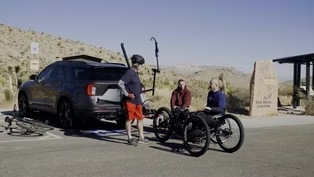
Accessible Mountain Biking with Adaptive All-Terrain Handcycles
Video has Closed Captions
Clip: S4 Ep9 | 7m 35s | Adventure is becoming more accessible with adaptive mountain bikes near Blue Diamond. (7m 35s)
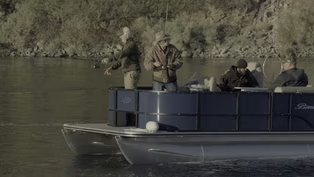
Beginner Fishing Tips & Ethical Angling with the Nevada Department of Wildlife
Video has Closed Captions
Clip: S4 Ep9 | 6m 58s | Learn ethical angling, beginner tips, and how fishing supports Nevada’s conservation efforts. (6m 58s)
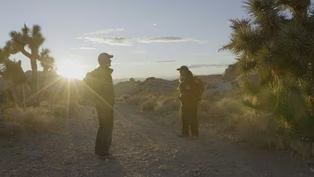
Meet a BLM Park Ranger Who Helps Protect Gold Butte National Monument
Video has Closed Captions
Clip: S4 Ep9 | 3m 16s | Explore Gold Butte National Monument with a BLM park ranger. (3m 16s)
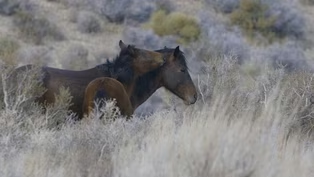
Wildlife Wonders at Willow Creek: Exploring Nevada’s Spring Mountains
Video has Closed Captions
Clip: S4 Ep9 | 6m 28s | Explore Willow Creek in the Spring Mountains & learn how to protect Nevada’s wildlife and habitats. (6m 28s)
Providing Support for PBS.org
Learn Moreabout PBS online sponsorship












Support for PBS provided by:
Outdoor Nevada is a local public television program presented by Vegas PBS