
William Connell, Ph.D.; Michele N. Siekerka; Anika Bhatnagar
9/2/2023 | 27m 57sVideo has Closed Captions
William Connell, Ph.D.; Michele N. Siekerka; Anika Bhatnagar
Steve welcomes William Connell, Ph.D., Seton Hall University, for a discussion about the history of Italian Americans; Michele Siekerka, President of NJBIA, discusses changes in tourism at the Jersey Shore; Jacqui Tricarico goes to the NJ Sharing Network 5K Celebration of Life to speak with Anika Bhatnagar, Youth Volunteer of the Year, about educating her peers about organ and tissue donation.
Problems playing video? | Closed Captioning Feedback
Problems playing video? | Closed Captioning Feedback
Think Tank with Steve Adubato is a local public television program presented by NJ PBS
William Connell, Ph.D.; Michele N. Siekerka; Anika Bhatnagar
9/2/2023 | 27m 57sVideo has Closed Captions
Steve welcomes William Connell, Ph.D., Seton Hall University, for a discussion about the history of Italian Americans; Michele Siekerka, President of NJBIA, discusses changes in tourism at the Jersey Shore; Jacqui Tricarico goes to the NJ Sharing Network 5K Celebration of Life to speak with Anika Bhatnagar, Youth Volunteer of the Year, about educating her peers about organ and tissue donation.
Problems playing video? | Closed Captioning Feedback
How to Watch Think Tank with Steve Adubato
Think Tank with Steve Adubato is available to stream on pbs.org and the free PBS App, available on iPhone, Apple TV, Android TV, Android smartphones, Amazon Fire TV, Amazon Fire Tablet, Roku, Samsung Smart TV, and Vizio.
Providing Support for PBS.org
Learn Moreabout PBS online sponsorship- [Narrator] Funding for this edition of Think Tank with Steve Adubato has been provided by NJM Insurance Group.
Serving New Jersey'’s drivers, homeowners and business owners for more than 100 years.
Citizens Philanthropic Foundation.
New Jersey'’s Clean Energy program.
Lighting the way to a clean energy future.
Robert Wood Johnson Foundation.
Working for a more a healthier, more equitable New Jersey.
Horizon Blue Cross Blue Shield of New Jersey.
Here when you need us most.
New Jersey Sharing Network.
The Turrell Fund, supporting Reimagine Childcare.
The Port Authority of New York and New Jersey.
Moving the region through air, land, rail, and sea.
And by The New Jersey Economic Development Authority.
Promotional support provided by New Jersey Globe.
And by New Jersey Monthly.
The magazine of the Garden State, available at newsstands.
[MOTIVATIONAL MUSIC] - We're now joined by Dr. William "Bill" Connell, who is La Motta Chair of Italian Studies at Seton Hall University, one of our higher education partners.
Good to see you, doctor.
- Great to see you, Steve.
Thanks for having me on.
- You got, listen, obviously I grew up as a young Italian American boy in Newark, New Jersey, all around Italian American culture my whole life.
Connell is not an Italian, just clarify this for me.
- No.
- It is not an Italian last name - It is an Irish name.
And my parents came from Wisconsin with Irish and German backgrounds.
And so there's probably not a day in my life that someone doesn't ask, "Why have you devoted your life to Italian history, Italian American history?"
- Go ahead, answer it.
- And well, there's a long one.
But the short answer, as a boy of seven, playing stickball in the streets of Yonkers with Italian American boys, their nonne, their grandmothers would come out to give the kids cookies at three o'clock.
And the grandmothers didn't speak English and they would give two cookies to the little Irish boy who said a word in Italian.
- By the way, Bill, let's have a whole separate conversation on Irish-Italian interaction and the disproportionate number of marriages between, my wife happens to have Irish background as well.
There's an Irish-Italian thing that is fascinating on many levels.
- Absolutely.
- Let's leave it at that.
Okay?
- Another show.
Great.
- That's another show.
Real quick.
Do this for us.
There are 17 million Italian Americans living in the United States.
Italian American culture is deeply embedded in certain communities, but at the same time, growing up in Newark, Sunday dinner was what it was.
Gravy is gravy, not sauce.
We'll go into, that's another conversation as well.
But growing up in the community I grew up in, virtually everyone was Italian American.
It was a big part of our lives.
As kids and their families started moving and spreading out all over the place, I was in Newark, New Jersey.
To what degree are you concerned about Italian American culture being lost in our country?
- Well, first of all, it's, in the country, fifth largest ethnic group according to the census.
New Jersey, however, it's the single largest ethnic and racial group.
- Number one.
- So it is an issue with assimilation, mixed marriages, moving to the suburbs.
And so it's a question that we address in the book that I've just published.
- Yeah, talk about that book, Bill.
- Yeah, it's called "The Routledge History of Italian Americans."
Big book, 700 pages.
It's an attempt, my attempt, and attempt of a good number of scholars and collaborators, there are 40 of us, to give a textbook for Italian American history so that in our growing our classes that have growing numbers of students in Italian history would have a good textbook that tells the accurate story.
- And that brought on a full, what award did that win?
- Oh, yeah, so we just, I was flown to Rome.
- Fulbright award?
- I was flown to Rome for a ceremony at the foreign ministry and the American embassy.
The Fulbright relationship between the United States and Italy is 75 years old.
And so this project was awarded that special honor.
It was really a great thing.
- Congratulations, Bill.
Do this for us.
I wanna ask you about this and I want you to expound upon it.
So my grandfather, Luigi Calvello, came to the United States from, people say Naples, but you know well that it wasn't really Naples.
Many people came from small towns, villages outside of Naples, but it was Provincia di Avellino And I know you know what I'm talking about.
But he came here in 1919.
Seven years later, Vincenta Calvello, he sent for her because he came here to make a living.
And until he could afford her coming here, that's when she came here.
Seven years they waited for each other.
That's another story.
Why do I raise this?
Because many Italian Americans whose parents and grandparents came from Italy talk about immigration in a certain way and believe that immigration today is dramatically different.
Am I oversimplifying that?
- I think immigration today involves a lot of the same issues, financial stress, families and their homeland.
Very important that way.
But there's something special about the Italian American experience.
I see it as really two experiences of migration, especially strong in the case of Newark, which you just mentioned.
That is, there's a distancing, a sense of alienation, of wondering where your future is going to be that comes from leaving the homeland, from leaving Italy.
But there's a second migration that takes place in the 1960s, '70s, that you know very well from Newark.
Your father combated, did everything he could, to deal with that sense of alienation and bring people together.
But there's also a sense of old homelands of Little Italy's being lost, that I think, that second era of, second aspect of alienation is important for Italian Americans.
- By the way, the term Little Italy, people talk about Little Italy is if it's Mulberry Street in lower Manhattan, which is not what it was.
But our family, there was a Little Italy in what was called the Old First Ward in Newark, New Jersey by St. Lucy's Church, the St. Gerard Feast, take a look at our programming we've done on that.
The reason I say that, there are Little Italy's all across this nation and in those communities, where my parents, grandparents, were from, they were poor, they were together, they supported each other, but to not overly complicate it, but many of those communities don't exist any longer.
Is that fair to say, Professor?
- Yeah, sure, I mean, in Newark, there were at least three.
I mean, there's also, in the Ironbound, there was a Little Italy and also around St. Rocco's Parish.
- That's right.
- Largest was north, was the north ward.
- In my neighborhood, right.
- And where you were, around St. Louis.
But yeah, a lot of them have disappeared, and yet there's an attachment and nostalgia.
So as you well know, I've gone to weddings and funerals at St. Lucy's.
There's this return from the suburbs back to these old places.
The church is very important in those... - And by the way, Bill, and I'm sure in Bill's book, "The Routledge History of Italian Americans" will also explain this, I'm sure, that the disproportionate number of Italians who came to the United States, or the first wave in the 1890s and other, the immigration effort, or the immigration initiative from Italy to United States, not from the north, but from the south.
- Yeah.
- Poor, difficult to find work, a totally different culture than Rome and Florence and other places.
So when people talk about Italians in Italy, Sicily's another story, but the bottom line is, many Italy's are there not, real quick, before I let you go, Bill?
- Yeah, yeah, yeah.
So they settle in what are known as urban villages.
So often people from the same town would gather together and recreate a kind of village with a parish church, with a baker, with a sausage shop, with a printer, with a mutual aid society.
And it would be a kind of reproduction of the town in Sicily or Provincia di Avellino or Calabria or wherever.
- Do you know what that was called?
They called the paes.
- Yeah, the paes.
The paes is (laughs) - Sorry.
- And the people within, they were the paesans, you know, within.
- Paesans.
(laughs) We'll have an offline conversation.
Professor, Dr. Bill Connell, La Motta Chair of Italian Studies at the Seton Hall University.
Thanks, Bill.
We'll talk offline more about this stuff.
I'm too passionate about it.
It's an Italian thing.
Stay with us.
We'll back after this.
- Be well.
To watch more Think Tank with Steve Adubato, find us online and follow us on social media.
- She's back by popular demand, Michele Siekerka, President and CEO, New Jersey Business & Industry Association.
Good to see you, Michele.
- Great to see you, Steve.
- We are gonna put up your website and talk about a whole range of business issues and also plug the fact that "New Jersey Business," the publication that NJBIA puts out, is our media partner.
Michele, let me ask you this.
The governor, Governor Murphy's budget, $54.3 billion budget, legislature passes it as well, governor signs it.
What do you like about it?
And then we'll talk about what you don't like.
What do you like about it?
- Yeah, so what we like about it, first and foremost, is that we have the sunset of the corporate business tax taking place at the end of this year.
So December 31st, say goodbye to the extra surcharge that we had on New Jersey's corporate business tax, which is 2.5%, which made us not just the largest corporate business tax in the nation, but an outlier by very much.
CBT, corporate business tax, will go down to 9% on January 1.
That puts us the fourth most expensive in the nation.
So still not as competitive as we would like to be, still a lotta work to do here, but definitely a move in the right direction.
- Stay on that, Michele.
- And Steve, there's also some other corporate tax reform I know we'll get to.
- Can we do that?
But before we get to that, there are some in the Democratic Party and some on the left, progressives, liberals, and I don't mean that in a negative way, it's just those who identify in that way, "Hey, what are we doing ending this surcharge?
We need to keep that going.
Why are you benefiting the wealthy?
Why are you benefiting the corporations?"
And there was pressure on Governor Murphy not to sunset the corporate business tax.
Is that an accurate description, Michele?
- Oh, there was so much disinformation around this.
First of all, let's talk about the corporations that create tens of thousands of jobs here in the State of New Jersey, our largest companies.
Let's talk about the need to keep New Jersey competitive and ensure that we do not invite another corporation to leave the State of New Jersey, right?
Competitiveness matters.
Cost of doing business matters, right?
These are real jobs.
And you know, Steve, you hear me say this all the time.
I'm so tired of this corporate greed, corporate welfare.
How about, these are the job creators.
We create livelihoods, right?
Let's celebrate the job creators.
Let's not continue to demonize them.
- Is there anything else about the budget that you like other than the sunsetting of the corporate business tax?
- There is some other very complex corporate property tax reform that we achieved in this.
We won't go into the detail of it because it's really nitty-gritty.
But suffice to say that, again, there are some relief areas where we will now be much more competitive with our neighboring states on some very complex taxes.
We also like the fully funded pension.
That's very important.
That's a debt that we need to take care of.
We like the debt defeasance that we see in there.
And we like the investment in infrastructure and higher education that we see in there.
- Michele, let me follow up on a totally different issue.
Maybe it's not totally different, but it is the issue of property tax reform.
Governor Murphy, many of the Democrats, talk about property tax reform, tax credits.
The StayNJ program, okay, in an effort to keep people, seniors, in New Jersey.
If you are a senior and you earn less than $500,000, in January of 2026, and if I'm wrong, you'll tell me, in January of 2026, you'll get up to a $6,500 property tax credit, which is a good thing on a lotta levels.
But January 2026, it happens.
That does help the business community because businesses own property, correct, Michele Siekerka?
- Unfortunately, that's incorrect, Steve.
It is true, New Jersey businesses pay approximately 50% of the property taxes.
However, they are not part of this program.
In fact, they're not part of ANCHOR either.
You know, the ANCHOR program is the other property tax, and let me say this, relief program.
None of this is reform.
It's relief, okay?
Reform is when you in and you change the rules from the beginning on how you tax, all right?
That's reform.
- That's not semantics?
- No, no, 'cause relief is like we're throwing a lifeline.
We're throwing money at something.
Reform is when you go in and you change the system.
The system needs to be changed.
And neither of these programs do that.
Look, I am all for keeping seniors here.
Please, okay, I'm not gonna say that I'm not supportive of this money back to senior community, right?
I don't wanna see seniors leave.
However, it's a check, that makes it vulnerable.
It's a credit, okay, right?
It makes it vulnerable.
When the money's not there, it's not gonna be there, okay?
And you said it, January 2026.
You know what January 2026 is?
The beginning of the next administration in New Jersey.
- So Governor Murphy- - Okay?
- Will not be in office?
- Correct.
(laughing) - Coincidence?
- You look at the timing and you can draw your own conclusions.
- So but, Michele, when you say, you know, reform is what we need, be more specific as to what is one action that needs to be taken to have our property taxes more, to be reformed versus relief, as you said, "Here's a check."
- Absolutely.
- "Only if we have the money," go ahead.
- We need to go back and look at how we fund education in the State of New Jersey.
Because the vast majority of property tax falls on how we fund education.
And until we are willing to sit down at the table and go back to how we fund education, K-12 education in New Jersey, we will never, ever start the pathway to true property tax reform.
- Be more specific.
Are you saying that having property taxes be the primary source of how we pay for public schools is a problem, the problem?
- It's a large part of the problem, absolutely.
- Where would the money come from?
Where should the money come from?
- Well, that's why we need to sit down and we need to understand comprehensively how we can fund education in the state so that we can have true reform.
- Interesting.
Complex stuff, no easy answers.
Can we try this one?
I'm curious about this.
You and I were just talking during a quick break about the Jersey Shore.
They were taping this toward the middle back end of July 2023.
It'll be seen a little bit later.
Business at, even if this is seen in August, September, business at the Jersey Shore, talk to us about it.
- So I hear very good things.
I'm fortunate enough to have a home down the Shore, so I am boots on the ground.
And trust me, I ask the business owners down there, "How's it going?"
The mixed bag I hear is, number one, activity is great, right?
We absolutely, we've got our J-1 workers, the visa workers, here, right, to supplement the workforce, right?
So that's good.
The workforce this year looks pretty strong, so that's good.
You know, stores are open and things are happening, right?
But what we do hear a change in is that, at the Shore, we don't have as much turnover on weekly tourism.
People own their homes, and they're staying there and they're not necessarily renting their houses to the extent that they did before.
And therefore, you're not having every week, a new family come in and then spend that money on new T-shirts, new sweatshirts, eating out every single night, right?
When you're living there, maybe you're eating out a couple of nights a week, you're buying one or two shirts for the season, right, you're doing your shopping, but not like when it turns over every single week.
So there's highs, there's lows.
The weekends seem to be busy.
I gotta tell you, during the week's a little quieter than I've seen in the past.
And I think that has a lot to do with a lotta people who own their homes aren't necessarily renting out their homes like they did in the past.
- We've got a minute left.
People use the term business-friendly.
The governor has, many times, we'll book the governor again for an interview in the next couple months.
What does it mean to be quote, truly "business-friendly" in your view?
- Well, listen to what the business community needs and then try to address that.
Business-friendly is slow and steady progress toward things and no shocks to the system.
It's allowing predictability so that businesses can make investments in the long term.
It's about long-term planning and understanding what drives up the cost of business from, as I say, the boots on the ground.
I think we lack some of that here in the State of New Jersey.
In fact, we lack a lot of it, because we are the most expensive state to do business in.
We're very happy recently.
Look, our economy's doing very well in New Jersey.
Let's celebrate that.
We had some good rankings recently that we're excited about.
But within even those good rankings, we're still recognized as not a very business-friendly state.
And I think we need to listen more closely to the needs of the business community.
- That's Michele Siekerka, President and CEO of New Jersey Business & Industry Association.
As I said, we will have the governor back, Governor Murphy, and he will make the case as to, as he sees it, why New Jersey is very business-friendly.
Thank you, Michele.
- Thanks to much, Steve.
- Stay with us, we'll be right back.
To watch more Think Tank with Steve Adubato, find us online and follow us on social media.
- Recently my colleague Jacqui Tricarico and I went to the New Jersey Sharing Network 5K.
The Gift of Life.
That's what it's all about, organ and tissue donation.
At the 5K, Sharing Network 5K, Jacqui spoke with Anika.
She's the New Jersey Sharing Network Youth volunteer the year.
Now, Anika's father needed a kidney transplant.
Anika's mother was a perfect match.
Jacqui she stood up with Anika.
and had a compelling and important conversation.
Here it is.
- Hi, I'm Jacqui Tricarico on location at the New Jersey Sharing Network's 5K here in New Providence, New Jersey.
And I am so pleased to be joined by Anika Bhatnagar who is a high school student but also New Jersey Sharing Network's Youth Volunteer of the Year this past year.
That's amazing.
Anika, tell me, first I wanna hear about your dad and his health journey that led to kidney donation.
- Of course, so my father had a condition known as IgA nephropathy and I'd known that he'd had it his entire life but we only really seriously started considering donation as an option about a couple years ago when we realized that his kidneys would go into failure and he would need a life-saving transplant.
And that is when discussion started about my mom potentially becoming a donor for my father.
So that's how that situation kind of arose.
- So talk about that conversation in your family 'cause you're the only child, right?
So talk about that conversation and how things came about that you all decided this was gonna be a good situation to have your mom be the donated kidney.
- Yeah, so obviously it was a difficult conversation.
It's always a daunting thing just to even talk about.
But fortunately, my family is very close.
We believe in having really open conversations.
So it was a pretty easy and natural conversation for us to have about the different realistic options that we had for my father.
And so, one of the first things we considered was actually organ donation.
And prior to this, we really had no idea what organ donation was but out of necessity we kind of had to research about it, learn about it, and through that we realized that this might be the most viable option.
And my mother was completely selfless.
She had no qualms about doing it at all.
And so, that's when the first conversation started and we decided to go from there, see if she was a match, and thankfully, she turned out to be.
- So she's a match and then they are getting ready for this surgery.
- Yes.
- How did you feel with both of them having surgery simultaneously?
I know you weren't able to be in the hospital because it was during COVID times and there was restrictions on visitors being able to be there.
Talk about that journey for you, that emotional journey for you and how you took that as an opportunity though to learn more and educate people about organ and tissue donation.
- Yeah, honestly, it was incredibly difficult because I am an only child.
I am extremely close to my parents.
Both of them are my best friends.
And so, it was really tough when both of them had to go into the same like, you know, surgery in the same place, three to four hours away.
You know, I couldn't really do anything about it but thankfully, we had an amazing support system 'cause my family's from India, so my parents moved here and we don't really have any family here but thankfully, we have some amazing friends to make up for it.
So my parents' friends were an incredible support system.
They took them to the hospital, brought them back, went to all of their appointments and they also made sure to keep me in the loop which was something that was really important for me as like a 14, 15 year old seeing both of my parents go into this very invasive surgery.
But thankfully, through FaceTime and everything, I was able to keep up and I was able to get live updates and I also was able to come visit them in the hospital, I think the day after the surgery.
So that was really helpful.
But in terms of the emotional journey, it was definitely a lot to process.
Thankfully, we kept a more positive attitude whenever we talked about it.
We didn't shy away from conversations.
So I think knowing what I was getting myself into fully and knowing how it was gonna play out really helps me process it as it was actually happening.
And yeah, sorry.
- Oh, no, yeah, I was just gonna say too, and obviously, they're both doing so well now, tell us about their health.
- Yeah, so they're doing incredible now.
You know, they're both taking excellent care of their health even more than they were before.
My dad goes on like mile walks every day at least.
So he's staying active, my mother as well.
So it's just really nice to see them healthy and happy and I think it's brought us together as a family as well.
- And when did New Jersey Sharing Network come into the picture for you and your family?
- Yeah, so we actually, so typically, someone finds out about NJ Sharing prior to their transplant but ours was a little bit different.
We got involved with them after our transplant was over.
So throughout our research before the transplant, we realized how many people didn't know what organ donation was because we ourselves didn't even know what organ donation was until we had to.
And so, that really got us thinking like, how many other people out there that don't even know about this?
And that really inspired us to get involved with NJ Sharing to reach out to them, go to their informational sessions, and yeah, kinda just sparked from there.
It was very natural.
We got in contact with a bunch of really cool people from here and I just really wanted to help out in any way that I could, especially being a teenager.
- Well, and you took that such a big step further.
You didn't say, "Okay, this is a great organization, "I wanna be a part of it."
You then went to your school and said, "I wanna start this club here, Donate Life Club."
Talk about that, what is it?
- Yeah, so Donate Life Club is it club at my school, it's about 22 member club.
And our mission is to, again, similar to NJ Sharing, raise awareness about organ and tissue donation.
One thing that was really important for me was raising awareness amongst teenagers like myself, right?
Because you know, we're gonna grow up, we're gonna be the adults of tomorrow and it's really important that we have all the information necessary to make an informed decision when deciding whether or not to actually become an organ donor and register.
So that was one of my main missions when starting this club.
And I think it was kinda just born from that desire to bring awareness to my peers.
And then we started this club, it's our first year but we've done a lot of really cool stuff.
Set up informational booths, done 5Ks like this one, raised money, so it's been really cool to kinda share my passion with other people and see them get involved as well.
- And what has been the reaction from your peers on this?
Because like you said, 17, that's typically when people go and get their license, get their driver's license for the first time.
Getting them to realize how important it is to consider checking that box to be an organ and tissue donor.
Talk about the response from your peers and your school.
- Yeah, so it started right off the bat with our informational session that we had to generate interest for the club.
You know I got a lot of just stares, a lot of like, "What are you talking about?"
Which I completely understand because that would've also been my reaction.
So I was really happy to kinda sit down and dispel those myths for people because I know that people have a lot of apprehensions about organ donation, a lot of questions.
So right off the bat there was a lot of that going on which was again, completely natural and I completely understood.
But I was really glad that I was the one that was able to kind of sit down and explain to them like this is not as daunting as it seems.
It's not that scary.
It's really easy to get involved even if you don't personally wanna become an organ owner, there's tons of other ways to support those who are organ donors and recipients.
And so, I think over time the reception to this club has been much better because I think people are becoming more aware, hopefully because of our efforts, they'll be more open to this idea in the future as well.
- Definitely, and talk about what it means for you and your parents and your friends to be here today at the 5K event.
- You know, it's so amazing.
We actually did this 5K last year as well with the same two friends that are here with me today.
So it's really incredible because two years ago, I never would've imagined that I could even be standing here with my friends and with my parents doing this walk.
So it means a lot to me that so many people are here and that it's such a successful event and that I get to even be like a small part of it.
It's really incredible.
- And finally, your parents must be so proud of you.
Are they?
- I hope so.
(Jacqui laughs) - I'm sure they are.
I'm sure they're beaming with pride with what you're doing and taking a situation that was scary and a lot of emotions and making it into a positive.
Anika, thank you so much for talking with us and have a great time at the 5K event today.
- Thank you.
- [Narrator] Think Tank with Steve Adubato has been a production of the Caucus Educational Corporation.
Funding has been provided by NJM Insurance Group.
Citizens Philanthropic Foundation.
New Jersey'’s Clean Energy program.
Robert Wood Johnson Foundation.
Horizon Blue Cross Blue Shield of New Jersey.
New Jersey Sharing Network.
The Turrell Fund, supporting Reimagine Childcare.
The Port Authority of New York and New Jersey.
And by The New Jersey Economic Development Authority.
Promotional support provided by New Jersey Globe.
And by New Jersey Monthly.
NJM Insurance Group has been serving New Jersey businesses for over a century.
As part of the Garden State, we help companies keep their vehicles on the road, employees on the job and projects on track, working to protect employees from illness and injury, to keep goods and services moving across the state.
We're proud to be part of New Jersey.
NJM, we've got New Jersey covered.
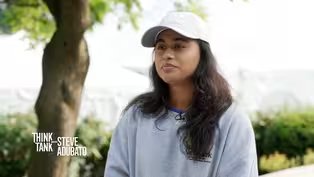
Educating Others About the Value of Organ & Tissue Donation
Video has Closed Captions
Clip: 9/2/2023 | 9m 10s | Educating Others About the Value of Organ & Tissue Donation (9m 10s)
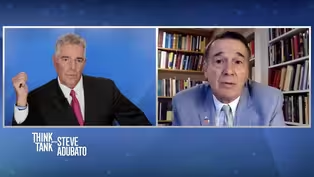
The History and Impact of Italian-Americans in New Jersey
Video has Closed Captions
Clip: 9/2/2023 | 9m 32s | The History and Impact of Italian-Americans in New Jersey (9m 32s)
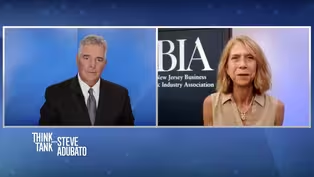
The Negative Implications of the New Corporate Business Tax
Video has Closed Captions
Clip: 9/2/2023 | 9m 59s | The Negative Implications of the New Corporate Business Tax (9m 59s)
Providing Support for PBS.org
Learn Moreabout PBS online sponsorship
- News and Public Affairs

Top journalists deliver compelling original analysis of the hour's headlines.

- News and Public Affairs

FRONTLINE is investigative journalism that questions, explains and changes our world.












Support for PBS provided by:
Think Tank with Steve Adubato is a local public television program presented by NJ PBS