Bower School of Music & the Arts
Wind Orchestra
2/22/2022 | 51m 40sVideo has Closed Captions
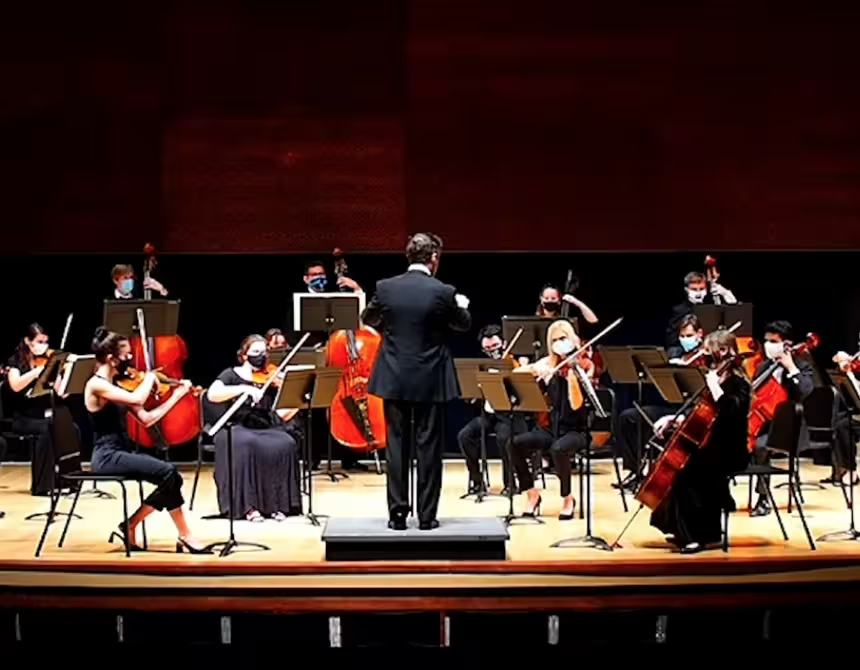
Join BSM’s Wind Orchestra for an evening of songs about home.
Join the Bower School of Music’s Wind Orchestra, directed by Timothy Yontz, in an evening of classics and new works about home.
Problems playing video? | Closed Captioning Feedback
Problems playing video? | Closed Captioning Feedback
Bower School of Music & the Arts is a local public television program presented by WGCU-PBS
Bower School of Music & the Arts
Wind Orchestra
2/22/2022 | 51m 40sVideo has Closed Captions
Join the Bower School of Music’s Wind Orchestra, directed by Timothy Yontz, in an evening of classics and new works about home.
Problems playing video? | Closed Captioning Feedback
How to Watch Bower School of Music & the Arts
Bower School of Music & the Arts is available to stream on pbs.org and the free PBS App, available on iPhone, Apple TV, Android TV, Android smartphones, Amazon Fire TV, Amazon Fire Tablet, Roku, Samsung Smart TV, and Vizio.
Bower School of Music & the Arts
All videos in the Bower School of Music & the Arts seriesProviding Support for PBS.org
Learn Moreabout PBS online sponsorshipGood evening and welcome to the Bower School of Music, we're glad you're here.
This evening's program centers around the theme of home and being home and feeling at home and that sort of thing.
The music that I selected for it comes from different, different genres, but different ideas that lead back to home.
The very first piece that we're doing is actually a fantasy on The Star-Spangled Banner.
It's a version of The Star-Spangled Banner.
It's a shortened version, but it's a very pretty version of The Star-Spangled Banner.
I chose it because, of course, we commemorated Veterans Day last week, and I just felt like what better way to start a program than thinking about our home here in the United States.
And what a wonderful place it is and honoring those men and women that sacrificed so much for us to be able to do what we do and be here this evening and enjoy this.
So the question always is from the audience.
If it's not really the Star Spangled Banner.
Do we stand up for it?
Do we stay seated?
What do we do?
And I don't want you to feel uncomfortable.
So I'm going to have you stand up.
All right.
And so when you hear the trumpet, here's your cue.
All right.
When you hear Owen, and raise your hand over when when you hear Owen and start the melody, you'll know it right, that's your time to stand out.
That way, you won't feel uncomfortable at all.
All right Star-Spangled Banner.
Elegy for a Young American was dedicated to John F. Kennedy.
This was composed by LoPresti back in 1967, which would be four years after the assassination of John F. Kennedy.
This is in honor of John F. Kennedy, and you'll hear it.
There'll be sadness in it.
There'll be angst in it.
There will be in some, some situations, like a little bit of jubilation, a celebration of life in it.
I told the students and just a personal story about myself, and that was that I was born in 61.
And there's a there's a situation in every generation where we remember exactly where we were at a certain time and I was telling them about, you know, being born in 61 and then his assassination being in the 63.
I would have been two years old, and I remembered watching the funeral procession on television as a two year old.
That's how impactful it was.
And so, you know, it's one of those things where we just think about those things that impact our lives.
They shape who we are.
They shape our whole.
They shape the way we do things.
And so this is a really moving dedication to John F. Kennedy Elegy for a Young American.
When you mention the name Eric Whitacre.
Some folks in the choral world just go gaga.
They just go crazy for Eric Whitacre's music.
Well, Eric Whitacre also wrote music for Wynben, and he wrote a number of pieces for us and one of them was called Godzilla Eats Los Vegas.
This is a really fun piece to play.
And this one here, Equus.
I was looking for something that gave kind of a drive home.
Well, Equus, I know what Equus is, what it was Equus mean.
You know what that means yet?
Horse.
That's right.
OK, so Eguus horse.
And so this is really driving piece goes all the way through.
And then at the end, that horse is racing for that finish line and you'll hear it right at the end.
So we hope you enjoy this wonderful Eric Whitacre piece - Equus.
It was nothing.
Yeah, that's a challenge.
I'm just in that piece, I'm just a timekeeper.
That's all I do.
I'm a I'm a human metronome during that whole piece.
That's a lot of fun.
This next piece, Letters from Home by Aaron Copeland.
The storyline behind this was he was asked to write this piece of music, and it doesn't.
I'm not sure how he got there, but he got to some little village in Mexico to write this.
To write this piece, so he's in this little village in Mexico, and he's like, there's like no electricity, he's working by candlelight.
It's like the old, you know, story composers working by candlelight to get this done.
A sad part of it is that in the time that he was there, his mother actually passed away and he didn't get notice until way later because mail was taking so long to get to him, so he wasn't able to get back for his his mother's funeral.
So while he was there and this was in 1944 during the second World War.
So while he was there, he really thought about his loneliness and that sort of thing.
And then also how lonely it must be for the soldiers and the folks overseas who are fighting for us.
And how important it was for them to get those letters.
And so you'll hear in this piece, there's just very, very beautiful writing in this and moments of sadness, moments of anger.
And it's it's just one of those things where, you know, he wanted to get that those letters from home and he felt like our our folks overseas should do the same.
This is Letters From Home.
Aaron Copland.
And just like that, we come to the end of our program.
Academic Festival Overture by Brahms, was a piece that he did because he was given a Ph.D. in 1880.
And so he wrote this piece with the idea that he would take four alma maters and put them in this piece.
And he actually then conducted it at the the program where it was premiered then in 1881.
It was for orchestra and then a large number of colleagues said, this is a great piece.
You should, you should, you know, transcribe it for wind band.
And so thankfully for us, he did.
And so we have this, this transcription, this isn't his transcription, but we do have a transcription that that we're playing this evening.
Interesting thing about transcription is that sometimes they work really, really well for orchestras and really horribly for wind bands because and I'll tell you why.
The reason is that there's all this.
There's a lot of string stuff, you know, in orchestra this all that string stuff that goes on.
And so there's all the strings that, well, you know, you put that sometimes in woodwind parts and that sort of thing, and they're like flying on the keys to try to make everything happen.
And it just doesn't transcribe, sometimes really well.
This one does.
So I think you're going to really enjoy this.
We're really happy that you were here this evening.
Our next concert is February 3rd.
It's right here.
And same time, it's a Thursday night at 7:30 on February 3rd, and Jeannie Darnell will be joining us and singing with the wind orchestra.
And we're really excited about that on that program.
So again, thank you so much for being here tonight.
This is Brahms Academic Festival Overture.


- Arts and Music
The Best of the Joy of Painting with Bob Ross
A pop icon, Bob Ross offers soothing words of wisdom as he paints captivating landscapes.












Support for PBS provided by:
Bower School of Music & the Arts is a local public television program presented by WGCU-PBS