
Winemaking
Season 5 Episode 2 | 26m 41sVideo has Closed Captions
Explore a forgotten age when winemaking was Southern California’s principal industry.
Before the movies, before aerospace and oranges and oil, there was wine. This episode explores a largely forgotten age when winemaking was Southern California’s principal industry. We’ll pick grapes from the oldest vines in Los Angeles, learn about the laborers who built the industry, and meet enterprising winemakers who are resurrecting a long-lost Southern California tradition.
Problems playing video? | Closed Captioning Feedback
Problems playing video? | Closed Captioning Feedback
Lost LA is a local public television program presented by PBS SoCal
Winemaking
Season 5 Episode 2 | 26m 41sVideo has Closed Captions
Before the movies, before aerospace and oranges and oil, there was wine. This episode explores a largely forgotten age when winemaking was Southern California’s principal industry. We’ll pick grapes from the oldest vines in Los Angeles, learn about the laborers who built the industry, and meet enterprising winemakers who are resurrecting a long-lost Southern California tradition.
Problems playing video? | Closed Captioning Feedback
How to Watch Lost LA
Lost LA is available to stream on pbs.org and the free PBS App, available on iPhone, Apple TV, Android TV, Android smartphones, Amazon Fire TV, Amazon Fire Tablet, Roku, Samsung Smart TV, and Vizio.
Providing Support for PBS.org
Learn Moreabout PBS online sponsorshipMasters: So when did you first suspect that there was something special about these vines?
Holland: For years, when I talked to the El Pueblo people, they didn't know.
I sent an e-mail to UC Davis.
I told them about these, and what they said to me was, "Oh, are those the ones in Olvera Street?
We don't have those in our database.
Tell you what.
If we send you the collection kits to get leaf samples and, you know, tendrils, that kind of stuff, we'll do a DNA analysis for free."
Announcer: This episode of "Lost L.A." was made possible in part by a grant from Anne Ray Foundation--a Margaret A. Cargill philanthropy, and the Frieda Berlinski Foundation.
Masters: So what did the folks at Davis say?
Holland: Well, the e-mail they sent said, "Yes.
What you have is what's known as Vina Madre," Vina Madre, mother vine.
They recognized them almost right away because they, in fact, did have it in their database because it's the same grape as the Mission San Gabriel has been growing for century and a half, 200 years, and so we know that it came from there, but what they told is that it is a combination of the actual grapes stock that the Spanish brought up with them from Spain through Mexico when they were establishing the mission system, and somewhere early in its introduction, it cross-pollinated with a native local grape, wild grape called vitis girdiana.
Masters: These vines are a hybrid, a hybrid of imported Spanish grapes and indigenous California grapes... Holland: Yep.
Masters: and so you can make an argument that these are actually a California original.
It could be the oldest grape vines within the City of Los Angeles.
Holland: I would say so because if you're going to exclude Mission San Gabriel, which is in the city of San Gabriel, then, yeah, you're absolutely right.
These are the oldest vines in the City of Los Angeles proper.
Masters: So the kind of wine you make... Holland: Yes.
Masters: called Angelica, right?
Holland: Angelica.
The reason it's called Angelica was that the story's always been that it was invented in the City of the Angels, and its main purpose back in the day was sacramental wine for the Mass.
They couldn't depend on it coming by barrel from either Mexico or even from Spain or, you know, the old country... Masters: Right.
Holland: and so they decide to start growing it locally.
Since they saw these, all these grapes growing everywhere, they figure, "We must be able to grow, you know, our stuff."
Masters: So there's not a lot of Angelica being made these days commercially.
I mean, how did you figure out how to make it?
Holland: I actually asked the woman who was making the best Angelica in California, and that was a woman by the name of Deborah Hall at Gypsy Canyon Vineyard and Winery in the Santa Rita Hills in Santa Barbara County... Masters: Yeah.
Holland: because they actually have some Mission vines from about 1887 on their property, and so they decided, "Well, we can't do anything else with it.
Let's make a barrel of Angelica every year," and so they did that for a number of years, and she was kind enough to share the recipe with me when I contacted her, saying, "Hey, I'm in the process of picking Mission grapes on Olvera Street.
Can you give me some clues on how to make it?"
and she was kind enough to send me the recipe that she'd found in the archive at the Mission Santa Barbara.
Masters: Can you eat these?
Holland: I wouldn't recommend it.
They're going to be very, very tart.
Masters: Oh, I like them.
No.
They're great.
It's like table grapes.
Holland: You're telling me that they're actually, that sweet?
Masters: Well, the blue ones are, at least.
Holland: Try a green one.
Masters: Ha ha!
Holland: See, there's a big difference between the green one.
Masters: Oh, big difference.
Yeah.
Is this enough in the bucket?
Holland: That's good start.
Masters: Good start?
Holland: You missed one up there.
Masters: Ha ha ha!
Just a short walk from Union Station, Olvera Street is a living monument to L.A. history.
This is the oldest part of downtown, and Avila Adobe, where Mike and I were picking grapes, is the oldest building.
200 years ago, when California was a part of Mexico, Olvera Street was surrounded by farms, ranches, and vineyards.
Back then, it also had a different name--Wine Street.
And so if we had a time machine, probably we could go back 150, 170 years maybe, stand on the roof of the Adobe here, we could probably see Aliso, right, that majestic sycamore tree, and then the famed winery that... Holland: Oh, yeah, yeah.
Yeah.
You wouldn't have Union Station there to block the view.
Masters: Right.
Holland: Yeah.
You could see as far as the eye could see from the top here.
I know there's some photographs from that period that exist, and you can make out the tree.
It was a landmark.
It was.
It was for a very, very long time.
Masters: And Don Aliso, or Vignes, he probably grew some Mission grapes, right, in addition to the European varietals he brought over.
Holland: He would have had to until he was able to get the better stock sent in from France... Masters: Right.
Holland: and so then once he was able to do that and people were making better grapes from--better wine from better grapes, they didn't need the Mission anymore.
It kind of fell out of favor.
Masters: And so today it's actually pretty hard to find Mission grapes, like, L.A.'s original grape, growing in the L.A. area.
Holland: There's a few little places in Santa Barbara County that I know of, and there may be some other ones, but no one knows what they are.
Masters: There's not a lot of room for vineyards in L.A. Basin anymore.
Holland: No, unfortunately not.
The land became more valuable for housing and parking lots and freeways and the schools and, you know, all the other signs of civilization.
Masters: But before the freeways, the parking lots, the tall buildings, and the Hollywood studios, this was the original California Wine Country, and vineyards sprouted everywhere from Anaheim to Rancho Cucamonga, and if you look carefully, you can still find world-class winemaking right here.
Mike and I went up to the Alonso Family Vineyards in Agua Dulce, about an hour north of L.A. We got a chance to harvest some grapes for Angelino Wine Company and talk with historian Julia Ornelas-Higdon.
Holland: Ah, this one.
This looks nice.
Masters: Ah, these look like some good grapes.
Holland: Taste one.
I promise you, it'll be a world different than what you tasted back on Olvera Street.
Masters: Mm, that's delicious.
Holland: That is what a ripe grape is supposed to taste like.
Masters: Hmm.
They really are beautiful, aren't they?
Ornelas-Higdon: They are.
Masters: And they just sit in the sun all day, and that actually does the work for them?
That ripens them?
Holland: Mm-hmm.
Yeah.
There's a certain amount of sunlight that will go into creating the sugars and giving these grapes the color that they need to ripen and be attractive to, you know, birds and so forth because wine--I should say, grapes are not-- You know, natively, they are not here for our benefit, you know.
You know, their existence is not based on what we do with them.
Their job is basically to be enticing to birds and animals that will eat them and then spread their seeds and propagate the, you know, plant.
Masters: Now, Julia, what I find just absolutely fascinating about your work is that, you know, we often think of wine as just a beverage, something to facilitate good times, but it's so much more than that.
Ornelas-Higdon: Right.
It's this leisure activity in the 21st century.
It's something that's refined.
It's elegant.
There's certain class status associated with it, but its origins are really, you know, they're found in the missions, in the California missions, with the California Indians, and its purpose was not for leisure or fun initially.
It was really a source of conquest and colonization, or rather, a tool for that.
Masters: It makes so much sense when you explain it that way, but it's not immediately intuitive.
Ornelas-Higdon: And the wine itself, I mean, we have California's indigenous populations making it under the supervision of the Franciscans.
Why are they making it?
Why is it?
Why is there so much pressure for them to make it?
They needed it for the Mass, and if they wanted to colonize and conquer the California Indians, they needed to perform the Mass, so they needed the sacramental wine.
This is all part of the process of conquest, and then the vineyards--planting them, tending them, harvesting, et cetera--it's part of the process of colonization through hispanicization, teaching them agricultural methods that would have been used in Spain.
Masters: How is the way, you know, say, we're picking grapes now or the way people pick grapes today, how is that different from the way Native laborers were told to pick?
Ornelas-Higdon: Oh, that's such a great question.
It was completely different.
We today would not recognize vineyards as they were planted in the late 18th century and early 19th century.
Masters: They wouldn't look like this.
Ornelas-Higdon: No, so these are all beautifully trellised on stakes, and in early California, they grew them using the head-pruning method, so they just grew them on the ground, basically, trailing, so they looked like bushes.
Holland: Yeah, almost looked like rose bushes with, you know, extra long branches on them.
Ornelas-Higdon: Right.
Masters: So why did they do that?
Ornelas-Higdon: It was the custom, the Old-World custom at the time, and, you know, the Franciscans brought with them their agricultural manuals.
I've read them.
They're crumbling in the missions today, but they still exist, and that was the best practice of the day, so the Californian Natives just planted the vineyards, and they would just grow.
Holland: So they would be these short, little bushes about maybe, you know, yay high, you know, little less than what we've got here, and so to pick them, you would be literally on your hands and knees crawling along the ground doing this stuff, you know, whether it was hot, cold.
Ornelas-Higdon: Right.
Absolutely, so they were bending over a lot, and, you know, at this point, agriculture's not mechanized, and the missions were even farther behind other parts of North America, so they had the California Indians doing this with, you know, the short-handled hoes, bending over, so it was tremendously-- When I say back breaking, it really was.
Masters: As you were saying, there was sort of this constant of indigenous labor.
How did things change?
Ornelas-Higdon: Well, what we see happening is, you know, immigrants coming into California from the eastern states, from Europe, and we see new generations of wine growers purchasing land, sometimes taking land from Mexican Californios and expanding and commercializing the wine industry, so these were Germans, French... Masters: A big, big mess.
Yeah.
Ornelas-Higdon: right, so certainly, all sorts of different European groups coming here.
Holland: Matt Keller, who was an Irishman.
Ornelas-Higdon: Right, right, and what we see happening to California's indigenous populations in the 1860s is, they die, sadly, due to smallpox epidemics, and the influx of the Gold Rush in Northern California really speeds up that process, and as they die in large numbers, they're replaced by the Chinese working in the vineyards, so California's wine industry, it's really built by immigrants from all over the world and California Natives.
Masters: Yeah, and the work that you're doing to uncover these sort of forgotten histories, that sort of has a personal meaning to you.
Ornelas-Higdon: I grew up in Northern California in the shadow of the wine industry.
It came from a desire to know about the Chinese, who, if you've ever gone wine-tasting up in Napa or Sonoma, you know that they are the ones who built the tunnels out of the lime rock there, that they had the experience with dynamite from the Gold Rush, but as I started to dig, I realized that this was really about California Natives and the missions, that that was the origins of this industry that we all enjoy today.
Masters: Conditions for migrant workers remained extremely difficult for close to 200 years, but in 1965, grape, pickers went on strike.
They got support from Cesar Chavez and Dolores Huerta of the National Farm Workers union.
The strike lasted 5 years.
Chavez went on a hunger strike.
The union organized a boycott of table grapes, and in July of 1970, the strike was settled.
Since then, conditions and worker pay have improved, but these are strenuous jobs filled by hard-working people trying to support themselves and their families.
After those Alonso Vineyard grapes are harvested, the next step takes place back in Downtown L.A., where owners Amy Luftig-Viste and Jasper Dixon operate the Angelino Wine Company.
Jasper, how are you?
Dixon: How's it going?
Good to see you, man.
Good to see you.
Come on over.
Masters: Thank you, thank you.
Dixon: Come on over.
We're just getting ready to stem some fruit.
Want to add your bins to the bucket here?
Masters: Oh, yeah.
That'd be great.
OK. Dixon: Dump 'em on in.
Masters: Just put them in?
Dixon: Yeah.
Masters: All right.
Ready?
Go for it.
1, 2, 3.
Dixon: There we go.
Masters: Oh, that's fun.
Luftig-Viste: So what we are doing is, we are going to destem the grapes.
Thanks to technology, we don't have to do it by hand.
We're going to throw it in here.
There's a rotating cylinder, and the clusters of grapes without the stems will fall into this newly cleaned bucket, and then the stems will fall into the red bucket at the end and be composted later.
Masters: OK. Is it going into a straight Grenache?
Are you doing a blend or-- Luftig-Viste: We will probably with this make sparkling wine.
Masters: Sparkling wine.
OK. Luftig-Viste: Yeah, pink sparkling wine with it or a rose.
Masters: To me, it's amazing that you guys have this here because I've long been sort of fascinated by this history of winemaking in Los Angeles, and it's such a shame to have to drive so far when this used to be the wine capital of, you know, North America.
I actually grew up in Anaheim, which was, of course, founded as a wine colony, which is what, you know, you learn in school, right--German, semisocialist, utopian community.
Yeah.
Luftig-Viste: And it would have been if it hadn't been for vine disease, which used to be called Anaheim disease, but now it's Pierce's disease... Masters: Yeah.
Luftig-Viste: which, as you know, eventually spread to Los Angeles and then killed so many of the vines here... Masters: Right.
Luftig-Viste: right around the time that we were building roads and buildings and movie studios.
Masters: Yeah.
I've thought about what Anaheim would have been like, you know, when my parents moved there in the early Sixties.
It was, half of Anaheim was still orange groves, right?
They used to ride their bikes through the orange groves, but, yeah, I guess if that disease hadn't come in, it would have been all grapevines... Luftig-Viste: Yeah.
Masters: yeah, kind of beautiful in a different way.
And what do you do with it now?
Luftig-Viste: We do all-natural fermentations here, so we don't add yeast.
We don't add anything else.
We just set it aside, like these grapes here, and in about two or 3 days, we'll come in, and it'll be almost like boiling.
Dixon: All right, so what we have here, this is our skin-fermented Moscato, and what happens as it's fermenting, which is basically the sugars turning into alcohol in the wine in the bin here, is, it's also producing CO2 gas, and that's the little bubbles here that you can see.
Masters: Can I touch this?
Dixon: Yeah.
Get in there.
Just smell it, too.
It's beautiful.
Moscato is a super awesome aromatic grape, yeah, and so what happens--exactly, exactly--is, it's pushing all the-- That CO2 gas is pushing all these skins up, and it forms what's called a cap.
If I put my hand out, you can kind of see it's all this kind of, like, connected piece here, and what happens if that stays up there, it's going to start oxidizing, and it's gonna start hardening, and, like, very bad things can happen.
Holland: It's gonna start getting moldy.
Dixon: It's gonna start getting moldy, exactly, so we want to keep mixing it up, which is the punch-downs, and also kind of getting more and more flavor and character out of these, out of the skins of the grapes, so pushing them back into the wine.
Masters: Now, orange wine probably wasn't around in the 1800s.
Dixon: It was.
There was one.
Yeah.
It's one of the oldest types of--quote, unquote-- "white wine" there is.
Masters: Oh.
You cannot compare the winemaking process today to the work done over 200 years ago.
For some, there was no other option.
Mike and I had one more stop to make.
We drove up the 101 to Lompoc to see a unique winery called Camins 2 Dreams.
It's owned by wives and winemakers Mireia Taribo and Tara Gomez, who honor their roots with every vintage.
Taribo: Yeah, so it's an awesome variety, but it's getting pretty popular here in Santa Rita Hills, so a little bit of this cool climate allows us to have some Gruner here, and it's a variety that we like because it's, like, fresh and crisp and just, like, really food-friendly wine.
Gomez: Something other than your typical Chardonnays and Pinot Noirs, which are predominantly grown here in Santa Rita Hills, so we wanted to focus on other varieties that not only that we enjoy, but also, you know, what we want, you know, people to taste and also enjoy, as well, hopefully.
Taribo: Yeah.
I think the varieties that we chose for being here in Santa Rita Hills, it was at the beginning thinking of like, "OK. We're gonna start.
We're gonna be really small, and how do we put our name out there?"
You know, it's like, as she say, like, so much Pinot and Chardonnay, so we decided to go with Gruner and also with Syrah, which it's already-known variety, but there's not that much here still, or, like the [indistinct] started making more now.
We're like warm-climate style of Syrah, so that's what we have, so our lineup of reds, it's actually 4 different Syrahs from different vineyards here in the area.
Gomez: Which are, like, literally less than a mile apart from each other but yet so different.
It's like night and day between.
Holland: So the expressions are different in those 4 places.
Wonderful.
Masters: That's what I love about wine tasting, is you really experience the geography in one place.
Gomez: Not only the geography, but each vineyard site has something unique about itself, and that's what we try and align ourselves with, is our vineyards that kind of share the same philosophy, the same, you know, care for the land and, of course, in the grapes, as well.
Masters: So is there a story behind the name?
Gomez: Yeah.
So Camins 2 Dreams translates to path, a route in her Catalan language, so path to our dreams and through all of our travels back and forth, visiting each other, me going to Spain to visit her, her coming here through all the routes and paths that we have traveled, it has finally led us back here to my hometown and... Taribo: Opening our dream winery, so-- Gomez: opening our dream winery.
Yeah.
Taribo: so the path to our dreams.
Masters: That's amazing, and I love the logo, too, the label here.
It's, like, whimsical, and it's--yeah.
Taribo: Yeah, so the logo kind of, like, we wanted-- You know, like, when you have to make a logo and choose a name, it's, like, the most difficult thing that you can do in a winery.
This is a 2019 vintage, so it's actually one year younger.
This one, we just released it a few months ago with our wine club.
Gomez: So this is John Sebastiano Vineyard, where you get more clay loam soils versus sandy silt clay loam, which is the Spear Vineyard, so this is predominantly more clay, and you could see just in the soil how much darker it is, how much richer it is, so-- Taribo: Yeah, so the wine is also like that, like, darker and richer.
It's literally like you're looking at the soil profile.
It has a lot more concentration.
It has a lot more of the darker fruits, like the blackberries, and still, like, some pepper on the nose, but I would say, like, yeah, definitely more dark fruit and more concentration.
We focus here, you know.
Like, we like to focus on Santa Rita Hills and Santa Barbara County, like, to build this community, too.
You're supporting the farmers that are working here, and it's like-- Gomez: Your local community.
Taribo: Yeah.
Right.
Mm-hmm.
Gomez: We go out there for every single pick, regardless of what time it is.
It could be at 1:00 in the morning.
It could be at 4:00 in the morning.
It's like we're up and we're out there for all of our picks.
Masters: So are there ways that your, you know, maybe just your personal background or your identity sort of express themselves in these wines?
Gomez: Yeah.
I mean, for me personally, like, it just comes naturally.
I have this connection to the land of being indigenous and having that respect for the land, but I also feel that Mireia shares the same with that Old-World winemaking versus New World, which is what you see here in America, but, yeah, we combine a little bit of both in our winemaking process, but really just being able to connect to the land, I think, is super important.
I'm really into, like, the soil profile and-- Masters: Boy, look.
You have these.
You have the land in jars right here.
Gomez: Yeah, just describing the different soil types because, to me, that's what distinguishes each of these vineyards sites, as well, and and we work with organic, SIP-certified, or... Taribo: Biodynamic.
Gomez: biodynamic vineyards.
We try and align ourselves with those types of vineyards.
Our people occupied from Paso Robles all the way down to Malibu with a coastal band of Chumash.
You know, working with the soils and with the land is something that comes in my culture, as well.
Masters: Tell me a little bit more about what you mean by, you know, respect for the land.
Taribo: We're just wanting to take care of it and be sure that we're doing the most that we can to preserve it for the future generations, and we just want to work with farmers that want to take care of the land, too, and that they want to preserve it and-- Gomez: Yeah, take care of the land and take care of their workers... Taribo: and the workers, too, obviously.
Yeah.
Gomez: so we go out there a lot, and we talked with the vineyard team, with the pickers, you know, and with the owners, as well, so we have, like, this connection with them.
We just don't go there and it's like, "OK.
Here's our fruit.
Like, let's go back."
No.
We establish this relationship, and so, to us, that's very important because working together, we could create something very beautiful.
I think it's just so fun just to watch the whole life cycle of the grapevine.
I mean, it's just like it's almost like it's your children.
You're watching them kind of, like, grow up, and then you're going to pick them and process them, but, I mean, it's just, like, a feeling inside that you find this connection not only to the land, but to the vines and kind of, like, listen to it and talk to it and see, like, you know, maybe it needs nutrients or maybe it needs new water, more water, or whatever the aspect is of it, but, you know, you're constantly just going out there and just watching it grow.
It's just something really fascinating, I guess, to me.
Ha ha ha!
Masters: And so when are you gonna join us?
Taribo: Oh, drinking?
Right now.
Gomez: Oh, yeah.
Ha ha ha!
Masters: I think we actually-- Mike brought up a bottle from Los Angeles.
Holland: Actually, yeah, I do have a special bottle.
I make Angelica out of Mission vines that grow near Olvera Street in Downtown L.A. ... Taribo: We need new glasses.
Holland: so I have about-- thank you--I have about 5 or 6 left, and these were actually a charity bottling that I did for the City of Los Angeles.
They own Olvera Street where the vines are, and so I made a deal with them that they could use some of the bottles as a fundraiser, and I got to keep some... Gomez: Oh, great.
Holland: so at the-- Taribo: It's nice.
Holland: This is not-- This is good.
Gomez: Yeah.
Holland: It's about the way I remember it.
Gomez: Oh, good.
Taribo: Thank you for coming and tasting the wine with us.
Holland: Oh, thank you very much.
Gomez: Thank you.
Cheers.
Taribo: Cheers.
Masters: As we said good-bye to Mireia and Tara, I began to understand there's much more to appreciating great wine than just tasting notes.
Next time I pour a glass, I guarantee I won't just be thinking about French new oak and hints of tobacco.
I'm gonna think about the history, the land, the people, their struggles, their vision, their dreams.
I'm gonna think about respect for tradition, preserving our past, and celebrating what we still have right here for all of us to enjoy.
I'll drink to that.
Announcer: This episode of "Lost L.A." was made possible in part by a grant from Anne Ray Foundation--a Margaret A. Cargill philanthropy, and the Frieda Berlinski Foundation.
Masters: So when did you first suspect that there was something special about these vines?
Holland: For years, when I talked to the El Pueblo people, they didn't know.
I sent an e-mail to UC Davis.
I told them about these, and what they said to me was, "Oh, are those the ones in Olvera Street?
We don't have those in our database.
Tell you what.
If we send you the collection kits to get leaf samples and, you know, tendrils, that kind of stuff, we'll do a DNA analysis for free."
Announcer: This episode of "Lost L.A." was made possible in part by a grant from Anne Ray Foundation--a Margaret A. Cargill philanthropy, and the Frieda Berlinski Foundation.
Masters: So what did the folks at Davis say?
Holland: Well, the e-mail they sent said, "Yes.
What you have is what's known as Vina Madre," Vina Madre, mother vine.
They recognized them almost right away because they, in fact, did have it in their database because it's the same grape as the Mission San Gabriel has been growing for century and a half, 200 years, and so we know that it came from there, but what they told is that it is a combination of the actual grapes stock that the Spanish brought up with them from Spain through Mexico when they were establishing the mission system, and somewhere early in its introduction, it cross-pollinated with a native local grape, wild grape called vitis girdiana.
Masters: These vines are a hybrid, a hybrid of imported Spanish grapes and indigenous California grapes... Holland: Yep.
Masters: and so you can make an argument that these are actually a California original.
It could be the oldest grape vines within the City of Los Angeles.
Holland: I would say so because if you're going to exclude Mission San Gabriel, which is in the city of San Gabriel, then, yeah, you're absolutely right.
These are the oldest vines in the City of Los Angeles proper.
Masters: So the kind of wine you make... Holland: Yes.
Masters: called Angelica, right?
Holland: Angelica.
The reason it's called Angelica was that the story's always been that it was invented in the City of the Angels, and its main purpose back in the day was sacramental wine for the Mass.
They couldn't depend on it coming by barrel from either Mexico or even from Spain or, you know, the old country... Masters: Right.
Holland: and so they decide to start growing it locally.
Since they saw these, all these grapes growing everywhere, they figure, "We must be able to grow, you know, our stuff."
Masters: So there's not a lot of Angelica being made these days commercially.
I mean, how did you figure out how to make it?
Holland: I actually asked the woman who was making the best Angelica in California, and that was a woman by the name of Deborah Hall at Gypsy Canyon Vineyard and Winery in the Santa Rita Hills in Santa Barbara County... Masters: Yeah.
Holland: because they actually have some Mission vines from about 1887 on their property, and so they decided, "Well, we can't do anything else with it.
Let's make a barrel of Angelica every year," and so they did that for a number of years, and she was kind enough to share the recipe with me when I contacted her, saying, "Hey, I'm in the process of picking Mission grapes on Olvera Street.
Can you give me some clues on how to make it?"
and she was kind enough to send me the recipe that she'd found in the archive at the Mission Santa Barbara.
Masters: Can you eat these?
Holland: I wouldn't recommend it.
They're going to be very, very tart.
Masters: Oh, I like them.
No.
They're great.
It's like table grapes.
Holland: You're telling me that they're actually, that sweet?
Masters: Well, the blue ones are, at least.
Holland: Try a green one.
Masters: Ha ha!
Holland: See, there's a big difference between the green one.
Masters: Oh, big difference.
Yeah.
Is this enough in the bucket?
Holland: That's good start.
Masters: Good start?
Holland: You missed one up there.
Masters: Ha ha ha!
Just a short walk from Union Station, Olvera Street is a living monument to L.A. history.
This is the oldest part of downtown, and Avila Adobe, where Mike and I were picking grapes, is the oldest building.
200 years ago, when California was a part of Mexico, Olvera Street was surrounded by farms, ranches, and vineyards.
Back then, it also had a different name--Wine Street.
And so if we had a time machine, probably we could go back 150, 170 years maybe, stand on the roof of the Adobe here, we could probably see Aliso, right, that majestic sycamore tree, and then the famed winery that... Holland: Oh, yeah, yeah.
Yeah.
You wouldn't have Union Station there to block the view.
Masters: Right.
Holland: Yeah.
You could see as far as the eye could see from the top here.
I know there's some photographs from that period that exist, and you can make out the tree.
It was a landmark.
It was.
It was for a very, very long time.
Masters: And Don Aliso, or Vignes, he probably grew some Mission grapes, right, in addition to the European varietals he brought over.
Holland: He would have had to until he was able to get the better stock sent in from France... Masters: Right.
Holland: and so then once he was able to do that and people were making better grapes from--better wine from better grapes, they didn't need the Mission anymore.
It kind of fell out of favor.
Masters: And so today it's actually pretty hard to find Mission grapes, like, L.A.'s original grape, growing in the L.A. area.
Holland: There's a few little places in Santa Barbara County that I know of, and there may be some other ones, but no one knows what they are.
Masters: There's not a lot of room for vineyards in L.A. Basin anymore.
Holland: No, unfortunately not.
The land became more valuable for housing and parking lots and freeways and the schools and, you know, all the other signs of civilization.
Masters: But before the freeways, the parking lots, the tall buildings, and the Hollywood studios, this was the original California Wine Country, and vineyards sprouted everywhere from Anaheim to Rancho Cucamonga, and if you look carefully, you can still find world-class winemaking right here.
Mike and I went up to the Alonso Family Vineyards in Agua Dulce, about an hour north of L.A. We got a chance to harvest some grapes for Angelino Wine Company and talk with historian Julia Ornelas-Higdon.
Holland: Ah, this one.
This looks nice.
Masters: Ah, these look like some good grapes.
Holland: Taste one.
I promise you, it'll be a world different than what you tasted back on Olvera Street.
Masters: Mm, that's delicious.
Holland: That is what a ripe grape is supposed to taste like.
Masters: Hmm.
They really are beautiful, aren't they?
Ornelas-Higdon: They are.
Masters: And they just sit in the sun all day, and that actually does the work for them?
That ripens them?
Holland: Mm-hmm.
Yeah.
There's a certain amount of sunlight that will go into creating the sugars and giving these grapes the color that they need to ripen and be attractive to, you know, birds and so forth because wine--I should say, grapes are not-- You know, natively, they are not here for our benefit, you know.
You know, their existence is not based on what we do with them.
Their job is basically to be enticing to birds and animals that will eat them and then spread their seeds and propagate the, you know, plant.
Masters: Now, Julia, what I find just absolutely fascinating about your work is that, you know, we often think of wine as just a beverage, something to facilitate good times, but it's so much more than that.
Ornelas-Higdon: Right.
It's this leisure activity in the 21st century.
It's something that's refined.
It's elegant.
There's certain class status associated with it, but its origins are really, you know, they're found in the missions, in the California missions, with the California Indians, and its purpose was not for leisure or fun initially.
It was really a source of conquest and colonization, or rather, a tool for that.
Masters: It makes so much sense when you explain it that way, but it's not immediately intuitive.
Ornelas-Higdon: And the wine itself, I mean, we have California's indigenous populations making it under the supervision of the Franciscans.
Why are they making it?
Why is it?
Why is there so much pressure for them to make it?
They needed it for the Mass, and if they wanted to colonize and conquer the California Indians, they needed to perform the Mass, so they needed the sacramental wine.
This is all part of the process of conquest, and then the vineyards--planting them, tending them, harvesting, et cetera--it's part of the process of colonization through hispanicization, teaching them agricultural methods that would have been used in Spain.
Masters: How is the way, you know, say, we're picking grapes now or the way people pick grapes today, how is that different from the way Native laborers were told to pick?
Ornelas-Higdon: Oh, that's such a great question.
It was completely different.
We today would not recognize vineyards as they were planted in the late 18th century and early 19th century.
Masters: They wouldn't look like this.
Ornelas-Higdon: No, so these are all beautifully trellised on stakes, and in early California, they grew them using the head-pruning method, so they just grew them on the ground, basically, trailing, so they looked like bushes.
Holland: Yeah, almost looked like rose bushes with, you know, extra long branches on them.
Ornelas-Higdon: Right.
Masters: So why did they do that?
Ornelas-Higdon: It was the custom, the Old-World custom at the time, and, you know, the Franciscans brought with them their agricultural manuals.
I've read them.
They're crumbling in the missions today, but they still exist, and that was the best practice of the day, so the Californian Natives just planted the vineyards, and they would just grow.
Holland: So they would be these short, little bushes about maybe, you know, yay high, you know, little less than what we've got here, and so to pick them, you would be literally on your hands and knees crawling along the ground doing this stuff, you know, whether it was hot, cold.
Ornelas-Higdon: Right.
Absolutely, so they were bending over a lot, and, you know, at this point, agriculture's not mechanized, and the missions were even farther behind other parts of North America, so they had the California Indians doing this with, you know, the short-handled hoes, bending over, so it was tremendously-- When I say back breaking, it really was.
Masters: As you were saying, there was sort of this constant of indigenous labor.
How did things change?
Ornelas-Higdon: Well, what we see happening is, you know, immigrants coming into California from the eastern states, from Europe, and we see new generations of wine growers purchasing land, sometimes taking land from Mexican Californios and expanding and commercializing the wine industry, so these were Germans, French... Masters: A big, big mess.
Yeah.
Ornelas-Higdon: right, so certainly, all sorts of different European groups coming here.
Holland: Matt Keller, who was an Irishman.
Ornelas-Higdon: Right, right, and what we see happening to California's indigenous populations in the 1860s is, they die, sadly, due to smallpox epidemics, and the influx of the Gold Rush in Northern California really speeds up that process, and as they die in large numbers, they're replaced by the Chinese working in the vineyards, so California's wine industry, it's really built by immigrants from all over the world and California Natives.
Masters: Yeah, and the work that you're doing to uncover these sort of forgotten histories, that sort of has a personal meaning to you.
Ornelas-Higdon: I grew up in Northern California in the shadow of the wine industry.
It came from a desire to know about the Chinese, who, if you've ever gone wine-tasting up in Napa or Sonoma, you know that they are the ones who built the tunnels out of the lime rock there, that they had the experience with dynamite from the Gold Rush, but as I started to dig, I realized that this was really about California Natives and the missions, that that was the origins of this industry that we all enjoy today.
Masters: Conditions for migrant workers remained extremely difficult for close to 200 years, but in 1965, grape, pickers went on strike.
They got support from Cesar Chavez and Dolores Huerta of the National Farm Workers union.
The strike lasted 5 years.
Chavez went on a hunger strike.
The union organized a boycott of table grapes, and in July of 1970, the strike was settled.
Since then, conditions and worker pay have improved, but these are strenuous jobs filled by hard-working people trying to support themselves and their families.
After those Alonso Vineyard grapes are harvested, the next step takes place back in Downtown L.A., where owners Amy Luftig-Viste and Jasper Dixon operate the Angelino Wine Company.
Jasper, how are you?
Dixon: How's it going?
Good to see you, man.
Good to see you.
Come on over.
Masters: Thank you, thank you.
Dixon: Come on over.
We're just getting ready to stem some fruit.
Want to add your bins to the bucket here?
Masters: Oh, yeah.
That'd be great.
OK. Dixon: Dump 'em on in.
Masters: Just put them in?
Dixon: Yeah.
Masters: All right.
Ready?
Go for it.
1, 2, 3.
Dixon: There we go.
Masters: Oh, that's fun.
Luftig-Viste: So what we are doing is, we are going to destem the grapes.
Thanks to technology, we don't have to do it by hand.
We're going to throw it in here.
There's a rotating cylinder, and the clusters of grapes without the stems will fall into this newly cleaned bucket, and then the stems will fall into the red bucket at the end and be composted later.
Masters: OK. Is it going into a straight Grenache?
Are you doing a blend or-- Luftig-Viste: We will probably with this make sparkling wine.
Masters: Sparkling wine.
OK. Luftig-Viste: Yeah, pink sparkling wine with it or a rose.
Masters: To me, it's amazing that you guys have this here because I've long been sort of fascinated by this history of winemaking in Los Angeles, and it's such a shame to have to drive so far when this used to be the wine capital of, you know, North America.
I actually grew up in Anaheim, which was, of course, founded as a wine colony, which is what, you know, you learn in school, right--German, semisocialist, utopian community.
Yeah.
Luftig-Viste: And it would have been if it hadn't been for vine disease, which used to be called Anaheim disease, but now it's Pierce's disease... Masters: Yeah.
Luftig-Viste: which, as you know, eventually spread to Los Angeles and then killed so many of the vines here... Masters: Right.
Luftig-Viste: right around the time that we were building roads and buildings and movie studios.
Masters: Yeah.
I've thought about what Anaheim would have been like, you know, when my parents moved there in the early Sixties.
It was, half of Anaheim was still orange groves, right?
They used to ride their bikes through the orange groves, but, yeah, I guess if that disease hadn't come in, it would have been all grapevines... Luftig-Viste: Yeah.
Masters: yeah, kind of beautiful in a different way.
And what do you do with it now?
Luftig-Viste: We do all-natural fermentations here, so we don't add yeast.
We don't add anything else.
We just set it aside, like these grapes here, and in about two or 3 days, we'll come in, and it'll be almost like boiling.
Dixon: All right, so what we have here, this is our skin-fermented Moscato, and what happens as it's fermenting, which is basically the sugars turning into alcohol in the wine in the bin here, is, it's also producing CO2 gas, and that's the little bubbles here that you can see.
Masters: Can I touch this?
Dixon: Yeah.
Get in there.
Just smell it, too.
It's beautiful.
Moscato is a super awesome aromatic grape, yeah, and so what happens--exactly, exactly--is, it's pushing all the-- That CO2 gas is pushing all these skins up, and it forms what's called a cap.
If I put my hand out, you can kind of see it's all this kind of, like, connected piece here, and what happens if that stays up there, it's going to start oxidizing, and it's gonna start hardening, and, like, very bad things can happen.
Holland: It's gonna start getting moldy.
Dixon: It's gonna start getting moldy, exactly, so we want to keep mixing it up, which is the punch-downs, and also kind of getting more and more flavor and character out of these, out of the skins of the grapes, so pushing them back into the wine.
Masters: Now, orange wine probably wasn't around in the 1800s.
Dixon: It was.
There was one.
Yeah.
It's one of the oldest types of--quote, unquote-- "white wine" there is.
Masters: Oh.
You cannot compare the winemaking process today to the work done over 200 years ago.
For some, there was no other option.
Mike and I had one more stop to make.
We drove up the 101 to Lompoc to see a unique winery called Camins 2 Dreams.
It's owned by wives and winemakers Mireia Taribo and Tara Gomez, who honor their roots with every vintage.
Taribo: Yeah, so it's an awesome variety, but it's getting pretty popular here in Santa Rita Hills, so a little bit of this cool climate allows us to have some Gruner here, and it's a variety that we like because it's, like, fresh and crisp and just, like, really food-friendly wine.
Gomez: Something other than your typical Chardonnays and Pinot Noirs, which are predominantly grown here in Santa Rita Hills, so we wanted to focus on other varieties that not only that we enjoy, but also, you know, what we want, you know, people to taste and also enjoy, as well, hopefully.
Taribo: Yeah.
I think the varieties that we chose for being here in Santa Rita Hills, it was at the beginning thinking of like, "OK. We're gonna start.
We're gonna be really small, and how do we put our name out there?"
You know, it's like, as she say, like, so much Pinot and Chardonnay, so we decided to go with Gruner and also with Syrah, which it's already-known variety, but there's not that much here still, or, like the [indistinct] started making more now.
We're like warm-climate style of Syrah, so that's what we have, so our lineup of reds, it's actually 4 different Syrahs from different vineyards here in the area.
Gomez: Which are, like, literally less than a mile apart from each other but yet so different.
It's like night and day between.
Holland: So the expressions are different in those 4 places.
Wonderful.
Masters: That's what I love about wine tasting, is you really experience the geography in one place.
Gomez: Not only the geography, but each vineyard site has something unique about itself, and that's what we try and align ourselves with, is our vineyards that kind of share the same philosophy, the same, you know, care for the land and, of course, in the grapes, as well.
Masters: So is there a story behind the name?
Gomez: Yeah.
So Camins 2 Dreams translates to path, a route in her Catalan language, so path to our dreams and through all of our travels back and forth, visiting each other, me going to Spain to visit her, her coming here through all the routes and paths that we have traveled, it has finally led us back here to my hometown and... Taribo: Opening our dream winery, so-- Gomez: opening our dream winery.
Yeah.
Taribo: so the path to our dreams.
Masters: That's amazing, and I love the logo, too, the label here.
It's, like, whimsical, and it's--yeah.
Taribo: Yeah, so the logo kind of, like, we wanted-- You know, like, when you have to make a logo and choose a name, it's, like, the most difficult thing that you can do in a winery.
This is a 2019 vintage, so it's actually one year younger.
This one, we just released it a few months ago with our wine club.
Gomez: So this is John Sebastiano Vineyard, where you get more clay loam soils versus sandy silt clay loam, which is the Spear Vineyard, so this is predominantly more clay, and you could see just in the soil how much darker it is, how much richer it is, so-- Taribo: Yeah, so the wine is also like that, like, darker and richer.
It's literally like you're looking at the soil profile.
It has a lot more concentration.
It has a lot more of the darker fruits, like the blackberries, and still, like, some pepper on the nose, but I would say, like, yeah, definitely more dark fruit and more concentration.
We focus here, you know.
Like, we like to focus on Santa Rita Hills and Santa Barbara County, like, to build this community, too.
You're supporting the farmers that are working here, and it's like-- Gomez: Your local community.
Taribo: Yeah.
Right.
Mm-hmm.
Gomez: We go out there for every single pick, regardless of what time it is.
It could be at 1:00 in the morning.
It could be at 4:00 in the morning.
It's like we're up and we're out there for all of our picks.
Masters: So are there ways that your, you know, maybe just your personal background or your identity sort of express themselves in these wines?
Gomez: Yeah.
I mean, for me personally, like, it just comes naturally.
I have this connection to the land of being indigenous and having that respect for the land, but I also feel that Mireia shares the same with that Old-World winemaking versus New World, which is what you see here in America, but, yeah, we combine a little bit of both in our winemaking process, but really just being able to connect to the land, I think, is super important.
I'm really into, like, the soil profile and-- Masters: Boy, look.
You have these.
You have the land in jars right here.
Gomez: Yeah, just describing the different soil types because, to me, that's what distinguishes each of these vineyards sites, as well, and and we work with organic, SIP-certified, or... Taribo: Biodynamic.
Gomez: biodynamic vineyards.
We try and align ourselves with those types of vineyards.
Our people occupied from Paso Robles all the way down to Malibu with a coastal band of Chumash.
You know, working with the soils and with the land is something that comes in my culture, as well.
Masters: Tell me a little bit more about what you mean by, you know, respect for the land.
Taribo: We're just wanting to take care of it and be sure that we're doing the most that we can to preserve it for the future generations, and we just want to work with farmers that want to take care of the land, too, and that they want to preserve it and-- Gomez: Yeah, take care of the land and take care of their workers... Taribo: and the workers, too, obviously.
Yeah.
Gomez: so we go out there a lot, and we talked with the vineyard team, with the pickers, you know, and with the owners, as well, so we have, like, this connection with them.
We just don't go there and it's like, "OK.
Here's our fruit.
Like, let's go back."
No.
We establish this relationship, and so, to us, that's very important because working together, we could create something very beautiful.
I think it's just so fun just to watch the whole life cycle of the grapevine.
I mean, it's just like it's almost like it's your children.
You're watching them kind of, like, grow up, and then you're going to pick them and process them, but, I mean, it's just, like, a feeling inside that you find this connection not only to the land, but to the vines and kind of, like, listen to it and talk to it and see, like, you know, maybe it needs nutrients or maybe it needs new water, more water, or whatever the aspect is of it, but, you know, you're constantly just going out there and just watching it grow.
It's just something really fascinating, I guess, to me.
Ha ha ha!
Masters: And so when are you gonna join us?
Taribo: Oh, drinking?
Right now.
Gomez: Oh, yeah.
Ha ha ha!
Masters: I think we actually-- Mike brought up a bottle from Los Angeles.
Holland: Actually, yeah, I do have a special bottle.
I make Angelica out of Mission vines that grow near Olvera Street in Downtown L.A. ... Taribo: We need new glasses.
Holland: so I have about-- thank you--I have about 5 or 6 left, and these were actually a charity bottling that I did for the City of Los Angeles.
They own Olvera Street where the vines are, and so I made a deal with them that they could use some of the bottles as a fundraiser, and I got to keep some... Gomez: Oh, great.
Holland: so at the-- Taribo: It's nice.
Holland: This is not-- This is good.
Gomez: Yeah.
Holland: It's about the way I remember it.
Gomez: Oh, good.
Taribo: Thank you for coming and tasting the wine with us.
Holland: Oh, thank you very much.
Gomez: Thank you.
Cheers.
Taribo: Cheers.
Masters: As we said good-bye to Mireia and Tara, I began to understand there's much more to appreciating great wine than just tasting notes.
Next time I pour a glass, I guarantee I won't just be thinking about French new oak and hints of tobacco.
I'm gonna think about the history, the land, the people, their struggles, their vision, their dreams.
I'm gonna think about respect for tradition, preserving our past, and celebrating what we still have right here for all of us to enjoy.
I'll drink to that.
Announcer: This episode of "Lost L.A." was made possible in part by a grant from Anne Ray Foundation--a Margaret A. Cargill philanthropy, and the Frieda Berlinski Foundation.
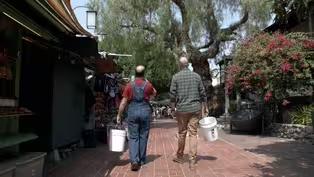
When Olvera Street Was Wine Street
Video has Closed Captions
Clip: S5 Ep2 | 1m 51s | Before freeways and Hollywood, Los Angeles was the original wine country. (1m 51s)
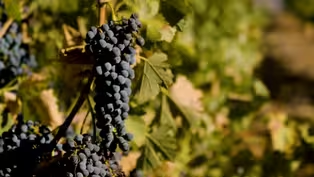
Video has Closed Captions
Preview: S5 Ep2 | 30s | Explore a forgotten golden age of Southern California winemaking. (30s)
Providing Support for PBS.org
Learn Moreabout PBS online sponsorship














Support for PBS provided by:
Lost LA is a local public television program presented by PBS SoCal